- The paper presents a novel one-step generative reconstruction method using subspace-restricted mean flows to guarantee measurement consistency.
- It bypasses iterative inference by learning an average velocity in the null space, significantly reducing computational cost.
- Empirical results show that NullFlow achieves state-of-the-art perceptual quality in tasks like image inpainting while maintaining competitive distortion metrics.
NullFlow: One-Step Generative Reconstruction for Imaging Inverse Problems
Introduction
NullFlow introduces a novel approach for imaging inverse problems by enabling measurement-consistent, single-step generative reconstruction via subspace-restricted mean flows. Imaging inverse problems—such as inpainting, accelerated MRI, and sparse-view CT—require recovery of signals from incomplete, noisy, or partial measurements, which intrinsically constrains only part of the signal space. The ill-posedness arises from the nontrivial null space of the measurement operator, necessitating the synthesis of plausible content unobservable from the measurements. Existing generative approaches such as denoising diffusion, flow-based models, and plug-and-play priors generally rely on computationally expensive iterative procedures. NullFlow distinguishes itself by formulating posterior sampling as a direct, amortized mapping confined entirely to the measurement-consistent subspace, attaining state-of-the-art perceptual quality at a significantly reduced computational cost.
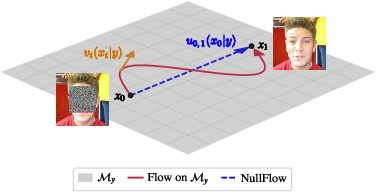
Figure 1: NullFlow is able to reconstruct in a single step without leaving the measurement-consistent subspace Sy:={x:Ax=y} by learning the average velocity μ0,1(x0∣y) rather than the instantaneous velocity vt(xt∣y) of a flow confined to Sy.
The central idea of NullFlow is to restrict the generative flow to the affine subspace Sy defined by the measurements, such that every trajectory generated by the model is, by construction, measurement-consistent at all times. The flow evolution is constrained to the null space null(A), as any movement within this subspace does not alter the measured values.
Given a forward operator A∈Rm×n, the solution space can be decomposed as the sum of the observed row space (fixed by the pseudo-inverse A†y) and an unobserved null space that must be filled with plausible content sampled from the conditional posterior. Prior work handles this by costly iterative mixing of generative model inference and explicit enforcement of data consistency. In contrast, NullFlow parameterizes a deterministic mean flow directly within the null subspace, such that a single network evaluation transports an initial null-space-perturbed least squares estimate to a plausible posterior sample.
The paper formally derives that the global minimizer of a specific training objective, built on the measurement-constrained MeanFlow identity, yields a vector field that defines this one-step posterior sampler.
Training and Inference
NullFlow leverages the mean flow framework to bypass stepwise integration present in previous ODE-based solvers. Instead of learning the instantaneous velocity and simulating a generative trajectory, NullFlow trains a network to predict the average velocity over a randomly chosen interval [r,t] inside the measurement-constrained subspace. This is operationalized via an expectation-minimizing ℓ₂ loss, built from the closed-form subspace-based MeanFlow identity. The training process introduces noise only in the null space, ensuring all sampled solutions share exact measurement consistency.
During inference, reconstruction is initialized with the least-squares solution perturbed by null-space Gaussian noise, and a single forward pass through the trained network produces the generative reconstruction.
Theoretical Guarantee
The authors establish a rigorous theoretical underpinning: the minimum of their loss function corresponds to the unique average velocity field for the measurement-constrained mean flow, which determines an explicit one-step sampler from the measurement-conditional posterior. This result represents a significant extension of mean flow theory to measurement-constrained signal manifolds. Notably, the method guarantees all intermediate and final outputs remain strictly within the feasible measurement set without requiring alternate enforcement procedures.
Empirical Results
On challenging natural image inpainting tasks with large missing regions (specifically center-masked 256×256 RGB images with μ0,1(x0∣y)0 holes), NullFlow demonstrates strong empirical performance. With only a single neural function evaluation at test time, NullFlow obtains the best LPIPS (perceptual similarity score) among state-of-the-art solvers, and competitive PSNR/SSIM, compared to both amortized (U-Net) and iterative (Diffusion/Flow Matching) approaches.
A single NullFlow sample is described as perceptually sharp with faithful semantics—often preferred over MSE-optimal reconstructions, which are overly smoothed. By averaging multiple NullFlow samples, the output approaches the MMSE estimator, resulting in higher PSNR/SSIM but reduced perceptual quality, closely matching the behavior of retrained MSE solvers.
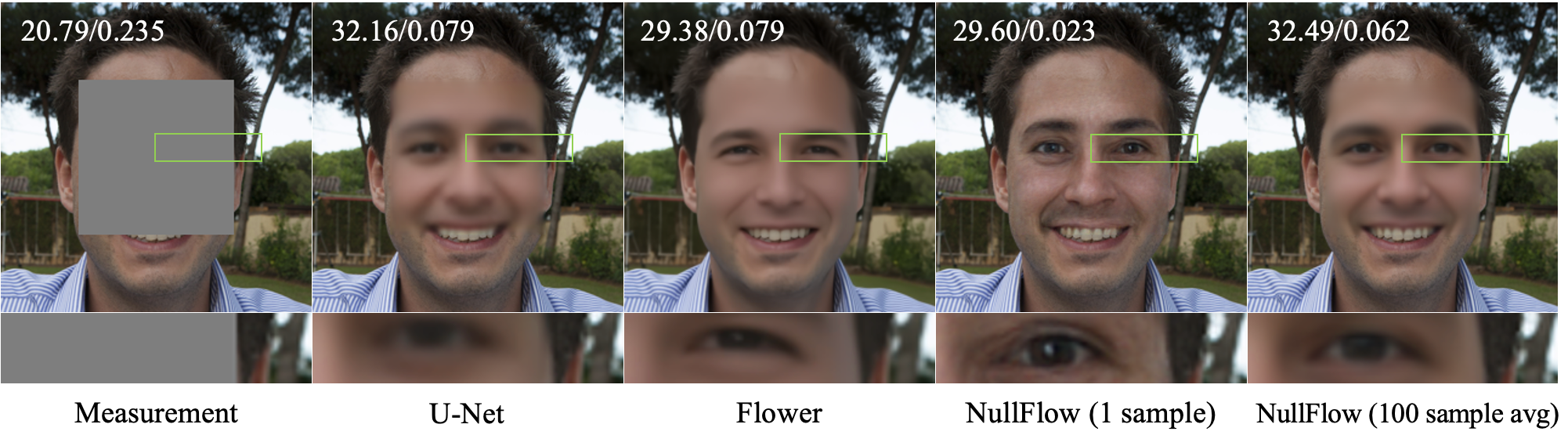
Figure 2: Reconstructions on a test image: measurement, U-Net, Flower, a single NullFlow sample, and the average of 100 NullFlow samples; PSNR/LPIPS are annotated, illustrating NullFlow's sharp, perceptually faithful reconstructions, and the perception-distortion tradeoff via sample averaging.
Systematic analysis reveals that increasing the number of posterior samples used for MMSE-averaging monotonically improves distortion metrics, at the expense of visual quality as measured by LPIPS, reinforcing that NullFlow captures a well-calibrated conditional posterior.

Figure 3: Effect of sample averaging on reconstruction quality, confirming that more samples lead toward the MMSE optimum and distortion metric improvement, but at a loss of perceptual fidelity compared to single-sample outputs.
Practical and Theoretical Implications
NullFlow demonstrates that amortized, single-step posterior sampling for linear inverse problems is feasible without iterative data-fidelity corrections or unrolling. The approach provides an efficient, high-throughput path for practical large-scale image restoration tasks, such as rapid inpainting, super-resolution, and medical imaging reconstructions, where prediction time and guaranteed data consistency are critical.
Theoretically, NullFlow extends the scope of score-based generative modeling by establishing that mean flows confined to manifolds associated with forward operators can act as exact conditional samplers. This result lays down possibilities for extensions to non-linear inverse problems, adaptive noise models, and signal-dependent operators.
In practice, NullFlow enables users to trade off perceptual quality for distortion-based scores without retraining, simply by adjusting the sample aggregation scheme, while always remaining consistent with observed data.
Conclusion
NullFlow advances the state of generative reconstruction for inverse imaging problems by providing a mathematically principled, subspace-constrained, one-step sampler with empirically validated perceptual and distortion quality. The method eliminates the need for run-time iterative inference while guaranteeing measurement consistency, marking a conceptually and practically significant step toward efficient, high-fidelity generative solvers in computational imaging. Further investigations may examine robustness to measurement noise and generalization to variable measurement operators, as well as extensions to nonlinear data acquisition models.

