- The paper presents a novel orchestration engine that integrates schema-constrained planning with topological scheduling, achieving verifiable task structures and efficient parallel execution.
- It demonstrates a median latency reduction of 1.6× by leveraging dependency-aware concurrency without altering underlying agent reasoning.
- The methodology features token-budgeted context pruning and robust fault isolation, ensuring predictable performance and safety in industrial deployments.
DynAMO: Deployment-Oriented Asset Management via Topological Multi-Agent Scheduling
Motivation and Context
DynAMO addresses critical deployment requirements for agentic systems in industrial environments, particularly those involving asset lifecycle management. The paper identifies key bottlenecks and hazards—latency, concurrency instability, and safety risks—in applying LLM-based agents to Industry 4.0 scenarios. Existing agent orchestration frameworks often lack mechanisms for dependency validation and fail to provide reliable latency or structural guarantees, especially in safety-critical settings. DynAMO explicitly targets these gaps, offering a Plan-then-Execute architecture grounded in schema-constrained planning and topological, dependency-aware parallel execution.
System Design: Schema-Constrained Planning and Topological Scheduling
DynAMO's architecture enforces verifiable workflow graphs and leverages dependency-driven task scheduling. The schema-constrained planner generates plans conforming to a strict JSON schema, ensuring that each task's identifier, agent assignment, explicit dependencies, and declared outputs are validated against a registry and checked for acyclicity prior to execution. Invalid plans are rejected and re-prompted, shifting structural error detection from runtime to planning time.
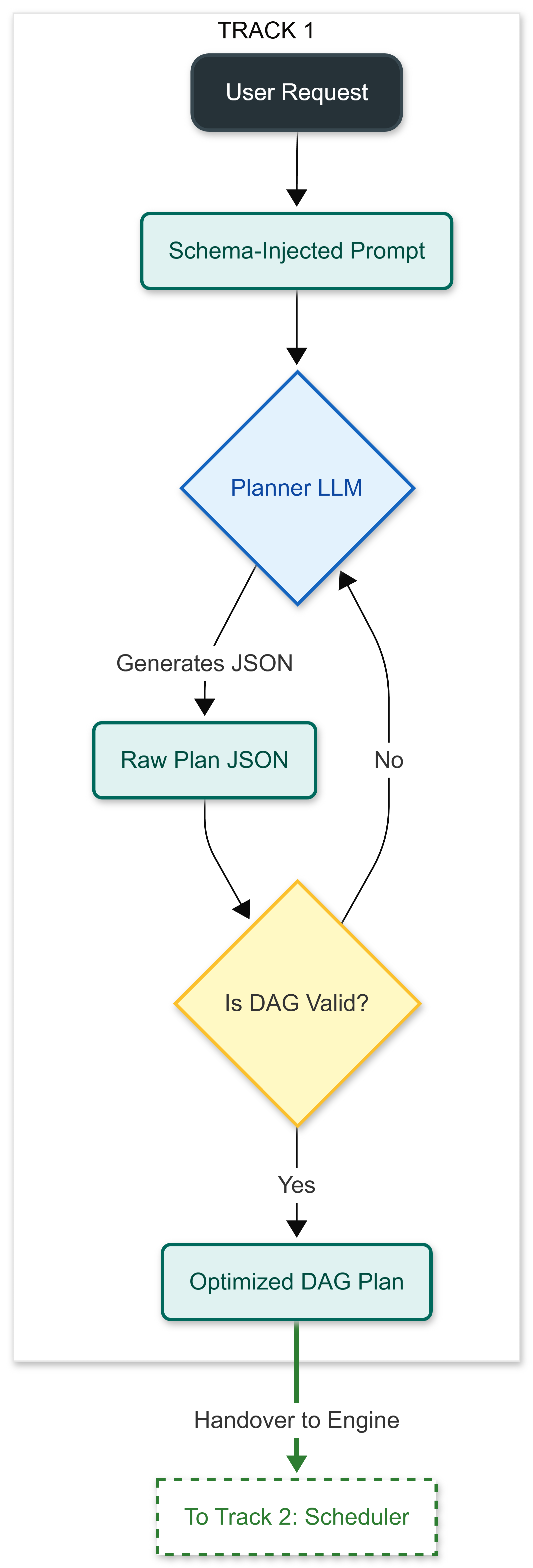
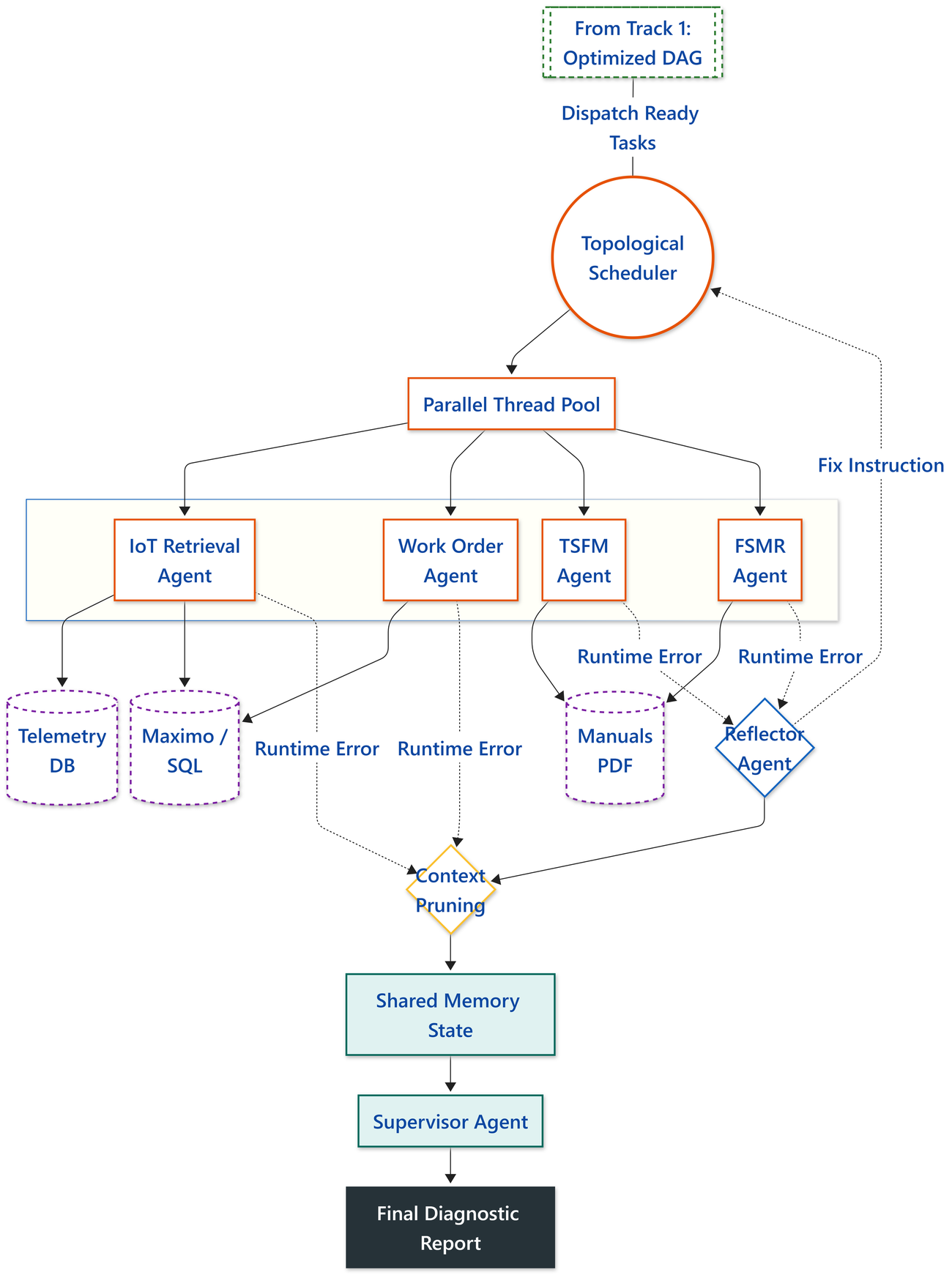
Figure 1: Schema-constrained planning enforces structural correctness at the planning stage, ensuring verifiable task graphs for execution.
Validated plans are materialized as directed acyclic graphs (DAGs), where independent nodes can be executed concurrently, and dependent nodes await completion. The topological execution engine exploits agent–tool metadata to differentiate resource requirements, enabling I/O-bound and compute-bound tasks to execute in parallel, maximizing throughput and reducing artificial bottlenecks.
Execution Efficiency: Latency Analysis and Context Pruning
The empirical evaluation on AssetOpsBench—containing 141 realistic industrial queries—demonstrates that DynAMO's parallel execution strategy yields a consistent median latency reduction of 1.6× (moving from $308.53s$ to $190.49s$), with highly parallelizable workflows reaching 1.8× speedup. The improvement is achieved through pure scheduling enhancements, without modification of agent reasoning logic or planner prompt strategy.
Crucially, latency decomposition (with realistic tool I/O instrumentation) reveals that LLM inference and orchestration remain the dominant contributors to end-to-end workflow execution (>90%), refocusing optimization priorities for industrial agent systems away from orchestration micro-optimization toward model inference and context efficiency.
DynAMO incorporates token-budgeted context pruning, propagating only minimal schema headers and immutable file pointers at agent handoffs. Semantic relevance scoring enables just-in-time retrieval of critical information. Empirically, this context reduction reduces inference latency by about 30%, mitigating the "lost-in-the-middle" effect and maintaining signal fidelity for multi-step root-cause analysis.
Robustness: Concurrency, Fault Tolerance, and Stability
Concurrency stress tests illuminate the limits of system scalability under simultaneous multi-workflow operation. Failures and latency spikes are attributable to shared inference resource saturation and external API contention—never to dependency violations or scheduling bugs. This positions DynAMO as structurally robust under load, though it underscores the need for admission control and resource isolation in practical deployments.
Fault injection experiments (tool timeouts, partial sensor failures) show graceful degradation: all workflows complete; increased latency under fault is bounded ($0.445s$ to $1.245s$ at worst). The system isolates failures, preventing cascading termination and maintaining workflow viability. Reproducibility analysis indicates that parallel execution reduces latency variance by more than 2.4×, improving predictability and providing tighter worst-case guarantees—essential for industrial environments.
Functional Correctness and Deployment Implications
Schema-constrained planning yields high agent sequencing and output clarity (9/11 and 10/11 in manual scoring, respectively), with data retrieval errors as the primary remaining failure mode. Hallucinated tool invocations are reduced compared to free-form prompting, attributed to explicit registry enforcement. While accuracy evaluation is limited to a curated subset, structural correctness is reliably achieved.
In practical terms, DynAMO establishes a deployable blueprint for Industry 4.0 automation pipelines. The findings suggest that real-time agentic deployment hinges less on orchestrator sophistication and more on scalable inference and context-efficient memory architectures. Robust planning-time validation, dependency-aware parallelism, and runtime fault isolation are critical for safety in industrial workflows.
Theoretical and Practical Implications
DynAMO reframes the performance bottlenecks in agentic industrial systems: inference and orchestration, rather than tool I/O or scheduling, dominate latency. Ensuring verifiable plan validity at design time is essential for deployment safety, and dependency-aware parallelism can yield substantial efficiency gains even in complex, multi-branch workflows. The architectural patterns—schema-constrained planning, explicit DAG construction, and topological scheduling—point to future research directions in benchmarking reliability and latency, rather than accuracy alone.
Comparative evaluation with general-purpose frameworks (LangGraph, CrewAI, AutoGen) is absent, highlighting a major direction for follow-on work: rigorous head-to-head benchmarking under real-world industrial constraints.
Future Developments and Research Directions
Improvements in context-efficient model serving, memory management, and inference parallelization will be necessary for scaling agentic workflows in Industry 4.0. Admission control and infrastructure-level isolation are required to address concurrency-induced instability. Automated accuracy and fault-diagnosis evaluation on full industrial benchmarks are open research questions. Integration of schema-constrained planning and runtime dependency validation offers a path forward for reliable agent deployment in safety-critical environments.
Conclusion
DynAMO provides an empirically grounded orchestration engine for industrial asset management, integrating schema-constrained planning with topological, dependency-aware parallel execution. Results demonstrate clear latency benefits, high structural correctness, and robust fault isolation. The primary bottleneck—LLM inference latency—indicates a shift in engineering focus for agentic systems. Future work should extend comparative analysis against mature orchestration frameworks and scale context-aware inference architectures to meet production deployment requirements.