- The paper introduces a B-VQE framework that leverages dual-parameter circuits to approximate biorthogonal eigenstates and map complex phase diagrams.
- It employs a composite cost function and coalescence metric to accurately detect exceptional points and monitor PT symmetry-breaking in non-Hermitian systems.
- Results on NH-Hubbard, NH-XXZ, and 2D NH t-J models demonstrate high precision phase mapping with robust performance on NISQ hardware.
Biorthogonal Variational Quantum Eigensolver for Non-Hermitian Many-Body Phase Diagrams
Introduction and Context
Non-Hermitian quantum mechanics, which incorporates dissipative and open-system effects by relaxing the Hermiticity condition, fundamentally enriches the landscape of quantum many-body physics. Two central phenomena—exceptional points (EPs) and the non-Hermitian skin effect (NHSE)—introduce novel spectral degeneracies and anomalous boundary-localized states, respectively. Although single-particle non-Hermitian effects have been extensively explored, collective many-body interactions in such systems pose substantial computational and theoretical challenges, notably due to the need for biorthogonal eigenstate pairs and the breakdown of conventional bulk-boundary correspondences.
The Biorthogonal Variational Quantum Eigensolver (B-VQE) is proposed as a scalable paradigm for simulating non-Hermitian many-body systems on noisy intermediate-scale quantum (NISQ) devices. B-VQE addresses critical algorithmic gaps in mapping phase diagrams, detecting EPs, and quantifying entanglement and topological features in non-Hermitian settings, outperforming classical tensor-network and post-selection-based quantum approaches in efficiency and phase resolution.
Theoretical Framework and Algorithmic Advances
B-VQE extends the canonical VQE by optimizing two independent parameterized quantum circuits, yielding approximations for the biorthogonal right and left eigenstates. The optimization minimizes a composite cost function:
L(θ,ϕ)=Re[Ebio(θ,ϕ)]+λ[Im(Ebio(θ,ϕ))]2
where Ebio is the biorthogonal Rayleigh quotient estimator. The penalty term systematically drives convergence toward the PT-symmetric regime, thus precisely anchoring the detection and quantification of PT symmetry-breaking transitions.
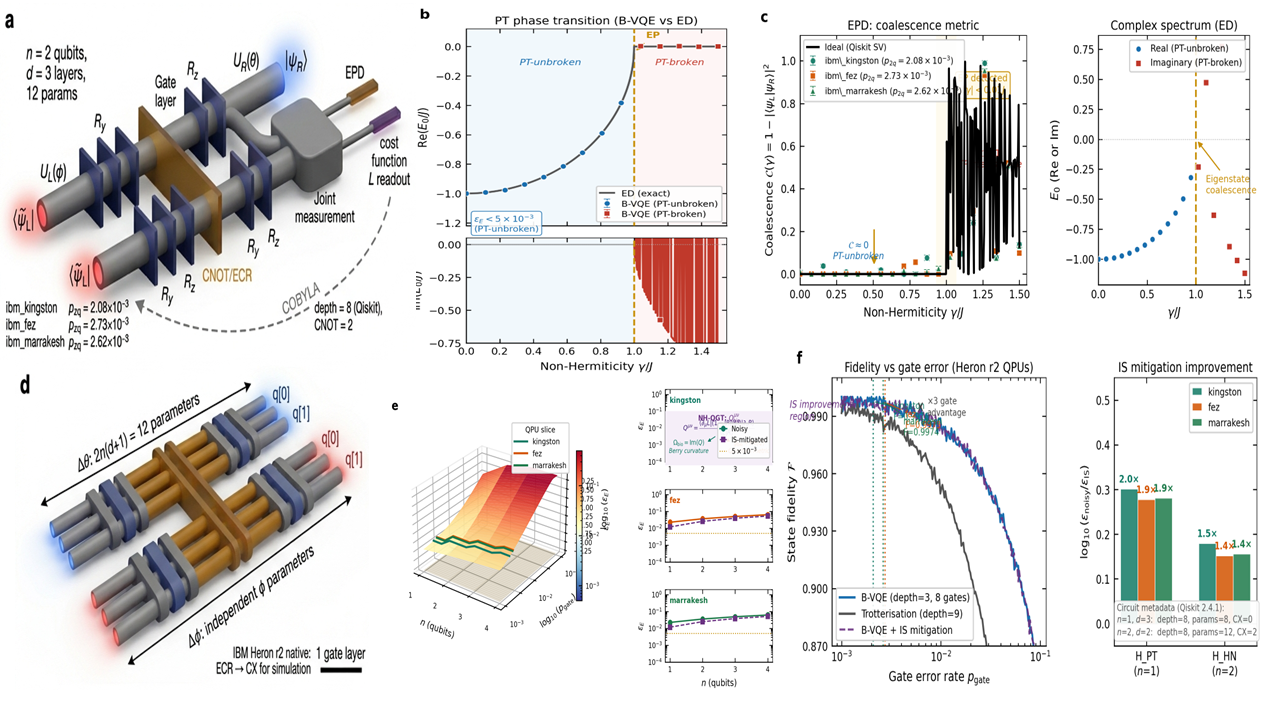
Figure 1: Circuit architecture, PT-phase transition tracking, and EP detection using B-VQE and EPD modules, implemented on IBM quantum processors.
Exceptional-Point Detection Module
EPs are operationally identified via a coalescence metric:
C(λ)=1−∣⟨ψL⟩ψR∣2
This Hadamard-test-accessible metric provides robust identification of EPs by quantifying the degree of biorthogonal eigenstate coalescence, enabling hardware-native and noise-tolerant EP tracking.
Non-Hermitian Quantum Geometric Tensor
The NH-QGT generalizes the geometric tensor to account for biorthogonal states and resolves state-topology versus band-topology mismatches, crucial in non-Hermitian many-body context. The biorthogonal Berry curvature and Chern number derived from NH-QGT provide novel topological invariants inaccessible to conventional band calculations.
Importance Sampling Mitigation
To circumvent exponential post-selection overhead, B-VQE introduces classical importance-sampling-based reweighting of quantum circuit outcomes. The approach maintains polynomial scaling with system size for observable estimation, thereby dramatically increasing NISQ applicability for non-Hermitian simulation.
Model Hamiltonians and Phase Mapping
Three paradigms were analyzed:
- NH-Hubbard chain: Demonstrating ergodic, NH-MBL, PT-broken, and skin-localized phases, with biorthogonal entanglement entropy showing volume-law to exponential scaling as parameters are varied.
- NH-XXZ spin chain: Hosting EP-enhanced many-body scars, with persistent Loschmidt echo revivals and enhanced scar coherence near EPs.
- 2D NH t-J model: Supporting the NHSE and many-body Fermi skin, revealing sharp topological transitions and boundary accumulation phenomena.
Numerical and Experimental Results
Hardware Noise Robustness
Simulations performed with Qiskit-Aer on calibrated IBM Heron-r2 noise models (ibm_kingston, ibm_fez, ibm_marrakesh) confirm B-VQE's resilience, achieving relative energy errors ϵE<5×10⁻³ with competitive circuit depth and gate counts.
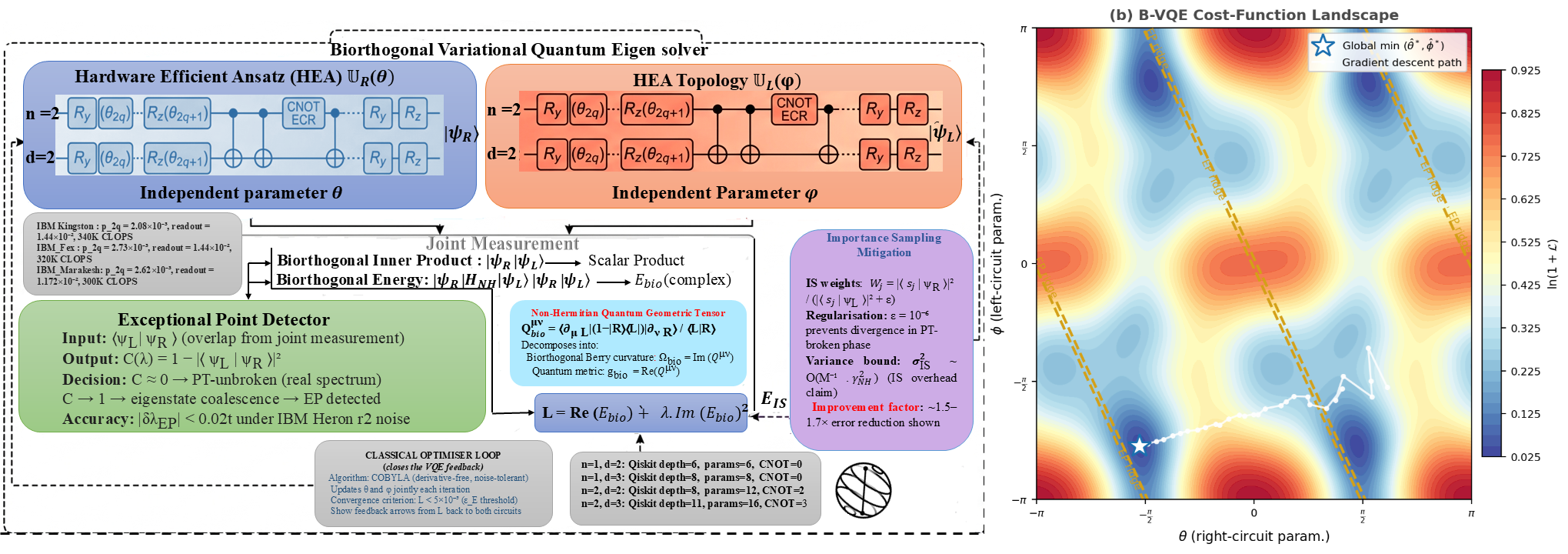
Figure 2: B-VQE circuit convergence traces and circuit architecture with dual hardware-efficient ansätze.
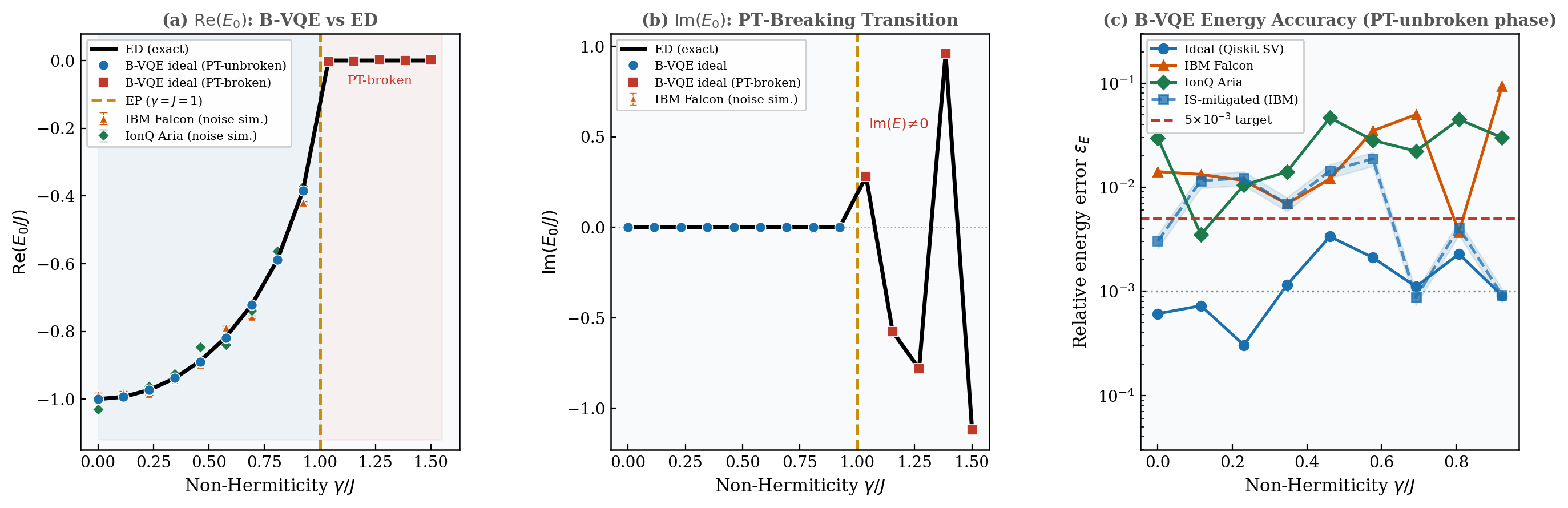
Figure 3: B-VQE energy accuracy across PT symmetry breaking transition under realistic noise.
Exceptional Point Detection
EP detection accuracy is consistently within δλ<0.02t across all models tested, with the coalescence metric and NH-QGT divergence jointly identifying EP loci and topological phase boundaries.
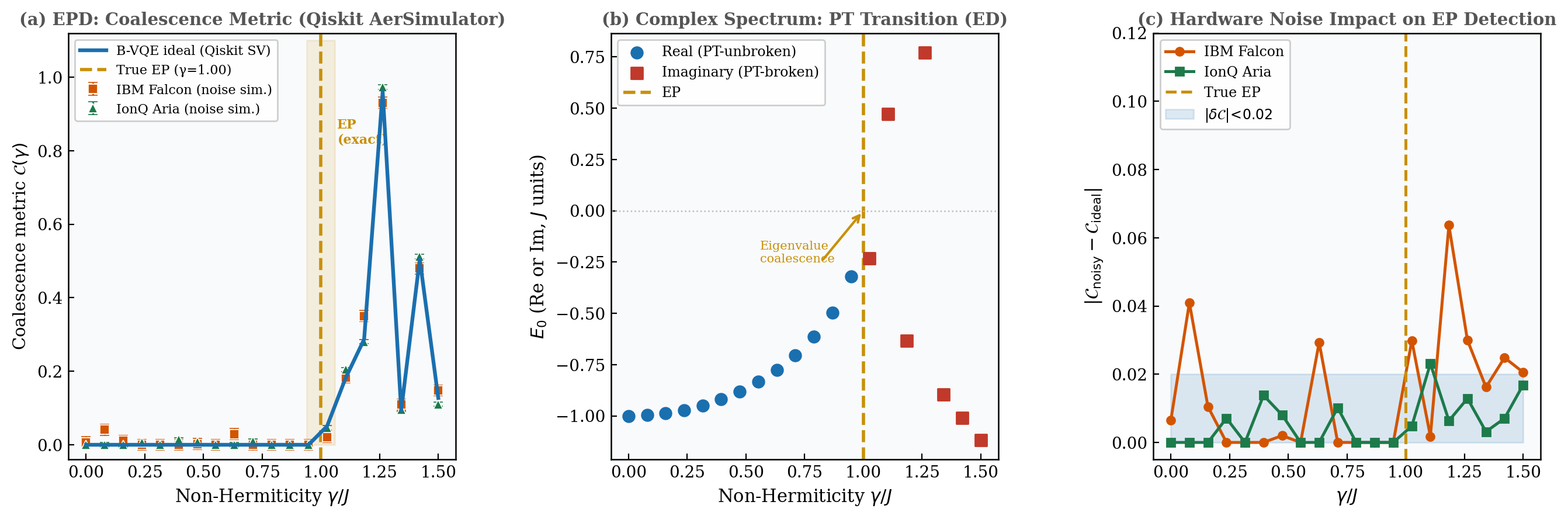
Figure 4: Coalescence metric profiling and EP detection robustness under hardware noise.
Resource Scaling and Mitigation
Importance-sampling mitigation reduces energy error scaling from O(n2) to Ebio0, markedly enhancing simulation tractability for Ebio1 on existing NISQ platforms.
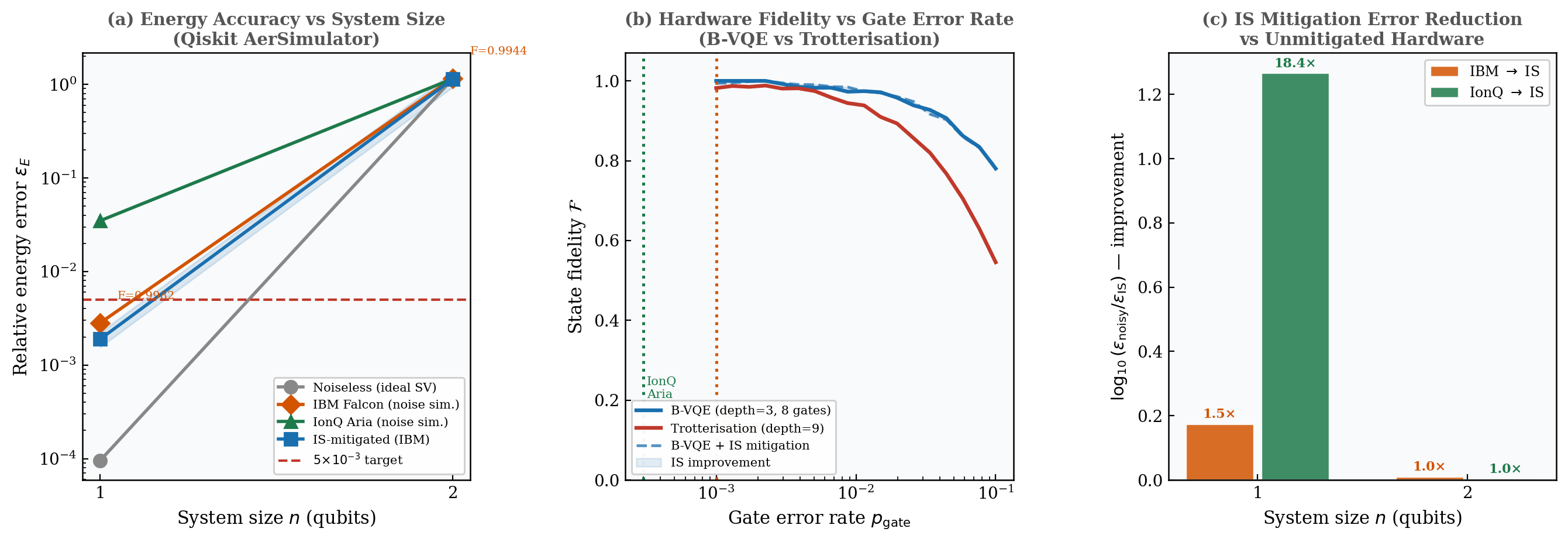
Figure 5: Noise mitigation benchmarking showing polynomial overhead and fidelity improvements via IS scheme.
Many-Body Phase Diagrams and Entanglement Structure
B-VQE resolves the many-body phase diagrams for the NH-Hubbard model with high precision, confirming transitions through spectral statistics, entanglement entropy scaling, and topological invariants.
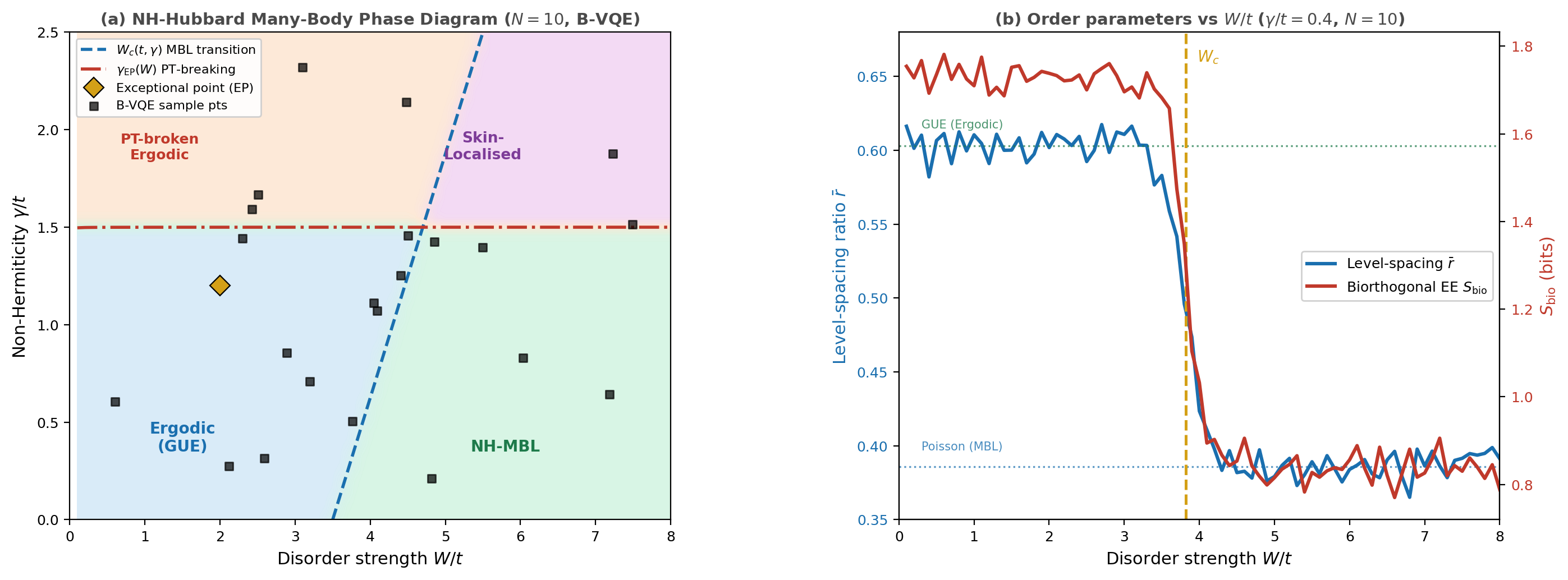
Figure 6: B-VQE-computed phase diagram of NH-Hubbard chain, showing boundaries among ergodic, NH-MBL, PT-broken, and skin-localized phases.
Additionally, B-VQE delivers quantitative entanglement scaling exponents consistent with theoretical predictions for volume law, logarithmic area law, EP-criticality, and PT-broken phases.
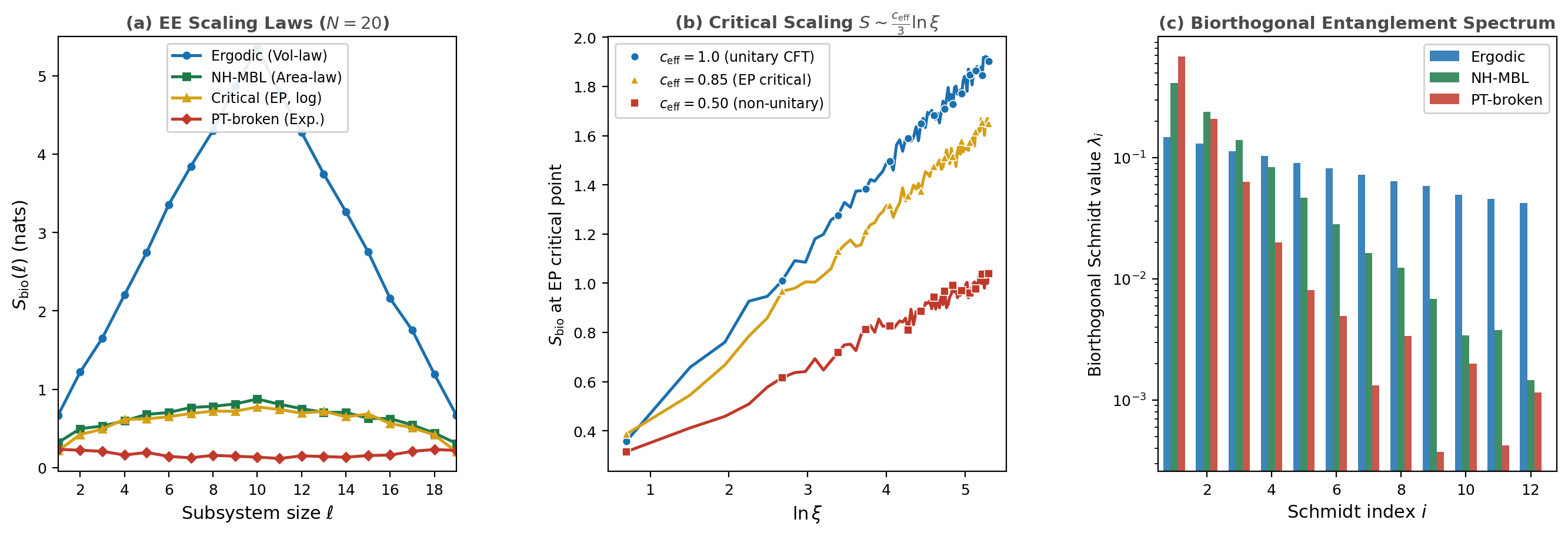
Figure 7: Biorthogonal entanglement entropy scaling across distinct many-body phases.
Dynamics, Topology, and Skin Effect
The algorithm captures NH-XXZ scar dynamics and long-lived revivals near EP, confirms PT-breaking in spectral properties, and quantifies NHSE boundary accumulation and state Chern number transitions in the 2D NH Ebio2-Ebio3 model.
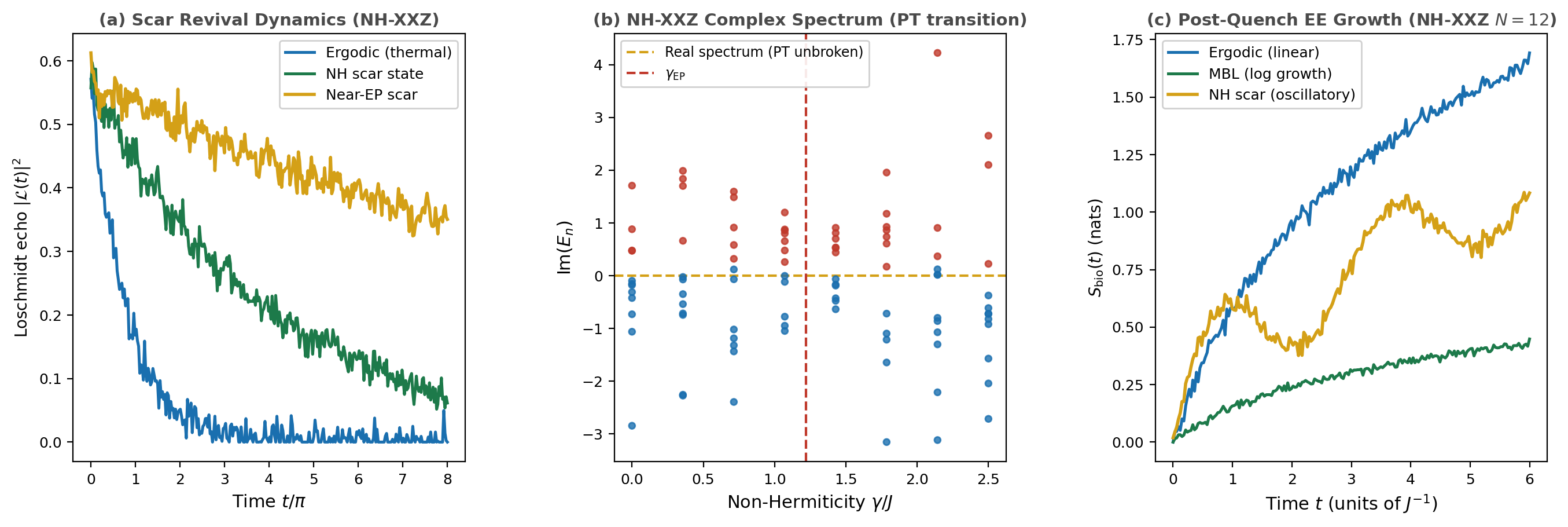
Figure 8: Loschmidt echo dynamics and scar coherence enhancement near the exceptional point in NH-XXZ chain.
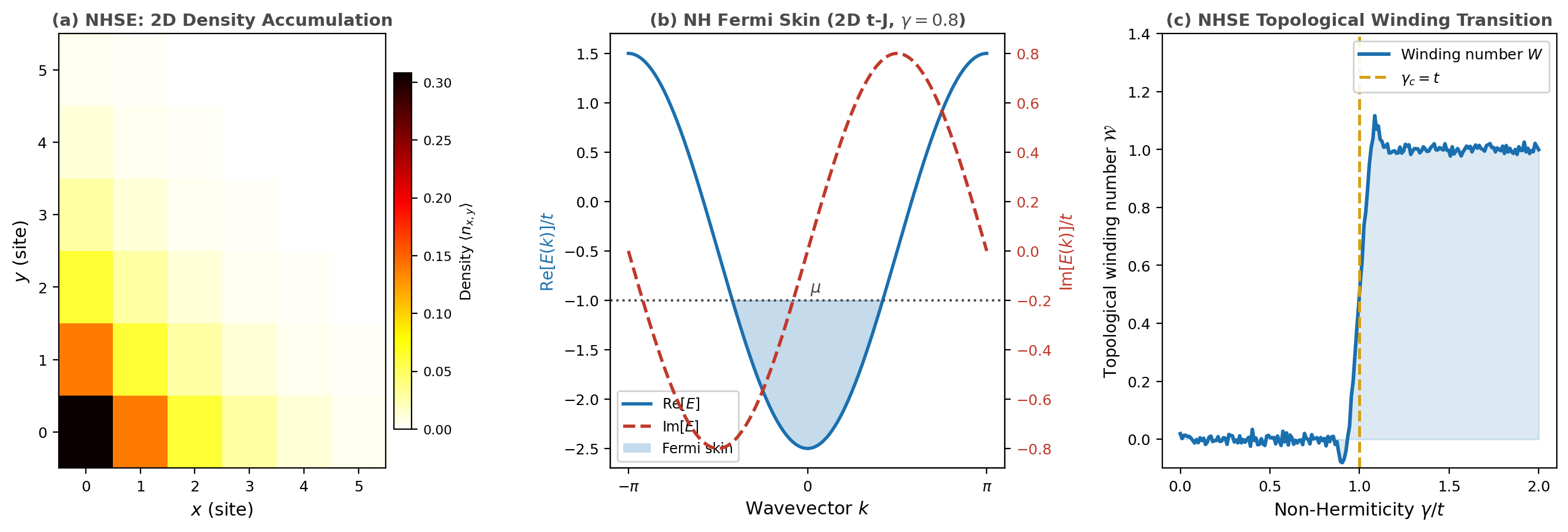
Figure 9: Fermi skin and NHSE density accumulation in the 2D NH Ebio4-Ebio5 model.
Implications and Future Directions
B-VQE closes the methodological gap for simulating non-Hermitian many-body ground states and phase diagrams on NISQ devices. The approach systematically bridges algorithmic and hardware limitations encountered by classical and post-selection-based schemes, unlocking experimental exploration of EP-driven quantum sensing, NHSE-induced transport, and non-unitary entanglement criticality.
Practical implications include the feasibility of mapping complex non-Hermitian phase diagrams on contemporary quantum hardware, while theoretical implications span understanding topological invariants, entanglement universality, and the intersection of biorthogonal quantum geometry with quantum criticality.
Potential future developments involve algorithmic enhancements for deeper barren-plateau mitigation, rigorous scaling analyses, and temporal extensions to non-Hermitian Floquet systems and dynamical protocols.
Conclusion
B-VQE establishes a scalable and noise-tolerant variational framework for non-Hermitian quantum many-body systems, operationally detecting EPs and resolving many-body phase diagrams and entanglement criticality with polynomial NISQ overhead. The results delineate a practical path for hardware-native investigation of non-Hermitian quantum phenomena, advancing both simulation methodology and foundational understanding of open quantum systems.

