- The paper establishes a framework where trace-norm Hamiltonian diagnostics and observable asymmetries distinctly identify exceptional points in complex XY spin chains.
- It demonstrates that in the RT regime, a divergence in the first derivative signals symmetry breaking, while in the PT regime, higher-order derivatives mark topological transitions.
- The research reveals that quench-induced dynamical entanglement differences effectively probe EPs, offering actionable protocols for non-Hermitian quantum experiments.
Observable Distinctions of Exceptional Points in Non-Hermitian Quantum Spin Chains
Introduction
The study addresses the manifestation and detection of exceptional points (EPs) in non-Hermitian quantum many-body systems, with focus on a generalized one-dimensional complex XY spin chain. EPs correspond to spectral singularities where both eigenvalues and eigenvectors coalesce, leading to fundamentally distinct physical behavior compared to Hermitian systems. The paper establishes a formal framework for identifying EPs via observable differences between left and right eigenstate manifolds and explores both static and dynamic signatures in RT- and PT-symmetric regimes (2606.11333).
Model Architecture and Symmetry Classification
The central model is a complex XY spin chain, parameterized by anisotropy (γ~) and transverse magnetic field (h~), both potentially complex. Depending on parameter choice, the model exhibits either rotation-time (RT) symmetry (imaginary anisotropy, real field) or parity-time (PT) symmetry (real anisotropy, imaginary field) [Song_RT_symm, PT_sym_imaginary_magnetic_field]. Both cases are exactly solvable via Jordan–Wigner and Bogoliubov transformations, allowing rigorous analysis of eigenstate structure and spectral transitions.
EPs assume fundamentally distinct roles:
- RT-Symmetric Regime: EP marks spontaneous symmetry breaking, separating a real-spectrum phase from a complex-spectrum phase. The position is $h_{\rm ep}^{\mathcal{RT}} = \sqrt{1 + (\gamma^{\mathcal{RT})^2}$.
- RT0-Symmetric Regime: EP signals a topological phase transition determined by the winding number RT1, with the transition boundary at RT2.
Hamiltonian-Level Quantifiers: Non-Hermiticity Detection
A global trace-norm-based non-Hermiticity quantifier RT3, constructed from the difference between the Hamiltonian and its adjoint, is employed as an analytic diagnostic. The response of RT4, and its derivatives with respect to field strength, localizes the EP through non-analytic behavior; the analytic structure is symmetry-dependent.
In the RT5 regime, the first derivative of RT6 diverges at the EP, signaling symmetry breaking.
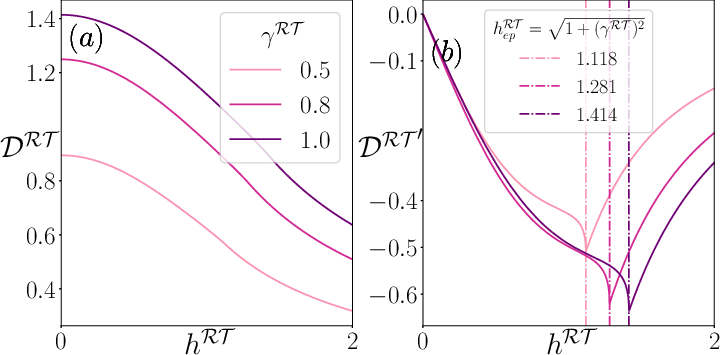
Figure 1: The Hamiltonian-based quantifier RT7 and its derivative demonstrate non-analyticity precisely at the exceptional point.
In the RT8 regime, only the second derivative exhibits non-analyticity at the EP, denoting a higher-order transition.
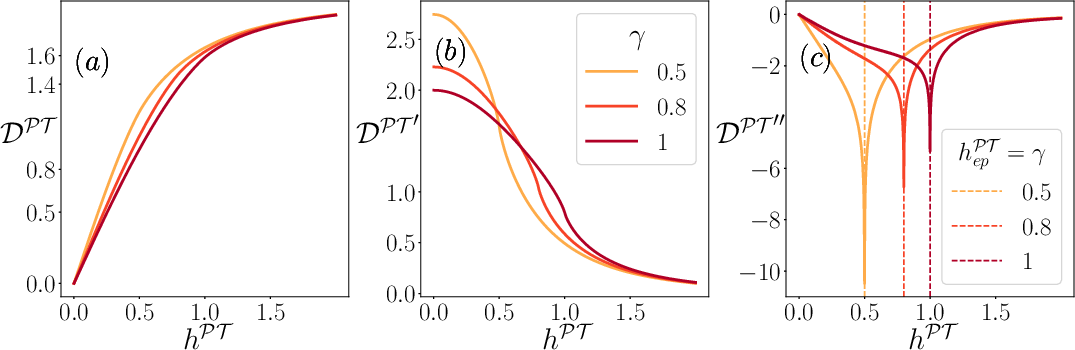
Figure 2: The quantifier’s second derivative RT9 sharply diverges when crossing the exceptional point, marking topological transition.
Observable-Based Quantification: Static Left-Right Asymmetry
Observable differences between left (PT0) and right (PT1) eigenmanifolds are evaluated for local correlators (nearest-neighbor spin correlations, magnetization). In the broken symmetry phase, off-diagonal correlator differences (notably PT2) act as order parameters for PT3 transitions, vanishing in the unbroken regime.
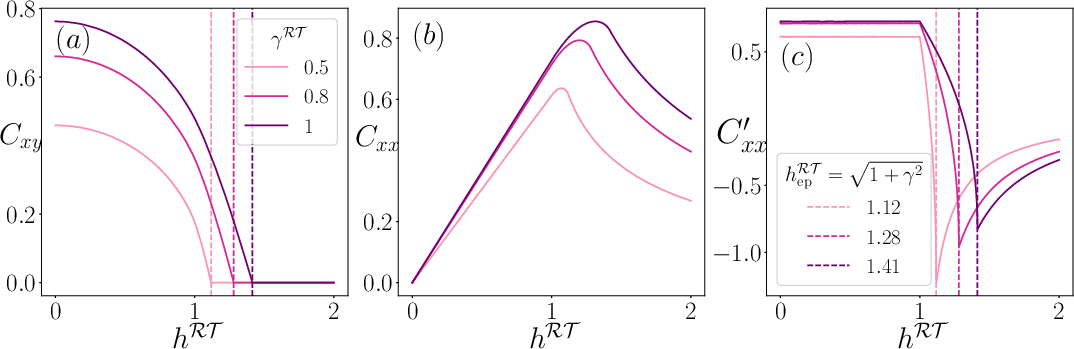
Figure 3: Differences in local observables (PT4, PT5) sharply capture the PT6 exceptional point.
In the PT7 regime, derivatives of both correlation and magnetization differences exhibit pronounced non-analyticities at the EP, but the actual difference values remain smooth.
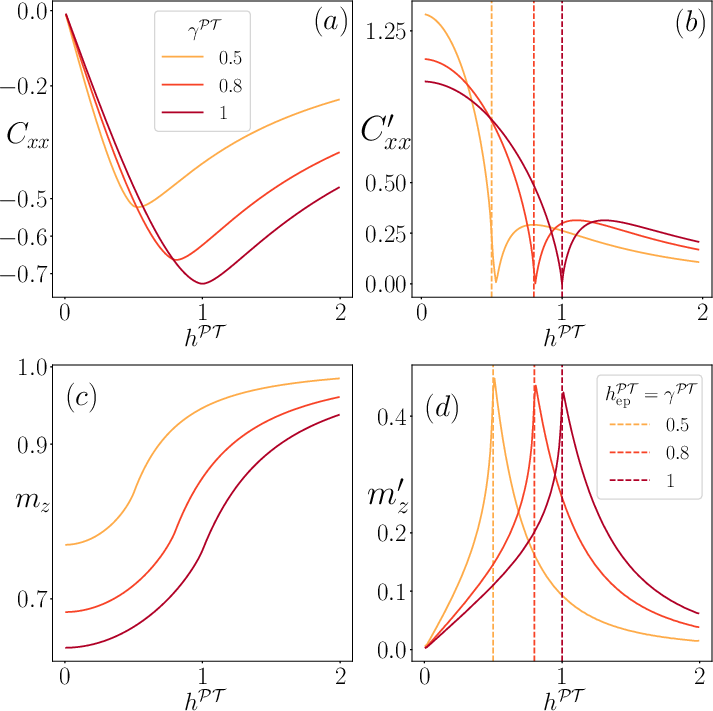
Figure 4: Observable-based correlator and magnetization difference derivatives spike at the PT8 exceptional point.
Significantly, static bipartite entanglement entropy fails to resolve EPs: left and right ground states hold identical entanglement in all parameter regimes, indicating an observable selectivity in non-Hermitian systems.
Dynamical Signatures: Entanglement Entropy Difference under Quench
Non-equilibrium dynamics following a sudden quench from a Hermitian ground state into the non-Hermitian regime are analyzed. Trajectories generated by the Hamiltonian and its adjoint lead to distinct dynamical states, where the time-averaged entanglement entropy difference between left and right vectors, PT9, becomes a highly sensitive probe for EPs.
For XY0 symmetry, this dynamical entropy difference presents a sharply defined peak precisely at the EP for large subsystem sizes, reflecting a macroscopic sensitivity.
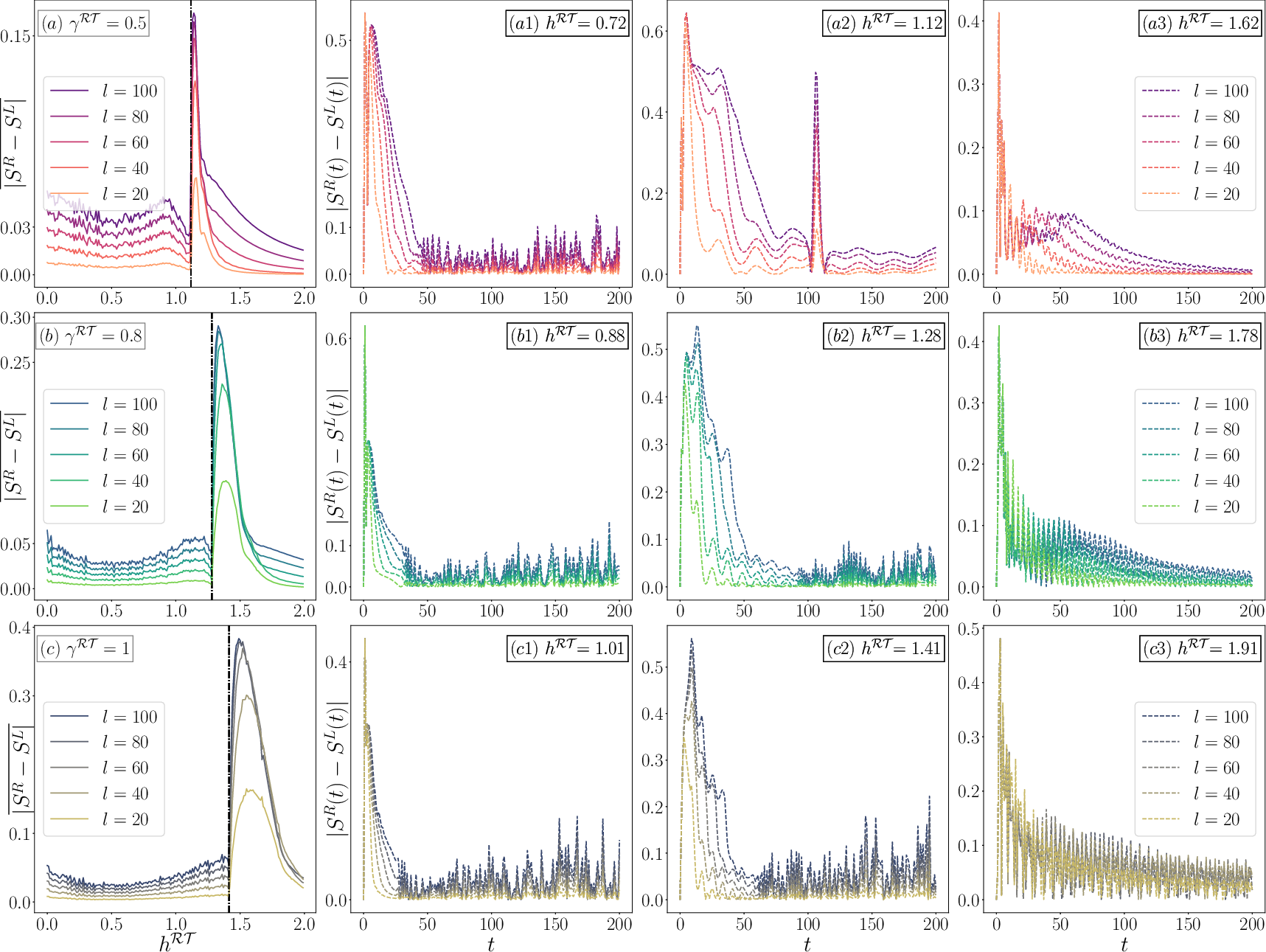
Figure 5: Time-averaged dynamical entanglement entropy difference peaks at the XY1 exceptional point and serves as a robust indicator.
In the XY2 regime, the entropy difference behaves like a strict order parameter, remaining finite in the topologically non-trivial phase and vanishing exactly at the EP.
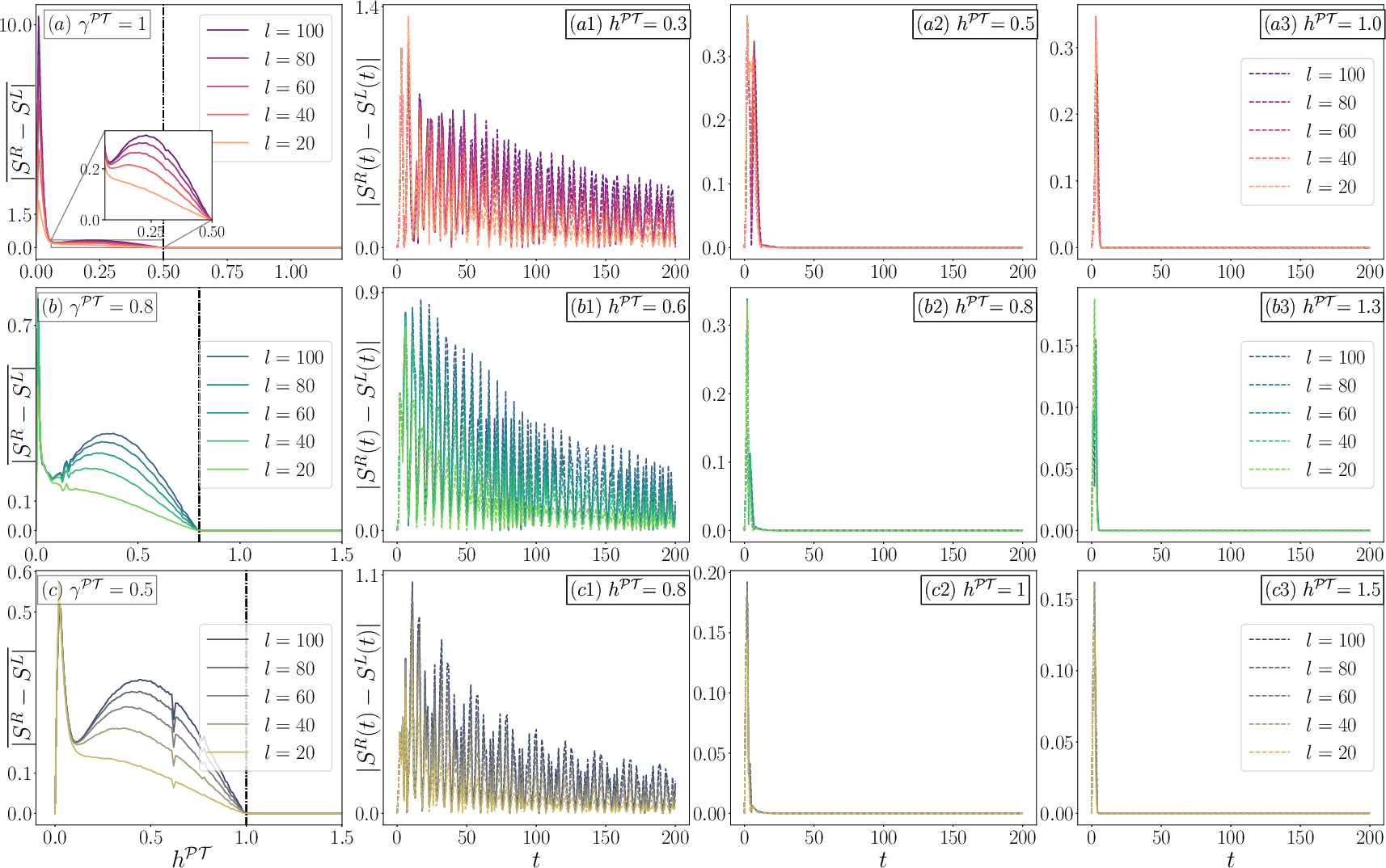
Figure 6: In the XY3 regime, the dynamical entropy difference drops abruptly to zero at the exceptional point, demarcating phase boundaries.
Implications and Outlook
The presented framework unifies static and dynamical diagnostics for EPs in non-Hermitian many-body systems. Crucially, while select local observables and global Hamiltonian quantifiers capture EP positions, static quantum information metrics are entirely blind to left-right distinctions; only quench dynamics reveal the full structure of non-Hermitian spectral singularities. These findings introduce practical protocols for EP identification in quantum simulators, where quench experiments are more feasible than ground-state preparation.
Beyond foundational interests in non-Hermitian quantum mechanics and phase transitions, these results implicate diverse domains: robust quantum sensing at EPs, reservoir engineering for state preparation, and non-equilibrium quantum information processing. Future extensions should explore the scaling of dynamical entropy differences across more general non-Hermitian and interacting models, investigate the selective robustness of observables, and use EPs as operational resources in quantum technology.
Conclusion
The paper rigorously demonstrates how left-right eigenstate distinctions in a complex XY4 spin chain permit experimental and theoretical detection of exceptional points, bridging static and dynamical observables. The quantification protocols developed here utilize trace-norm Hamiltonian diagnostics, local correlator analyses, and dynamical entanglement asymmetry, providing a comprehensive framework for probing EPs in non-Hermitian many-body systems. This observable selectivity and dynamical sensitivity highlight new pathways for the characterization and exploitation of non-Hermitian physics in quantum information science and technology.

