- The paper introduces a real variance-based VQE (RVVQE) that minimizes the real variance to extract eigenstates from non-Hermitian matrices.
- It employs a hardware-efficient ansatz and multi-start optimization to achieve convergence up to machine precision across different matrix sizes.
- The approach extends standard VQE to simulate open quantum systems, enabling studies of resonance, decay phenomena, and diverse applications.
Real Variance-Based Variational Quantum Eigensolver for Non-Hermitian Matrices
Introduction
The simulation of open quantum systems and the extraction of complex spectra from non-Hermitian matrices constitute foundational challenges in quantum computation. The vast majority of quantum algorithms, specifically the Variational Quantum Eigensolver (VQE), are tailored for Hermitian problems and fail to address the general non-Hermitian case characteristic of physically relevant open systems where eigenvalues can be complex. The paper "Real Variance-Based Variational Quantum Eigensolver for Non-Hermitian Matrices" (2603.28892) introduces a Real Variance-Based VQE (RVVQE) that directly addresses this issue by proposing a mathematically justified cost function built on variance minimization, maintaining compatibility with current quantum hardware and unlocking new directions for simulating open quantum phenomena.
The main theoretical advance lies in the adoption of the real part of the variance as the cost function for eigenstate search. For a non-Hermitian operator M, whose eigenvalue equation is M∣ψ⟩=λ∣ψ⟩, the cost function is defined as:
Cvar(θ)=⟨H2⟩θ+⟨K2⟩θ−⟨H⟩θ2−⟨K⟩θ2
where M=H+iK, and H and K are Hermitian. This cost function is strictly real, non-negative, and vanishes if and only if ∣ψ⟩ is a true eigenstate of M, thus sidestepping the inapplicability of the expectation value minimization in non-Hermitian contexts.
The workflow decomposes M into its Hermitian and anti-Hermitian components and calibrates measurements to quantities accessible via current quantum hardware. The optimization proceeds by variationally preparing quantum states parametrized by an ansatz and minimizing Cvar(θ) with a classical optimizer until convergence, after which the complex eigenvalue M∣ψ⟩=λ∣ψ⟩0 is computed.
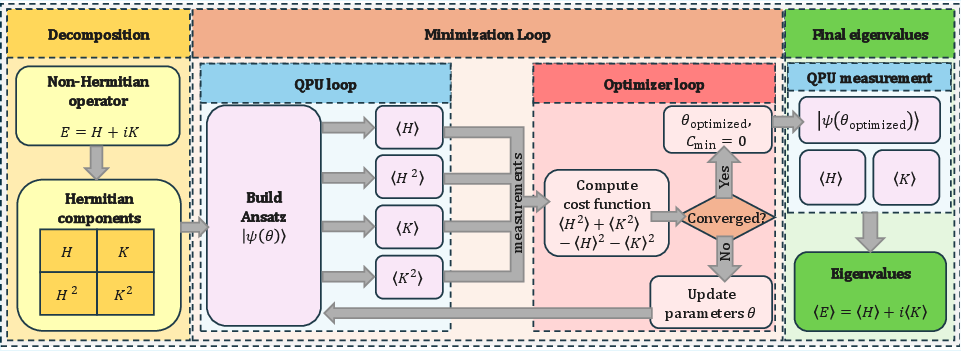
Figure 1: Quantum algorithm to find eigenvalues and eigenstates for non-Hermitian operators.
The RVVQE framework is evaluated on dense non-Hermitian matrices M∣ψ⟩=λ∣ψ⟩1 (M∣ψ⟩=λ∣ψ⟩2), M∣ψ⟩=λ∣ψ⟩3 (M∣ψ⟩=λ∣ψ⟩4), and M∣ψ⟩=λ∣ψ⟩5 (M∣ψ⟩=λ∣ψ⟩6). The proposed ansatz is hardware-efficient, using layers of M∣ψ⟩=λ∣ψ⟩7-M∣ψ⟩=λ∣ψ⟩8-M∣ψ⟩=λ∣ψ⟩9 Euler rotations and nearest-neighbor CNOT entanglers, providing sufficient expressibility within shallow depth. Multi-start optimization strategies were employed, leveraging the non-convexity of the variance landscape to simultaneously recover all eigenstates (including excited states) by sampling multiple initialization points.
Convergence results demonstrate that, across all tested matrices and with different parameter initializations, the cost consistently reaches machine-level zero at eigenstates, i.e., variance drops to Cvar(θ)=⟨H2⟩θ+⟨K2⟩θ−⟨H⟩θ2−⟨K⟩θ20 for small matrices and Cvar(θ)=⟨H2⟩θ+⟨K2⟩θ−⟨H⟩θ2−⟨K⟩θ21 for Cvar(θ)=⟨H2⟩θ+⟨K2⟩θ−⟨H⟩θ2−⟨K⟩θ22 matrices.
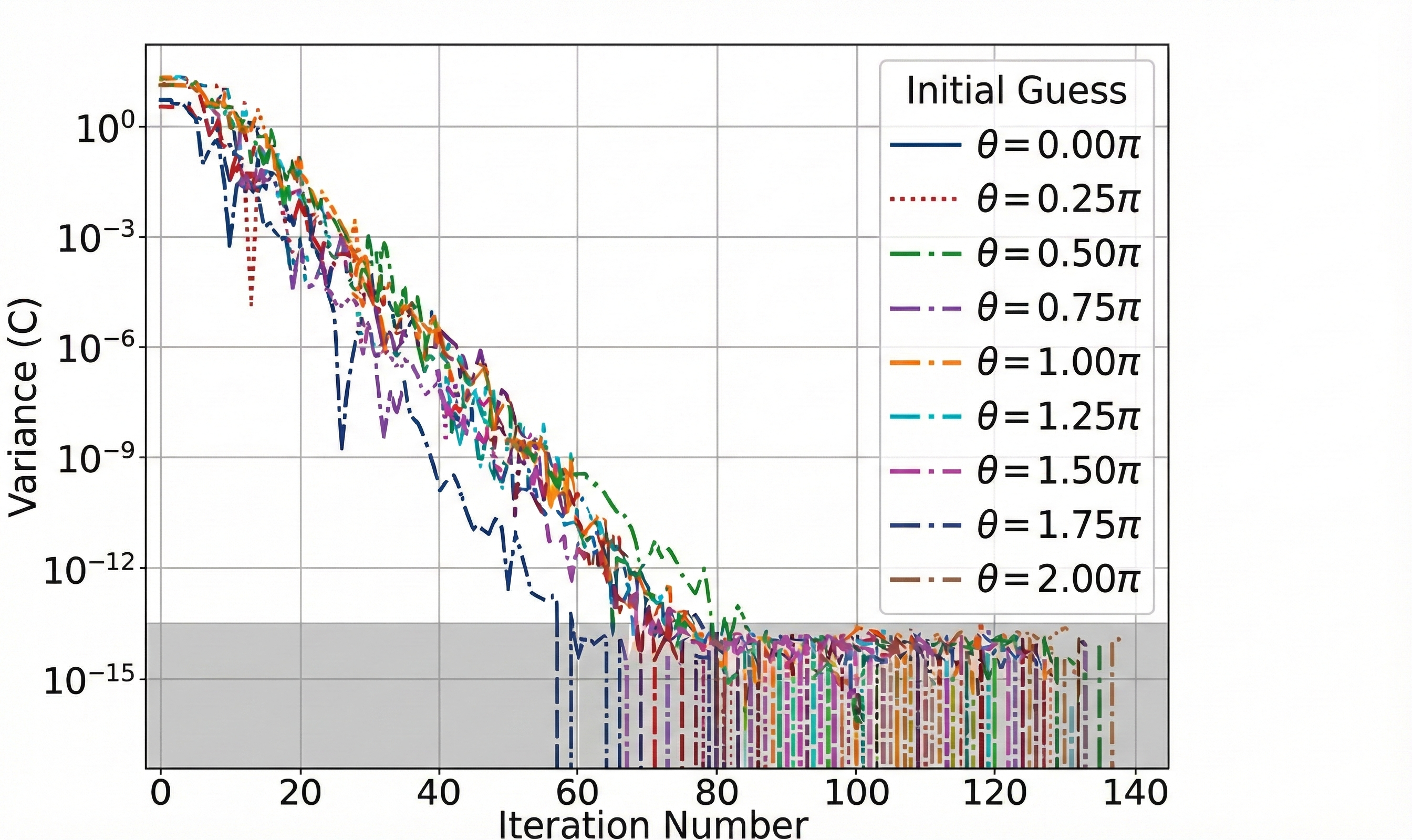
Figure 2: Plot showing convergence of the evaluated cost function from the matrix Cvar(θ)=⟨H2⟩θ+⟨K2⟩θ−⟨H⟩θ2−⟨K⟩θ23 to zero for different initial guesses, highlighting rapid convergence to within machine precision.
The optimization landscapes are characterized by multiple valleys corresponding to the global minima (eigenstates). The ability to access multiple distinct minima is central to retrieving the entire complex spectrum.
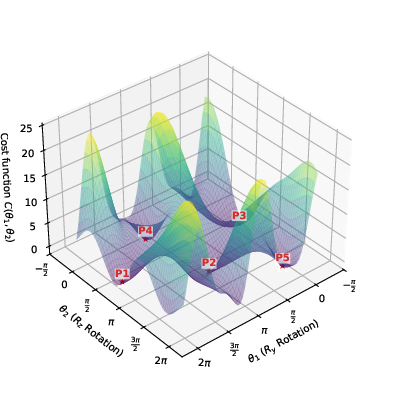
Figure 3: Real part of the variance as cost function for Cvar(θ)=⟨H2⟩θ+⟨K2⟩θ−⟨H⟩θ2−⟨K⟩θ24 in the Cvar(θ)=⟨H2⟩θ+⟨K2⟩θ−⟨H⟩θ2−⟨K⟩θ25--Cvar(θ)=⟨H2⟩θ+⟨K2⟩θ−⟨H⟩θ2−⟨K⟩θ26 plane. The eigenvalues are obtained at points Cvar(θ)=⟨H2⟩θ+⟨K2⟩θ−⟨H⟩θ2−⟨K⟩θ27 to Cvar(θ)=⟨H2⟩θ+⟨K2⟩θ−⟨H⟩θ2−⟨K⟩θ28 where cost is zero.
An explicit correlation between cost function zeros and expected eigenvalues is illustrated, reinforcing the robustness of the variance principle.
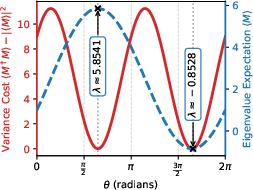
Figure 4: Correlation between eigenvalues (dashed blue) and real part of the variance as cost function (solid red) for matrix Cvar(θ)=⟨H2⟩θ+⟨K2⟩θ−⟨H⟩θ2−⟨K⟩θ29. Maxima and minima of eigenvalue expectations correspond to global minima of the cost.
The convergence trajectory from diverse initializations toward eigenstates demonstrates that the optimization reliably finds multiple global minima.
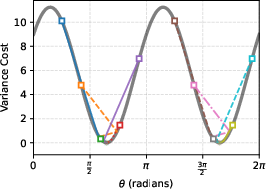
Figure 5: Optimization trajectories starting from diverse initializations converge to global minima in the parameter landscape, representing distinct eigenstates.
Comparative Analysis and Computational Considerations
RVVQE is set in contrast with standard VQE, notably in two regimes: ground-state Hermitian problems and general non-Hermitian/eigenstate extraction. While standard VQE aims solely for ground state via expectation minimization and scales linearly with the number of Hamiltonian terms, RVVQE’s variance-based metric expands the search to the full spectrum, including excited states, at increased computational cost—a quadratic scaling due to measurement overhead from evaluating squared operators.
For Hermitian M=H+iK0, M=H+iK1 vanishes, recovering variance-based VQE as a strict superset of standard VQE, theoretically maintaining equivalence but practically differing in measurement cost and optimizer landscape. Access to the entire spectral manifold, rather than only the lowest state, is a key differentiator—RVVQE is not ground-state-selective, and its optimization domain is characterized by multiple global minima.
Implications and Future Directions
This work formalizes variance minimization as the principled extension of variational eigensolvers for non-Hermitian quantum mechanics, providing a direct route to efficiently simulating resonance and decay phenomena in open quantum systems on NISQ devices. The separation of the eigenstate identification problem into measurement of Hermitian components is immediately compatible with existing hardware, sidestepping requirements for non-unitary gates or special ancilla-based constructions.
The scalability of the approach is, however, naturally bounded by the growing expressibility challenges and optimization complexity as system size increases, with potential effects from barren plateaus. This suggests a research direction toward the co-design of more expressive ansatz architectures and advanced multi-modal optimization techniques. Furthermore, future work may investigate hybrid approaches that exploit this variance formulation while incorporating improvements in measurement reduction or error mitigation.
Practical implications are immediate in quantum chemistry, nuclear resonance structure, quantum sensing, and broader contexts where non-Hermitian effects are dominant, such as photonic networks and biological energy landscapes.
Conclusion
The RVVQE algorithm systematically addresses non-Hermitian eigenproblems by leveraging a variance-based cost function, guaranteeing physical validity while maintaining direct compatibility with contemporary quantum hardware. The framework enables extraction of the full complex spectrum, provides robust convergence, and paves the way for practical quantum simulations of open-system dynamics on NISQ devices. The demonstrated reliability and extensibility of RVVQE position it as a foundational approach in the algorithmic repertoire for simulating non-Hermitian quantum phenomena.

