- The paper demonstrates that the free-fermion spectrum remains invariant even with complex anisotropy by mapping the XY chain to a quadratic fermionic problem.
- It employs Chebyshev-polynomial representations to precisely encode boundary conditions and unravel exceptional point (EP) topology with algebraic transparency.
- Construction of biorthogonal fermionic operators and Jordan chain completion at EPs establishes rigorous exact solutions for non-Hermitian many-body quantum systems.
Exact Solution for Non-Hermitian Free Fermions in the XY Chain
Overview
The paper "Exact Solution for Non-Hermitian Free Fermions: A Case Study of the XY Chain" (2605.26813) presents a comprehensive analysis of the non-Hermitian extension of the XY spin chain with open boundary conditions, focusing on the case where the anisotropy parameter γ assumes complex values. Utilizing the free-fermion structure inherent to the XY model, the authors rigorously demonstrate that the quasi-energy spectrum remains invariant upon complexification of the anisotropy, and they construct the biorthogonal basis needed for analyzing non-Hermitian systems both away from and at exceptional points (EPs). The use of Chebyshev-polynomial representations facilitates exact analytic treatment, particularly for defective points, and yields direct insights into EP topology beyond traditional momentum-space approaches.
Non-Hermitian XY Model: Free-Fermion Structure and Quasi-Energies
The model under consideration is the XY spin chain with Hamiltonian
Hγ=−21j=1∑L−1(21+γσjxσj+1x+21−γσjyσj+1y),γ∈C
Open boundaries lead to a quasi-Hamiltonian matrix M which, via Jordan-Wigner transformation, allows mapping to a quadratic fermionic problem. While Hermiticity is lost due to complex γ, the characteristic polynomial for M is found to possess the same structure as in the Hermitian case, guaranteeing identical quasi-energy solutions and enabling the mapping to the well-established free-fermion spectrum.
Chebyshev polynomials of the second kind are used to encode the boundary conditions and mode structure, where the spectral variable is the quasi-energy ε and not the quasi-momentum k. The energy spectrum remains
E=±ε1±ε2⋯±εL
where each εk solves the characteristic boundary polynomial dictated by the Chebyshev relations. This algebraic encoding of both the eigenvectors and boundary quantization conditions in terms of ε is crucial for exact analytic treatment, especially as the system is extended into the complex parameter regime.
Biorthogonal Fermionic Basis and Anticommutation Relations
The explicit construction of biorthogonal fermionic operators Hγ=−21j=1∑L−1(21+γσjxσj+1x+21−γσjyσj+1y),γ∈C0 and Hγ=−21j=1∑L−1(21+γσjxσj+1x+21−γσjyσj+1y),γ∈C1 is facilitated by the orthogonal diagonalization of Hγ=−21j=1∑L−1(21+γσjxσj+1x+21−γσjyσj+1y),γ∈C2, as it remains symmetric even though it is non-Hermitian. The resulting operators obey canonical anticommutation relations: Hγ=−21j=1∑L−1(21+γσjxσj+1x+21−γσjyσj+1y),γ∈C3
The many-body eigenstates are constructed as products of these creation and annihilation operators acting on appropriately chosen vacua, and the Hamiltonian is diagonalized even in the non-Hermitian regime.
Exceptional Points: Jordan Decomposition and Generalized Eigenvectors
Exceptional points occur when the characteristic polynomial develops repeated roots, rendering the quasi-Hamiltonian matrix defective. The analysis shows that at EPs, the degeneracies correspond to repeated roots in the Chebyshev boundary polynomial, and the eigenvectors must be extended via differentiation with respect to Hγ=−21j=1∑L−1(21+γσjxσj+1x+21−γσjyσj+1y),γ∈C4 to construct a complete Jordan chain. The Jordan normal form is explicitly derived, and the exact counting of independent many-body eigenstates at EPs is obtained: for even chain length Hγ=−21j=1∑L−1(21+γσjxσj+1x+21−γσjyσj+1y),γ∈C5, the degeneracy structure produces Hγ=−21j=1∑L−1(21+γσjxσj+1x+21−γσjyσj+1y),γ∈C6 independent eigenstates at EPs, in contrast to the Hγ=−21j=1∑L−1(21+γσjxσj+1x+21−γσjyσj+1y),γ∈C7 states away from EPs.
The self-orthogonality of eigenvectors at EPs is verified, as demonstrated by the vanishing biorthogonal overlap Hγ=−21j=1∑L−1(21+γσjxσj+1x+21−γσjyσj+1y),γ∈C8.
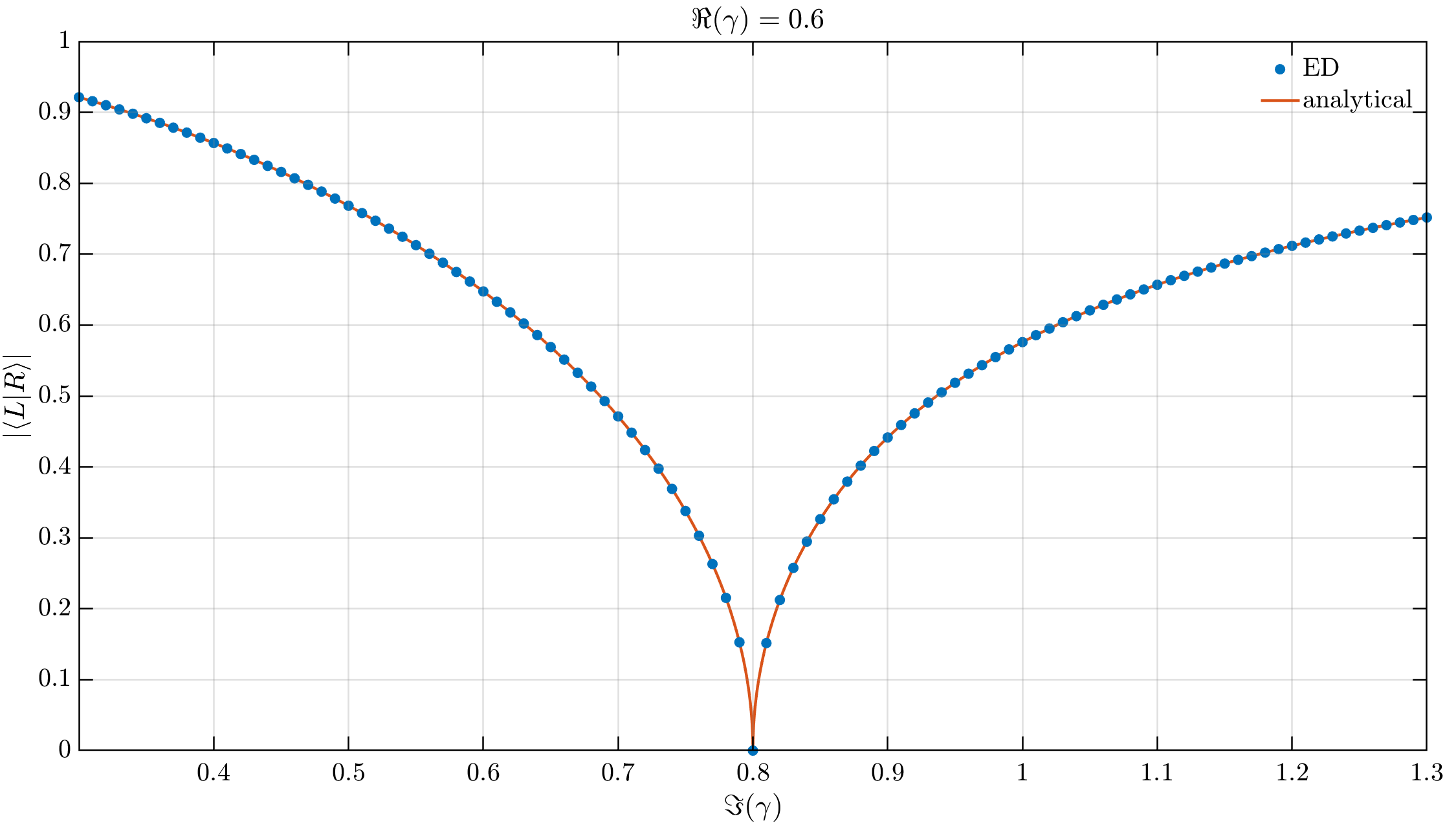
Figure 1: Hγ=−21j=1∑L−1(21+γσjxσj+1x+21−γσjyσj+1y),γ∈C9 as a function of M0 for M1; the zero at the EP confirms self-orthogonality.
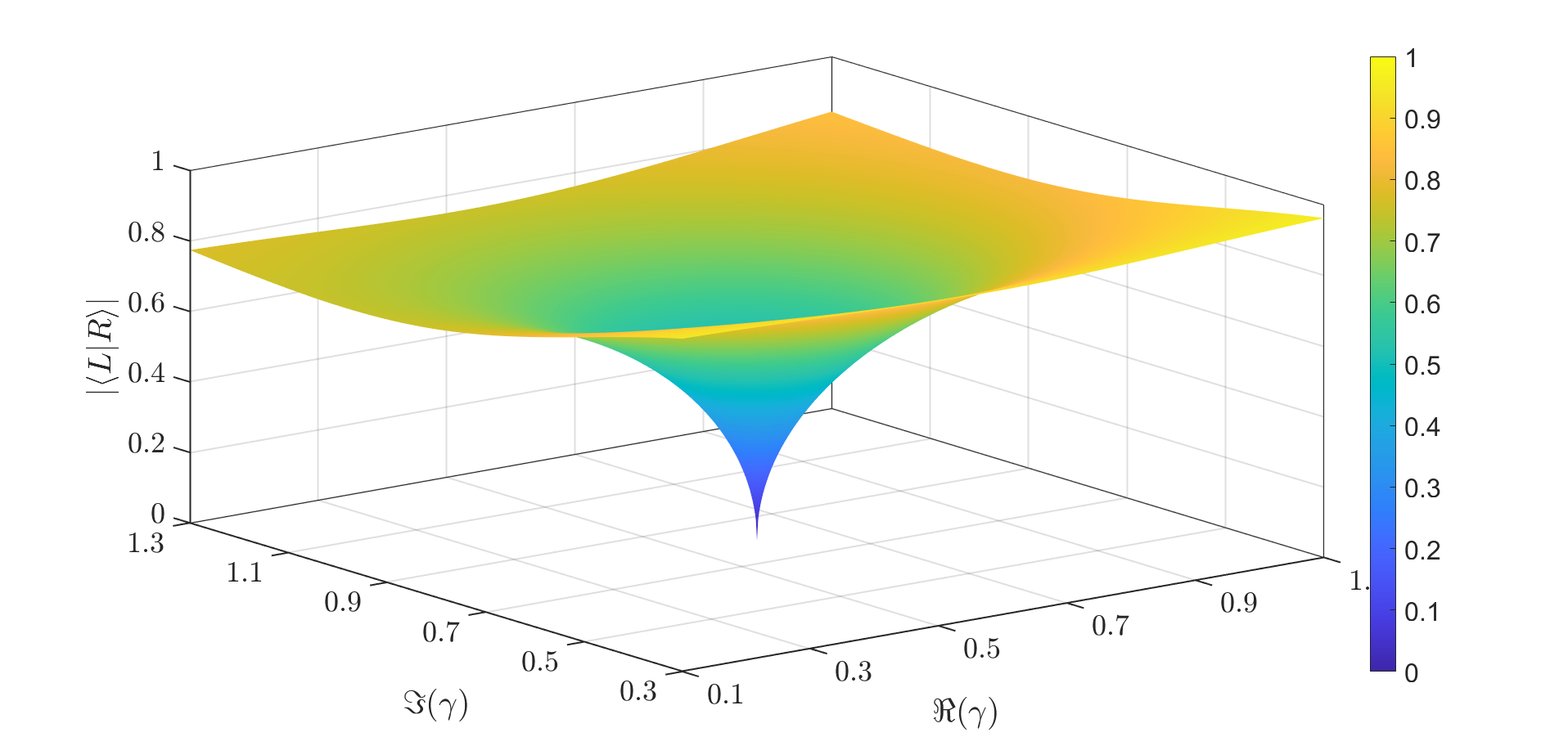
Figure 2: M2 in the complex M3 plane for M4; vanishing at EP distinguishes the branch point.
EP Topology and Branch Cut Structure
The Chebyshev-polynomial formulation directly exhibits the Riemann-sheet topology of eigenvalues and eigenvectors as functions of the complex anisotropy parameter. Encircling an EP in parameter space results in the non-trivial permutation of both eigenenergies and eigenstates: a clear manifestation of non-Hermitian topology, previously reported primarily in momentum-space Bogoliubov-de Gennes analyses.
Analytic continuation of the eigenvalue and eigenvector branches across the complex M5 plane reveals branch cuts emanating from EPs. The paper's visualizations confirm this:
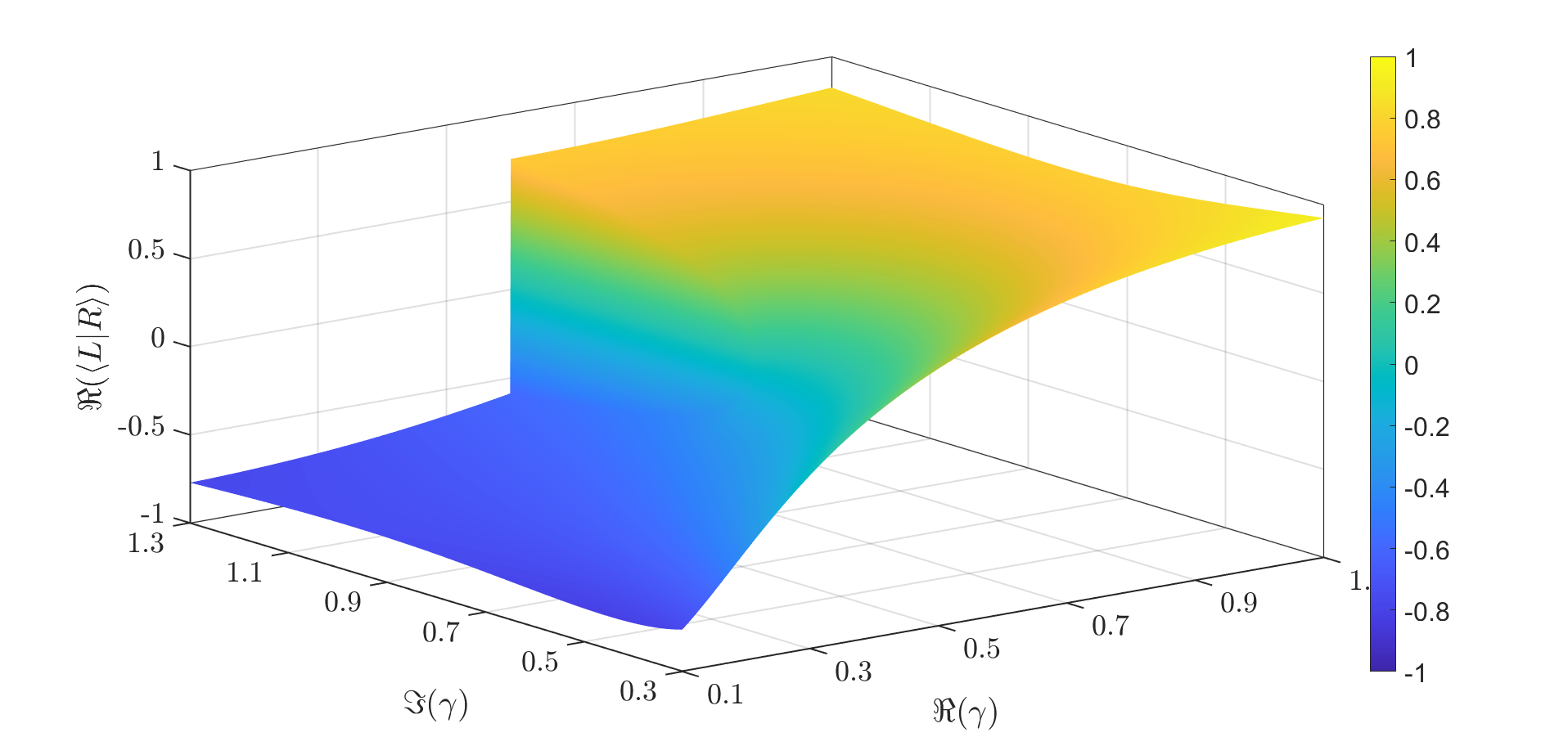
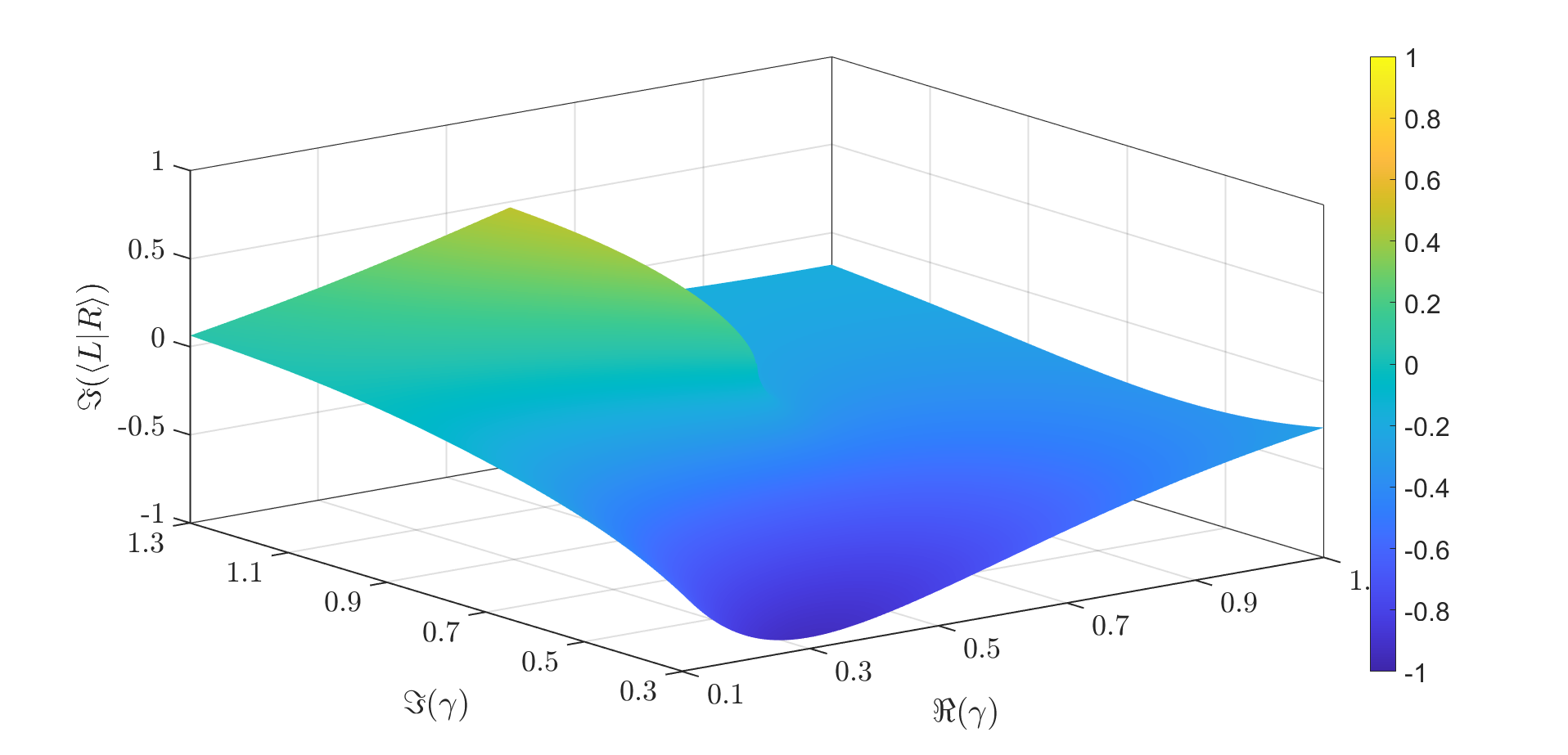
Figure 3: Real and imaginary parts of M6 as functions of M7 in the complex plane, illustrating discontinuity across the branch cut.
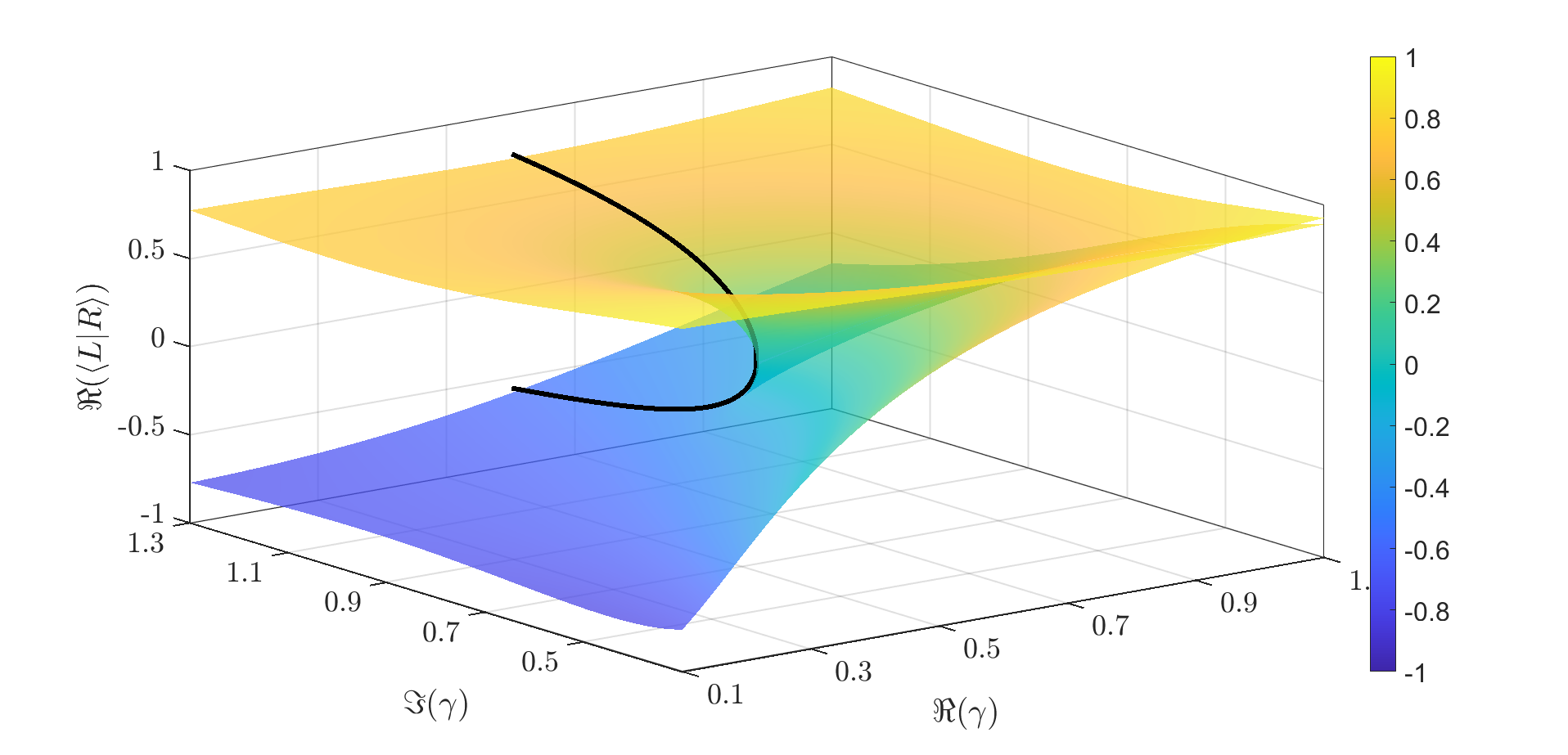
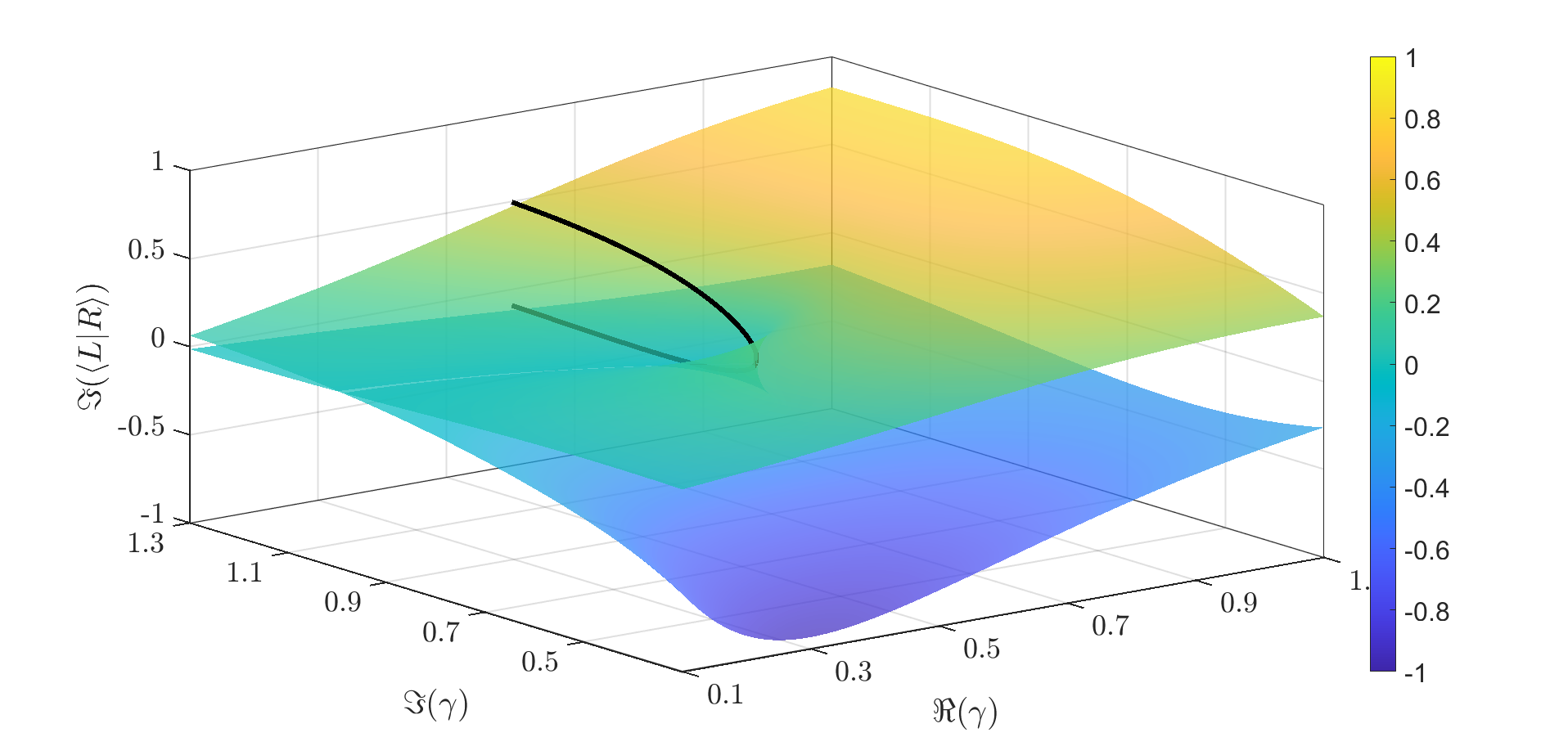
Figure 4: Real and imaginary parts of the Riemann surface for M8, with the branch cut marking the exchange of eigenstates upon EP encirclement.
These branch point singularities underpin the exchange phenomena, and their algebraic origin is unified across both energies and eigenstates.
Numerical Results and EP Location
For finite size chains (M9 up to γ0), EPs are tabulated as specific complex values of γ1 where the characteristic polynomials become degenerate (see paper's Appendix for explicit values). The biorthogonal overlaps are confirmed via exact diagonalization, reinforcing the analytic approach.
Implications and Future Directions
The analytic control over the quasi-energy polynomial, boundary conditions, and eigenvector construction offers significant advantages for advancing non-Hermitian many-body quantum theory. The demonstration that EP physics, including branch cut topology and self-orthogonality, can be captured within a real-space open boundary model underscores the robustness of the Chebyshev-polynomial approach relative to conventional Fourier-based solutions. This framework is poised for extension to more complex interacting and integrable models, and provides a template for studying non-Hermitian topology outside translationally invariant or momentum-space-centric scenarios. The methods developed are applicable for exploring parafermionic models, criticality in dissipative systems, and connections to logarithmic CFTs.
Conclusion
The authors have established a rigorous and algebraically transparent pathway for solving the non-Hermitian XY spin chain with complex anisotropy, utilizing quasi-energy polynomial representations and biorthogonal fermionic operators. They show that the free-fermion spectrum persists, and that at EPs, Jordan-chain completion via γ2-differentiation is effective, allowing for exact eigenstate construction and defect analysis. The visualization and analytic diagnosis of branch cut topology around EPs illuminates eigenstate and energy permutation phenomena, expanding the toolkit for non-Hermitian quantum many-body physics and highlighting the utility of real-space, algebraically encoded solutions.

