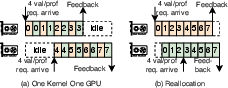
- The paper introduces speculative generation to reduce LLM generation latency and accelerate iterative agentic kernel optimization.
- It employs a dual-component architecture with SpecController and ElasticScheduler to trigger early termination and maximize GPU resource utilization.
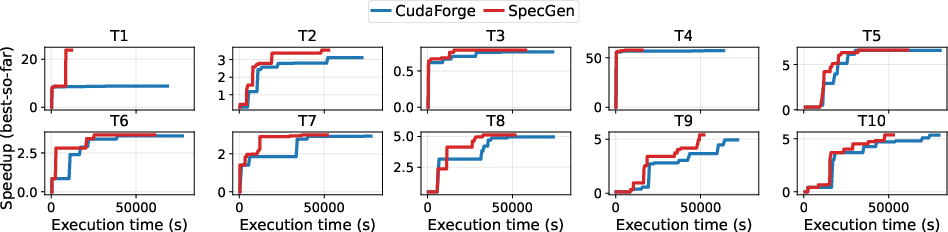
- Empirical results demonstrate up to 1.91× kernel speedups and significantly improved profiling feedback density compared to existing frameworks.
SpecGen: Accelerating Agentic Kernel Optimization with Speculative Generation
Introduction
Agentic kernel optimization utilizes iterative LLM-driven strategies to automate high-performance GPU kernel generation, executing cycles of candidate generation, correctness validation, and performance profiling. The "SpecGen: Accelerating Agentic Kernel Optimization with Speculative Generation" (2606.17518) paper introduces a novel system architecture, SpecGen, which incorporates speculative generation to mitigate three dominant inefficiencies in prior agentic frameworks: high LLM generation latency, insufficient actionable profiling feedback, and persistent underutilization of validation/profiling resources.
Systemic Inefficiencies in Agentic Kernel Optimization
Existing agentic frameworks (e.g., CudaForge, AlphaEvolve, KernelAgent) cast kernel design as iterative feedback loops, where each iteration runs a reasoned LLM generation, validates correctness, and profiles for hardware metrics.
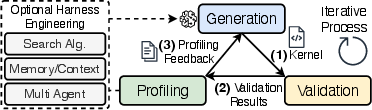
Figure 1: The three phases of agentic kernel optimization iteration: generation, validation, and profiling.
Empirical workload analysis demonstrates that LLM reasoning often dominates iteration wall time—up to 99% in complex tensor kernel tasks—directly bounding iteration count per hardware/time budget (C1). Furthermore, only 36–64% of iterations yield kernels that pass both validation and profiling, exacerbating the resource inefficiency (C2). The practical outcome is profound resource idleness: validation and profiling GPUs are utilized at 4–18%, remaining dormant through the LLM generation bottleneck (C3).
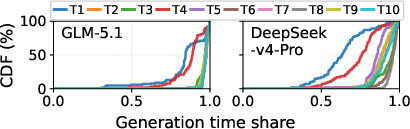
Figure 2: Per-iteration generation time share across ten KernelBench kernel optimization tasks per model.
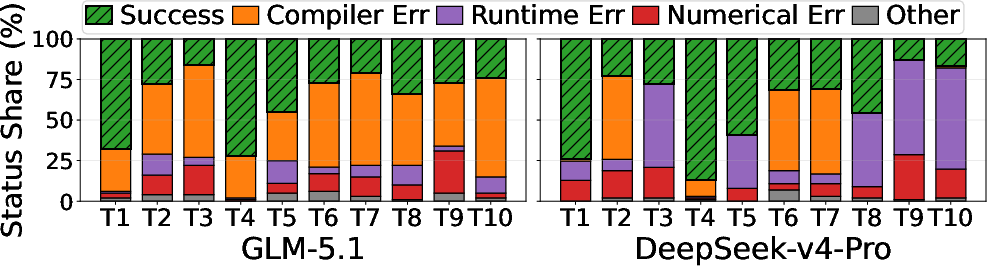
Figure 3: Distribution of iteration status across 100 iterations per kernel with two models. An iteration is Success iff its emitted kernel compiles, runs, and matches the reference.

Figure 4: End-to-end execution time of 100 iterations per task on GLM-5.1 and DeepSeek-V4-Pro.
SpecGen: Speculative Generation Architecture
The central insight of SpecGen is that LLMs expose their kernel design intent incrementally across the reasoning trace, presenting an opportunity to launch non-reasoning speculative generations conditioned on partial reasoning output (prefixes). These speculative generations are dispatched concurrently with the ongoing reasoning, validated and profiled in parallel. If any speculative candidate exceeds a dynamic threshold (e.g., mean speedup over prior candidates), the reasoning generation is terminated early, thus accelerating progress.
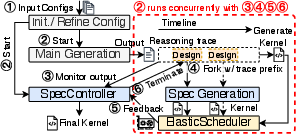
Figure 5: System overview of SpecGen.
The architecture splits into two principal components:
Algorithmic and System Contributions
SpecGen’s speculative generation mechanism is realized through continuous monitoring and parsing of the reasoning trace for trigger signals.
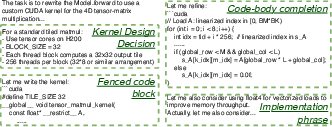
Figure 7: A reasoning trace of GLM-5.1 on the 4D tensor Matmul task. Trigger signals are highlighted in red.
These triggers, empirically mined through regular-expression parsing of tens of thousands of traces, encompass both code and explicit kernel-design commitment. The speculative branches, initialized with this context, benefit from prefix KV cache sharing, so their incremental token cost is low. The number of speculative forks is controlled to balance maximal resource utilization against queue overload.
When profiling feedback from any speculative branch meets or exceeds a termination criterion, SpecGen aborts the ongoing (slower) reasoning generation. This paradigm is orthogonal to token-level speculative decoding: it operates at the iteration/candidate level and complements methods such as Medusa or Hydra-style decoding [specdec, medusa, hydra].
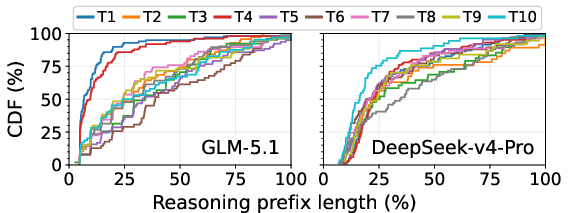
Figure 8: CDF of the shortest reasoning prefix length for generating a kernel with higher speedups than the average speedup of previously generated kernels across both models.
Evaluation
The authors evaluate SpecGen across 20 KernelBench Level 1/2/3 tasks using both GLM-5.1 [glm5] and DeepSeek-V4-Pro [deepseekv4] on NVIDIA H200 GPU infrastructure. Baselines include CudaForge [cudaforge], AlphaEvolve [AlphaEvolve], and KernelAgent. SpecGen exhibits several dominant effects:
Analysis of token overhead finds it modest, and early termination reduces unnecessary generation, especially for tasks where performant kernels appear early. The full ablation shows the majority of wall-time gain arises from speculative generation and early termination, with further improvements from elastic resource reallocation and prefix cache sharing.
Practical and Theoretical Implications
Practically, SpecGen enables higher iteration rates under fixed hardware/cost budgets—closing the performance gap previously left by system-level inefficiencies, not by new LLM training. This method can be retrofitted atop any agentic kernel optimization harness without LLM modification.
Theoretically, SpecGen reframes agentic coding as a streaming/anytime problem: optimal candidates may arise well before full LLM generation completes, and appropriately surfaced early, can allow system-level schedules to break the bottleneck of strictly serial LLM agentic cycles. This approach is robust to the reasoning-model architecture and orthogonal to improvements in agent intelligence or token-level inference speed.
Future Directions
SpecGen highlights the system-level inefficiencies in agentic optimization previously overlooked by LLM-centric research. Future work will likely integrate speculative generation techniques with RL- or curriculum-fine-tuned kernel-code LLMs [kevin32b, kernelblaster, cudal1, kernelagent2025]. The architecture’s iteration-level speculative approach is complementary to token-level speculative decoding, and hybrid methods may yield further gains for interactive agentic reasoning and code generation workflows.
Extensions to speculative generation could include adaptive trigger learning, dynamic per-task termination criteria, and generalization across compilation domains beyond CUDA/Triton, including heterogeneous and custom accelerators. If paired with ever-larger or more reflective agent strategies, this approach could further saturate practical hardware and realize convergence rates approaching those of expert human developers.
Conclusion
SpecGen (2606.17518) establishes speculative generation as a primary advancement for agentic kernel optimization systems, dramatically improving throughput and hardware utilization independently of LLM algorithmic innovation. Its architectural and algorithmic contributions provide a template for high-efficiency agentic search systems across code generation tasks.