Human Universal Grasping
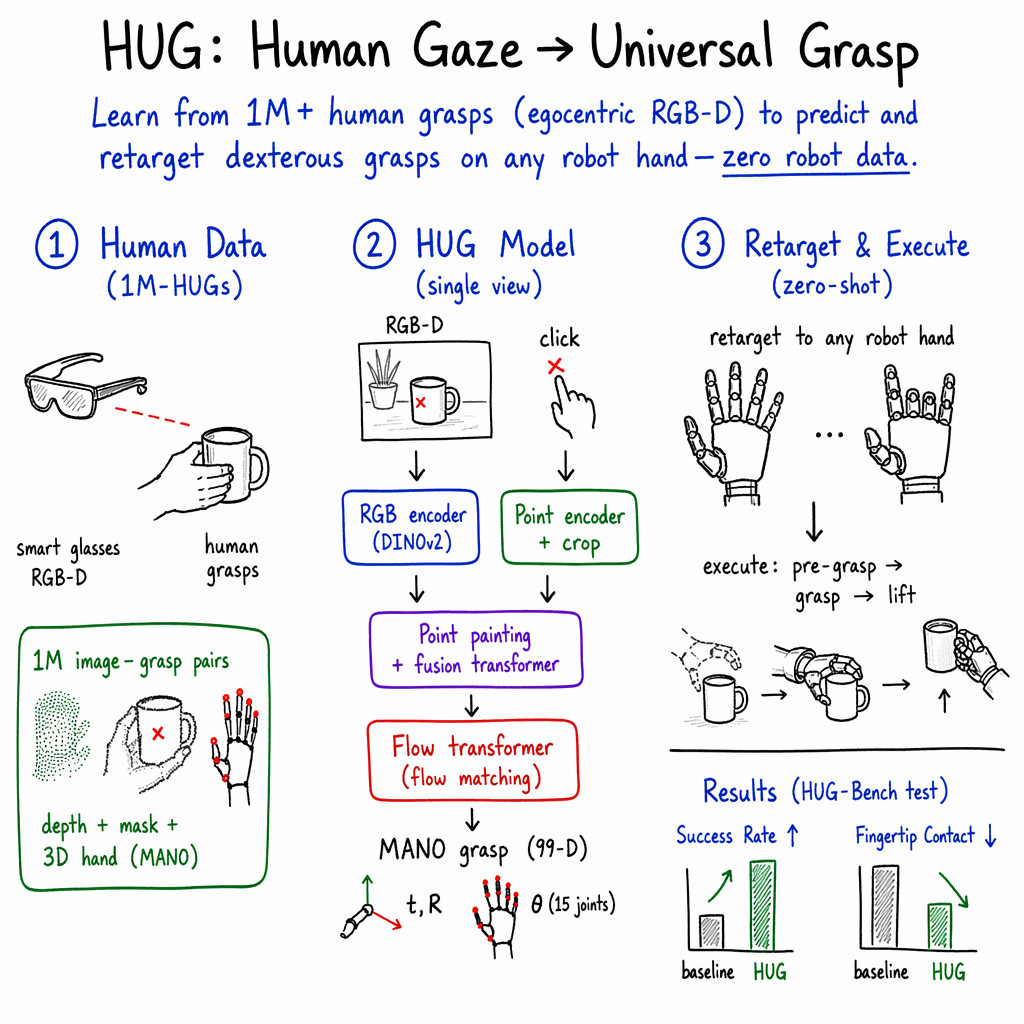
Abstract: Humans can grasp objects effortlessly, whereas multi-fingered robots are far from this level of generality. We argue that the most natural source of robot grasping data is from humans, who pick up thousands of objects every day. We present HUG, a flow-matching model that generates diverse human grasps for any user-specified object in a single RGB-D image captured from a stereo camera. Using smart glasses, we first collect 1M-HUGs, an egocentric dataset of human grasps spanning 1M frames (27.8 hrs) and 6,707 object instances across 41 buildings. Next, to model the distribution of natural human grasps, our novel flow-matching model fuses RGB and depth observations to output a grasp parameterized by wrist translation, wrist rotation, and MANO hand pose. Predicted grasps can be retargeted to various robot hands, enabling zero-shot grasping in everyday scenes. To standardize evaluation, we build a new simulated benchmark, HUG-Bench, of 90 unseen objects from five geometric categories and various sizes, with metric-scale 3D meshes. We evaluate HUG in the real world on the 30-object test set of HUG-Bench across multiple stereo cameras, robot embodiments, and household environments. HUG outperforms the state-of-the-art grasping baselines by +23% and +34% on our challenging object set. Code, data, benchmark, checkpoints, and an interactive demo are released on our website: https://grasping.io/
Paper Prompts
Sign up for free to create and run prompts on this paper using GPT-5.
Top Community Prompts
Explain it Like I'm 14
What is this paper about?
This paper shows a new way to teach robot hands to pick up almost any everyday object by learning directly from how humans naturally grab things. The system is called HUG (Human Universal Grasping). It uses videos from smart glasses to learn what good human grasps look like, then predicts a human-like hand pose for a new object from a single camera view. That predicted human grasp can be “retargeted” (translated) to different robot hands so robots can grasp objects without extra training.
What questions did the researchers ask?
- Can we train robot grasping entirely from real human grasps, instead of from simulations or tedious robot teleoperation?
- Can one model predict a good grasp for almost any object using just one RGB-D image (a color picture plus depth)?
- Will those predicted human grasps work on different robot hands, cameras, and locations without retraining?
- How do we fairly test these grasps on many hard, real-world objects?
How did they do it?
1) Collecting a giant human-grasp dataset with smart glasses
People wore lightweight smart glasses (with two cameras that see depth, like human eyes). For each object, the wearer first looked around it (no hands in view), then reached in and grasped it. Because the glasses know their own motion and depth, one real grasp can be “back-propagated” to many earlier frames, creating lots of training pairs for free.
- Size: about 1 million frames (27.8 hours), covering 6,707 object instances across 41 different buildings.
- Each training example includes:
- An image and a depth map (think: a color photo plus a per-pixel distance “ruler”).
- An object mask (which pixels belong to the object).
- A 3D hand pose using a standard hand model called MANO.
What’s MANO? Picture a digital glove that can bend at each joint. MANO describes hand shape and finger angles, so the computer can represent a hand pose in 3D precisely and consistently.
2) Teaching the model to predict a human grasp from one view
Input: one RGB-D image and a single click on the target object.
- RGB-D: “RGB” is the color image; “D” is depth. The depth lets the system build a “point cloud,” which is like sprinkling thousands of tiny dots in 3D space to show where surfaces are.
- The model looks at both color and 3D dots. Color helps it recognize the object and its parts (like a handle), while depth tells it the object’s exact shape and distance.
Focus where it matters: The model zooms in on a 30 cm bubble around the clicked point so it concentrates on the target object, not the whole room.
Predicting the grasp: The model outputs the wrist position and rotation plus all finger joint angles in the MANO hand. It uses a technique called flow matching, which you can imagine like guiding a “cloud” of possible hand poses to settle into a realistic, safe grasp pose step by step.
Why flow matching and 3D supervision? The model doesn’t just guess numbers; it’s also taught to put fingertips near the object’s surface in 3D. That extra 3D guidance helps the predicted hand actually make good contact, not just look right.
Retargeting to robot hands: A human-like hand pose won’t match every robot hand perfectly. Retargeting is like tailoring the same outfit to fit different body shapes. The system maps the MANO hand pose onto various robot hands so they can perform a similar grasp.
3) Testing on a tough benchmark in simulation and in the real world
They built HUG-Bench: 90 objects across five shapes (like cylindrical, prismatic, spheroidal) and three sizes (small, medium, large), all unseen during training. They made accurate 3D meshes for these objects, then:
- Simulation tests: Try to grasp and lift each object with a MANO hand in physics simulation.
- Real-robot tests: Try on 30 of these objects in real households and labs, with different robot hands and cameras.
What did they find?
Here are the key results, and why they matter:
- Strong performance without any robot training:
- In simulation on unseen objects: about 73% success, close to a “human grasp” replay upper bound (~94%).
- This shows the model learned human-like grasps that mostly work physically.
- Real-world success across different setups:
- Tabletop lab setting (ZED camera + xArm + Ability hand): 66.7% success.
- In-the-wild home setting (Aria glasses + mobile robot + WUJI hand): 62.0% success.
- The small drop shows the method transfers well to new cameras, robot hands, and rooms.
- Beats strong baselines:
- Outperforms two advanced methods by large margins on the 30-object real test set:
- +23% over Dex1B (a massive simulation-trained grasp generator).
- +34% over CAP (a contact-conditioned parallel-jaw approach).
- This suggests learning from real human grasps can be more robust than training only in simulation.
- Color + depth works best:
- Using both RGB (color) and depth point clouds together makes grasps more accurate than either alone.
- Depth-only sometimes goes for the wrong part (like grabbing a brush by the bristles), while RGB-only struggles to reach the right 3D location. Together, they avoid both problems.
- More data clearly helps:
- Training on more human grasp frames steadily increased success and fingertip accuracy.
- Performance didn’t max out at 1 million frames, hinting that even more real data could push results higher.
- Where it still fails:
- Biggest failures happen during the hand closing phase—bumping the object or table—because execution is open-loop (no feedback mid-grasp).
- Very large objects or very small, thin ones are tougher, and some robot hands are physically too small to wrap certain objects.
Why does this matter?
- Learning from humans at scale: Instead of spending huge effort collecting robot-specific data or relying only on imperfect simulations, this work taps into natural human behavior captured by smart glasses. That’s a practical, scalable way to cover the endless variety of objects and scenes in the real world.
- General and flexible: One model can suggest grasps for many new objects from a single camera view and then adapt those grasps to different robot hands without retraining. That’s key for robots in homes, offices, and stores where everything varies.
- Better benchmarks: HUG-Bench is a challenging, realistic test set with metric-accurate 3D objects, linking simulation to real-world trials. That helps the field measure progress fairly and reproducibly.
- Path to more capable robots: With better grasping, robots can do more useful tasks—like putting away groceries, using tools, or cleaning up—because grasping is the first step to many actions.
In short, this paper shows that learning “how people grab things” from real, everyday video can teach robots to grasp a wide range of objects, often better than simulation-trained systems, and work across different cameras, robot hands, and homes—bringing us closer to helpful, general-purpose household robots.
Knowledge Gaps
Unresolved gaps, limitations, and open questions
Below is a concise, actionable list of concrete gaps the paper leaves open for future work:
- Target selection dependency: The method requires a user-provided 2D click to indicate the object. Robust, automatic target selection (from detection, language, or task context) and sensitivity to click errors are not studied.
- One-hand, right-handed only: Training and inference are limited to single, right-hand grasps. Left-handed, bimanual, and handover scenarios remain unaddressed.
- Morphology awareness: MANO shape is fixed and predictions are not conditioned on the target robot’s kinematics, size, or actuation limits. A morphology-aware model (predicting shape/scale or optimizing grasps under robot constraints) is missing.
- Retargeting robustness: Retargeting can fail when robot hands cannot reach feasible analogs of predicted poses. There is no quantitative study of retargeting success across diverse hands or learning retargeting “in the loop” with robot-specific constraints.
- Open-loop control: Real-world execution is open-loop with no visual/force feedback, leading to collisions and slips. Closed-loop servoing with tactile/force feedback and online pose adaptation is not explored.
- Motion planning integration: The approach does not integrate collision-aware motion planning (hand/arm) to avoid premature table/object contacts; planning in cluttered scenes is unaddressed.
- Clutter and occlusion: Evaluation uses single-object scenes. Performance in dense clutter, partial occlusions, shelf/bin picking, and contact-rich environments remains unknown.
- Dynamic objects: All evaluations assume static objects. Grasping moving/handed-over objects, or objects that articulate during reach, is untested.
- Material and sensing brittleness: Data and training filters bias toward reliable stereo depth. Generalization to transparent, reflective, black, glossy, or deformable objects (where stereo depth often fails) is unquantified.
- Scale extremes and resolution: Accuracy drops for very small, very large, or far objects, partly due to 224×224 inputs and fixed 0.3 m PC crop. Multi-scale encoders, higher resolutions, or adaptive crops are not explored.
- Camera modality generalization: While some cross-stereo transfer is shown, generalization to monocular-only depth (or no depth), ToF/LiDAR, mobile phones, low light, and strong HDR conditions is not evaluated.
- Label noise and uncertainty: Grasp labels degrade under hand occlusion in Aria. The model does not account for label uncertainty; probabilistic supervision or label denoising is not investigated.
- Contact modeling: Training uses a 3D landmark loss but no explicit contact constraints, penetration penalties, or contact-map supervision. Learning contact-consistent grasps (e.g., via SDF/contact losses) is unexplored.
- Confidence and selection: Real-world trials execute a single sample. Sampling-and-ranking, confidence estimation, or success prediction to choose among multiple candidates is not studied.
- Diversity vs executability: The model is generative, but there is no metricized analysis of grasp diversity, mode coverage, or diversity–success trade-offs.
- Functional grasp quality: Success is defined as “lifted,” not task- or affordance-appropriate (e.g., grasping handles for pouring/using tools). Measuring and optimizing functional correctness is open.
- Simulation realism and sensitivity: The human-oracle <100% indicates sim–real mismatch (friction, asset fidelity). A thorough sensitivity analysis of physics parameters and contact models is missing.
- Query-point depth errors: The approach centers on a 3D query point; robustness to erroneous depth at the click or to missing depth is not analyzed.
- Dataset coverage and bias: 1M frames but ~1.5k unique objects and 41 buildings; right-hand only; unknown subject diversity. Systematic analysis of demographic/scene biases and their effect on grasp style is absent.
- Active data collection: Scaling curves suggest the model is data-bound. Strategies for active data acquisition, coverage-driven sampling, or uncertainty-aware collection are not explored.
- Embodiment breadth: Only two robot hands (Ability, WUJI) are evaluated. Transfer to underactuated/tendon-driven hands, non-anthropomorphic grippers, or soft/hybrid hands remains untested.
- Whole-body coordination: The method predicts hand poses only; integration with arm/base planning in constrained spaces and mobile manipulation is not evaluated.
- Latency and deployability: Inference/runtime, onboard compute constraints, and real-time performance on embedded platforms are not reported.
- Safety constraints: No explicit handling of self-collisions, pinch hazards, or safe approach distances; safety-aware planning and control are not incorporated.
- Outdoor and broader domains: Experiments are indoor-only. Robustness to outdoor scenes, weather, and varied terrain/lighting is unknown.
- Broader sensing modalities: The approach does not exploit tactile, proprioception, or audio; how multimodal signals could reduce slips and improve contact reasoning is open.
- Generalization to deformable/soft/cloth and liquids: Beyond a few compliant items, systematic handling of deformable objects, bags, cloth, or containers with liquids is not addressed.
- Benchmark scope: HUG-Bench has 90 rigid objects with known meshes; standardized benchmarks with deformables, transparent items, articulated mechanisms with tight tolerances, and clutter are lacking.
- Privacy and ethics in data collection: Egocentric in-home capture raises privacy concerns; methods for privacy-preserving data collection, annotation, and release are not discussed.
Practical Applications
Practical Applications of “Human Universal Grasping (HUG)”
Below are actionable, real-world applications derived from the paper’s findings, methods, and artifacts (HUG model, 1M-HUGs dataset, aria2mano/aria2mesh pipelines, and HUG-Bench). Each item notes relevant sectors, potential tools/products/workflows, and key assumptions/dependencies.
Immediate Applications
- [Robotics, Consumer Robotics] Drop-in dexterous grasping for mobile manipulators in homes and labs
- What: Use HUG as a perception-to-grasp module for picking diverse household items with anthropomorphic hands (e.g., Ability Hand, WUJI) and a stereo RGB-D camera (e.g., ZED, Aria Gen 2).
- Tools/products/workflows: ROS/MoveIt integration; “click-to-grasp” UI; HUG inference server; retargeting plugin for specific hands; on-robot scripts for pre-grasp → grasp → lift.
- Assumptions/dependencies: Stereo RGB-D calibration; single-view RGB-D availability; a user-provided target selection (pixel click or detector); anthropomorphic hand with similar kinematics; open-loop execution (no contact/force control); indoor object distribution similar to training data.
- [Healthcare, Assistive Tech] Supervised assistive picking for activities of daily living (ADLs)
- What: Caregivers or clinicians trigger grasps via a point-and-click interface for patients with limited mobility; pilot deployment in clinics or supervised home settings.
- Tools/products/workflows: Tablet/voice UI to select object; HUG + retargeting to assistive hand; caregiver confirmation and emergency stop.
- Assumptions/dependencies: Human-in-the-loop oversight for safety; compliant actuation preferred; regulatory approvals for clinical settings; constraints due to right-hand-only training and open-loop control.
- [Robotics, Operations] Teleoperation bootstrapping and operator load reduction
- What: Use HUG to generate an initial grasp pose that a human teleoperator refines, reducing task time and fatigue.
- Tools/products/workflows: Operator station with visual preview and “accept/refine” workflow; teleop stack integration; confidence scoring for candidate grasps.
- Assumptions/dependencies: Low-latency links; reliable retargeting; dexterous hand availability; operators remain responsible for safety and final execution.
- [Retail/Logistics, Robotics] Pilots for handling irregular inventory and restocking in backrooms
- What: Deploy HUG for tricky, non-standard items (handles, deformable packaging, short or flat items) where parallel grippers underperform.
- Tools/products/workflows: Backroom testbed with stereo cameras; HUG module as a fallback for “hard items”; SKU-specific success tracking; gradual workflow integration.
- Assumptions/dependencies: Tolerance for moderate failure rates; anthropomorphic hands on-site; indoor lighting; need for target selection (automatic detection or manual click); speed constraints.
- [AR/VR, Education] Augmented reality guidance for human grasping and training
- What: Use HUG’s human-like grasp predictions to overlay recommended grasp poses through smart glasses for training novice users (e.g., lab, shop class).
- Tools/products/workflows: AR overlay app; click-to-target on the glasses; replay and feedback for ergonomics training.
- Assumptions/dependencies: Accurate alignment of camera intrinsics/extrinsics; latency and rendering quality; generalization to the specific tools/tasks.
- [Academia, Open-Source] Turnkey dataset and benchmark to accelerate manipulation research
- What: Adopt 1M-HUGs for human-grasp learning; use HUG-Bench for standardized evaluation across sim and real; extend aria2mano and aria2mesh in new projects.
- Tools/products/workflows: Public code, checkpoints, meshes; course projects and reproducible baselines; ablations on RGB-only/PC-only; data scaling studies.
- Assumptions/dependencies: Compliance with dataset licenses and privacy policies; access to RGB-D sensors and (optional) dexterous hands for real-world tests.
- [Product Design, Software] Early-stage graspability assessment on CAD/meshes
- What: Evaluate how a “human-like” hand would grasp new product designs; flag ergonomics issues early.
- Tools/products/workflows: Import CAD into a HUG-enabled sim pipeline (aria2mesh or equivalent); run multiple views and clicks to estimate grasp diversity and success; generate reports for design review.
- Assumptions/dependencies: Accurate, metric-scale meshes; indoor, single-hand grasp assumptions; no modeling of force/torque usage yet.
- [Software, Cloud Services] Grasp-as-a-Service API for integrators and robotics startups
- What: Provide a cloud API that takes a calibrated RGB-D image and object reference (click, mask, or bbox) and returns a retargeted robot-hand grasp.
- Tools/products/workflows: Containerized inference; device-agnostic intrinsics handling; SDKs for Python/ROS; usage dashboards.
- Assumptions/dependencies: Network latency and security; privacy handling for in-home images; standardized retargeting profiles per hand.
- [Education, STEM Kits] Ready-to-run demos for robotics courses and competitions
- What: Use HUG with affordable stereo cameras and robotic hands to teach dexterous manipulation topics (perception fusion, retargeting, sim-to-real).
- Tools/products/workflows: Course labs using HUG-Bench; sample code to swap hands or cameras; rubrics tied to success metrics (SR, FC error).
- Assumptions/dependencies: Availability of safe manipulators; instructor oversight; manageable object set.
- [HRI, Personalization] Rapid on-site adaptation via egocentric data collection
- What: Collect a small, in-home dataset with smart glasses and fine-tune HUG for personalization to objects/layouts users actually own.
- Tools/products/workflows: aria2mano pipeline; short fine-tuning job on local or cloud GPU; periodic re-training as home inventory changes.
- Assumptions/dependencies: Compute resources; informed consent and privacy controls for in-home captures; sufficient data quality.
Long-Term Applications
- [Robotics] Closed-loop dexterous manipulation with tactile/force control
- What: Integrate HUG with motion planning, tactile feedback, and compliant control for robust grasps that avoid premature contacts and slipping.
- Tools/products/workflows: Tactile sensor suites; force-aware policies; online re-planning; multi-view or on-wrist cameras.
- Assumptions/dependencies: New data capturing contact forces; robust controllers; benchmarking of contact-rich tasks.
- [Robotics] Bimanual, left-handed, and whole-hand manipulation; tool use
- What: Extend beyond right-hand, single-hand grasps to cooperative bimanual tasks and tool manipulation.
- Tools/products/workflows: Data collection for left-hand and bimanual interactions; expanded MANO or full-body models; more sophisticated retargeting.
- Assumptions/dependencies: Larger, more diverse human datasets; joint control of two dexterous hands and arms.
- [Healthcare, Assistive Robotics] Independent in-home assistive robots for ADLs
- What: End-to-end assistive robots that autonomously pick and manipulate daily objects safely around vulnerable users.
- Tools/products/workflows: Certified safety layers; fail-safes and intent recognition; user-specific preference models.
- Assumptions/dependencies: Regulatory approval; thorough safety certification; reliability far above pilot-level success rates.
- [Logistics, E-commerce] General-purpose picking of unstructured items at scale
- What: Use dexterous hands to reduce SKU engineering and increase coverage of odd-shaped items in fulfillment centers.
- Tools/products/workflows: Language/vision-grounded object selection; conveyor and bin integration; cycle-time optimizations; hybrid pipelines with grippers + dexterous hands.
- Assumptions/dependencies: Cost and durability of dexterous hands; throughput targets; maintenance and robustness under heavy use.
- [Software, HCI] Language-grounded, click-free grasping (“Pick the red mug by the handle”)
- What: Combine HUG with VLMs for object selection and affordance grounding without manual clicks; align with user instructions and preferences.
- Tools/products/workflows: Multi-modal models (RGB-D + language); affordance detection; uncertainty-aware grasp proposals.
- Assumptions/dependencies: Additional training on grounded language datasets; reliable object/part segmentation under clutter.
- [Education, AR/Training] Skill coaching for specialized tasks (surgery, maintenance)
- What: AR overlays showing recommended human-like grasp strategies for tools and components in specialized domains.
- Tools/products/workflows: Domain-specific datasets; safety and effectiveness studies; continuous feedback systems.
- Assumptions/dependencies: High-fidelity hand-object models for domain tools; strict validation in high-stakes environments.
- [Prosthetics, Rehabilitation] Personalized grasp planning for prosthetic and customized hands
- What: Retarget HUG predictions to diverse prosthetic devices, adapting to individual morphology and grasp preferences.
- Tools/products/workflows: Morphology-aware retargeting; user-in-the-loop calibration; integration with EMG or intent interfaces.
- Assumptions/dependencies: Expanded models to handle diverse hand shapes/sizes; clinical trials and device approvals.
- [Policy, Standards] Privacy-preserving frameworks for egocentric data collection at home
- What: Establish consent, storage, and redaction standards for scaling in-the-wild human grasp datasets.
- Tools/products/workflows: On-device redaction; federated learning; standardized consent templates and audit trails.
- Assumptions/dependencies: Cross-stakeholder adoption (academia/industry/regulators); compliance with regional laws.
- [Consumer Robotics, Daily Life] Broad deployment of home robots for chores involving diverse objects
- What: Household robots that can reliably pick and place clothing, kitchen items, toys, and tools.
- Tools/products/workflows: Robust perception stacks; long-horizon task planning; user-friendly interfaces for corrections.
- Assumptions/dependencies: Lower hardware cost; significantly improved reliability; long-term maintenance and safety.
- [Manufacturing, Digital Twins] Automated scan-to-sim for grasp testing at design and pre-production stages
- What: Turn physical prototypes into metric digital assets for automated grasp tests and ergonomic checks at scale.
- Tools/products/workflows: Production-grade aria2mesh-like pipelines; batch simulation services; design feedback loops.
- Assumptions/dependencies: High-quality, automated meshing and watertightness; standardized evaluation metrics.
- [Edge AI] On-device, low-power grasp inference on embedded hardware
- What: Run HUG-like models on microservers or on-robot compute for low-latency grasping without cloud dependency.
- Tools/products/workflows: Model distillation/quantization; hardware acceleration (NPU/GPU); streaming depth processing.
- Assumptions/dependencies: Aggressive compression without loss of accuracy; thermal and power constraints.
- [Certification, Safety] Standardized grasping test suites and safety benchmarks
- What: Expand HUG-Bench into a certified suite for testing dexterous grasp performance and safety across embodiments.
- Tools/products/workflows: Formal metrics beyond SR and FC error (e.g., contact forces, slippage); pass/fail thresholds for certification.
- Assumptions/dependencies: Community/industry consensus on metrics; alignment with regulatory bodies.
- [Cross-Sector R&D] Foundation models for manipulation that generalize across tasks and embodiments
- What: Build on HUG to create generalist manipulation models covering grasping, placement, tool use, and assembly across many hands and environments.
- Tools/products/workflows: Multi-task, multi-embodiment datasets; modular retargeting; hierarchical policies combining perception, planning, and control.
- Assumptions/dependencies: Considerable data expansion (including outdoor, left/bimanual, force-labeled interactions); scalable training infrastructure.
Notes on global assumptions across applications:
- Current model limitations: right-hand only; single-hand grasps; open-loop execution; indoor training distribution; canonical MANO hand shape; dependence on stereo RGB-D and accurate intrinsics; user click or reliable object selection required.
- Hardware dependencies: anthropomorphic dexterous hands and reliable retargeting; camera calibration; safety-compliant arms.
- Data and governance: privacy and consent for egocentric recordings; reproducible benchmarks and transparent evaluation.
Glossary
- 6-DoF: Six degrees of freedom describing a rigid body’s 3D position and orientation. "which provide synchronized RGB and stereo grayscale views together with 6-DoF camera poses and 3D hand landmarks."
- 6D rotation representation: A continuous 6-parameter representation for rotations suited to neural networks. "continuous 6D rotation representation"
- Ablation study: An experimental analysis that removes or alters components to assess their impact. "Ablation study."
- AdamW: An optimizer with decoupled weight decay used for training neural networks. "We train for 100K steps with AdamW"
- AdaLN-Zero: A conditioning mechanism that modulates transformer layers via Adaptive LayerNorm Zero. "AdaLN-Zero modulation."
- Alpha Wrap: A method to make meshes watertight by wrapping surfaces tightly. "make the meshes watertight with Alpha Wrap"
- anthropomorphic robot hands: Robot hands designed to resemble human hands in structure and movement. "anthropomorphic robot hands~\cite{ruka, abilityhand, shaw2023leap, wujihand}"
- Aria Gen 2: Smart glasses hardware that streams calibrated RGB-D and hand tracking for egocentric capture. "Aria Gen 2 glasses"
- back-projected: Converting depth pixels into 3D points using camera intrinsics. "The depth image is back-projected to a metric point cloud (PC)"
- bilinearly sampled: Interpolating image features at non-integer pixel locations using bilinear interpolation. "its DINOv2 patch feature is bilinearly sampled"
- CAP (Contact-Anchored Policies): A robot control method that conditions actions on specified contact anchors. "CAP (Contact-Anchored Policies)"
- camera extrinsics: Parameters that define the camera’s pose in the world (rotation and translation). "injecting Aria camera intrinsics, extrinsics, and stereo depth into their pipeline."
- camera intrinsics: Parameters that define the camera’s internal geometry (focal length, principal point). "using its depth value and the camera intrinsics "
- CoACD: An algorithm for approximate convex decomposition of 3D meshes. "with CoACD~\cite{wei2022coacd}"
- convex decomposition: Splitting a complex mesh into a set of convex parts for simulation or physics. "obtain their convex decomposition with CoACD"
- cross-attend: A transformer operation where one token attends to another set of tokens. "cross-attend to the query token"
- DDP: Distributed Data Parallel; a training paradigm that splits batches across multiple GPUs. "Training with DDP on two RTX 5090s"
- DiT: Diffusion Transformer; a transformer architecture tailored for diffusion/flow generative models. "passed through DiT~\cite{peebles2023dit} blocks"
- DINOv2-Base ViT: A self-supervised Vision Transformer model used for robust visual feature extraction. "a frozen DINOv2-Base ViT with register tokens"
- egocentric: First-person viewpoint data captured from the wearer’s perspective. "an egocentric dataset of human grasps spanning 1M frames"
- EMA: Exponential Moving Average of model parameters to stabilize evaluation. "We keep an EMA from step 50K"
- Euler integration: A simple numerical method to integrate differential equations step-by-step. "we generate samples with $50$-step Euler integration of the learned ODE."
- FC error: Fingertip Contact error; a metric measuring fingertip proximity to the object surface. "fingertip contact error (FC error, mm)"
- force-closure: An analytic grasp criterion ensuring contact forces can resist arbitrary external wrenches. "optimizing analytic objectives like force-closure"
- flow-matching model: A generative approach that learns velocity fields and integrates them via an ODE to sample outputs. "We present HUG, a flow-matching model that generates diverse human grasps"
- human grasp oracle: A ground-truth baseline that replays recorded human grasps for evaluation. "The human grasp oracle replays the 10 recorded human grasps"
- human-robot morphology gap: Differences in human vs. robot hand structure that complicate transfer. "human-robot morphology gap, facilitating direct robot deployment."
- MANO: A parametric 3D hand model with shape and pose parameters for articulated meshes. "MANO hand pose"
- metric-scale 3D meshes: Object meshes scaled to real-world units for accurate simulation and evaluation. "with metric-scale 3D meshes."
- MLP: Multi-Layer Perceptron; a feedforward neural network used for projection/decoding. "projected by a two-layer MLP"
- motion planning: Computing collision-free trajectories for robot movement. "Motion planning beyond the open-loop trajectory would prevent the hand from striking the object or table"
- MuJoCo: A physics engine for simulating robots and articulated bodies. "validate in MuJoCo"
- MV-SAM3D: Multi-view SAM3D; a pipeline for reconstructing meshes from multiple views. "Multi-view SAM3D (MV-SAM3D)"
- object mask: A per-pixel segmentation identifying the target object in the image. "an object mask"
- ODE: Ordinary Differential Equation; used to integrate learned flow velocities into clean states. "flow-matching ODE"
- open-loop: Executing a motion without feedback corrections during rollout. "open-loop pre-grasp grasp lift rollout"
- OpenCV convention: A coordinate convention commonly used in computer vision libraries. "in the OpenCV convention"
- parallel-jaw gripper: A gripper with two opposing fingers that close in parallel to grasp objects. "parallel-jaw gripper for execution."
- point cloud: A set of 3D points representing object/scene geometry. "metric point cloud (PC)"
- PointNeXt: A point-cloud neural network architecture for 3D feature extraction. "PointNeXt~\cite{qian2022pointnext} U-Net"
- point painting: Augmenting 3D points with aligned image features to fuse RGB and depth modalities. "We fuse the two encoder streams with point painting"
- pre-grasp: An approach pose offset from the final grasp used to position the hand before closing. "pre-grasp grasp lift"
- pre-norm transformer: A transformer variant applying LayerNorm before attention/MLP blocks. "a $4$-layer pre-norm transformer"
- query point: A user-specified pixel (lifted to 3D) indicating the target object location. "a 3D query point "
- random Fourier feature encoder: A positional encoding using random Fourier features to represent coordinates. "a shared random Fourier feature encoder "
- register tokens: Special ViT tokens that capture global information for improved feature representations. "with register tokens"
- reinforcement learning: Learning policies via trial-and-error interaction with environments. "via reinforcement learning"
- retargeting: Mapping a human hand pose to different robot hands or embodiments. "learned retargeting"
- RGB-D: Combined color (RGB) and depth sensing modality. "a single RGB-D image captured from a stereo camera"
- signed distance: A distance measurement to surfaces that includes sign (inside/outside). "where is the signed distance from fingertip to the object surface"
- sim-to-real gap: Performance drop when deploying models trained in simulation to the real world. "they suffer the sim-to-real gap"
- SLAM semidense point cloud: A partially dense 3D reconstruction produced by SLAM systems. "Aria Gen 2 SLAM semidense point cloud"
- stereo camera: A dual-lens camera providing depth via disparity between two views. "captured from a stereo camera"
- stereo depth: Depth estimated from stereo image pairs. "stereo depth"
- success rate (SR): The percentage of trials that achieve a successful grasp outcome. "Success rate (SR, \%) is the fraction of trials"
- teleoperation: Controlling a robot remotely by a human operator, often via specialized interfaces. "Teleoperation~\cite{iyer2024open, arunachalam2023holo, ding2024bunnyvisionpro, qin2023anyteleop} yields real grasps"
- U-Net: An encoder–decoder neural network with skip connections, commonly used for dense predictions. "PointNeXt~\cite{qian2022pointnext} U-Net"
- vision-LLM: A model that jointly processes images and text to solve tasks. "A vision-LLM identifies the grasped object"
- watertight: A mesh property with no holes, suitable for physical simulation. "make the meshes watertight"
- wrist translation: The 3D positional component of the wrist in a grasp parameterization. "parameterized by wrist translation"
- zero-shot: Generalizing to new tasks or settings without additional training. "enabling zero-shot grasping in everyday scenes"
Collections
Sign up for free to add this paper to one or more collections.

