- The paper demonstrates that AI chaining yields nonlinear productivity gains by integrating contiguous automation steps.
- It employs dynamic programming to optimize task bundling and reduce coordination costs through strategic job design.
- Empirical evidence shows that clustering automatable steps enhances AI efficiency, challenging classical task allocation principles.
Chaining Tasks and the Reorganization of Work Under AI: An Analytical Essay
Introduction and Model Architecture
The paper "Chaining Tasks, Redefining Work: A Theory of AI Automation" (2606.15960) presents a comprehensive analytical framework for understanding the joint impact of AI automation and organizational redesign on work. It departs from the conventional independent task-based models of production by endogenizing both the partition of steps into tasks and the bundling of tasks into jobs. The paper’s central mechanism arises from the technical and economic implications of AI chaining—the execution of multiple contiguous steps by AI before human validation—driving nonlinearities in task allocation, job design, and productivity.
The model formalizes production as a sequence of steps, where firms optimize over the grouping of steps into worker tasks and subsequently jobs, trading specialization against hand-off (coordination) costs. Each production step can be executed in one of three modes: manual by a human, augmented (AI with human oversight), or automated (AI only), with the possibility to chain contiguous steps via AI. Firms solve a joint optimization: deciding which steps to automate/augment, and how tasks are grouped into jobs. The optimization problem can be efficiently solved using dynamic programming, accounting for both skill and time costs as well as hand-off frictions.
This formalization yields two key departures from classical comparative advantage logic: (1) the optimality of "pulling in" marginal steps to longer AI chains even if manual execution is cheaper in isolation, and (2) the existence of threshold effects where marginal improvements in AI yield little benefit until enabling the formation of longer chains, resulting in non-linear productivity gains.
Geometric and Organizational Trade-offs
A geometric approach elucidates the structure of job and task designs. The model admits a compact visualization where each task is a rectangle—with height corresponding to skill (driving wages) and width to time—while hand-off costs appear as fixed blocks at job boundaries. This facilitates analysis of the classic Becker-Murphy exchange: combining tasks into a single job eliminates hand-off costs but requires upskilling; pure specialization (one task per worker) minimizes per-task upskilling at the cost of repeated coordination frictions.
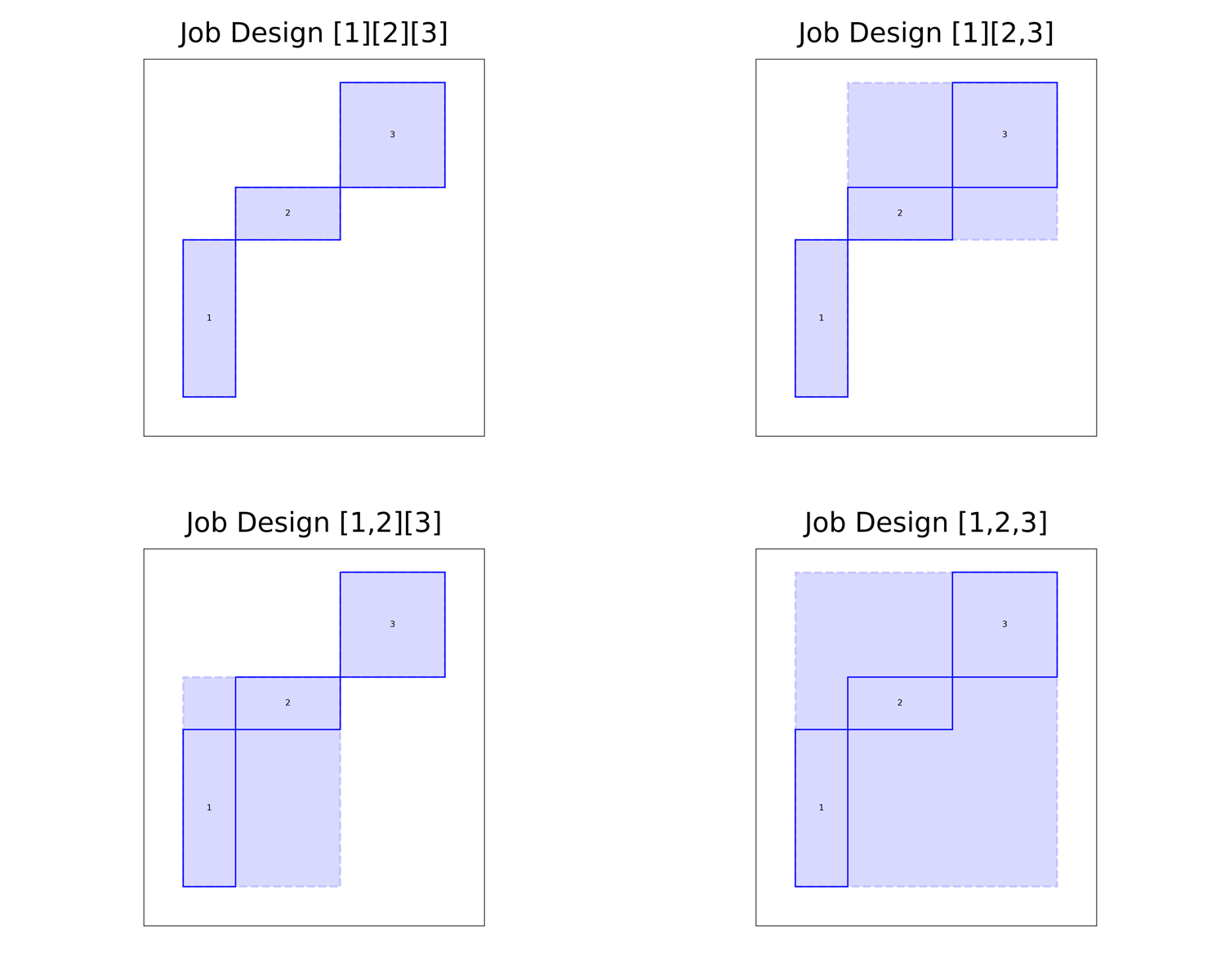
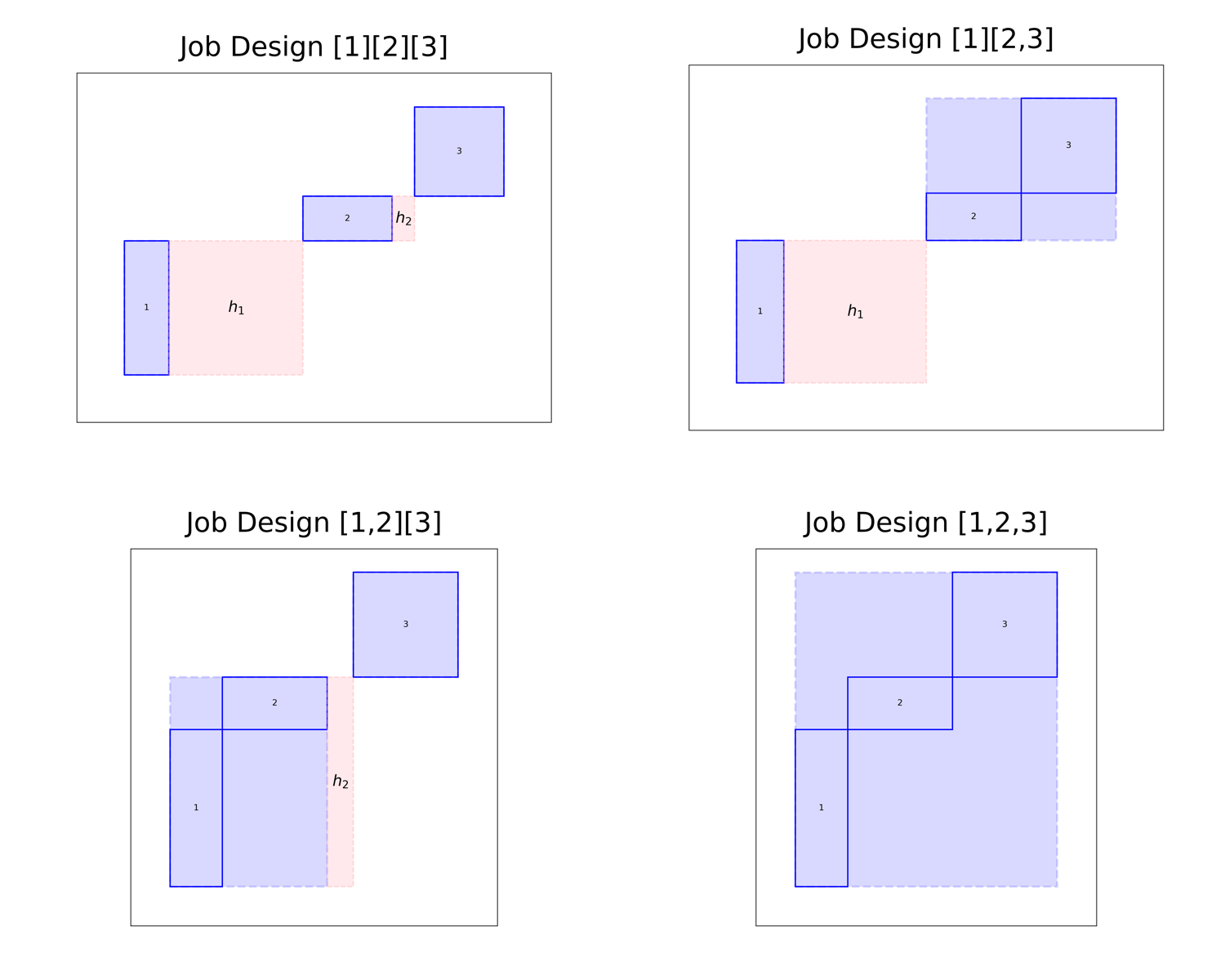
Figure 1: Visualization of trade-offs between worker specialization and hand-off (coordination) costs; aggregation of tasks into jobs affects both skill and time costs.
The framework generalizes this reasoning to a hierarchical organization: steps are aggregated into tasks according to AI feasibility and into jobs according to the cost-minimizing assignment over hand-offs and skill requirements.
AI Chaining and Task Redefinition
The model’s central innovation is the explicit micro-foundation for AI chaining. When AI executes multiple consecutive steps, only the final output requires human oversight. Adding a marginal step to an existing chain does not introduce an additional verification burden—a fixed output validation cost at the chain terminus replaces multiple incremental checkpoints. This creates complementarities between steps: automating one step increases the benefit of automating its neighbors, overturning classical task-level comparative advantage doctrine.
A direct implication is that automatable steps’ spatial distribution in the sequence matters critically. If automatable steps are clustered, longer chains emerge with greater returns; if they are dispersed, fragmentation forces the formation of shorter chains, reducing realized automation even when exposure is high.
Empirically, this is reflected in real-world occupations: jobs where AI-suitable steps appear together (e.g., in lecture preparation) benefit more from AI chains than jobs where automation potential is interrupted by non-automatable steps (e.g., tutoring, where diagnosis and feedback tasks are interleaved).
Tent-Pole Tasks and Specialization Dynamics
The model further identifies the importance of "tent-pole" tasks—skill- or time-intensive outliers that generate substantial coordination inefficiencies when placed adjacent to low-skill tasks. Optimal job bundling may change dramatically as AI chains absorb such tent-poles or, conversely, as chain boundaries are repositioned. AI can facilitate both reskilling (replacing a high-skill workflow with a low-skill chain overseen by a generalist) and upskilling (if AI-augmented steps require more complex direction).
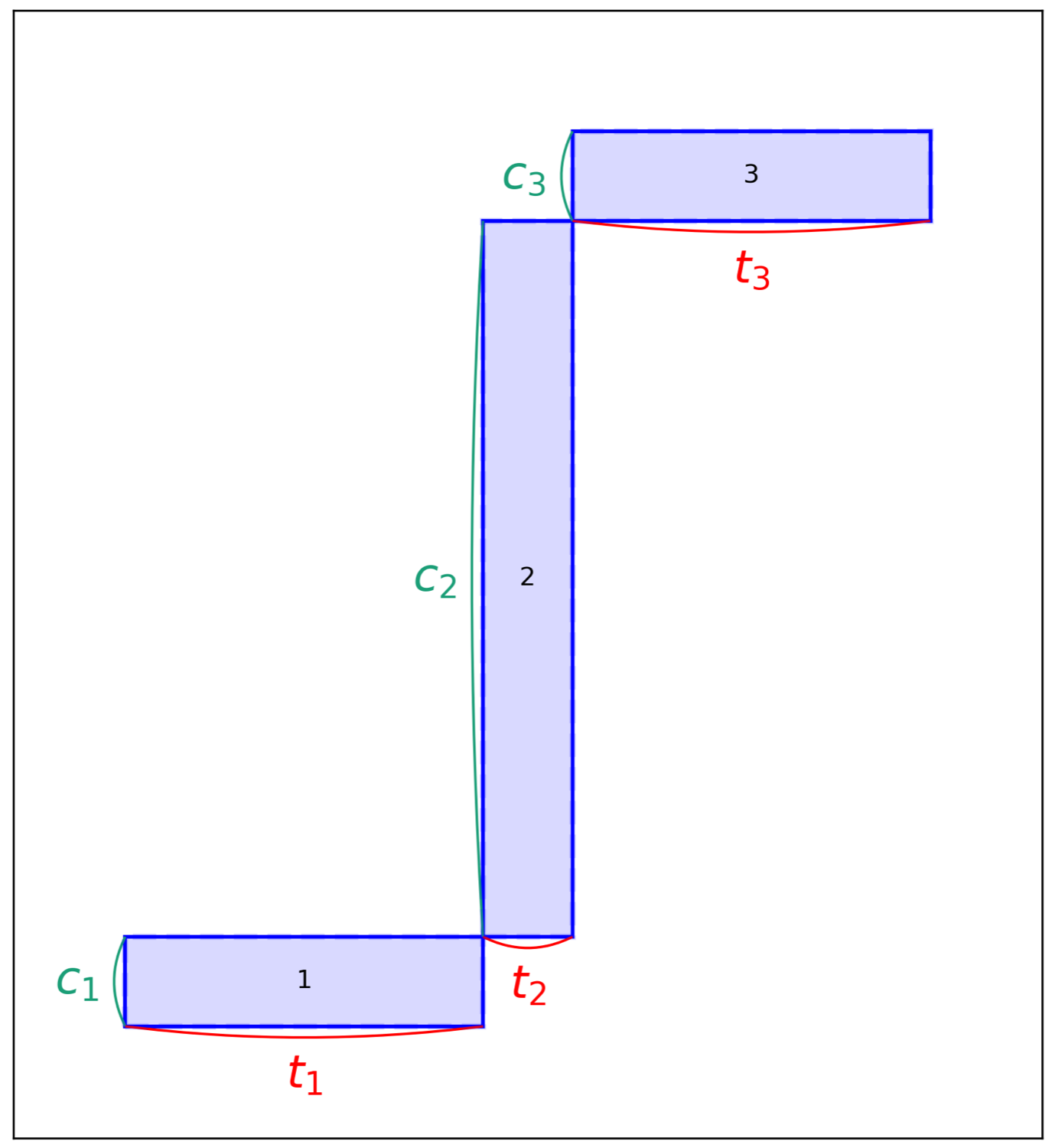
Figure 2: Schematic illustration of tent-pole tasks—short, high-skill blocks bracketed by long, low-skill segments—demonstrating their criticality in organizational design.
Algorithmic and Analytic Results
The paper establishes that both the short-run AI deployment problem (fixed job boundaries, optimize over AI assignment) and the long-run joint problem (free job and task redesign) can be solved in polynomial time via dynamic programming. The solution space scales in the sequence length but not exponentially, which facilitates tractable application to large real-world datasets such as O*NET.
Notably, the model predicts sharp, nonlinear gains in productivity as AI quality passes task-dependent thresholds that “unlock” the possibility of automating long chains. Below these thresholds, marginal improvement in AI success probability yields little change; above, mass substitution can occur with abrupt effects on workforce composition and wage structure.
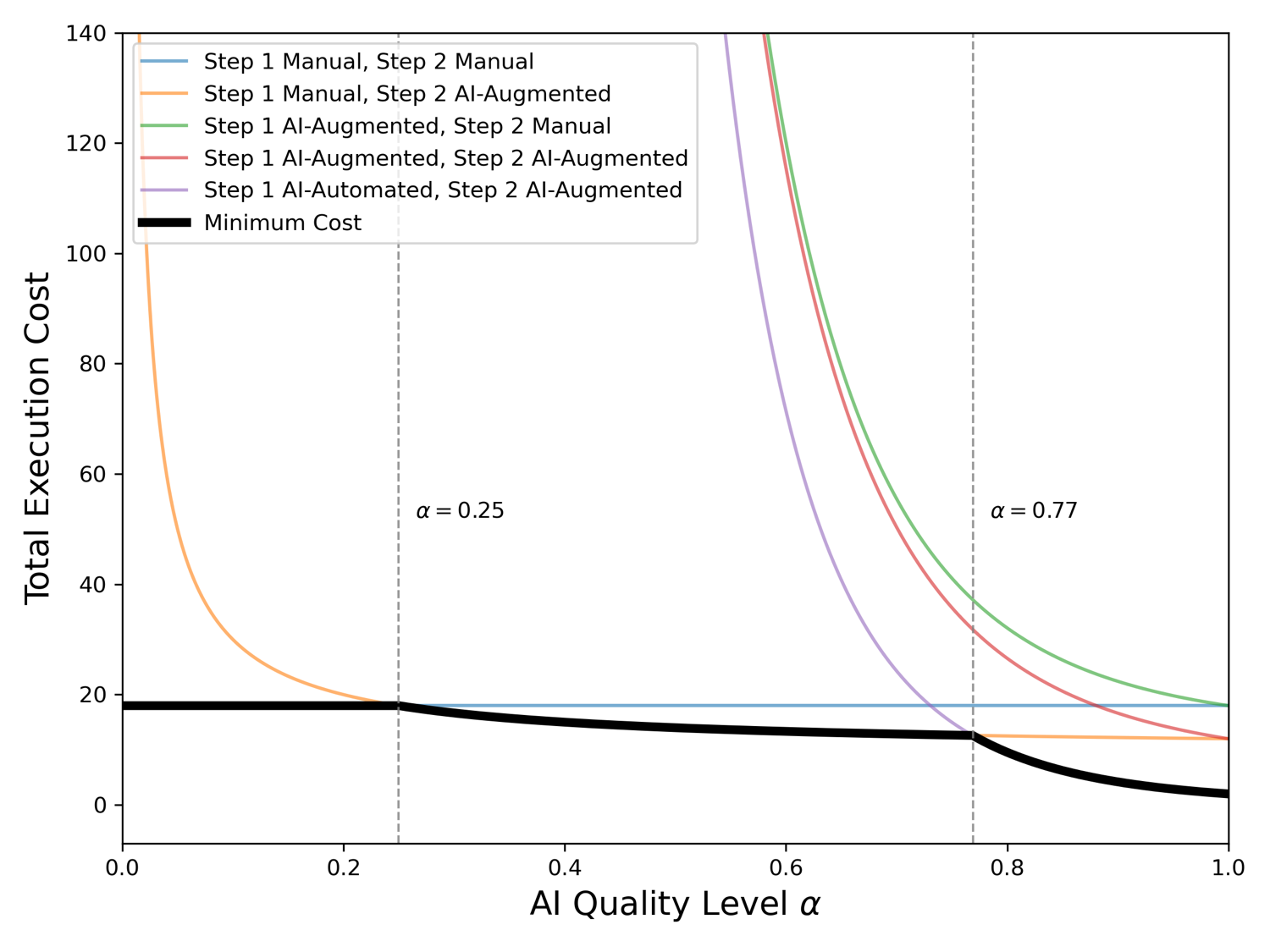
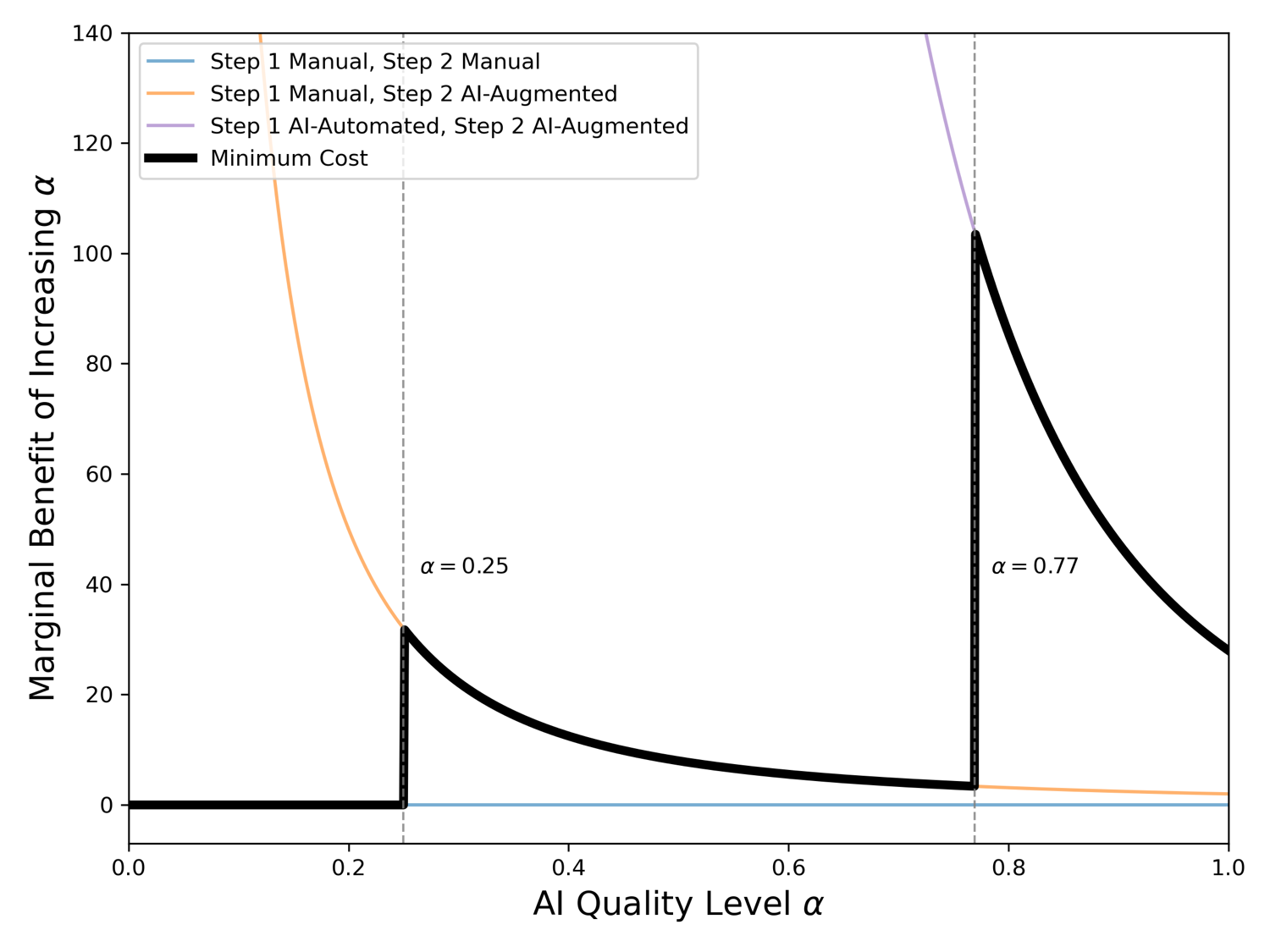
Figure 3: Cost comparison for alternative AI strategies as a function of AI quality parameter α; illustrating the discrete shift in production structure and the non-linear productivity jump when chain automation becomes cost-minimizing.
Empirical Evidence for Chaining and Fragmentation
The authors assemble a linked dataset covering O*NET tasks, empirical AI exposure data [eloundou2023gpts], realized AI execution outcomes (from Anthropic's Economic Index), and LLM-generated task orderings. The empirical analysis validates three core theoretical predictions:
- AI-executed steps appear as contiguous chains, not scattered islands. Average chain lengths are significantly greater than in permutation-shuffled counterfactuals, and chain counts are lower, evidencing clustering beyond chance.
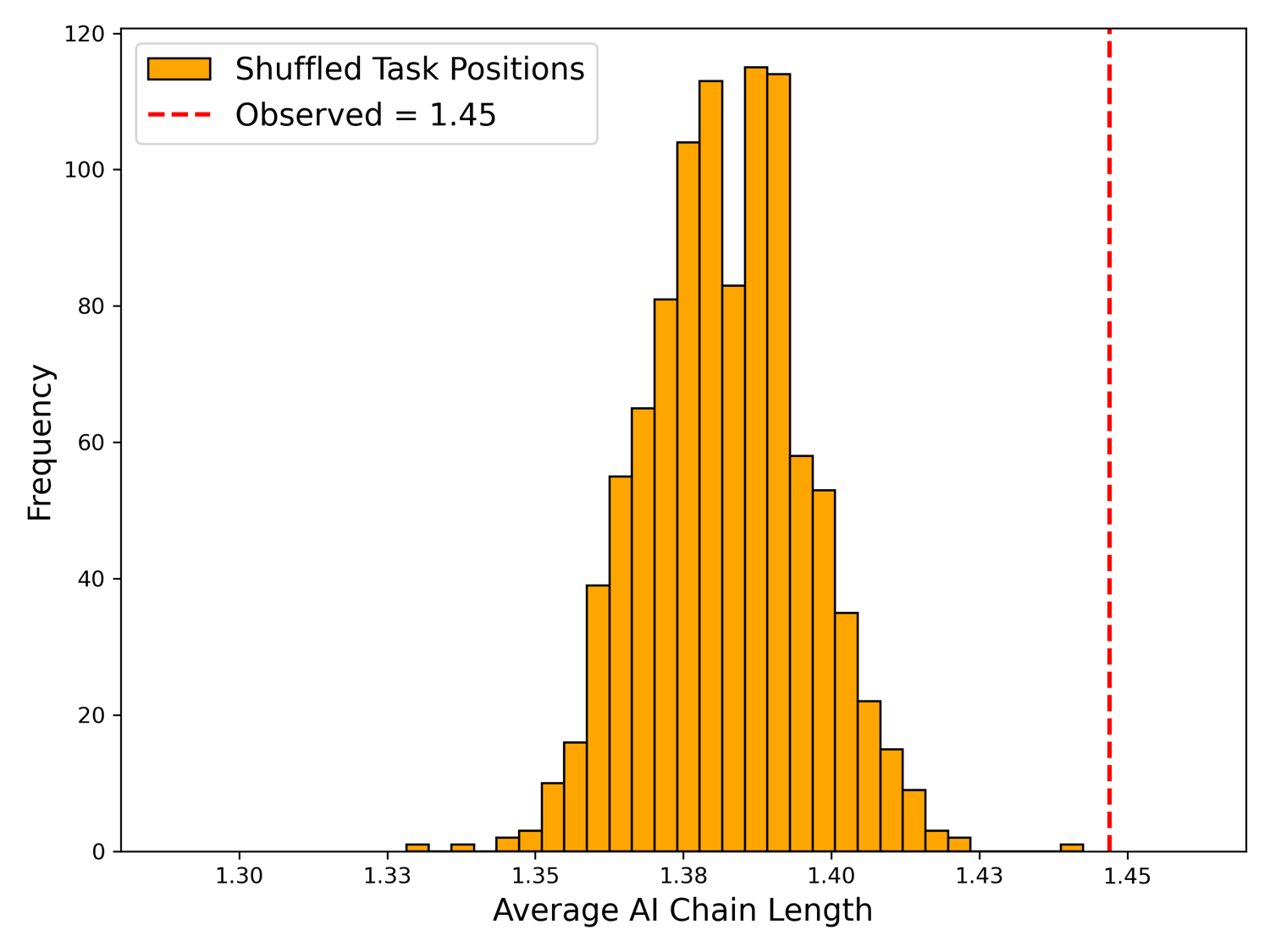
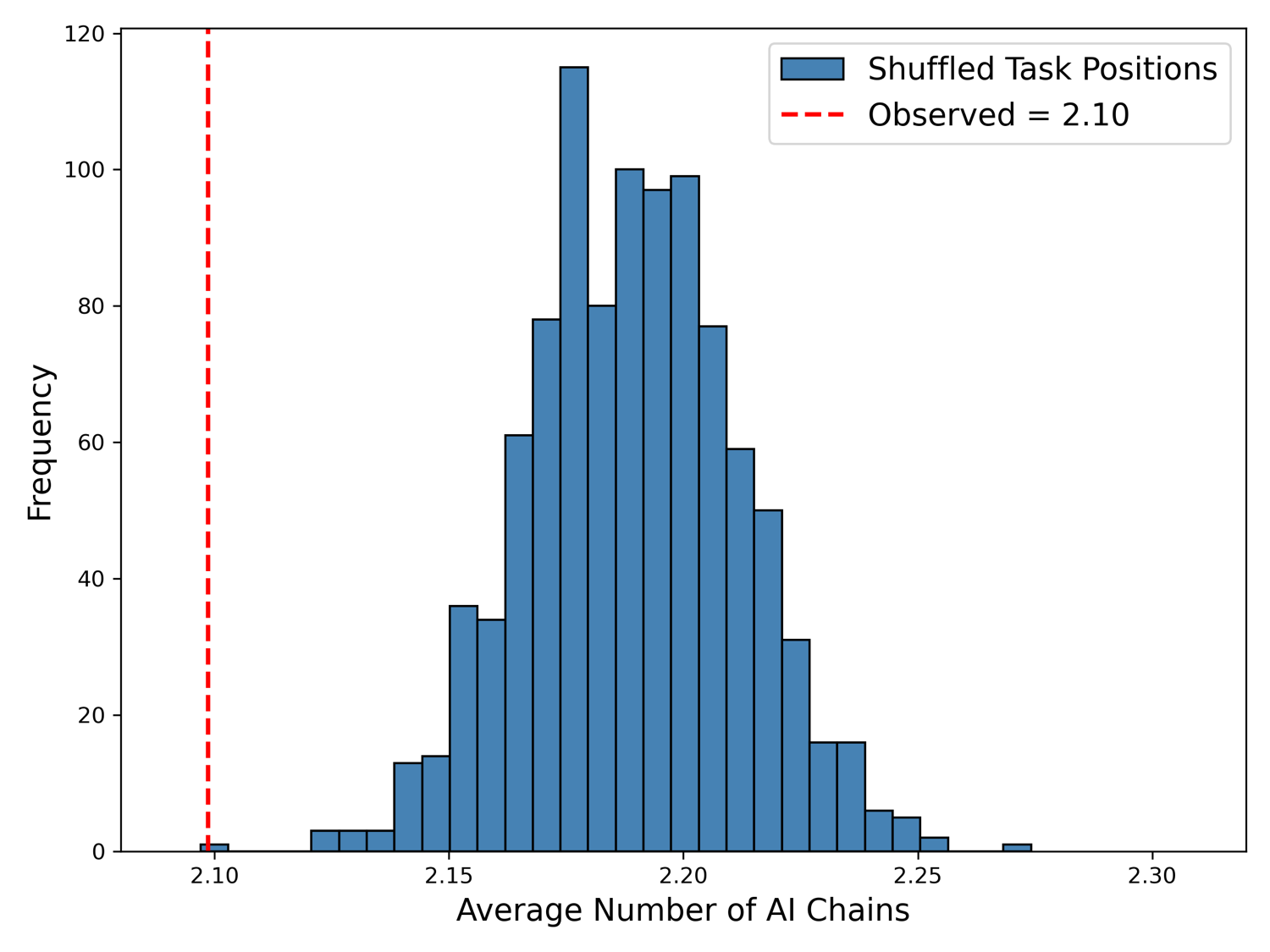
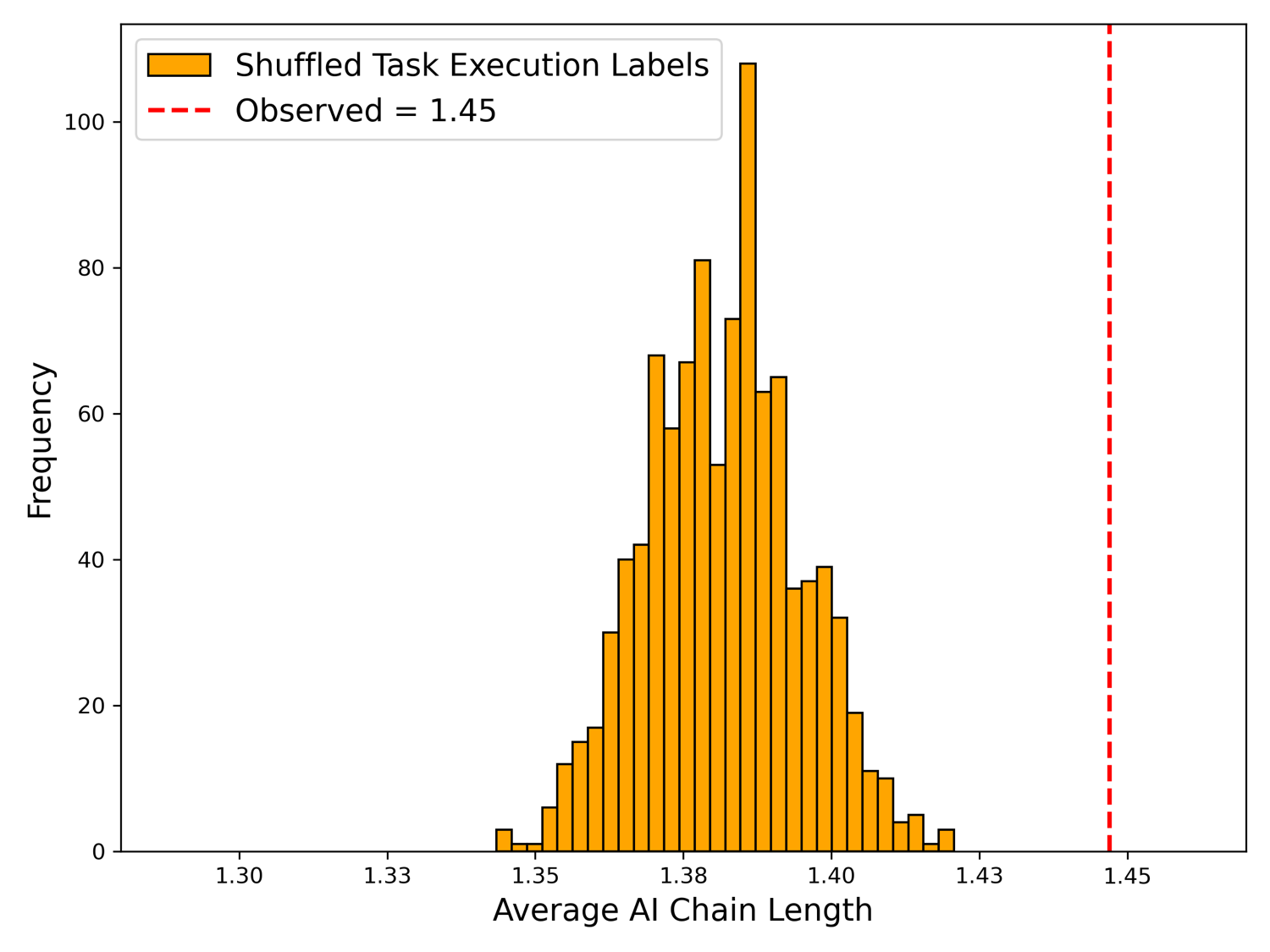
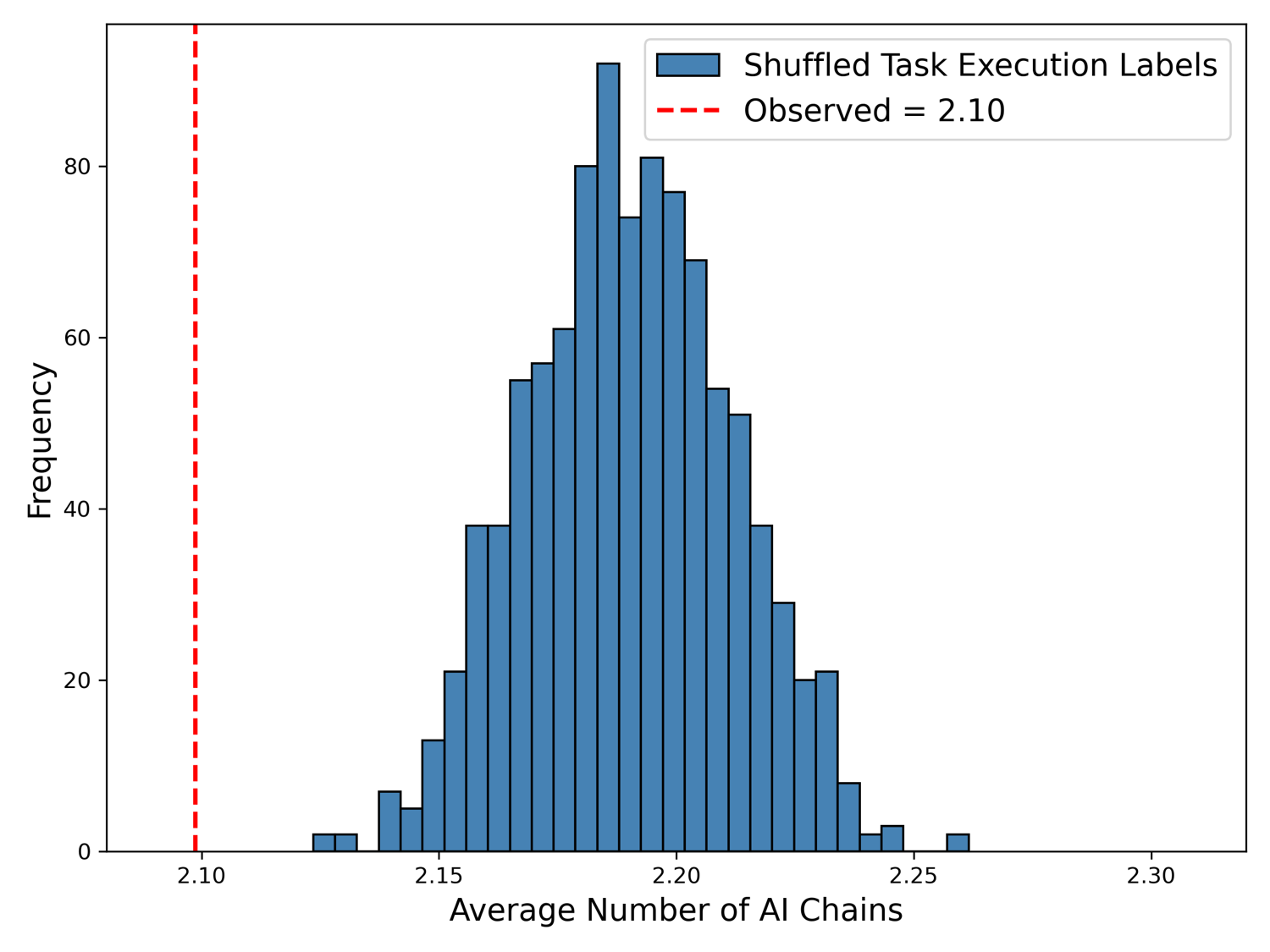
Figure 4: Distribution of chain lengths and chain counts, benchmarking observed AI chain statistics against randomized placebos demonstrates non-random contiguity of AI-chained tasks.
- Fragmentation of AI exposure predicts lower realized AI execution. Conditioning on exposure, jobs where automatable steps are dispersed have less automation than those where automatable steps are clustered, as anticipated by the analytic “fragmentation index.”
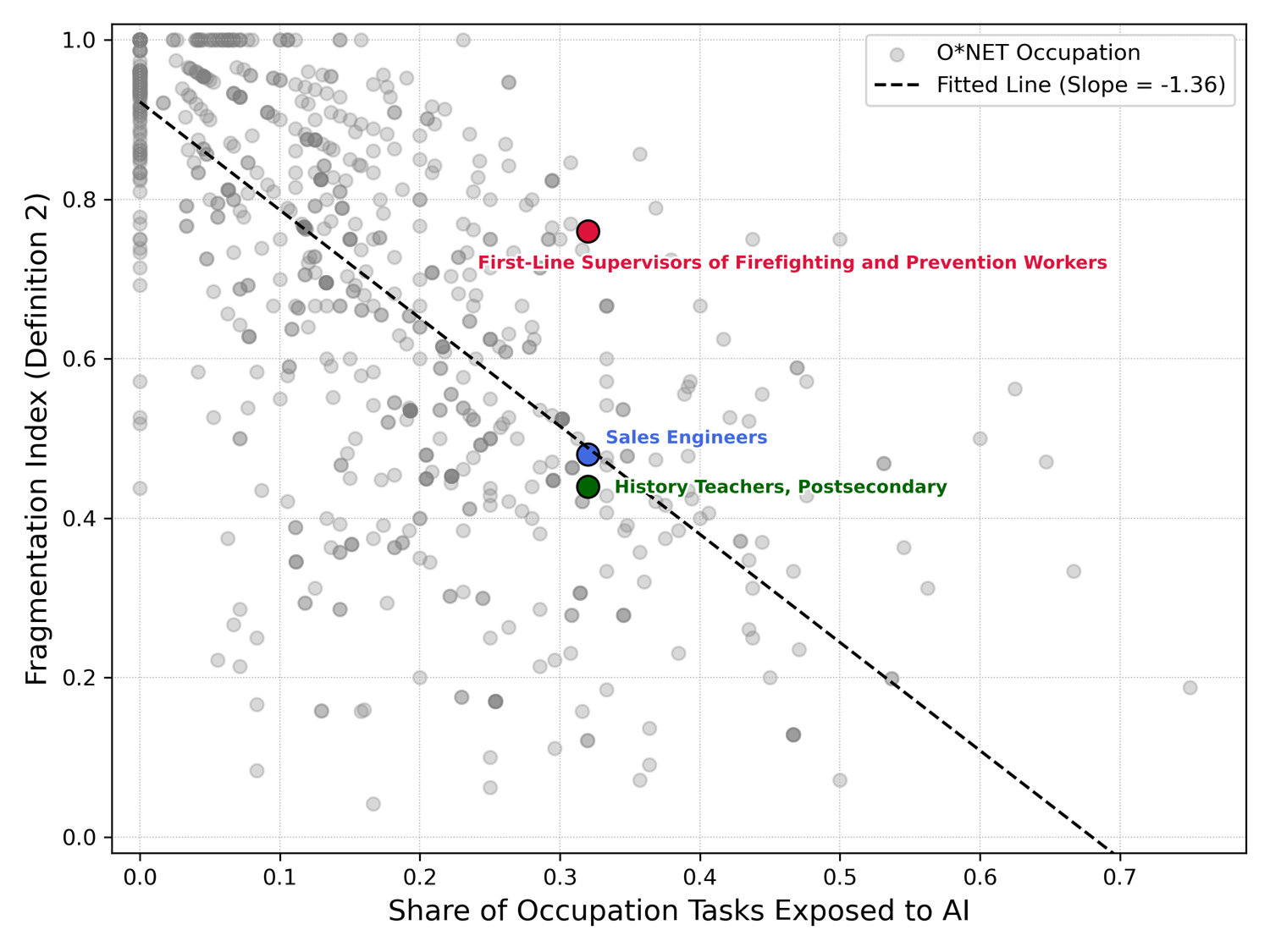
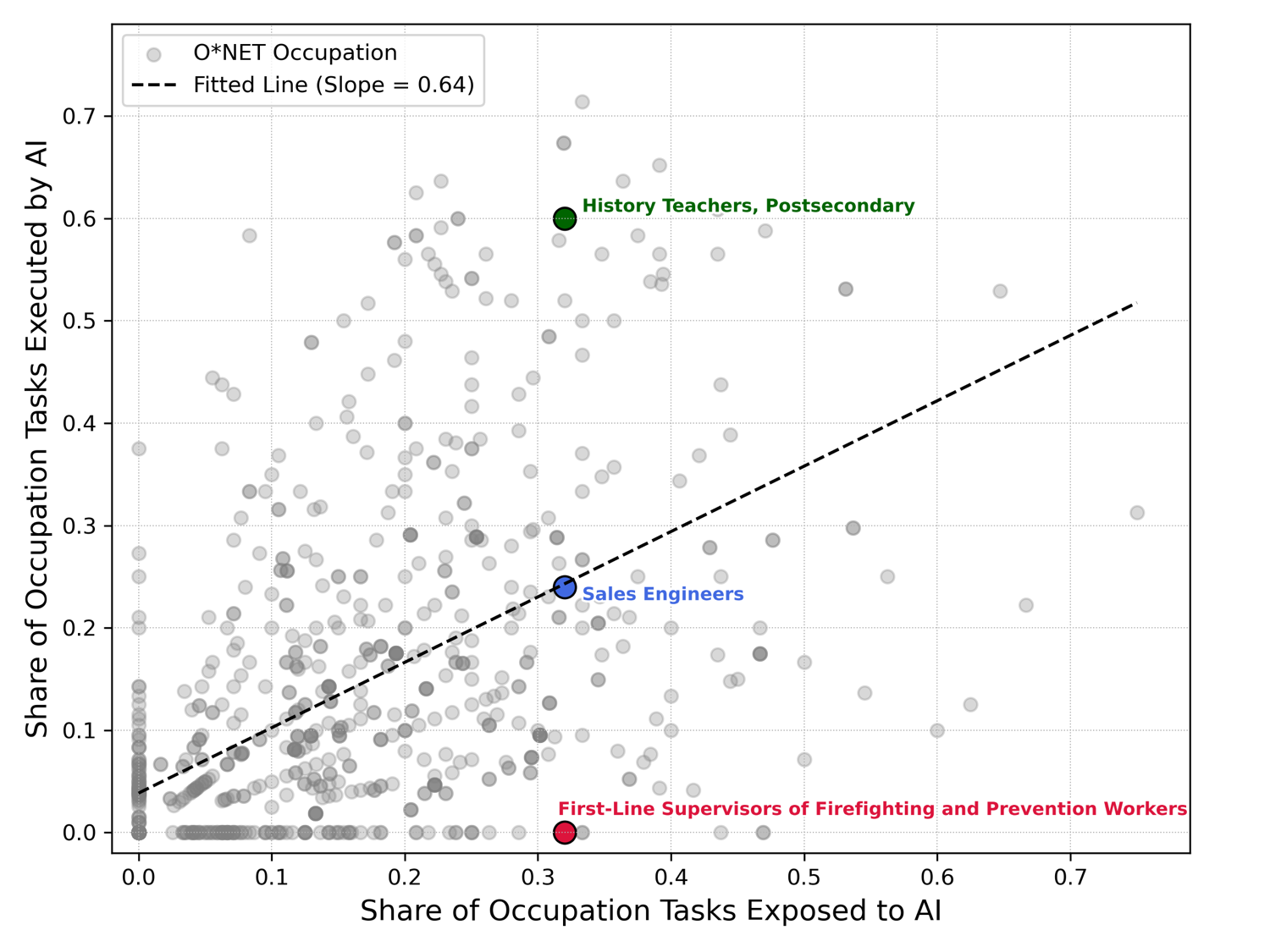
Figure 5: Empirical relationship between occupational AI exposure, the empirical fragmentation index (horizontal fragmentation of AI-exposed steps), and realized AI execution.
- Spillover in task assignment: The likelihood a step is executed by AI is strongly elevated if its immediate neighbors are also assigned to AI, controlling for exposure and occupation family; the effect decays with distance. This local complementarity is consistent with a chaining technology rather than independent taskwise automation.
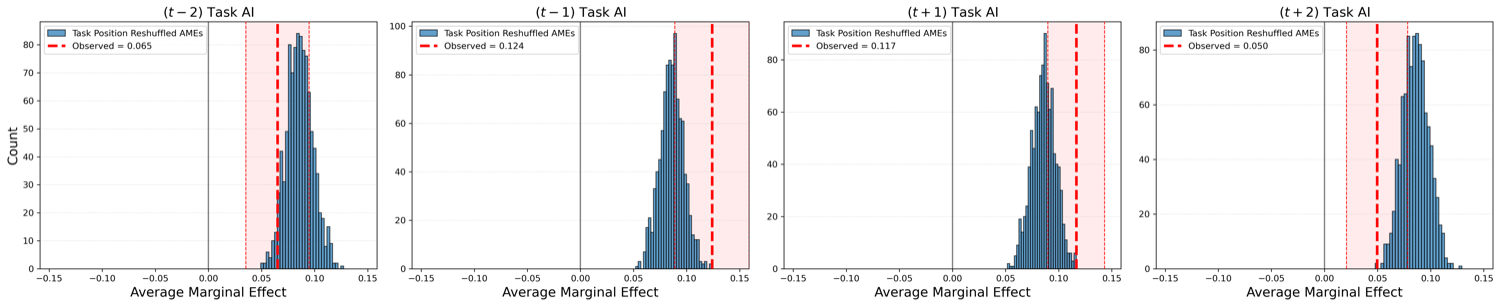
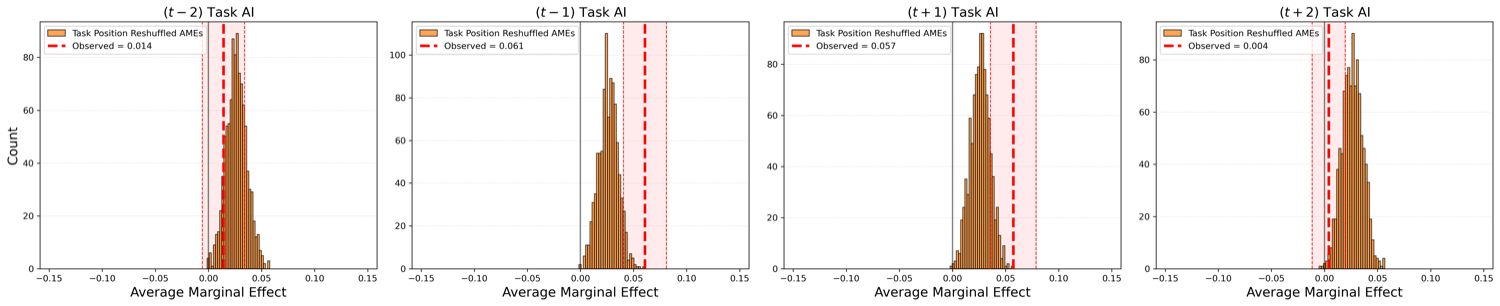
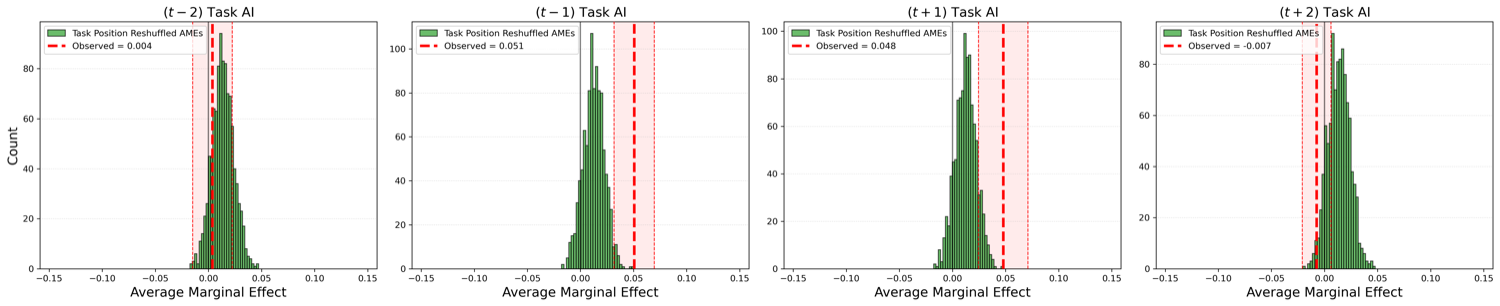
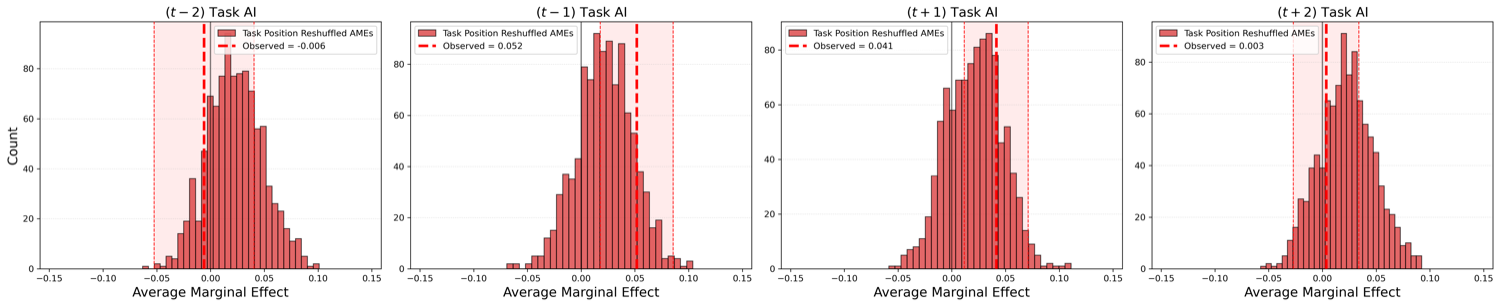
Figure 6: Effect sizes for the AI-execution status of neighboring tasks on the probability a task is AI-executed, demonstrating localized spillovers in factor assignment.
These results are robust to alternative task orderings, definitions of AI-execution, and similarity matching at the task concept level (using O*NET DWAs).
Theoretical Implications and Macro Aggregation
Beyond micro-assignment, the paper develops a bridge to macroeconomic analysis. The cost-minimizing firm-level solution yields a Leontief aggregator over tasks, which, under cross-firm heterogeneity in effective AI quality, aggregates into a CES production function at the macro level, with distinct arguments for manual labor, AI-augmented labor, and capital. This analytical connection formally justifies the use of aggregate CES representations when examining the substitution and complementarity between AI and labor, resolving micro-macro inconsistencies in the literature.
Implications and Scope for Further Research
The model’s main contradictory claim relative to prior work is that classical comparative advantage principles in task allocation are systematically violated in the presence of AI chaining: the optimal allocation may automate steps with a human cost advantage in isolation, provided that adjacent chain formation economizes on output evaluation or hand-off costs.
Practically, this suggests several implications:
- Threshold effects in AI capability deployment: Investment returns to increasing AI success probabilities are highly non-linear, with potentially long “gestational” periods before discrete productivity jumps.
- Shifts in skill demand: Gains from AI depend both on the initial organization of steps and on the feasibility of re-organizing tasks, with potential for both upskilling and deskilling.
- Frictions via fragmentation: Jobs with interleaved automatable and non-automatable steps are structurally less susceptible to AI-driven productivity gains, even as exposure metrics may suggest otherwise.
- Empirical diagnosis: Productivity and wage effects of AI should be measured not by linear aggregation of exposure scores but by occupational metrics that incorporate fragmentation and adjacency.
Further theoretical developments could consider endogenous changes in hand-off costs (e.g., AI-assisted coordination), stochastic step success, or intra-chain error propagation. Empirical extensions may leverage richer workflow data and exploit variation in task adjacency to instrument for AI adoption patterns.
Conclusion
This work presents a rigorous theory of how AI automation interacts with firm task architecture and job design, providing both computational tools and empirical regularities to reframe the analysis of technological change. It highlights the central importance of chaining, fragmentation, and threshold nonlinearities in mediating the impact of AI on labor markets and organizational structure, offering a micro-founded framework for interpreting empirical findings on AI adoption and labor demand. The insights strongly suggest that future advancements in AI—and policy analysis thereof—must account for interactions within production chains and the endogeneity of organizational boundaries, not only marginal task-level substitution.