EgoGuide: Egocentric Guidance for Efficient Robot-Free Demonstration Collection and Learning
Abstract: Robot learning from real-world demonstrations is currently constrained by data scaling. Universal Manipulation Interface (UMI) provides an efficient robot-free data collection interface, yet current UMI-style pipelines often collect redundant demonstrations and lack global scene context. To improve data efficiency, we present EgoGuide, a collection interface that records synchronized wrist and head/egocentric observations and couples them with online visual-geometric data quality guidance. We also introduce a Gated Egocentric Residual Policy for robust learning from a viewpoint-varying egocentric camera, allowing head/egocentric context to correct ambiguous local observations while preserving stable wrist-view control. Real-world experiments show that EgoGuide reduces the required number of data episodes and improves data efficiency. The residual policy further improves robustness under visual occlusion. Project Page: https://silicx.github.io/EgoGuide

Paper Prompts
Sign up for free to create and run prompts on this paper using GPT-5.
Top Community Prompts
Explain it Like I'm 14
What is this paper about?
This paper introduces EgoGuide, a simple, low-cost way to teach robots how to use their hands by watching people, without needing a robot during recording. It adds two ideas:
- Collect better, more varied “how-to” videos by showing the human live hints about what’s missing.
- Train a robot control method that uses both a close-up hand camera and a wider “head” camera so the robot can handle tricky views and occlusions.
Together, these make learning faster and more reliable, so the robot needs fewer examples to do the job well.
What questions did the researchers ask?
- How can we collect teaching demonstrations that are less repetitive and cover more situations, without using a robot during recording?
- Can a second, head-mounted view (like a GoPro on your head) help the robot understand the bigger scene, not just the close-up of the gripper?
- Can we guide humans, in real time, to record more useful examples so the robot needs fewer total recordings?
- How do we combine the close-up “wrist” view (stable, good for precise control) with the head view (global context) so the robot is both accurate and robust?
How did they do it?
The data collection tool: EgoGuide
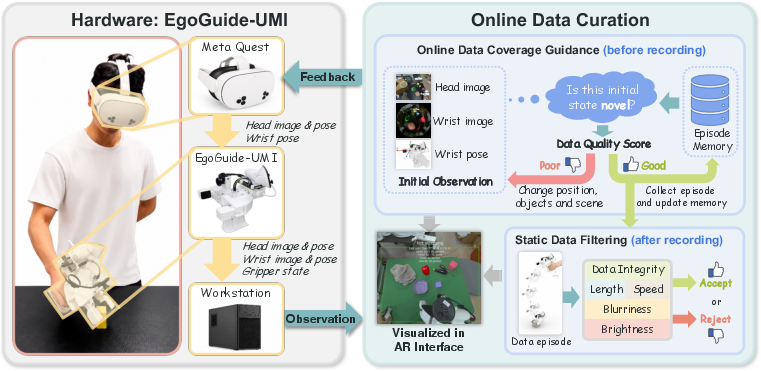
Think of EgoGuide as a teaching setup with two cameras:
- A “wrist” camera near a handheld gripper (like a fake robot hand you hold). This shows a close-up view of the object and your hand.
- A “head” camera in a headset (like a VR headset), which sees the whole table and surroundings, similar to what you see.
Both cameras, plus hand opening and positions, are recorded at the same time and sent to a computer. Everything is synced so the views line up in time.
Smart guidance during recording
Before you hit “record,” EgoGuide gives you AR (augmented reality) feedback inside the headset. It computes how “new” or “different” your current setup looks compared to what’s already in the dataset. It checks:
- Wrist image novelty: Does this close-up look like something new (different lighting, angle, contact)?
- Head image novelty: Are the objects and layout different from before (new positions, backgrounds)?
- Wrist pose novelty: Is your hand in a new position/orientation?
This is like a “coverage meter” telling you if you’re filling in missing puzzle pieces, not just repeating the same move. If the meter is low, you can slightly change the start position, camera angle, or object arrangement to make the new demo more useful.
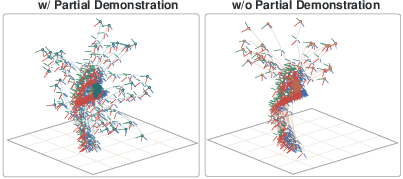
They also allow “partial demonstrations,” meaning you can start recording in the middle of a task. This helps cover later steps (like putting something in a drawer) that are often underrepresented if you always record from the very beginning.
Finally, after a recording, simple automatic checks remove bad takes (too short, blurry, jumpy motion) so the dataset stays clean.
Learning to use the extra view: a “gated residual” policy (GERP)
Robots are trained on these demos to predict actions (how to move the gripper) from camera views. The authors use a two-part strategy:
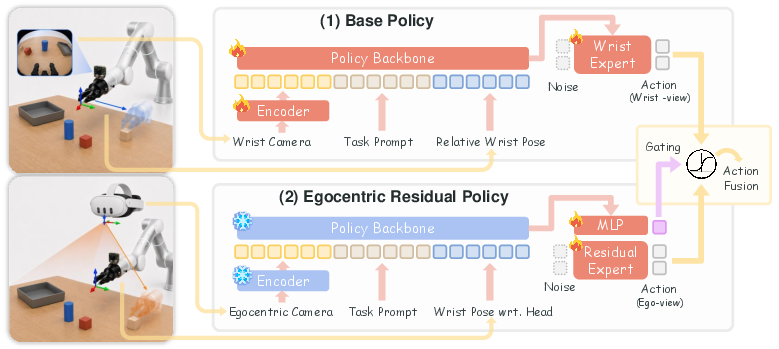
- Base policy (wrist view): This is the robot’s “default driver.” It looks at the close-up wrist camera and learns precise hand motions. This is stable and accurate for normal cases.
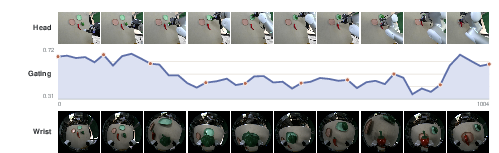
- Egocentric residual branch (head view): This is like a “co‑pilot” that sees the bigger picture from the head camera. It suggests an alternative full action when the wrist view is confusing (for example, when the object is blocked from view).
A small “gate” decides how much to trust the co‑pilot at each moment. If the local wrist view is clear, the gate mostly trusts the base policy. If the wrist view is ambiguous, the gate allows more help from the head view. This blending makes control robust without being distracted by the moving head camera.
In everyday terms: the robot normally follows the close-up camera, but when it’s unsure, it asks the wide camera for help, and a dial blends the two suggestions.
What did they find?
Here are the main results across real robot tasks like picking up a cube, sorting peppers into color-coded trays, putting garlic into a drawer, and rotating a Rubik’s cube:
- Fewer demos needed for the same success:
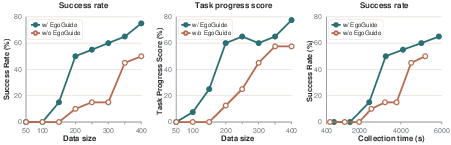
- With EgoGuide’s live guidance, the team reached similar success rates using around half as many demonstrations on a sorting task. In one example, success went from about 10% to 50% with the same number of demos, or reached 50% success with only half the demos.
- Better data variety:
- The recorded examples covered more different views, poses, and layouts. This variety is key for learning policies that work in new situations.
- Allowing “partial demonstrations” increased coverage of middle and late steps, not just the start of tasks.
- Stronger performance under occlusion:
- The gated wrist+head policy (GERP) handled blocked views better, improving success by roughly 5–10 percentage points over using the wrist view alone on several tasks.
- Minimal extra time:
- The live guidance added only a few seconds per demo on average, yet improved overall data efficiency.
Why this matters: If robots can learn well from fewer, better-chosen examples, training becomes cheaper and faster. And if they can use a head-view for context, they’re less likely to get confused by occlusions or long, multi-step tasks.
Why does this matter and what could it change?
- Faster, cheaper robot training: People can collect useful data without a robot in the loop, and they get simple AR guidance to avoid wasting effort on repeats.
- More reliable robots in the real world: Using both close-up and global views makes robot actions more robust when things are blocked or the scene changes.
- Practical deployment: The method doesn’t require a robot to move its own head camera. It can be trained with a human head view and then run with a fixed overhead camera, keeping setups simple.
- Better datasets for the community: The approach encourages coverage of underrepresented states and later steps, which could improve many kinds of robot skills, not just the tasks tested here.
In short, EgoGuide helps people collect smarter examples, and the gated policy helps robots make smarter use of those examples. Together, they make it easier to teach robots useful hand skills in the real world.
Knowledge Gaps
Knowledge gaps, limitations, and open questions
Below is a single list of concrete gaps and unresolved questions that future researchers could address.
- Data coverage metric validity: No per-episode validation that the displayed novelty percentiles (from CLIP/DINOv2 features and k-NN pose similarity) correlate with downstream policy utility; quantify episode-level contribution vs. guidance score.
- Sensitivity analysis of guidance hyperparameters: Unreported effects of k in k-NN, feature encoders used, memory size, percentile calibration strategy, and the relative weighting/aggregation of the three guidance channels (wrist image, head image, wrist pose).
- Joint state-action coverage: Current guidance estimates novelty per-modality independently; lacks a principled joint coverage objective over state-action occupancy that reflects imitation-learning sample complexity.
- Guidance update rate and timing: The 2 Hz guidance loop only shapes initial states; unexplored benefits and risks of within-episode guidance vs. pre-episode-only guidance (e.g., inducing exploration vs. distracting demonstrators).
- Partial-demonstration policy impacts: No analysis of how mid-trajectory starts affect temporal credit assignment, distribution shift within action chunks, or policy stability on very long horizons.
- Failure-aware curation: Static filters remove only gross sensor issues; missing strategies to detect and exclude semantically wrong demonstrations (wrong-object picks, inconsistent task goals) or label noise in wrist-relative actions.
- Human factors and usability: No user study on AR UI comprehension, cognitive load, or how operators “game” the novelty metric (maximizing novelty at the expense of task relevance or success).
- Data efficiency theory: Absent theoretical or empirical sample-complexity analysis linking the proposed coverage proxy to imitation-learning error bounds or to DAgger-style on-policy improvements.
- Cross-domain generalization: Evaluations limited to one robot (Flexiv Rizon 4), one gripper, and four tabletop tasks; unclear transferability to other embodiments, grippers, mobile bases, or bimanual/dexterous settings.
- Task diversity and difficulty: Limited evaluation on contact-rich, deformable, cluttered, or highly occlusive scenes; no demonstrations on long-horizon multi-stage assembly or tool-use tasks.
- Object diversity and category generalization: Experiments use a small set of objects; missing tests on category-level generalization and unseen object instances under varied textures and lighting.
- Multi-environment robustness: Robot deployment uses a disjoint room but similar camera intrinsics/extrinsics; robustness to significant extrinsic drift, lighting/weather changes, or background clutter is untested.
- Calibration robustness: GERP relies on accurate TH and TW and their transform; no analysis of performance under extrinsic/intrinsic calibration errors, drift, or latency-induced misalignment.
- Latency and synchronization effects: End-to-end ~100 ms latency and cross-modality alignment within 20 ms are reported, but their effects on demonstration fidelity, AR guidance accuracy, and learned policies are not quantified.
- Scalability of online guidance compute: Guidance requires CLIP/DINOv2 inference at 2 Hz on a GPU-equipped workstation; feasibility on low-cost or edge devices and multi-operator settings is unclear.
- Memory management over long runs: Unspecified policies for memory growth, deduplication, or forgetting; no results on how saturated memories affect novelty percentiles or induce guidance plateaus.
- Safety and constraints: No systematic assessment of safety when encouraging novelty (e.g., odd viewpoints or object placements) or of the trade-off between diversity and feasible robot execution limits.
- GERP gate expressivity: A single scalar α gates all action dimensions; unexplored alternatives like per-DoF or time-step gates, uncertainty-aware gating, or learned confidence weighting.
- Residual learning formulation: The residual branch learns the full action rather than the residual; missing ablation comparing true residual learning, mixture-of-experts, attention-based fusion, or Q-filtering.
- Occlusion- and ambiguity-aware gating: Gate training is supervised only via action composition L2; no explicit use of occlusion estimators, view-quality scores, or disagreement-based confidence to trigger egocentric corrections.
- Fusion baselines: Comparisons lack stronger multi-view fusion baselines (e.g., cross-attention transformers, late fusion with uncertainty, world-model fusion) or active viewpoint selection with fixed-camera constraints.
- Deployment camera configuration: “Egocentric” camera is fixed third-person at deployment; no study of sensitivity to camera placement changes, height, FOV, or multiple fixed global cameras.
- Pose-only geometry proxy: Wrist-pose novelty uses a simple translation-quaternion distance; untested richer geometric measures (e.g., SE(3) geodesics with task-relevant weighting, contact pose distributions).
- Action-space and horizon choices: Fixed action horizon K=16 at 10 Hz; no exploration of different chunk sizes, variable horizons, or hierarchical actioning for long-horizon subtasks.
- Instruction conditioning: Policies condition on an instruction ℓ, but instruction semantics, variability, and language generalization are not evaluated or ablated.
- Statistical robustness: Results report SR/TPS without confidence intervals or multiple seeds; sensitivity to random initialization, data splits, and operator variability is unreported.
- Operator generalization: Single or few demonstrators; no analysis of inter-operator variability, head-movement styles, or how guidance performs with novices vs. experts.
- Failure modes under heavy occlusion: While GERP helps with some occlusions, its behavior under extreme occlusion, rapid scene changes, or camera dropouts is not characterized.
- Tactile or force sensing: System is vision- and pose-centric; integration with tactile/force signals (especially for contact-rich tasks) is left unexplored despite relevant related work.
- On-policy data augmentation: EgoGuide avoids on-policy rollouts (e.g., DAgger); open question is whether occasional on-robot queries could further refine coverage guidance without large overhead.
- Automatic subgoal discovery: Partial-demonstration starts are manually chosen; a method to suggest underrepresented intermediate states or subgoals automatically is missing.
- Coverage vs. task feasibility: The novelty signal does not encode feasibility or safety constraints; mechanisms to penalize novel-but-infeasible states are absent.
- Robustness to embodiment mismatch in visuals: Head-view includes the human-held device during collection but deployment uses a robot; no explicit mitigation for embodiment mismatch in egocentric imagery.
- Generality beyond CLIP/DINOv2: Reliance on specific pre-trained encoders may bias novelty; it’s unclear how encoders trained on different distributions affect guidance reliability.
- Data acceptance criteria: Only 2–5% episodes are filtered; potential silent errors (mis-synchronization, subtle blur, incorrect wrist/head poses) may persist; a learned yet debiased post-filter is not investigated.
Practical Applications
Immediate Applications
Below are concrete, deployable use cases that can leverage EgoGuide’s findings and components today, along with sector links, potential tools/workflows, and key dependencies that affect feasibility.
- AR‑guided task programming for cobots in small‑batch production
- Sectors: manufacturing, electronics assembly, kitting
- What it enables: Non-expert operators can use a UMI-style handheld gripper plus AR “novelty/coverage” feedback to set initial poses, object layouts, and viewpoints before recording, reducing redundant demos and improving transfer success. The paper shows up to ~50% fewer demos for comparable success on Pepper Sorting.
- Tools/workflows: EgoGuide-UMI handheld kit; Unity/Quest AR app showing wrist/ego image novelty and wrist-pose novelty; workstation service computing CLIP/DINOv2 coverage scores; per-episode static quality checks
- Dependencies/assumptions: Meta Quest-class headset for egocentric sensing; reliable WLAN; a workstation GPU (e.g., RTX 4070) for real-time feature extraction; basic camera–robot calibration; safety procedures for AR in production
- Faster, higher-quality data collection in robotics R&D labs
- Sectors: robotics research, corporate labs
- What it enables: Collect fewer, more diverse in-the-wild demonstrations for imitation learning; explicit support for partial demos improves coverage of late-stage states and recoveries without on-policy rollouts
- Tools/workflows: Coverage-score memory per modality; partial-demo UI to “start mid-task”; deterministic post-episode filters (blur/pose jumps/brightness); dataset dashboards for coverage drift over sessions
- Dependencies/assumptions: Repeatable workspace setup across rooms; CLIP/DINOv2 models available; timestamp sync (<20 ms) and end-to-end latency (<100 ms) comparable to paper
- Occlusion-robust manipulation policies via GERP with a fixed egocentric camera
- Sectors: manufacturing cells, warehousing logistics, lab automation
- What it enables: Use Gated Egocentric Residual Policy (GERP) to fuse a stable wrist-view base policy with an egocentric residual candidate, improving robustness when the wrist view is occluded or ambiguous
- Tools/workflows: Train wrist-only base diffusion policy, then freeze and train egocentric residual branch plus learned gate; deploy with a fixed, calibrated overhead/third-person egocentric camera
- Dependencies/assumptions: Consistent intrinsics/extrinsics for wrist and ego cameras between collection and deployment; the wrist-relative action space matches the target robot controller
- Rapid iteration on long-horizon workflows through mid-task starts
- Sectors: assembly, cabinet/drawer manipulation, lab workflows
- What it enables: Start recording from underrepresented subgoals (e.g., drawer half-open), accelerating coverage of difficult late stages and recovery behaviors
- Tools/workflows: Partial demonstration “record-from-here” control mapped to AR/controller buttons; subgoal catalogs for consistent mid-task initialization; TPS (task progress score) monitoring
- Dependencies/assumptions: Lightweight protocols for restoring mid-task states; clear subgoal definitions; careful data labeling if instructions/subtasks vary
- “Coverage-certified” manipulation datasets for internal or external consumption
- Sectors: AI data services, model providers, integrators
- What it enables: Sell or share datasets with documented wrist/ego image novelty and wrist-pose coverage distributions and rejection statistics; enable mix-in of EgoGuide-collected data to lift performance of existing corpora
- Tools/workflows: Coverage-score logs, t-SNE/UMAP visualizations of feature space, variance/covariance metrics; CI-style quality gates at ingest time
- Dependencies/assumptions: Agreed, transparent coverage metrics; reproducible memories per modality; privacy handling for egocentric video
- Teaching labs and coursework on robot learning with real-time data quality feedback
- Sectors: education
- What it enables: Hands-on courses where students collect UMI data with AR feedback, compare guided vs. unguided learning curves, and study the effect of partial demos and filtering on performance
- Tools/workflows: Open-source Unity/Quest app; ROS/robot drivers; prebuilt training scripts for wrist-only and GERP policies; evaluation protocols with SR/TPS metrics
- Dependencies/assumptions: Affordable hardware kits (handheld gripper + fisheye wrist cam + Quest headset); instructor-provided baselines
- QA/rework cells where the global scene context matters
- Sectors: electronics QA, remanufacturing, returns processing
- What it enables: GERP improves reliability when the wrist view is blocked by fixtures or parts; the fixed egocentric view preserves a global view of trays, bins, or drawers
- Tools/workflows: Fixed overhead egocentric camera mount; gating telemetry to monitor when global context is actively used; alarms when ego feed fails
- Dependencies/assumptions: Camera mounts that avoid arm occlusion; lighting consistency; periodic calibration checks
- MLOps-style data quality gates for robot-learning pipelines
- Sectors: software/tooling for robotics
- What it enables: “Pre-commit” filters (blur, motion jumps), novelty thresholds, and coverage regression tests; automatic rejection or flagging of redundant starts; traceable data provenance
- Tools/workflows: Data lake with per-sample coverage metadata; batch recomputation scripts when encoders update; alerting when diversity drifts
- Dependencies/assumptions: Stable encoder versions; compute budget for periodic rescoring; policy-team buy-in on thresholds
- On-site teaching for field prototypes under limited visibility
- Sectors: agriculture (sorting/packing), hospitality (bus/tote handling)
- What it enables: Use AR coverage feedback to ensure diverse initial states in non-lab environments; GERP compensates for frequent occlusions caused by clutter or humans
- Tools/workflows: Portable EgoGuide-UMI kit; local workstation in a ruggedized case; quick camera calibration routine
- Dependencies/assumptions: Adequate power and WLAN; safety protocols in public-facing spaces; tolerance to lighting/weather variability
- Home and enthusiast robots: quick teaching of household tasks
- Sectors: consumer/home robotics
- What it enables: Teach pick-and-place, sorting, simple cabinet/drawer tasks with fewer demos; partial demos to record corrective steps for common failures
- Tools/workflows: Consumer-grade AR headset; low-cost gripper surrogate; preconfigured policy training recipes; simple calibration wizard
- Dependencies/assumptions: Compatibility with the user’s robot stack; privacy controls for home egocentric video; cloud or local GPU access
- Benchmarking and reproducible evaluation protocols
- Sectors: academia, standardization groups
- What it enables: SR/TPS reporting with matched data budgets across guided vs. unguided collection; public logs of coverage distributions to contextualize results
- Tools/workflows: Benchmark suites using Pick Cube, Pepper Sorting, Garlic Storage; scripts to replicate feature-metric calculations
- Dependencies/assumptions: Community agreement on metrics and randomization protocols; accessible datasets
- Cross-embodiment transfer harness for UMI-to-robot deployment
- Sectors: robotics platforms
- What it enables: Systematic evaluation of transfers from handheld UMI to target arms/grippers with different kinematics; faster diagnosis of failure modes tied to coverage gaps
- Tools/workflows: Pose-space coverage monitors; transfer checklists for action-space normalization; replay tools
- Dependencies/assumptions: Access to robot SDKs (IK, safety stops); consistent camera brackets; environment resets across rooms
Long-Term Applications
These opportunities likely need additional research, validation at scale, or productization beyond the paper’s scope.
- Crowdsourced robot-teaching networks without robots on-site
- Sectors: data platforms, marketplaces
- What it could enable: Thousands of contributors collect UMI demos with AR guidance; central services prioritize “coverage bounties” for underrepresented states
- Dependencies: Standardized action spaces/instructions; contributor safety/privacy guidelines; robust calibration-free or auto-calibration methods; scalable QC pipelines
- Data marketplaces with coverage-linked incentives
- Sectors: finance/AI data economy
- What it could enable: Dynamic pricing for novel states (high percentile novelty); smart contracts rewarding contributors for quality and diversity
- Dependencies: Trusted coverage metrics; fraud prevention; licensing/IP frameworks for manipulation data
- Factory “teaching copilots” that proactively suggest initial states
- Sectors: manufacturing
- What it could enable: AR assistants propose object layouts, approach angles, or camera placements to maximize expected policy improvement before any recording
- Dependencies: Integration with digital twins; predictive models linking novelty to downstream performance; ergonomic and safety certification
- Generalist manipulation models trained with egocentric residual gating across sites
- Sectors: robotics platforms
- What it could enable: Foundation policies that rely on wrist-local priors while attending to site-specific global context via gated residuals; improved robustness to occlusions/domain shift
- Dependencies: Cross-site camera standardization or learned camera-agnostic representations; large-scale multi-site datasets; scalable multi-view fusion
- End-user programmable consumer robots via AR-first teaching
- Sectors: consumer robotics
- What it could enable: Home users teach new tasks quickly through an AR workflow, with the robot later executing using fixed home cameras; no teleop rigs required
- Dependencies: Seamless UX, privacy-preserving egocentric capture, on-device or low-latency cloud inference; robust long-horizon policy reliability
- Multi-modal residuals: fusing tactile/force and egocentric vision
- Sectors: contact-rich assembly, healthcare devices
- What it could enable: Extend GERP to gate multiple residual experts (tactile, force, audio) to resolve ambiguities in contact-rich settings (e.g., cable routing, press-fit)
- Dependencies: Sensorized UMI variants (TacUMI/ViTaMIn/FreeTacMan); alignment of multi-modal timebases; balanced training objectives
- Camera-array residual gating (multi-ego, multi-angle)
- Sectors: high-mix manufacturing, e-commerce fulfillment
- What it could enable: Gate multiple “global” action candidates from several fixed cameras; improve reliability in cluttered dynamic scenes
- Dependencies: Camera synchronization; scalable gating architectures; calibration management at scale
- Digital twin–guided data planning
- Sectors: software, simulation
- What it could enable: Simulate novelty gains and task progress payoff; auto-generate “next best demo” suggestions for human collectors; hybrid sim-to-real coverage planning
- Dependencies: High-fidelity scene models; sim-to-real alignment for novelty metrics; APIs between twin and AR app
- Edge deployment of guidance and GERP
- Sectors: embedded/edge AI
- What it could enable: Run CLIP/DINO-like encoders and policy inference on industrial PCs or edge GPUs near the cell for low-latency guidance and control
- Dependencies: Efficient encoders (quantized, distillations), thermal constraints, real-time OS integration
- Safety-aware, regulation-compliant AR teaching
- Sectors: policy/standards, industrial safety
- What it could enable: Certified procedures for AR-guided demonstration collection, including line-of-sight requirements, ergonomic limits, and data governance for egocentric video
- Dependencies: ISO/IEC standards development; incident logging; privacy-by-design tooling
- Human-in-the-loop data repair with AR DAgger-style prompts
- Sectors: robotics operations
- What it could enable: During robot execution, the system requests targeted additional demos in failure states; AR prompts guide operators to collect exactly the missing coverage
- Dependencies: Reliable on-policy failure detection; safe interruption protocols; online training infrastructure
- Cross-embodiment standardization for UMI-to-robot transfer
- Sectors: robotics consortia
- What it could enable: Shared coordinate/action conventions, calibration procedures, and benchmarks that simplify moving from handheld demos to diverse robot arms/grippers
- Dependencies: Multi-vendor cooperation; open specs; compliance test suites
Notes on Key Assumptions and Dependencies Across Applications
- Hardware availability and calibration: A head-mounted or fixed “egocentric” camera and a wrist fisheye camera must be calibrated and stable between collection and deployment.
- Compute and latency: Real-time coverage guidance in the paper uses desktop GPUs and delivers ~2 Hz guidance with <100 ms end-to-end latency; embedded or cloud alternatives may require optimization.
- Metric validity: Coverage (novelty) depends on feature encoders (CLIP/DINOv2) and memory design; updating encoders changes novelty scales and may require recalibration of thresholds.
- Environment consistency: The fixed-egocentric deployment assumes consistent intrinsics/extrinsics and similar scene layouts; significant shifts may reduce transfer.
- Safety and privacy: Egocentric video may capture people or sensitive environments; deployments must address consent, data retention, and AR safety protocols.
- Action-space conventions: Wrist-relative action targets and controller limits must match the target robot’s capabilities and workspace constraints.
Glossary
- Active perception: Techniques that actively control sensing (e.g., head/camera motion) to gather task-relevant observations. "Unlike active-perception methods that imitate or execute head motion"
- Action chunk: A fixed-horizon segment of low-level actions used as the training supervision target. "Let A\star denote the ground-truth demonstration action chunk used as supervision."
- AR (Augmented Reality): Overlaying computer-generated guidance on the user’s real-world view to assist collection. "The score is rendered in the AR interface to encourage adjustments to the initial hand pose, object arrangement, viewpoint, or workspace configuration before recording an episode."
- CLIP: A vision-LLM used here to compute image features for novelty/coverage estimation. "We compute this score with both DINOv2 and CLIP so the guidance signal captures complementary visual cues"
- Composed-action loss: A loss that supervises the final blended action produced by combining base and residual actions. "The composed-action loss is introduced after a 15~K-step egocentric warm-up, linearly ramped over 10~K steps, and kept for the remaining steps."
- Coordinate transform: Mapping a pose from one reference frame to another to align observations and control. "This coordinate transform is only used as residual input."
- Cosine similarity: A similarity metric between feature vectors based on the cosine of the angle between them. "the visual similarity is the average cosine similarity to the k nearest features in the corresponding memory:"
- Coverage score: A measure of how much a current state expands dataset diversity relative to stored memories. "computes an online data coverage score from wrist and head/egocentric visual-geometric information."
- DAgger: An interactive imitation-learning algorithm that aggregates expert labels on learner-visited states. "without on-policy rollouts like DAgger"
- DINOv2: A self-supervised vision model used to extract features for novelty/coverage measurement. "We compute this score with both DINOv2 and CLIP"
- Diffusion policy: An action-generation policy trained via diffusion-style objectives for robust control. "In the first stage, we train a standard wrist-view diffusion policy."
- Egocentric camera: A head-mounted viewpoint capturing the scene from the demonstrator’s perspective. "rather than building an active egocentric camera with imitation learning"
- Embodiment mismatch: Differences between human-held devices and robot hardware that can hinder policy transfer. "and the visible hand-held device introduces embodiment mismatch."
- End-effector: The robot’s tool or gripper at the end of the manipulator used to interact with objects. "The wrist camera is rigidly attached to the robot end-effector with a custom bracket."
- Flow-matching objective: A training objective related to matching trajectories of a flow model to target actions. "The base policy is trained with the standard flow-matching action objective toward A\star"
- Flow-matching loss: The loss that trains a flow-based model (here, the egocentric branch) to produce the target action distribution. "The flow-matching loss teaches the egocentric branch to generate action from head/egocentric context"
- Gate (gating): A learned scalar that blends residual and base actions to form the final control output. "A learned gate blends this candidate with the base action."
- Gated Egocentric Residual Policy (GERP): The proposed policy that adds a gated egocentric residual branch on top of a wrist-view base policy. "we introduce the Gated Egocentric Residual Policy (GERP)"
- Gripper proprioception: Internal sensing of the gripper state (e.g., opening width) used as input. "EgoGuide-UMI records wrist and head/egocentric views, gripper proprioception, and spatial poses"
- HG-DAgger: A human-in-the-loop variant of DAgger for interactive imitation learning. "Interactive imitation-learning methods such as DAgger, SafeDAgger, and HG-DAgger collect additional supervision"
- Influence functions: A technique to estimate each demonstration’s contribution to model performance. "CUPID estimates the contribution of individual demonstrations using influence functions."
- Inverse kinematics: Computing joint commands that realize desired end-effector motions in task space. "converted to joint control signals by the internal inverse-kinematics tool of FlexivRDK."
- Kinematics: The geometric description of motion (positions/velocities) without considering forces. "transferred to a robot with different kinematics, coordinates, and execution constraints"
- k-nearest neighbors: A neighborhood-based retrieval method used here to compute feature-space similarity. "the k nearest features"
- Laplacian variance: An image-blur metric based on the variance of the Laplacian of the image. "Blur is measured by the Laplacian variance of the gray-scale image"
- Normalized translation-rotation distance: A metric combining position and orientation differences for pose similarity. "using a normalized translation-rotation distance."
- Occlusion: Visual blockage where objects obscure each other, reducing observability. "observations can be too local to capture the full task state under occlusion"
- Passthrough API: An API that streams real-world video into a headset’s AR view. "It provides the head-camera image IH through the Unity Passthrough API"
- Quaternion orientation: A four-parameter rotation representation used for stable 3D orientation handling. "We represent it by translation and quaternion orientation"
- SE(3): The group of 3D rigid-body transformations (rotation and translation). "TW,TH \in SE(3)"
- SafeDAgger: A DAgger variant that queries the expert selectively for safety-critical states. "Interactive imitation-learning methods such as DAgger, SafeDAgger, and HG-DAgger collect additional supervision"
- Success rate (SR): The fraction of trials where the task is fully completed. "We report both binary success rate (SR) and task progress score (TPS)."
- t-SNE: A dimensionality-reduction method for visualizing high-dimensional features. "t-SNE visualization of wrist-camera CLIP features."
- Task progress score (TPS): A graded metric that measures partial completion across defined subtasks. "We report both binary success rate (SR) and task progress score (TPS)."
- Teleoperation: Direct human control of a robot (often with specialized hardware) to collect demonstrations. "Teleoperation systems such as ALOHA, Mobile ALOHA, and GELLO improve the accessibility of robot-native data collection."
- Universal Manipulation Interface (UMI): A portable, robot-free interface for collecting manipulation demonstrations. "Universal Manipulation Interface (UMI) provides an efficient robot-free data collection interface"
- Wrist-relative action space: An action representation defined relative to the current wrist pose. "it is expressed in a wrist-relative action space to the current wrist pose"
Collections
Sign up for free to add this paper to one or more collections.

