- The paper's main contribution is the CARE framework, which integrates an auditable controller to safely harness LLM-generated policies in high-throughput scientific experiments.
- It employs a layered architecture featuring a Policy Planner, public incumbent, and intervention gate that authorizes actions only when supported by public evidence.
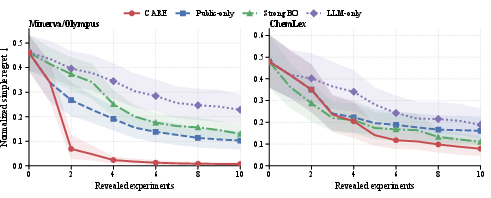
- Empirical evaluations on Minerva/Olympus and ChemLex benchmarks show improved AUC scores and reduced experimental regret over traditional BO methods.
Auditable Control of LLM-Generated Experiment Policies: CARE Framework
Contemporary LLM agents exhibit promising performance in virtual experimental domains but encounter significant barriers when deployed in high-throughput scientific experimentation (HTE), due to the irreversibility and cost of real-world experiments. Typically, Bayesian Optimization (BO) and self-driving lab frameworks are adopted for sequential candidate selection under constraints such as public-information boundaries. Nevertheless, the integration of LLMs into HTE optimization pipelines remains problematic, with direct delegation often yielding unsafe or suboptimal exploration behaviors. Empirical data indicate that LLM self-evolution frequently overfits to sparse evidence, overreacts to implementation artifacts, or fails to outperform incumbent BO policies, thus motivating an auditable, hybrid architecture in which LLMs generate policy proposals rather than directly select actions.
CARE Framework Architecture
The CARE (Controlling LLM-Generated Policies through Auditable Review of Evidence in Scientific Experimentation) system introduces a layered, auditable controller structure for language-generated policies interacting with scientific environments. Key architectural principles include: separation of proposal and authority, explicit use of default BO-based public incumbent controllers, and pre-reveal audit logs that guide action selection via a Public-Evidence Intervention Gate.
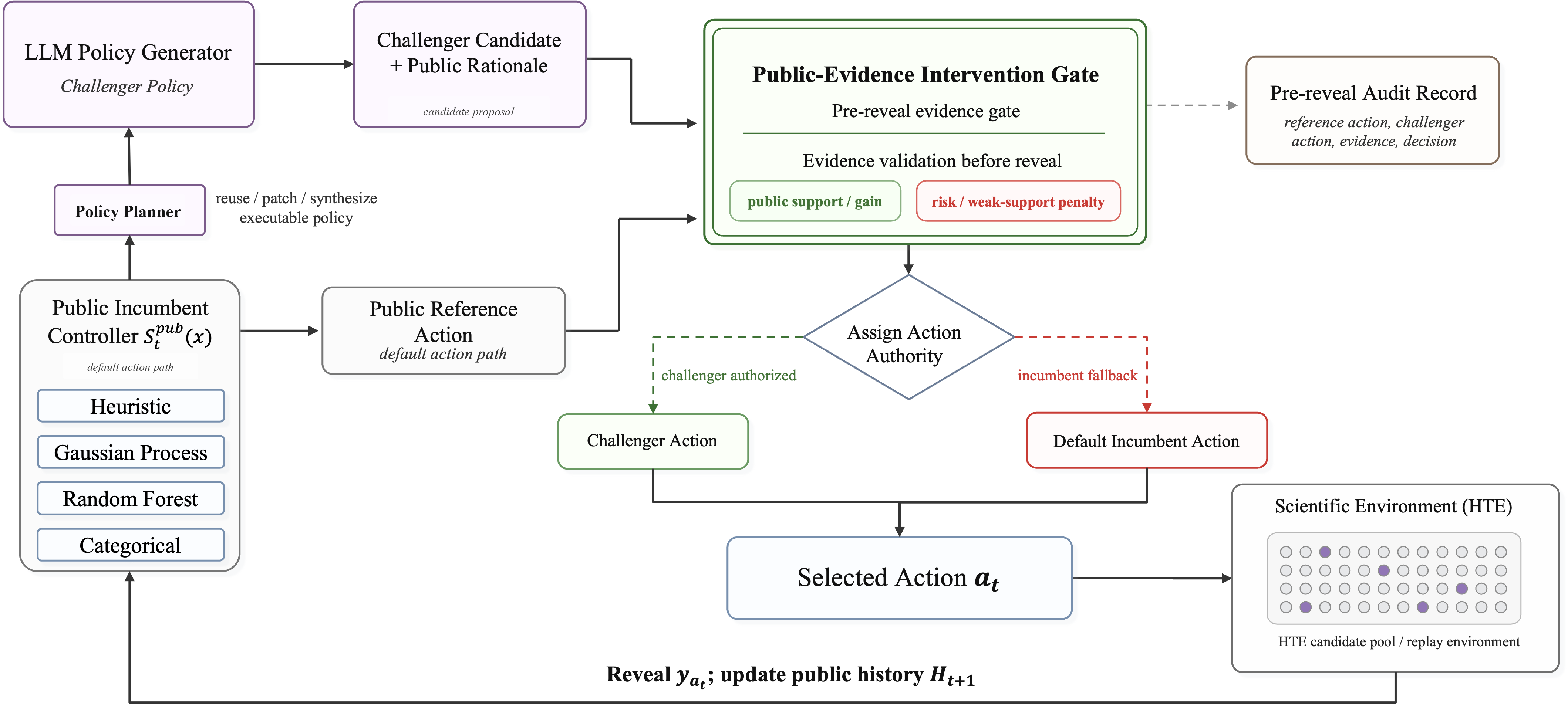
Figure 1: CARE pipeline structure showing proposal generation, intervention gate assignment, and audit logging within HTE replay.
The pipeline operates in rounds. First, a public incumbent computes the reference action using an ensemble ranking of remaining candidates. Concurrently, a Policy Planner and LLM Policy Generator maintain a challenger ranking policy, which is validated for compliance and invariance. The intervention gate compares the challenger action against the reference, authorizing the challenger only if public evidence supports it, with every decision logged before any outcome reveal. Policy planner modes—recovery and frontier—further permit structured challenger proposals based on trajectory stagnation or schema-conditioned exploration.
CARE formalizes HTE as a finite-pool sequential replay problem. Given candidates X and hidden objectives {yi}, the controller operates under a strict public-information boundary, utilizing only revealed outcomes, candidate features, and audit logs. Each action is scored by both final-best and anytime best-so-far AUC metrics, enabling evaluation of both trajectory and terminal gains. Policies must avoid label leakage and retain compliance with public decision interfaces.
Algorithmic Components
- Public Incumbent Controller: Maintains an ensemble ranking of candidates via public experts, scoring candidates by fused rank, novelty, coverage support, and categorical evidence. This reference action is the baseline path.
- Policy Planner/LLM Policy Generator: The LLM module proposes executable ranking policies. Actions include reusing, patching, or synthesizing policies based on public trajectory signals.
- Challenger Proposal and Audit: Challenger actions are constructed using policy rankings and public metadata, restricted to proposals until the intervention gate assigns authority based on gain/risk vector analysis.
- Public-Evidence Intervention Gate: Authorizes challenger actions only when public evidence (support, novelty, categorical alignment) outweighs risk. Intervention is sparse, and authority assignment is logged pre-reveal in the audit ledger.
Empirical Evaluation
CARE is evaluated across Minerva/Olympus Suzuki Coupling (i) and ChemLex Acid-Amine Wetlab benchmarks, using matched-seed protocols, reveal budgets, and public interfaces.
Ablation studies demonstrate directionally consistent performance declines when removing policy planner, intervention gate, or proposal modes, substantively confirming the necessity of each controller module. Expanding public expertise alone does not close the gap to gate-authorized challenger policies.
Robustness and Auditability
Replay-protocol robustness is confirmed across protocol variants changing initialization and reveal budgets—all cells show positive final-best and AUC delta compared to public incumbent and ablated variants.
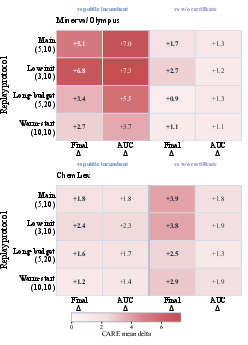
Figure 3: CARE’s replay-protocol robustness—positive performance margin under diverse initialization and reveal-budget settings.
Audit logs trace explicit authority transfer for challenger actions, and backend checks demonstrate that control behavior transfers across different LLM proposal backends. Policy evolution occurs through structured edits to ranking policies; the LLM is restricted to proposing candidate scores based only on public evidence, never holding direct authority.
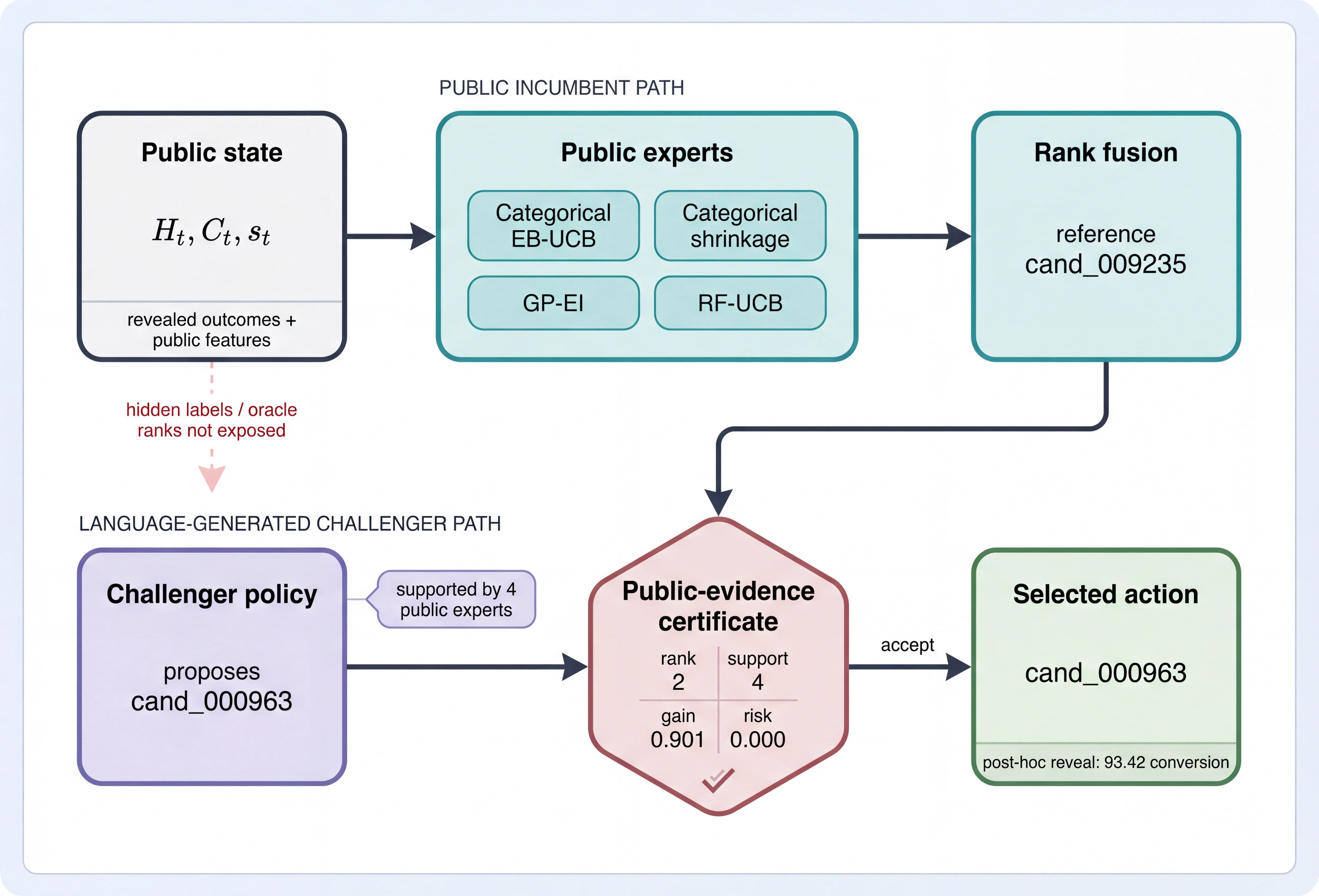
Figure 4: Example ChemLex audit record—intervention gate assigns authority based on pre-reveal gain/risk, outcome not visible until after action selection.
Implications and Future Directions
CARE’s control-centric paradigm establishes that LLM-written policies can reliably augment BO-based optimizers for HTE only under strict audit and evidence gating. Language self-evolution functions as a proposal-space expander rather than as an action selector, with authority constrained by pre-specified, auditable public-evidence gates. This architecture circumvents the pitfalls of direct LLM delegation in real-world experimentation and offers a scalable template for integrating LLM-generated proposals with classical, empirically-grounded decision rules.
Practically, this framework supports explainable, safe deployment of hybrid LLM-agent systems for finite-pool scientific optimization, with transparency and traceability of all action paths. The approach directly addresses deployment safety in costly physical experimentation, where auditability, compliance, and evidence-driven decisions are paramount.
On a theoretical level, CARE recasts policy evolution for LLMs as proposal generation under external control, separating exploration from exploitation authority. This separation is instrumental for constrained domains and may generalize to broader agentic decision-making tasks in scientific environments.
Conclusion
CARE demonstrates that LLM-driven policy self-evolution is beneficial for scientific experimentation only when integrated into a gated, auditable controller with a strong public incumbent path. Empirically, CARE posts superior final-best and AUC metrics on two established HTE benchmark suites, substantiated by rigorous ablations and protocol robustness analysis. The implications are salient for the design of trustworthy, explainable AI agents in physical scientific domains, and future work may extend the gating paradigm to multi-objective, cost-aware, and batch-optimized experimentation controllers (2606.14581).