- The paper demonstrates that embedding explicit human oversight within AI research workflows reduces critical failure rates by up to four times.
- It details the HLER framework that segregates stochastic LLM reasoning from deterministic data processing, mitigating risks like hallucination and misidentification.
- Empirical results across diverse datasets highlight the decisive role of human intervention in ensuring reliable, replicable outcomes in AI-assisted social science.
Human-in-the-Loop Decision Architecture for Reliable AI-Assisted Social Science
Motivation and Problem Statement
The delegation of empirical research tasks to LLMs introduces new structural risks in the reliability of automated scientific workflows, especially in the social sciences. While LLMs demonstrate probabilistic reasoning and generative flexibility, reliability failures arise when their stochastic outputs govern pipeline stages demanding deterministic discipline. This paper challenges the prevalent model-centric view and posits that reliability is fundamentally a property of the decision architecture governing human–AI interaction, not a product of model capability alone.
HLER Decision Architecture: Core Principles
The Human-in-the-Loop Economic Research (HLER) framework operationalizes reliability through explicit architectural design. The empirical research workflow is decomposed into eight specialized agent roles spanning data audit, profiling, hypothesis generation, data construction, identification assessment, econometric estimation, manuscript drafting, and review. Agents are partitioned by type: probabilistic (LLM-based reasoning) versus deterministic (executable code), with distinct human decision gates intervening at the stages of research question selection, identification-strategy review, and publication decisions. The Orchestrator maintains persistent state, ensuring cross-stage consistency and providing an auditable execution trail.
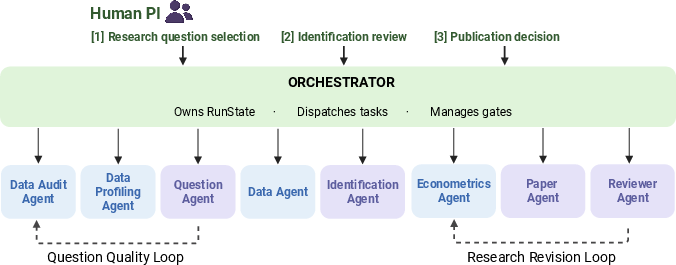
Figure 1: The HLER decision architecture decomposes the empirical workflow, enforces agent-type partitioning, and integrates fixed human gates at decisive stages for accountability.
This separation sharply contrasts with end-to-end autonomous research agents (e.g., AI Scientist, AutoGen, MetaGPT) that permit LLMs to operate across all pipeline stages, thereby amplifying classical empirical failure modes—p-hacking, specification search, hallucination, and inconsistent interpretation.
Theoretical Model: Task-Based LLM Research Production
HLER is grounded in a task-based production framework in which research output quality results from allocating oversight effort between block-specific human gates and workflow-wide general supervision. Candidate outputs within each block are drawn from a Fréchet distribution parameterized by task proximity to LLM training data. The coordination burden from probabilistic sampling increases with candidate count and output distributional tails; block-specific human gates with productivity ψA reduce this burden, while general oversight with productivity ψZ uplifts overall quality.
The model’s closed-form solution for the optimal allocation λt∗ of researcher effort to a given block’s human gate is:
λt∗=ψA1log(ψZχntψA),
with χ (Fréchet shape, “effective temperature”) and nt (candidate count) as principal drivers. The key comparative statics are:
- Rising candidate count or heavier-tailed output (higher χ) necessitates greater gating investment.
- Higher general oversight productivity (ψZ) favors reduced block-specific gating.
- When χntψA≤ψZ, full automation is optimal (no human gate).
This establishes architectural commitments as non-universal: the necessity for human gates is greatest where LLMs face unfamiliar (out-of-distribution) tasks and output distributions are heavier-tailed.
Experimental Design
A 2×4 factorial experiment (ψZ0) compares HLER with a baseline unconstrained LLM pipeline using four diverse datasets: UK Biobank (UKB), China Health and Nutrition Survey (CHNS), China Health and Retirement Longitudinal Study (CHARLS), and the historical China Multi-Generational Panel Dataset–Liaoning (CMGPD). The same LLM backbone (Claude Sonnet 4.6) and agent decomposition are used, but only HLER restricts probabilistic agents to reasoning tasks, employs deterministic execution for data and estimation, and enforces human gates. Outputs are independently adjudicated by three blinded experts on feasibility, identification credibility, and output consistency.
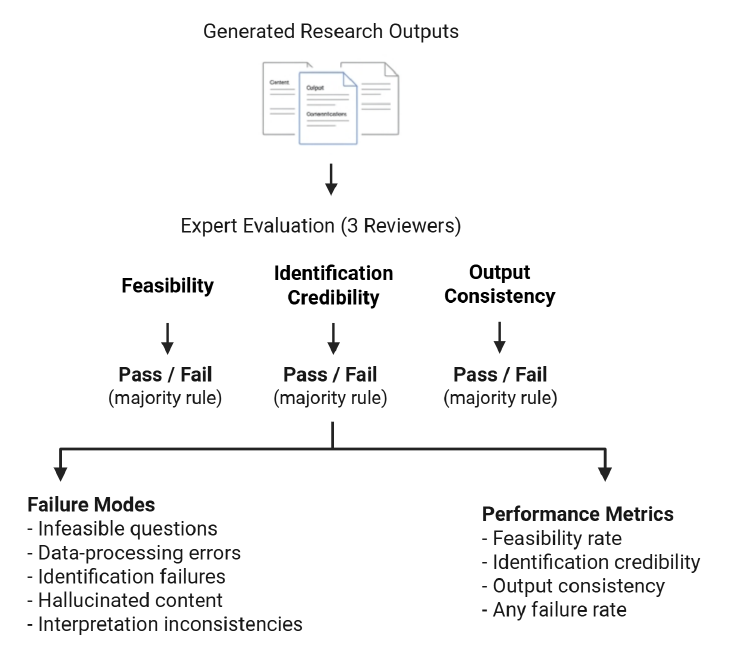
Figure 2: Evaluation framework utilizing multi-rater assessment and majoritarian rule on core dimensions, with failed outputs assigned primary failure modes.
Empirical Results
Sharp Reliability Improvements
- Critical failures drop from 72% in the unconstrained baseline to 16% with HLER (Fisher’s exact ψZ1).
- Feasibility, identification credibility, and output consistency are significantly higher under HLER (0.83, 0.65, 0.78) than baseline (0.37, 0.31, 0.29).
- The majority of residual failures even in the HLER regime occur at identification, underscoring the irreducible difficulty of causal inference given inadequate data or design.
Dataset Heterogeneity
- The largest reliability gains appear on the out-of-distribution CMGPD panel (failure rates 0.88 baseline vs. 0.16 HLER).
- More familiar datasets (UKB, CHNS, CHARLS) also benefit but with smaller, though still substantial, reductions.
- Failure mode decomposition highlights drastic reductions in hallucinated references (21 baseline vs. 3 HLER), interpretation inconsistencies (18 vs. 3), and infeasible questions.
Architectural Ablation
A focused ablation (80 runs) demonstrates that both deterministic computation and human gates independently lower failure, and joint removal leads to near-baseline unreliability (0.70). Evidence suggests complementarity between these features: each reinforces the reliability dividend of the other, consistent with the theoretical mechanism.
Mechanistic Insights: Case Analysis
Empirical case studies illustrate that:
- Deterministic diagnostics expose identification assumption violations that LLM-based reviewers may overlook, enabling escalation and containment of invalid causal claims through human gates.
- Methodological sophistication alone (e.g., machine learning–aided estimation) cannot substitute for valid research design; HLER ensures that such limitations are explicitly surfaced and not misrepresented as causal findings.
Implications
Architecture-Driven Reliability
The findings directly challenge the sufficiency of LLM advancements for epistemic reliability in automated research. With the identical model, agent decomposition, and prompts, the choice of system-level architecture—particularly the partitioning between stochastic reasoning and deterministic computation, and the instantiation of pre-committed human gates—reduces critical failure rates by a factor of four.
Practical Recommendations
- Model developers should focus on enhancing base capabilities, but governance should come from methodological and workflow-level system architecture.
- The harness concept—channeling AI-generated exploration through bounded, auditable processes—better aligns with core empirical science requirements than naive end-to-end automation.
- Embedding commitments architecturally (e.g., pre-commitment to design before estimation, explicit human approval for claims publication) offers a more sustainable solution for reliability than reliance on voluntary professional discipline or model-level prompt engineering.
Extension and Limitations
While the architecture is evaluated in the LLM research workflow context, the deterministic–probabilistic division likely has broader applicability in empirical science, both AI- and human-led. Boundary cases (e.g., mixed probabilistic/deterministic stages) and other research modalities (e.g., experimental, qualitative) present directions for extension.
Experimental limitations include small ablation cells, evaluation on only four datasets, and uncontrollable model-specific idiosyncrasies. Identification remains the most challenging criterion, and even the most disciplined workflow cannot circumvent fundamental data limitations.
Conclusion
This work demonstrates that the structuring of cognitive labor between humans and AI—via principled decision architecture—is a more effective lever for reliable empirical research than model improvement alone. HLER operationalizes architectural commitments that sharply reduce critical failures, especially when models face unfamiliar or out-of-distribution data. The findings advocate for workflow harnesses that partition reasoning and deterministic computation, and institutionalize explicit human decision gates at epistemically decisive points. The future of responsible AI-assisted science hinges not on human removal, but on the optimal placement of human oversight to reduce, expose, and contain inevitable failures.
(2606.12848)