- The paper introduces Games Mapper based on TDA, which enables unsupervised segmentation and temporal tracking of Steam game subgenres.
- It employs Cohen's h statistics and an elbow method for optimal cluster naming and resolution, ensuring interpretability and granularity.
- Findings reveal persistent and evolving dynamics across subgenres like Management, Exploration, and Horror, with distinct studio distribution patterns.
Topological Analysis of Steam Simulation Game Genres via Mapper
Methodological Framework: Games Mapper and TDA
The paper introduces Games Mapper, a scalable pipeline leveraging Topological Data Analysis (TDA), specifically via the Mapper algorithm, for unsupervised segmentation and temporal tracking of game subgenres within the Steam ecosystem. Unlike conventional clustering—typically performed per time period without connecting cluster lineages—Mapper provides a persistent topological map, encoding relationships between clusters across intervals and allowing the identification of stable, branching, or transient genre subtypes.
The pipeline integrates Grelier and Kaufmann's automated cluster naming mechanism, which employs Cohen's h statistics to identify the most overrepresented tags, maximizing interpretability within each cluster. Naming scores are used in the elbow method to select optimal cluster resolution per interval, balancing granularity and discriminative tag representation. The layered visualisation adopted places clusters per interval on aligned horizontal layers, maximizing the clarity of temporal evolution and topological relationships. Edges encode shared game memberships, weighted proportionally and optimized for minimal crossing via heuristic permutation.

Figure 1: Four main steps of Mapper: filtering, interval covering, clustering per interval, and building the Mapper graph.
Empirical Case Study: Simulation Games on Steam (2015–2025)
Simulation games were selected due to their broad coverage of Management, City-Building, Physical, and Exploratory subgenres. The dataset included Steam titles (2015–2025) with ≥100 reviews and Simulation tags with priority ≥0.6, yielding a temporal cross-section suitable for topological analysis. The filter function was defined as the release year, partitioned into overlapping two-year intervals, resulting in eleven layers.
Cluster resolution was determined via the naming score-elbow method for each interval, generally yielding 6–7 clusters per layer, ensuring computational tractability and granularity.
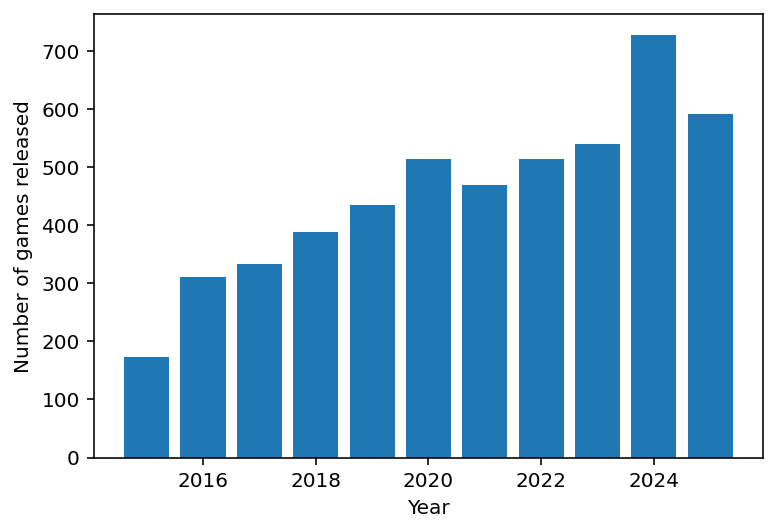
Figure 2: Distribution of simulation games released per year (with at least 100 reviews).
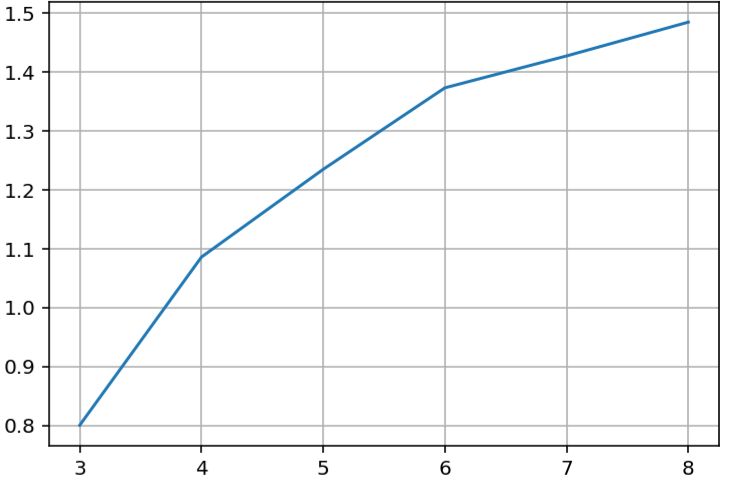
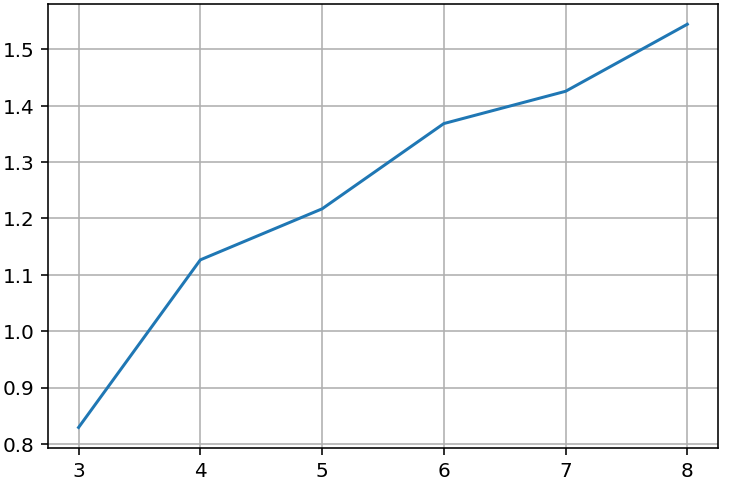
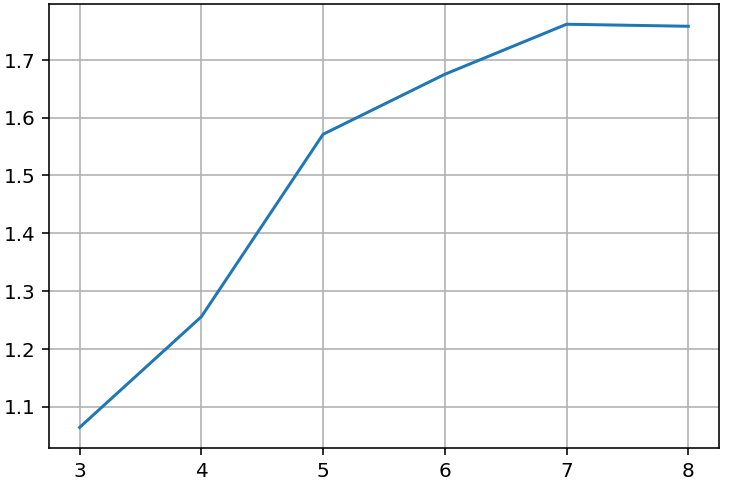
Figure 3: Naming scores from elbow method validate optimal cluster choices per interval.
Key Numerical Insights: Genre Segmentation and Temporal Dynamics
The Mapper graph reveals several persistent and dynamic subgenre trajectories:
- Management Games: Exhibited uninterrupted persistence with marked growth, from 80 to 331 games over the decade. High-weight vertical edges indicate continuity and isolation, with AA studios disproportionately represented among top review counts.
- Open World and Exploration: Initially coexisting as separate clusters, a transition from Open World to Exploration is evident around 2021, potentially indicating a shift in player characterization or developer focus. Growth from 64 to 221 games is documented. Larger indie and AA studios dominate, with AAA underrepresented relative to production complexity expectations.
- Sports Games: Remain stable (classic trend), with little numerical growth (63 to 93 games). AAA studios overwhelmingly dominate this segment, implying high entry barriers for indie/AA developers.
- Horror Games: Emerged as a trending subgenre since 2023, with clusters growing from 106 to 121 games. Indie studios are prevalent, consistent with lower production overheads and niche markets.
- Story Rich and Relaxing Games: Story Rich clusters are intermittent and generally small, often led by indie studios. Relaxing games show classic behavior, with stable cluster sizes (~137 to 134 games), again mostly driven by indie and AA developers.
- War/Visual Novel/Anime: These clusters are heterogeneous and large, mixing war-themed AAA/AA games and visual novel/anime titles from indie studios. Interpretation is complicated by cluster diversity; further subdivision may reveal finer structure.
- Miscellaneous Subgenres: Sci-fi, Funny, and Fantasy clusters appear sporadically, with insufficient sample sizes for strong conclusions.
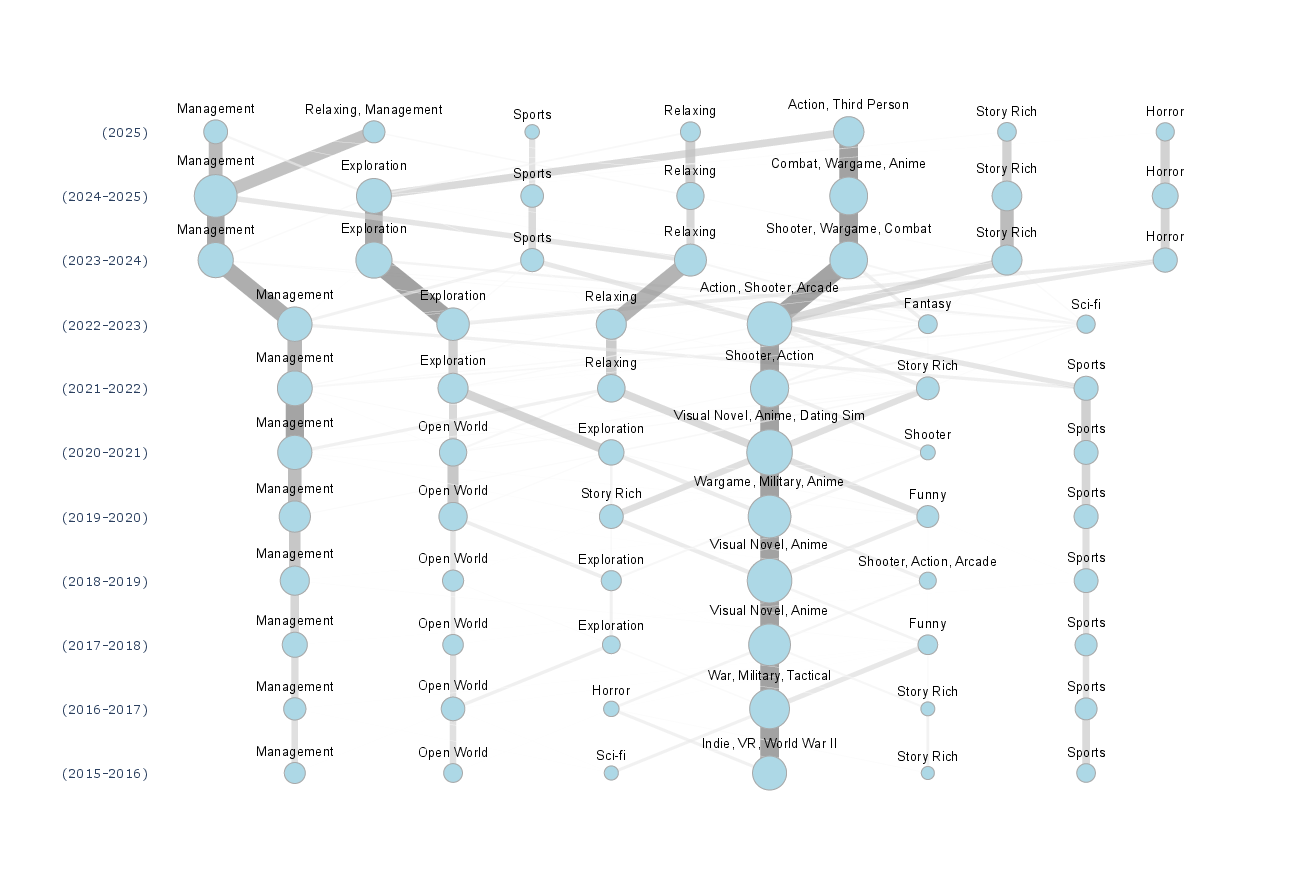
Figure 4: Mapper graph displays cluster trajectories and topological relationships for simulation games, visualizing persistent trends, transitions, and branching subgenres.
Practical and Theoretical Implications
By demonstrating the utility of TDA-based Mapper on game analytics, the paper provides a replicable methodology for genre evolution studies in digital markets. The explicit encoding of cluster lineage, branch, and stability allows for forecasting, market entry analysis, and trend detection beyond what traditional clustering or visualization methods provide. Mapper’s persistent structures are particularly relevant to multi-year development cycles, enabling studios to target stable or trending subgenres.
The cluster labelling approach, grounded in Cohen's h statistics, ensures actionable interpretability, directly linking game features with market dynamics. The consistent findings regarding studio type distribution across subgenres support the hypothesis that AAA studios dominate high-barrier segments (sports, war), whereas indie and AA studios succeed in emergent or niche genres.
Limitations include potential bias from review thresholds (favoring older titles), stochasticity in K-means/elbow methods, and reliance on community-generated tags, which may reflect perception as much as design intent. The methodology is extendable to alternative filter functions (e.g., reviews, concurrent users), potentially enabling multidimensional trend analysis.
Conclusion
Games Mapper operationalizes Mapper-based TDA for market analysis within Steam genre spaces, providing automated cluster naming, stable visualizations, and persistent trend detection. Applied to simulation games, it identifies Management, Exploration, and Horror as rapidly expanding subgenres, with Sports and Relaxing maintaining stability. AAA studios dominate Sports and War, while AA studios excel in Management and Exploration, and indie developers thrive in Story Rich, Relaxing, Horror, and niche clusters. The approach generalizes to broader genre, tag, and KPI analyses in digital markets, offering a robust foundation for data-driven studio strategies and theoretical examination of market dynamics.

