AI Native Games: A Survey and Roadmap
Abstract: Generative AI now enables games to produce dialogue, quests, characters, images, and worlds at runtime. Yet generation alone does not make a game AI-native, nor does it guarantee playability. This paper defines AI-native games by whether runtime generative AI is constitutive of the core loop: if the AI component were removed or trivially replaced, the central form of play would collapse or become fundamentally different. This counterfactual criterion separates AI-native games from AI-augmented games, boundary artifacts, chatbots, tavern-style role-play, procedural content generation, and AI-assisted production. Using this definition, we screen candidate artifacts and analyze 53 publicly available AI-native games and prototypes. We introduce a dual-axis G/N taxonomy: the G-axis captures player-facing game type, while the N-axis captures the dominant AI mechanic that makes generative AI indispensable to play. The corpus is concentrated around language-forward designs, especially narrative adventure, epistemic interaction, and generative narrative, while categories such as semantic adjudication, multi-agent simulation, generative construction, and relationship/companion play remain less represented. We argue that the central design problem is organizing semantic openness into stable gameplay. AI-native design depends on mechanical invariants: goals, rules, state, feedback, pacing, and player agency that make open-ended AI outputs interpretable and consequential. We conclude with a roadmap for controllable generation, AI-as-mechanic design, multimodal and multi-agent systems, inference economics, evaluation, safety, and regulation.
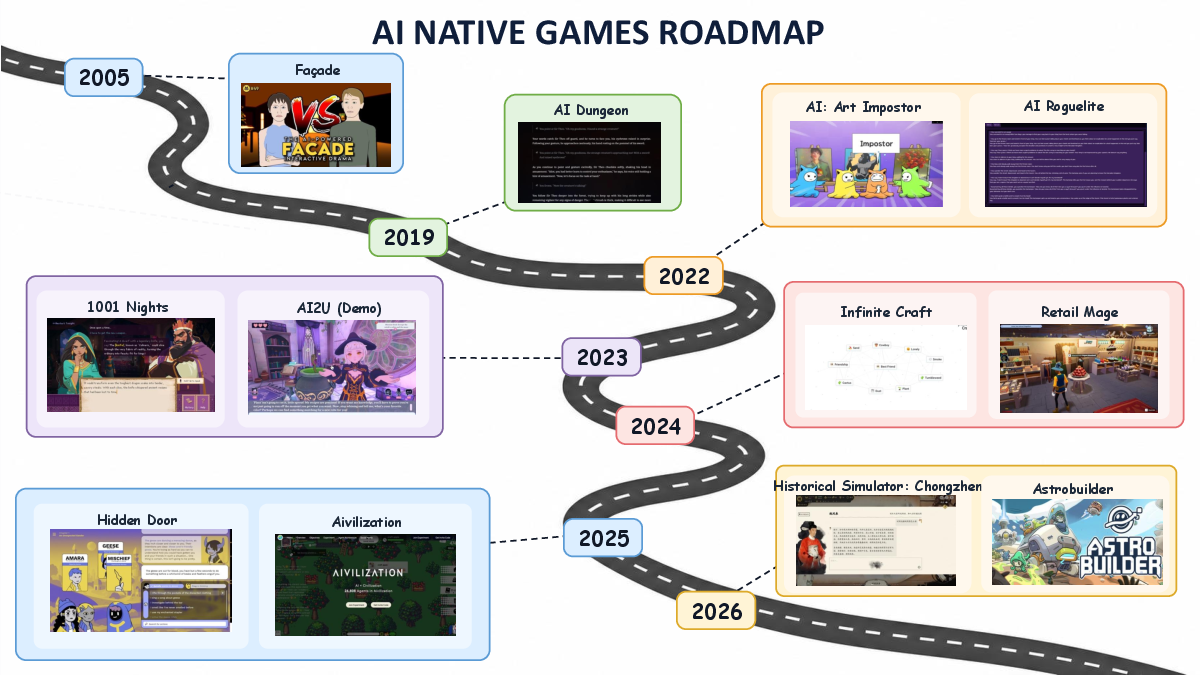
Paper Prompts
Sign up for free to create and run prompts on this paper using GPT-5.
Top Community Prompts
Explain it Like I'm 14
What this paper is about
This paper looks at a new kind of video game the authors call “AI‑native games.” These are games where a generative AI (like a smart chatbot or image model) isn’t just a helper behind the scenes, but a core part of how you actually play. If you took the AI out, the main way the game works would break or feel like a totally different game. The paper explains what counts as an AI‑native game, collects real examples, sorts them into clear categories, and shares a roadmap for where this kind of game design should go next.
The main questions in simple terms
- How do we tell the difference between a game that merely uses AI somewhere and a game that truly depends on AI to be playable?
- What kinds of AI‑native games already exist, and what do they have in common?
- Which AI features make these games work, and which parts are still hard or missing?
- What should designers and researchers focus on to make AI‑native games fun, safe, and reliable?
How the researchers studied it
The authors did a survey, which means they gathered and examined lots of examples:
- First, they defined AI‑native games as ones where generative AI is part of the “core loop” — the repeatable steps players perform to make progress. Think of the core loop like the heartbeat of the game: act → get feedback → the world updates → act again.
- They searched academic papers, game stores (like Steam and itch.io), official sites, and demos to find candidates.
- They only kept artifacts you can actually play or verify in public, and where the AI’s output changes the game’s state, rules, characters, story, or win/lose outcomes during play (this is called “runtime” use).
- Out of 93 candidates, they closely analyzed 53 games/prototypes.
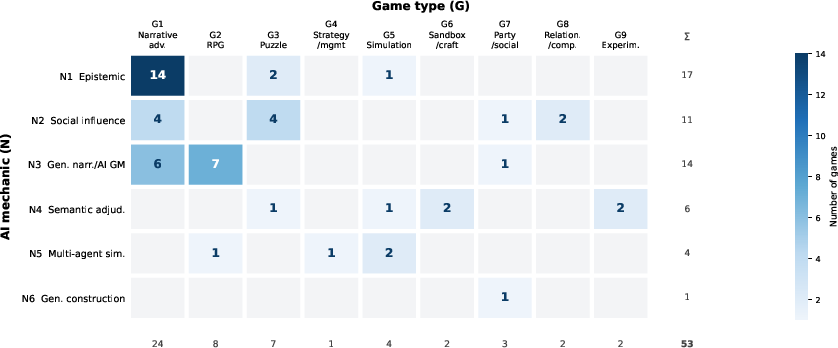
To make sense of the 53, they built two simple axes (like an X/Y chart):
- G-axis (Game type): What the game feels like to the player (for example, narrative adventure, RPG, puzzle, simulation).
- N-axis (AI mechanic): What the AI actually does that the game can’t do without (for example, answering investigations, continuing the story, judging whether a creative action should work).
They explained technical ideas with plain meanings:
- Generative AI: Models that can create new text, images, or audio.
- Runtime: The AI works during play, not just before release.
- Non‑substitutability: You can’t swap the AI for a fixed list of prewritten content without changing the whole kind of game it is.
What they found and why it matters
- A clear definition and boundary lines The paper draws a firm line between:
- AI‑native games: AI is essential to the core loop. Remove it, and the game’s main play breaks.
- AI‑augmented games: AI is present but not essential. Remove it, and the main play still works.
- AI‑boundary artifacts: AI is central, but the thing isn’t really a “game” (for example, open-ended role‑play with no clear goals or rules).
- Out‑of‑scope: AI is just decorative or used only during development.
This matters because “uses AI” is too vague. The definition helps designers and researchers know what they’re actually building and studying.
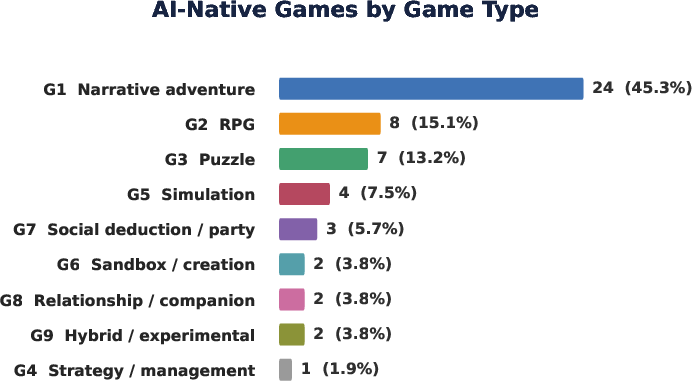
- A map of current AI‑native game types Most of the 53 games cluster around language-heavy play, especially:
- Narrative adventure and RPG: Players type what they want to do or say, and the AI responds with story events, character reactions, and updates to the world.
- Puzzle and investigation: Players ask questions, spot lies, or solve challenges by talking to AI-controlled characters.
Less explored areas include simulations with many AI agents interacting, creative sandboxes where AI judges whether your wild ideas “work,” and relationship/companion games that focus on long-term emotional connections.
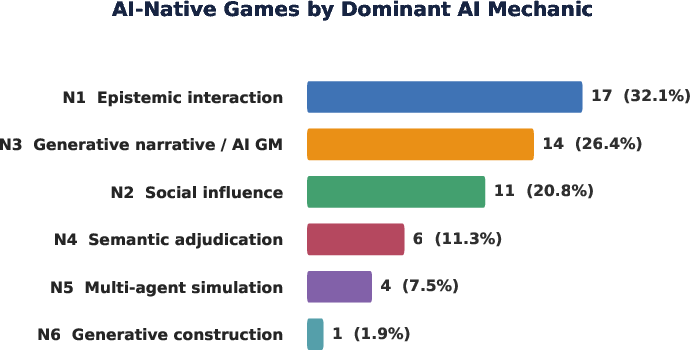
- The six “AI mechanics” that make games truly AI‑native Here’s what the AI is doing that the game can’t easily do without:
- Epistemic interaction: The AI acts like a source of hidden information. You interrogate suspects, ask follow-ups, and uncover clues through conversation.
- Social influence: You try to persuade, charm, trick, or negotiate with AI characters to get what you need.
- Generative narrative / AI game master: The AI continues the story based on your input, much like a tabletop game master who reacts to whatever you try.
- Semantic adjudication: The AI decides whether your open-ended action should work in the game world. Example: you invent a spell or craft recipe in plain language, and the AI rules on the outcome.
- Multi-agent simulation: Many AI characters live their own lives, form goals, and interact. You observe, guide, or manage this society.
- Generative construction: The AI makes content (images, text, objects), and that output is directly what you play with or judge.
Today, two mechanics dominate: investigation (finding hidden info) and story continuation. The rule-level mechanic where the AI judges your creative actions (semantic adjudication) is promising but still rare.
- The core design challenge: turn open-ended AI into solid gameplay Generative AI can produce lots of content, but games also need stability: clear goals, rules, feedback, pacing, and real consequences for player actions. Uncontrolled AI output can be inconsistent, unfair, or confusing. Strong AI‑native games solve this by adding guardrails:
- Constraints and validators that check or shape AI output.
- Memory systems so the AI remembers past events consistently.
- Clear goals and states so players know what matters.
- Safety, content filters, and backups to avoid harmful or broken results.
- Practical hurdles slowing things down The authors note real-world issues:
- Consistency and “hallucinations”: AI can make things up or contradict itself.
- Latency: Waiting for AI responses hurts pacing.
- Cost (“inference economics”): Calling large models during play can be expensive.
- Evaluation: It’s hard to test and rate AI‑driven experiences.
- Safety and regulation: Games must protect players and follow rules.
What this means for the future
- For designers: Treat the AI as a game mechanic, not just a content spigot. Build strong goals, rules, and feedback loops around it. Invest in controllable generation, good memory, and validators.
- For researchers: Develop better ways to measure fun, consistency, safety, and fairness in AI‑native play. Explore underused spaces like multi‑agent worlds, relationship/companion play, and robust rule‑level adjudication.
- For players: Expect games where you can express yourself in natural language and try creative actions that the game actually understands and judges.
- For the industry: Plan for runtime costs, moderation, and compliance. Push for model tools that are cheaper, faster, safer, and easier to steer.
In short, AI‑native games are not about stuffing in more AI for flashiness. They are about making AI the heart of play in a way that stays fair, understandable, and fun. If designers can tame open-ended AI with good rules and feedback, we’ll see new kinds of games where your ideas and words genuinely shape the world.
Knowledge Gaps
Knowledge gaps, limitations, and open questions
The following points summarize what remains missing, uncertain, or unexplored in the paper and suggest concrete directions for future research.
- Operationalizing the “non-substitutability” test: Develop measurable criteria and ablation protocols to decide when AI is truly constitutive of the core loop (e.g., remove/replace the model with scripted logic and quantify changes in task solvability, player behavior, and loop structure).
- Reliability of the taxonomy: Provide a formal codebook and report inter-rater reliability (e.g., Cohen’s kappa) for G/N assignments and the seven coded dimensions to ensure reproducibility of classifications.
- Sampling and coverage bias: Assess how the post-LLM, publicly available, mostly English-language corpus and platform sources (Steam/itch/web) bias findings; incorporate non-English, mobile/console, and pre-LLM lineage beyond Façade where applicable.
- Corpus reproducibility: Release the exact inclusion/exclusion decisions, interaction transcripts, and evidence levels per artifact; enable third-party revalidation and longitudinal updates of the corpus.
- External validity of G/N axes: Examine whether the taxonomy accommodates multimodal and embodied games (audio/vision/VR/AR), physical computing, and non-language interfaces; extend N-mechanics beyond language-centric functions.
- Player-centered evaluation: Run controlled user studies comparing AI-native vs AI-augmented vs scripted baselines on engagement, perceived agency, clarity, trust, challenge, and replayability; report statistically grounded effect sizes.
- Benchmarks for N1 (epistemic interaction): Create datasets of cases with ground-truth world state and lie/contradiction maps to evaluate interrogation robustness, information elicitation efficiency, and resistance to confabulation.
- Benchmarks for N4 (semantic adjudication): Formalize validator architectures and gold-standard test suites to measure action-interpretation accuracy, rule compliance, and exploit resistance (e.g., adversarial prompts, ambiguous instructions).
- Evaluation of N5 (multi-agent simulation): Define metrics for persistence, social plausibility, causal coherence, long-horizon stability, and intervention responsiveness; test across different agent scaffolds and memory designs.
- Memory and persistence design: Systematically compare memory architectures (episodic logs, semantic summaries, vector databases, tool memories) on retention, drift, interference, latency, and player editability across long sessions.
- Controllability techniques in gameplay: Empirically compare steering methods (function calling, constrained decoding/grammars, tool use/planners, DSLs, guards/critics) on fidelity to mechanics, safety, and designer handhold vs emergent play.
- Inference economics and QoS: Provide concrete cost/latency budgets for real-time loops, model-size trade-offs, batching/caching strategies, and on-device vs cloud deployments; publish load-testing benchmarks under peak concurrency.
- Model drift and portability: Develop regression-testing harnesses and compatibility contracts to keep saved games, balance, and behaviors stable across model/version/vendor changes; study vendor lock-in and fallback strategies.
- Safety and adversarial robustness: Create a taxonomy and empirical evaluation of in-game jailbreaks, prompt injections, and meta-gaming exploits; quantify mitigation efficacy (system prompts, structured tools, filters, affordance design) and latency overhead.
- Moderation pipelines in real time: Measure precision/recall, throughput, and user impact of content filters and human-in-the-loop escalation in fast-paced gameplay; characterize failure modes and escalation criteria.
- Legal and regulatory alignment: Map AI-native runtime generation to ratings systems (e.g., ESRB/PEGI), liability when models produce harmful/illegal content, logging/audit requirements, and player consent/notice standards.
- Accessibility and inclusivity: Evaluate how AI-native loops affect players with disabilities (e.g., speech reliance, text density), language diversity, and cultural norms; establish accessibility guidelines for AI-mediated mechanics.
- Underexplored G/N cells: Prototype and study games in sparse regions (e.g., G8 relationship/companion with N2/N5 mechanics; N6 generative construction beyond party play), with concrete success/failure criteria and longitudinal relationship measures.
- Tooling and open resources: Provide open reference implementations (validators, memory managers, safety wrappers), shared evaluation harnesses, and anonymized interaction corpora to accelerate replication and comparative studies.
- Environmental impact: Quantify energy/carbon costs of runtime inference at scale; evaluate caching, smaller models, and on-device inference as sustainability strategies without degrading play.
- Multiplayer fairness and exploits: Investigate anti-cheat and anti-collusion mechanisms when AI adjudicates outcomes; define fairness metrics and monitoring for model-mediated arbitration in competitive and party formats.
- Explainability and player transparency: Design and test UX patterns for surfacing model uncertainty, memory contents, and editable state; measure impacts on trust, strategy formation, and perceived fairness.
- Longitudinal stability and live ops: Study season-length persistence, save compatibility across updates, content drift control, and A/B testing for AI behavior changes; propose versioning and rollback practices specific to AI-native games.
- Bias and cultural harms: Audit NPC and world-generation biases across demographics and cultures in AI-native loops; test mitigation (counterfactual data augmentation, safety layers, persona constraints) and report residual disparities.
Practical Applications
Immediate Applications
Below are actionable use cases that can be deployed now, grounded in the paper’s taxonomy (game types G1–G9 and AI mechanics N1–N6), design principles (mechanical invariants, constraint/validator pipelines), and roadmap priorities (controllability, evaluation, safety, inference economics).
- AI-native narrative products and marketing tie-ins (media/entertainment)
- Use N3 “Generative Narrative/AI GM” to create bespoke interactive fiction and campaign microsites where the story adapts to each user.
- Tools/workflows: AI Game Master SDKs, scene/state trackers, safety filters, output caching for low latency.
- Dependencies/assumptions: stable prompt engineering and memory; moderation for brand safety; manageable inference costs; disclosure of AI use.
- Detective/interrogation training sims (education, corporate compliance, journalism)
- Use N1 “Epistemic Interaction” to practice eliciting facts, spotting inconsistencies, and asking follow-ups in open-ended scenarios.
- Tools/workflows: case libraries with hidden state, truth-consistency checkers, rubric-based scoring.
- Dependencies/assumptions: reliable state grounding to avoid hallucinated facts; clear success criteria; privacy controls for session logs.
- Negotiation and persuasion practice (HR/L&D, sales, law, diplomacy)
- Use N2 “Social Influence” to simulate negotiation counterparts with adjustable personas and goals.
- Tools/workflows: persona parameter panels, outcome adjudicators, conversation analyzers for tactics/ethics.
- Dependencies/assumptions: calibrated agent goals and bias controls; safety constraints to prevent harmful persuasion patterns; latency <1–2 s/turn.
- Classroom storytelling and language learning (education)
- Use N3 as an “AI GM” to scaffold creative writing, reading comprehension, and second-language conversation with goal-aligned constraints.
- Tools/workflows: curriculum-aligned prompt packs, teacher dashboards, automated rubrics for narrative structure and vocabulary.
- Dependencies/assumptions: age-appropriate moderation; offline/edge options for school networks; audit trails for assessment fairness.
- Natural-language “semantic adjudication” in creative tools (software/creator economy)
- Apply N4 to judge open-ended user intents (e.g., “blend these concepts” or “apply this style”) for prototyping in art, audio, or level design tools.
- Tools/workflows: rule validators, constraint grammars, deterministic post-processing, rollback/fallbacks for unsafe decisions.
- Dependencies/assumptions: guardrails to avoid unsafe or IP-risk outputs; user-controllable undo; consistent adjudication across sessions.
- Party and social games powered by generative content (consumer/daily life)
- Use N6 “Generative Construction” (e.g., prompt-to-image judging) and N2 for casual multiplayer formats.
- Tools/workflows: device-friendly inference with caching, profanity filters, room codes, and content voting.
- Dependencies/assumptions: robust moderation; low-latency pipelines; transparent data handling for UGC.
- LLMOps for games and interactive apps (game tech/software)
- Productize “inference economics” (caching, distillation, routing) and “mechanical invariants” (state machines, validators, memory) as middleware.
- Tools/workflows: cost/latency dashboards, prompt routers (small/large model selection), content filters, state persistence modules.
- Dependencies/assumptions: observable telemetry; predictable pricing (token budgets); multi-model support; privacy-by-design.
- Playtesting, QA, and evaluation harnesses for AI-native loops (game industry, academia)
- Use the paper’s G/N taxonomy to build test suites per mechanic (e.g., N1 truthfulness, N3 coherence, N4 rule consistency).
- Tools/workflows: synthetic user tests, regression suites for prompt changes, fun/safety rubrics, adversarial prompt libraries.
- Dependencies/assumptions: benchmark definitions of “consistency” and “fun”; versioned prompts/models; red-team processes.
- Accessibility features via natural-language interaction (games/UX)
- Layer N4 adjudication to allow players to express complex actions via speech/text in games otherwise gated by motor/vision demands.
- Tools/workflows: NL-to-action parsers, confirmation dialogs, predictable synonyms and macros.
- Dependencies/assumptions: predictable mappings; localization; on-device speech privacy; clear fail-states.
- Procurement and governance checklists using the “core-loop dependence” test (product management, policy/IT governance)
- Use the paper’s counterfactual criterion to decide when runtime AI is essential (AI-native) vs. optional (AI-augmented) and allocate risk/controls accordingly.
- Tools/workflows: design review templates, go/no-go gates for runtime AI, requirement profiles for safety/eval/cost.
- Dependencies/assumptions: cross-functional sign-off (design, legal, safety); documented risk grades per mechanic (N1–N6).
Long-Term Applications
These require further research, scaling, or ecosystem agreements; many hinge on advances discussed in the roadmap (multimodal/multi-agent systems, controllable generation, evaluation, safety, and regulation).
- Persistent multi-agent worlds for MMOs and simulations (games, smart cities, econ/policy analysis)
- Scale N5 “Multi-Agent Simulation” to persistent societies with institutions, memory, and emergent norms.
- Tools/workflows: agent schedulers, social memory graphs, event validators, designer-overseer consoles.
- Dependencies/assumptions: stable long-horizon memory; guardrails to avoid pathological dynamics; compute scaling and save/restore standards.
- General-purpose semantic adjudication engines (software, robotics, IoT)
- Mature N4 into standardized NL→action/rule interpreters for open-world commands (e.g., “organize these files,” “clean the kitchen around guests”).
- Tools/workflows: hierarchical policies, symbolic validators over LLM proposals, simulators/sandboxes for safety before actuation.
- Dependencies/assumptions: verifiable semantics; strong safety constraints (esp. in physical robotics); low-latency local inference.
- Long-horizon AI companions with durable relationships (healthcare, education, wellness)
- Advance G8+N2 with robust persona, affect, and memory for coaching, adherence support, or SEL curricula.
- Tools/workflows: privacy-preserving memory stores, clinical/educational outcome measures, drift detection for persona consistency.
- Dependencies/assumptions: regulatory clearance for health-adjacent uses; bias and harm mitigation; transparent consent and data retention.
- Multimodal AI-native play (image/audio/3D) with rule-stable outcomes (games, creative tools)
- Move beyond text to stable, controllable generation that respects pacing and goal/state constraints.
- Tools/workflows: scene graphs synchronized with LLM narration, differentiable validators, cross-modal memory.
- Dependencies/assumptions: reliable control over multimodal models; latency budgets for real-time play; licensing frameworks for assets.
- Platform standards for dynamic AI content and disclosures (policy/regulation, platform governance)
- Establish labeling, auditability, and age-rating processes for runtime-generated content.
- Tools/workflows: content provenance tags, dynamic rating evaluators, incident reporting pipelines, transparency APIs.
- Dependencies/assumptions: industry consensus; regulator guidance; standardized logs that don’t expose personal data.
- Cross-title AI persona and state portability (game platforms, identity/UX)
- Define open formats for agent memory, safety constraints, and capabilities so companions/NPCs can travel across games.
- Tools/workflows: persona schemas, capability negotiation, cross-game safety envelopes, consent UIs.
- Dependencies/assumptions: interoperability standards; IP rights over personas; secure, user-controlled data vaults.
- Energy- and cost-aware inference infrastructures (cloud/edge, sustainability)
- Operationalize “inference economics” with edge models, dynamic compression, and demand shaping for large player bases.
- Tools/workflows: on-device small LLMs, server offload policies, token budgets, green-SLA schedulers.
- Dependencies/assumptions: acceptable quality from compact models; device capability variance; predictable traffic patterns.
- Formal evaluation standards and leaderboards for AI-native mechanics (academia, industry consortia)
- Benchmarks for coherence, stability, fairness, and fun per N1–N6, with reproducible seeds and public scorecards.
- Tools/workflows: shared scenarios, metric suites, public corpora (e.g., the curated game list), automated harnesses.
- Dependencies/assumptions: agreement on construct definitions (e.g., “fun” proxies); version pinning; community governance.
- Advanced safety, red-teaming, and alignment for runtime play (safety labs, studios)
- Mechanic-specific threat models (prompt injection in N4, manipulation in N2) and countermeasures integrated into pipelines.
- Tools/workflows: adversarial simulators, safety scorecards, in-the-loop human moderation, auto-rollbacks.
- Dependencies/assumptions: ongoing monitoring; budget for human oversight; clear escalation paths and user remedies.
- Policy engagement and public consultation via AI-native experiences (civic tech)
- Use N3/N5 to create explorable policy narratives and agent-based sandboxes for participatory planning.
- Tools/workflows: scenario libraries tied to real data, outcome explainers, traceable decision logs.
- Dependencies/assumptions: data validity; non-manipulative framing; accessibility and inclusion standards.
- Domain-specific training for regulated sectors (healthcare triage, finance compliance, energy operations)
- Tailor N1/N2/N4 to simulate cases, audits, and incident responses with validated rule sets and outcomes.
- Tools/workflows: domain ontologies, rule-integrated LLMs, post-hoc explainability, audit loggers.
- Dependencies/assumptions: expert-verified ground truth; regulatory approval; strict privacy and data minimization.
Notes on feasibility across all items:
- Core technical assumptions: improved controllability, lower latency, predictable costs, and robust validator/guardrail stacks.
- Organizational dependencies: cross-functional collaboration (design, safety, legal), clear success metrics, and incident response capabilities.
- Ethical/regulatory dependencies: transparency, consent, age-appropriate moderation, and adherence to emerging standards for dynamic AI content.
Glossary
- Adaptive PCG: A runtime variant of procedural content generation that adapts content during play based on player state or behavior. "modern paradigms shift toward runtime or adaptive PCG"
- AI-as-mechanic design: Designing games so that an AI system itself functions as a core game mechanic, not just a content tool. "AI-as-mechanic design"
- AI-augmented games: Games that include AI features that enhance or add variety but are not essential to the core gameplay loop. "This counterfactual criterion separates AI-native games from AI-augmented games, boundary artifacts, chatbots, tavern-style role-play, procedural content generation, and AI-assisted production."
- AI-Boundary Game: An artifact where generative AI is central to the activity but lacks sufficient game structure to count as a strict game. "AI-Boundary Game: Generative AI is central to the activity, but the artifact lacks sufficient ludic structure---goals, rules, win/lose, or state progression---to count as a game in the strict sense; these cases sit at the frontier with chatbot and tavern-style role-play."
- AI Director: A dynamic pacing system that adjusts in-game events (e.g., enemy spawns) in real time to shape player experience. "systems like the Left 4 Dead ``AI Director'' dynamically modulate game pacing, enemy spawns, and resource distribution based on real-time heuristic evaluations of player stress"
- AI game master (AI GM): An AI system that assumes the role of a game master, guiding and generating narrative progression and challenges. "AI game masters"
- AI-native games: Games where generative AI is a constitutive core mechanism such that removing it would fundamentally change or collapse the core play. "We define an AI-native game as a game in which generative AI functions as a constitutive core mechanism, such that removing the AI component would make the core gameplay impossible or would fundamentally transform its nature"
- Believable agents: AI-controlled characters built to exhibit coherent, human-like behaviors and reactions in interactive narratives. "used natural language understanding, believable agents, beat sequencing, and drama management"
- Beat sequencing: Structuring narrative progression into discrete units (“beats”) that are sequenced to manage dramatic tension and flow. "used natural language understanding, believable agents, beat sequencing, and drama management"
- Closed-world constraints: Limits that restrict AI systems to operate within predefined, designer-authored logical boundaries. "it cannot generate logic or semantics outside its closed-world constraints"
- Controllable generation: Techniques to guide and constrain generative models so outputs remain aligned with design goals and game rules. "controllable generation"
- Core loop: The central, repeating cycle of player actions and system responses that defines gameplay. "runtime generative AI is constitutive of the core loop"
- Counterfactual criterion: A test that determines AI-nativity by asking whether gameplay collapses or changes fundamentally if the AI is removed. "This counterfactual criterion separates AI-native games from AI-augmented games, boundary artifacts, chatbots, tavern-style role-play, procedural content generation, and AI-assisted production."
- Drama management: Systems that regulate narrative tension and progression to maintain engaging dramatic structure. "used natural language understanding, believable agents, beat sequencing, and drama management"
- Dual-axis G/N taxonomy: A classification framework separating player-facing game type (G) from dominant AI mechanic (N). "We introduce a dual-axis G/N taxonomy: the G-axis captures player-facing game type, while the N-axis captures the dominant AI mechanic that makes generative AI indispensable to play."
- Emergent reasoning: Complex behavior or logic that appears from model dynamics without being explicitly programmed. "AI-native games leverage the open-world semantic processing and emergent reasoning of generative foundation models"
- Epistemic interaction: Gameplay centered on information seeking—investigation, interrogation, and uncovering hidden facts via AI. "especially narrative adventure, epistemic interaction, and generative narrative"
- Expressive AI: An approach framing AI systems as expressive mediums for creative behavior and interactive performance. "in terms such as AI-based games, Expressive AI, AI interactive drama, believable agents, drama management, and AI-driven interactive narrative"
- Foundation models: Large, pre-trained models that can be adapted to a wide range of tasks, including generative and interpretive functions in games. "foundation models are being integrated into games during play"
- Generative construction: A mechanic where play revolves around AI-generated artifacts (e.g., images, text, objects) that players use or evaluate. "generative construction"
- Generative narrative: AI-driven story continuation in response to player inputs, shaping plot, characters, and world state in real time. "especially narrative adventure, epistemic interaction, and generative narrative"
- Inference costs: Ongoing computational expenses incurred by executing model inferences at runtime. "recurring inference costs"
- Inference economics: The study and management of performance and cost trade-offs for runtime model inference in game systems. "inference economics"
- Interactive drama: Systems where AI mediates social and narrative interaction as the primary gameplay material. "Early interactive drama demonstrated a different possibility"
- LLMs: Transformer-based models trained on vast text corpora, enabling flexible language understanding and generation. "Recent surveys have examined LLMs and games"
- Ludic structure: The formal game scaffolding of goals, rules, states, and feedback that differentiates games from free-form interaction. "whether the artifact is a strict game with ludic structure"
- Mechanical invariants: Stable design elements—such as goals, rules, state, feedback, pacing—that constrain and give meaning to AI outputs. "AI-native design depends on mechanical invariants: goals, rules, state, feedback, pacing, and player agency"
- Mixed-initiative design: Collaborative processes where humans and AI alternately or jointly contribute to design or content creation. "mixed-initiative design"
- Model portability: The ability to move or substitute models across platforms or deployments without breaking core functionality. "model portability"
- Multi-agent simulation: Systems where multiple AI agents interact autonomously, producing emergent social or systemic dynamics. "multi-agent simulation"
- Non-substitutability: The requirement that deterministic or finitely authored alternatives cannot replicate the core AI-driven play without changing its nature. "non-substitutability"
- Procedural Content Generation (PCG): Algorithmic creation of game content (e.g., levels, quests) via rules, grammars, or search, often before play. "Procedural Content Generation (PCG) and its adaptive variants provide another critical computational precursor."
- Prompt-injection: A class of exploits or challenges where crafted inputs manipulate a model’s behavior or instructions. "prompt-injection challenges"
- Runtime generative AI: Using generative models during play to interpret inputs, produce content, or adjudicate outcomes. "runtime generative AI is constitutive of the core loop"
- Semantic adjudication: AI-based judgment of whether open-ended player actions have in-world effects, including rule or win/lose decisions. "categories such as semantic adjudication, multi-agent simulation, generative construction"
- Semantic crafting: Combining or transforming concepts via AI interpretation to produce new items or effects within the game world. "Semantic crafting, spell judgment, prompt-injection challenges."
- Semantic openness: The design property of allowing broad, flexible meanings in player inputs and AI outputs, while keeping play coherent. "organizing semantic openness into stable gameplay"
- Social influence: Mechanics focused on persuading, negotiating with, or manipulating AI characters to achieve goals. "Social influence (N2, 11, 20.8\%) ranks third"
- Symbolic AI: AI approaches based on explicit, human-interpretable symbolic representations and rules. "it relied on symbolic AI and extensive authoring rather than modern generative models"
- TTRPG: Tabletop role-playing game; here, an AI system hosts or runs a tabletop-style RPG experience. "AI TTRPG hosts"
Collections
Sign up for free to add this paper to one or more collections.

