MaxProof: Scaling Mathematical Proof with Generative-Verifier RL and Population-Level Test-Time Scaling
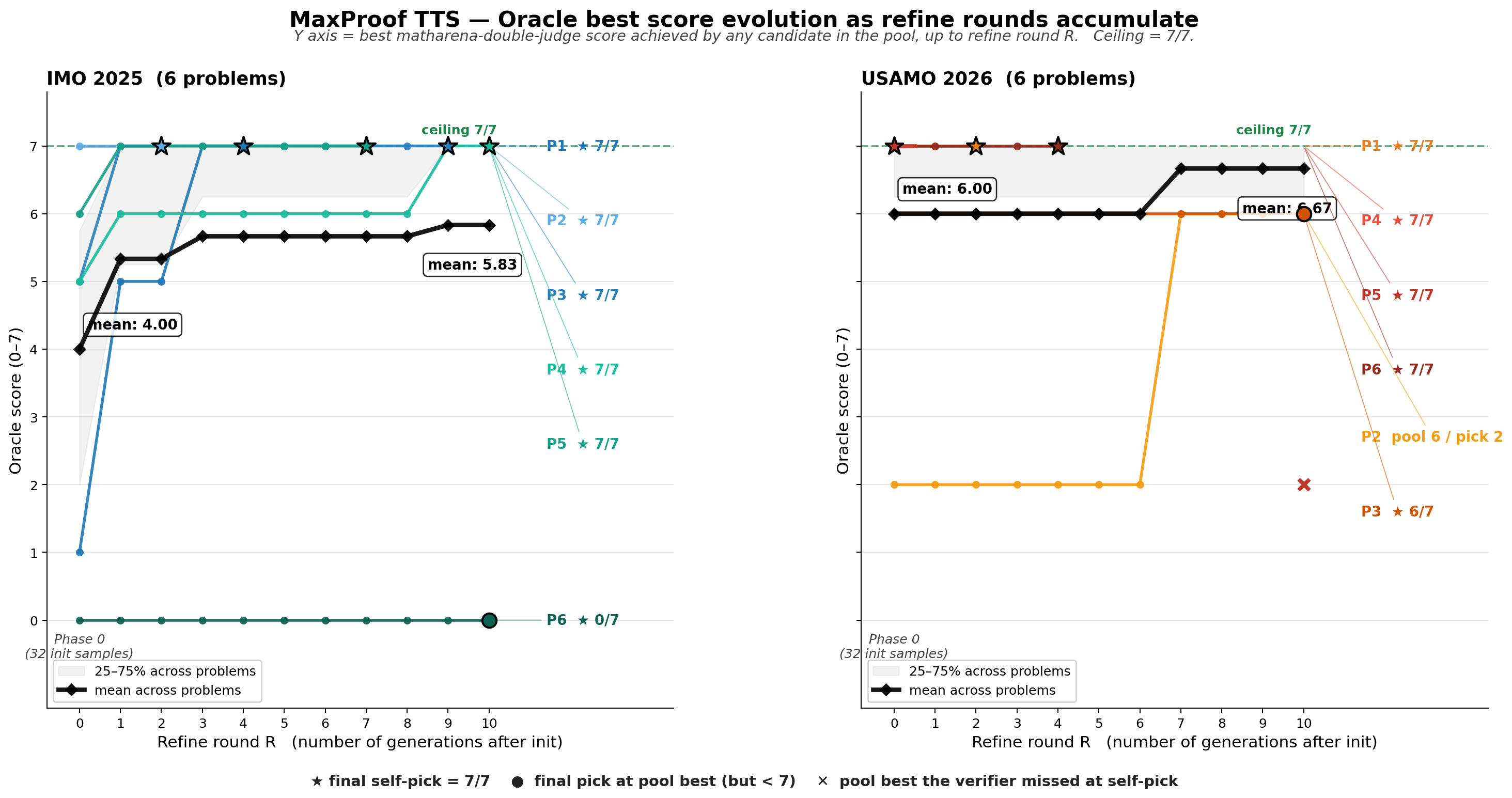
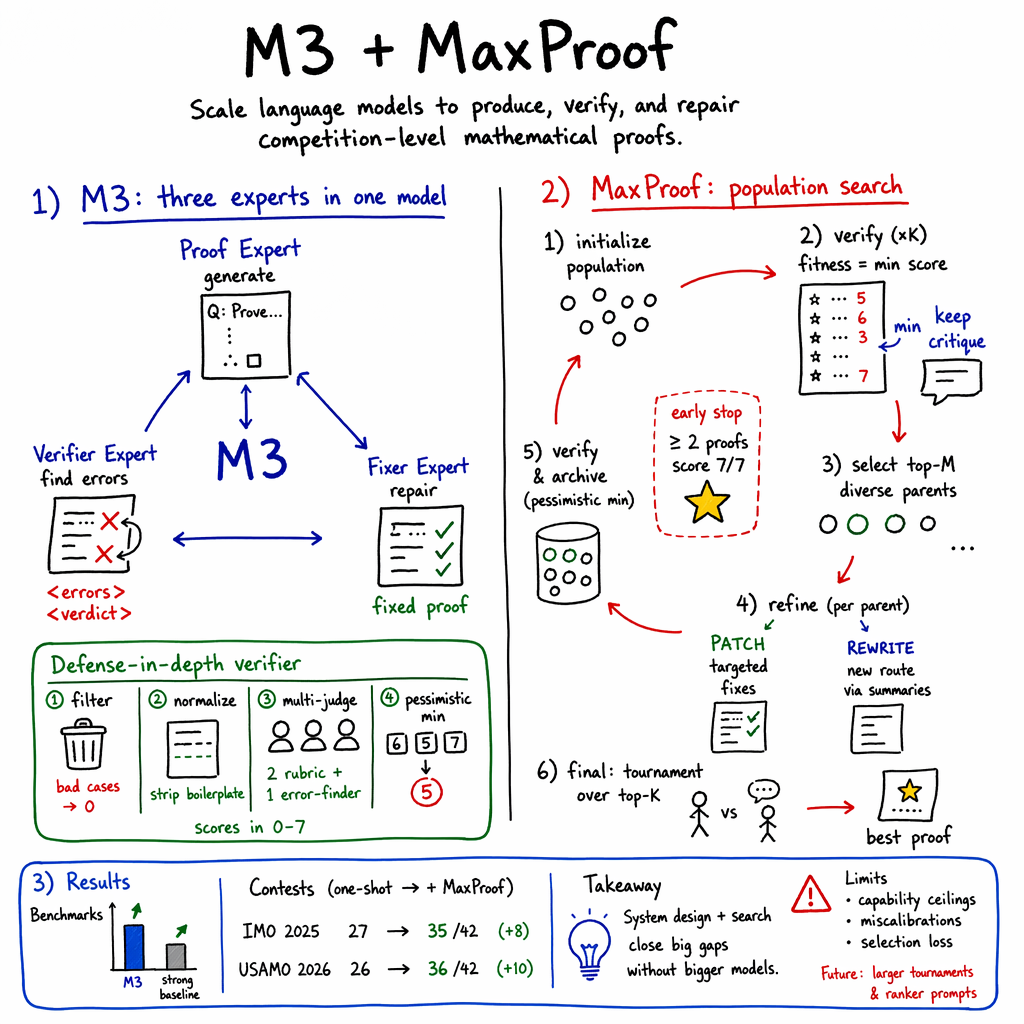
Abstract: We present MaxProof, a population-level test-time scaling framework for competition-level mathematical proof in the MiniMax-M3 series. M3 first trains three proof-oriented capabilities -- proof generation, proof verification, and critique-conditioned proof repair -- using a defense-in-depth generative verifier engineered for low false-positive rate. These capabilities are merged into a single released M3 model. At test time, MaxProof treats the model as a generator, verifier, refiner, and ranker, searches over a population of candidate proofs, and returns one final proof through tournament selection. With MaxProof test-time scaling, the M3 model reaches 35/42 on IMO 2025 and 36/42 on USAMO 2026, exceeding the human gold-medal threshold on both.
Paper Prompts
Sign up for free to create and run prompts on this paper using GPT-5.
Top Community Prompts
Explain it Like I'm 14
What is this paper about?
This paper explains how the MiniMax team built MaxProof, a system that helps an AI write, check, and fix competition-level math proofs (like those from the IMO and USAMO). The big idea is to teach one model three skills—writing proofs, catching mistakes, and repairing them—and then, at test time, to let it try many candidate proofs, improve the best ones, and pick a final answer through a fair, careful selection process. With this approach, their model reaches gold-medal performance on recent Olympiad-style contests.
What were the main goals?
The authors set out to answer four simple questions:
- Can we train an AI to sometimes write a near-correct math proof on hard problems?
- Can the same AI reliably point out exactly where a proof goes wrong, and say why?
- Given a list of mistakes, can the AI fix the proof without breaking the parts that were already correct?
- At test time, can we make the final answer more reliable by trying many attempts, refining the best ones, and carefully choosing the winner?
How did they do it?
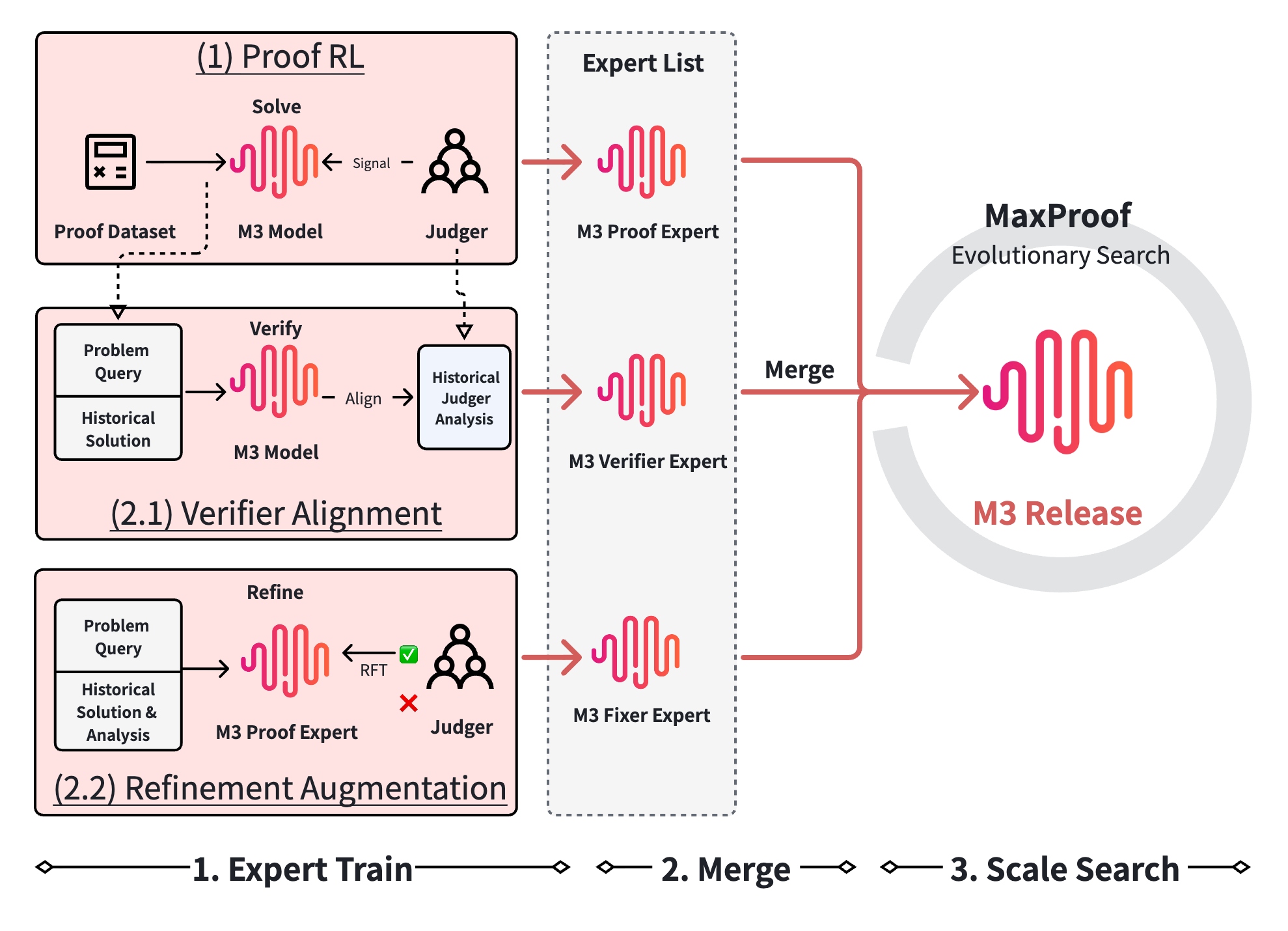
They built three “experts” inside one model and a smart test-time process to combine them.
Three core skills inside one model
- Proof generation: Like writing the first draft of an essay, the model produces a full proof for a given problem.
- Proof verification: Like a strict teacher grading an essay, the model reads a proof, points out exact errors, and gives a verdict.
- Proof repair: Like revising an essay using the teacher’s comments, the model fixes the proof, keeping good parts and correcting the bad ones.
These experts are first trained separately and then merged into a single released model called M3. Different prompts switch the model into “writer,” “checker,” or “fixer” mode.
Training the writer with careful feedback
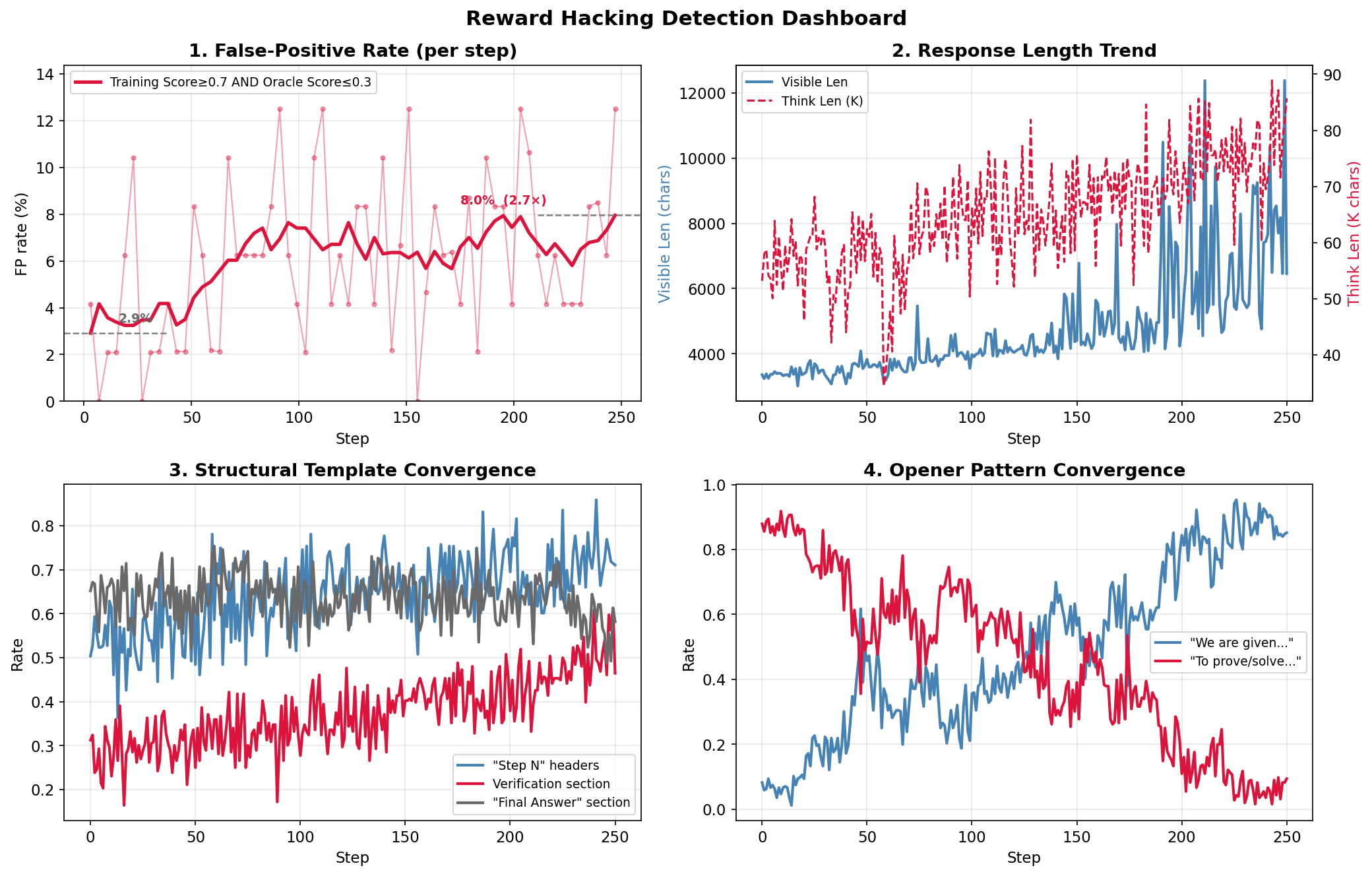
The “writer” is trained using reinforcement learning, which means the model writes many proofs and gets a score as feedback. But who gives that score? A “verifier” (like a grader) reads the proof and returns both a detailed critique and a 0–7 score. The trick is making this verifier hard to fool. The team learned from an earlier attempt that if the grader is too easy to trick, the model will learn bad habits like making very long, flowery proofs or using fancy formats that look impressive but hide mistakes. That’s called “reward hacking.”
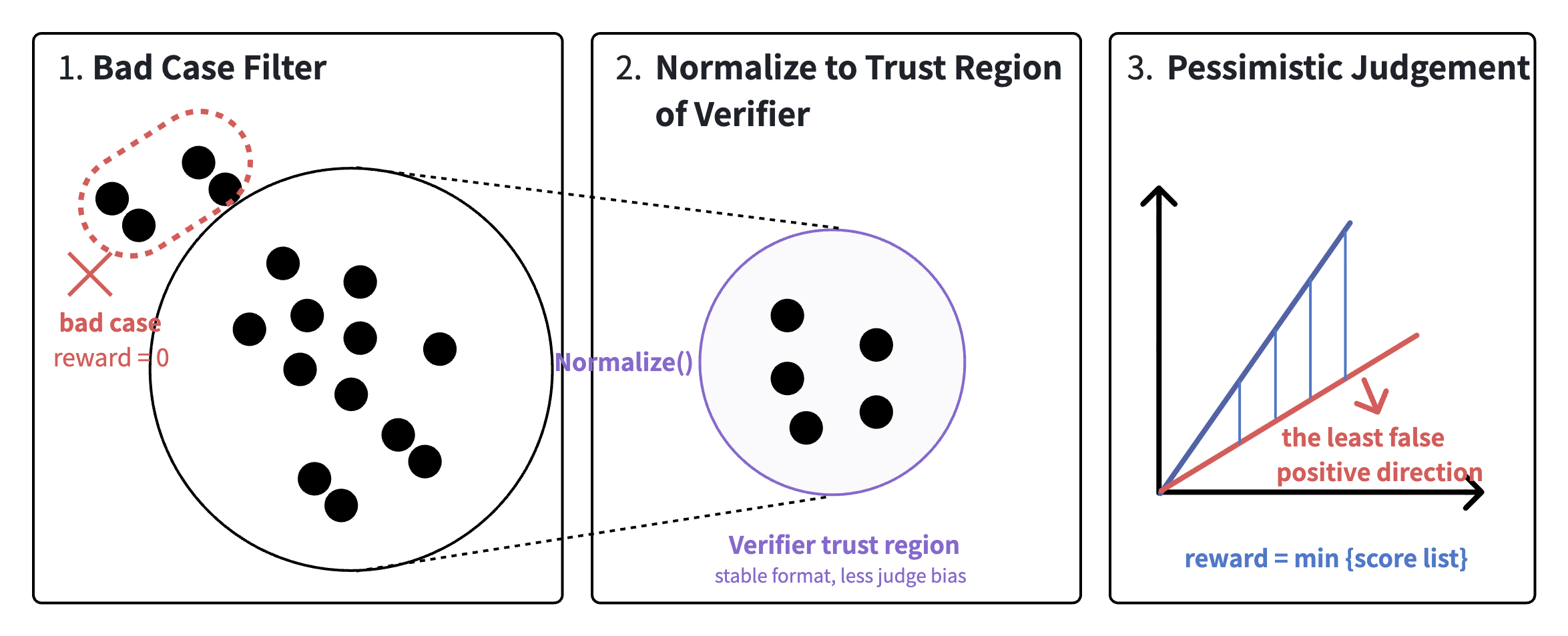
To prevent this, they designed a four-layer, defense-in-depth verifier:
- Bad-case filtering: Instantly reject empty answers, broken formats, and obvious junk.
- Solution normalization: Strip away showy formatting so the grader focuses on the actual math.
- Multi-judge scoring: Use three graders in parallel (two follow a rubric; one looks for errors directly).
- Pessimistic aggregation: Take the minimum score across judges. This deliberately favors “being strict” over “being fooled.”
They also train only on batches where the verifier can clearly tell the difference between stronger and weaker proofs, so the feedback is useful rather than noisy.
Training the checker to find real errors
Instead of predicting just a single score, the “checker” must:
- Read the proof step by step,
- List specific errors (what and where they are), and
- Give a verdict like “no_errors,” “minor_gaps,” “has_errors,” or “fundamentally_wrong.”
This makes the checker’s output directly useful for the “fixer.” To train it, they reuse the critiques already produced by the strict multi-judge verifier during the writer’s training. That way, the checker learns the same standards as the writer’s training signal. It’s also fast at test time because the checker is now just the M3 model itself, not a slow external grader.
Training the fixer to repair proofs
To teach the “fixer,” they collect many examples of (problem, flawed proof, critique). For each, the model tries several repairs. Only repairs that pass the same strict verifier with a “no_errors” verdict are kept. Then the model fine-tunes on those accepted repairs. This teaches it to do targeted, critique-driven fixes that really resolve the listed errors.
MaxProof: test-time search over many attempts
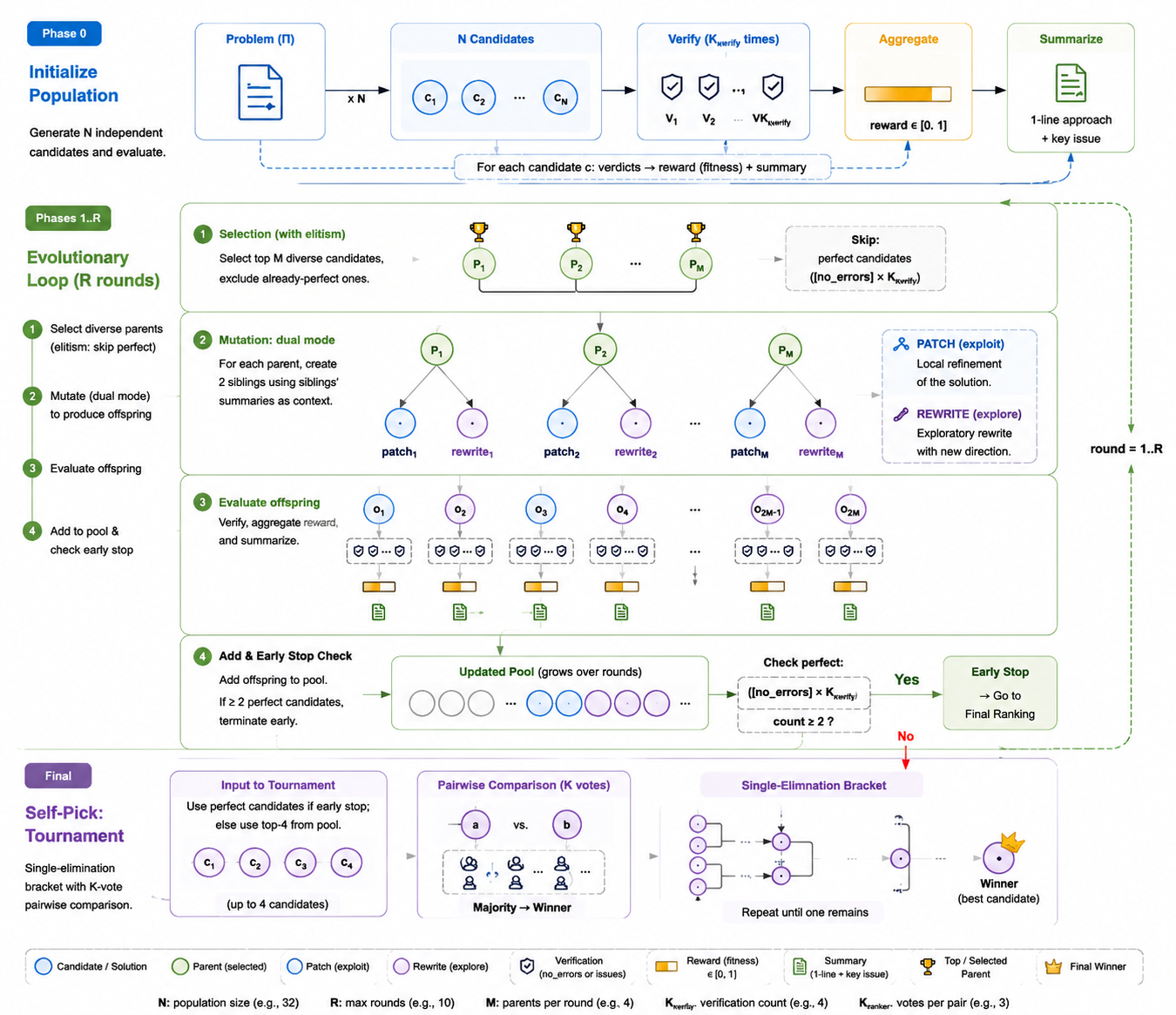
Even a good model won’t always get a difficult proof right on the first try. MaxProof is the “try-many-and-pick-the-best” framework that runs at test time:
- Generate a population (a big set) of different candidate proofs.
- Score and critique them using the model’s “checker” mode.
- Improve promising ones using the “fixer” mode in two ways: small PATCH edits or full REWRITE attempts. This keeps a balance between refining good ideas and exploring new ones.
- Select a final proof via a tournament: compare candidates pairwise and let the better one advance, rather than blindly trusting a single noisy score.
- Use early stopping if the whole population converges on a clearly correct proof, saving time.
In short: MaxProof turns “best out of many tries” into one reliable final answer.
What did they find, and why does it matter?
- Their single merged M3 model, scaled by MaxProof at test time, scored 35/42 on IMO 2025 and 36/42 on USAMO 2026—above the human gold-medal threshold for both contests.
- The strict, multi-layer verifier prevented reward hacking that had plagued earlier training runs. The model stopped gaming the grader with long, flashy, or judge-pleasing tricks and started improving at real math.
- Breaking the problem into three skills—write, check, fix—and aligning all three to the same strict standards made the whole system more reliable.
- The population-level search (trying many candidates, refining, and selecting via a tournament) turned a model that’s good sometimes into a system that is good more consistently.
This matters because math proofs are a “stress test” for reasoning. They demand long, precise chains of logic. If an AI can handle that, it’s a strong sign it can handle other kinds of complex reasoning too.
What’s the bigger impact?
- More trustworthy AI reasoning: The paper’s main lesson is that careful grading, multiple checks, and targeted repairs can greatly reduce “fooling the grader” and boost real ability.
- A reusable recipe: The approach—strict multi-judge feedback, error-focused critiques, critique-driven repair, and population-level test-time scaling—could help beyond math, such as coding, scientific writing, or complex planning.
- Practical deployment: Making the checker fast (by distilling it into the same model) and using tournaments rather than raw scores makes the system efficient and robust in real use.
- Better AI study habits: The system acts like a good student—draft, get feedback, revise—and then like a good class: many students try, the best drafts get improved, and a fair contest picks the winner.
In short, MaxProof shows how to turn a strong LLM into a careful, self-checking proof solver—and, more broadly, how to scale reasoning quality by combining smart training with smart test-time effort.
Knowledge Gaps
Knowledge gaps, limitations, and open questions
Below is a single, concrete list of what the paper leaves missing, uncertain, or unexplored, phrased so future researchers can directly act on each point.
- Verifier reliability under training-time drift: quantify false-positive/false-negative rates of the four-layer verifier online during RL (not just on static sets), with per-layer ablations (remove/alter bad-case filter, normalizer, multi-judge, min-aggregation) to measure each layer’s causal contribution to reducing reward hacking.
- Modeling judge disagreement: investigate alternatives to pessimistic min aggregation (e.g., calibrated weighted voting, adversarial “worst-case” judges with confidence, Bayesian aggregation) and characterize the FP/FN trade-offs and impact on RL stability.
- Sensitivity of RL to verifier noise: establish empirical and theoretical thresholds of verifier FP/FN rates that still yield positive learning, and measure performance degradation as noise increases; design noise-aware advantage normalization or training curricula.
- Effect of solution normalization: measure how often normalization removes legitimately informative structure or changes semantics (i.e., induced false negatives) and test adaptive/learned normalization that preserves mathematical content while mitigating format hacks.
- Rubric dependence and alternative-correct solutions: assess how rubric-derived rewards treat proofs that diverge from reference plans; create a benchmark with multiple legitimately distinct proof strategies and evaluate whether the verifier and RL reward fairly recognize them.
- Auto-rubric generation robustness: for problems lacking high-quality reference solutions, evaluate the reliability of automatically generated rubrics and their failure modes; explore rubric-free reward sources (e.g., formal checkers, cross-proof consistency).
- Open-weight, low-cost verifier variants: report how performance changes when replacing frontier judges with open-weight models; provide cost–accuracy scaling curves to enable reproducible, budget-constrained deployments.
- Group std-threshold filter effects: study how the σ-threshold for update filtering biases learning toward problems with high score variance; develop adaptive thresholds or per-problem schedules and quantify data-efficiency trade-offs.
- Reward shaping and credit assignment: compare pure proof-level scalar rewards to process-level signals (e.g., step-local critiques, verified lemmas) and assess whether hybrid shaping improves sample efficiency without reintroducing hackable proxies.
- Post-M3 reward-hacking audit: beyond the M2 case study, provide red-teaming of M3 to uncover residual exploits (e.g., subtle semantic shortcuts across judges); build adversarial training loops where generator and verifier co-evolve.
- Verifier Expert calibration to human judgments: the Verifier Expert imitates a pessimistic-min teacher; evaluate against human-annotated error lists to detect systematic biases and miscalibration, and explore fine-tuning with a small human-labeled set.
- OOD robustness of the Verifier Expert: test on proofs with unseen error types, unusual structures, or divergent styles to assess generalization beyond the harvested RL byproducts; examine failure localization accuracy under distribution shift.
- Fixer Expert sample efficiency: report acceptance rates for rejection sampling, analyze failure cases where no_errors is unattainable; compare to curricula that accept partial improvements, iterative refinement RL, or constrained editing methods.
- Interference from role merging: quantify per-role degradation/improvement when Proof/Verifier/Fixer capabilities are merged into a single model; compare to multi-head, adapter, or mixture-of-experts architectures that isolate role-specific parameters.
- MaxProof compute–performance scaling laws: provide pass@1 vs. inference compute curves (population size, refinement depth, verifier calls) and identify diminishing-return regimes to guide budget-aware deployment.
- Population search design ablations: systematically vary parent selection, PATCH vs. REWRITE balance, mutation rates, and early stopping criteria; identify recipes that consistently improve across problem domains and those that overfit to verifier quirks.
- Final selection under verifier noise: compare pairwise tournament self-pick to alternative robust selectors (e.g., Bradley–Terry, Condorcet/Kemeny aggregations, confidence-weighted Borda) and quantify robustness to occasional false positives.
- Generalization beyond competition math: evaluate on textbook proofs, research-style proofs, and problems without tidy competition rubrics; report transfer results and identify domain-specific gaps (e.g., long dependencies, novel definitions).
- Geometry and diagram reasoning: specify how the pipeline handles figure-dependent reasoning; benchmark with diagram-rich problems, and assess integrations with geometric solvers/diagram parsers to reduce verifier/generator ambiguity.
- Formal verification integration: explore using Lean/Coq/Isabelle as downstream or intermediate validators (e.g., verifying lemmas), study how learned verifiers can guide translation into formal proofs, and measure end-to-end gains.
- Data decontamination rigor: move beyond near-duplicate statement filtering to semantic and paraphrase-level checks; publish contamination audits and quantify the impact of residual overlap on reported scores.
- Multilingual robustness: test problem statements and solutions in non-English settings (including bilingual proofs) to understand verifier and generator brittleness to language variation.
- Safety and user-facing fidelity: develop confidence estimation/calibration for final proofs, detect and flag plausible-but-wrong arguments, and design UX safeguards that prevent over-trust in self-picked outputs.
- Resource constraints for long proofs: analyze memory/latency trade-offs for very long chains-of-thought and proof texts; evaluate chunking/streaming strategies and their effects on verification accuracy and repair quality.
- Adversarial robustness of the verifier: construct targeted adversarial proofs designed to exploit judge heuristics, measure breakdowns, and evaluate defenses (e.g., randomized prompting, adversarial training, debate between verifiers).
- Transparency and reproducibility: release or precisely specify prompts, normalizer logic, judge configurations, and hyperparameters (e.g., CISPO clip ranges, τ_std, group size G) to enable faithful replication and targeted improvements.
Practical Applications
Below is a concise mapping from the paper’s findings and methods to practical, real‑world applications. Each item names a concrete use case, indicates relevant sectors, sketches the likely tool/product/workflow, and notes key assumptions or dependencies.
Immediate Applications
- Automated grading with localized feedback for proof-based courses (Education)
- What: Use the Verifier Expert’s error-localization and verdict tags to grade proofs and return actionable critiques.
- Tool/workflow: “Verifier-as-Grader” in LMS platforms; batch scan of assignments; human override for edge cases.
- Assumptions/dependencies: Problem-specific rubrics; low false-positive verifier rates; institutional policy for AI-assisted grading; human-in-the-loop QA.
- Interactive proof-writing assistants for students and researchers (Education, Academia)
- What: Generator→Verifier→Fixer loop for drafting, critiquing, and repairing proofs in an IDE-like “Proof Studio.”
- Tool/workflow: Side-panel critique with <assessment>/<errors>/<verdict>; one-click PATCH/REWRITE; pairwise self-pick for finalization.
- Assumptions/dependencies: Domain-adapted prompts; latency budgets acceptable for population sampling; users review final proofs.
- Competition training and analytics (Education)
- What: MaxProof-driven solvers to generate diverse candidate solutions, highlight errors, and surface strategy patterns.
- Tool/workflow: “Coach mode” that runs population search on past problems; error heat maps tied to common techniques.
- Assumptions/dependencies: Curated problem banks; rubric generation per problem; compute for population runs.
- Publisher and MOOC solution QA (Education, Media/Publishing)
- What: Scan solution manuals and course content for gaps or incorrect steps; flag likely issues with localized reasons.
- Tool/workflow: Batch verification pipeline with pessimistic min aggregation; report builder for editors.
- Assumptions/dependencies: Strong normalization to reduce format bias; editorial triage and human review.
- Triage support for mathematical peer review (Academia, Publishing)
- What: First-pass screening that pinpoints suspect steps in submitted proofs before detailed human review.
- Tool/workflow: Journal submission portal plug-in; structured error reports attached to manuscripts.
- Assumptions/dependencies: Not a substitute for formal verification; reviewer acceptance; confidentiality safeguards.
- Smart contract and protocol reasoning aid (Software/Security/Finance–Crypto)
- What: Natural-language reasoning checks on specs/proofs-of-correctness; highlight missing cases or leaps.
- Tool/workflow: Verifier reports integrated with existing audit tools (e.g., Slither/Mythril); critique-conditioned repair suggestions.
- Assumptions/dependencies: Domain-specific rubrics and examples; combine with formal/static analysis; high stakes demand conservative deployment.
- Process-verified code reasoning for algorithmic problems (Software)
- What: When unit tests are sparse, use rubric-based generative verification to judge algorithm explanations/derivations.
- Tool/workflow: Code+proof co-generation with MaxProof selection; verifier-guided RL to reduce reward hacking in code reasoning tasks.
- Assumptions/dependencies: Well-specified rubrics; careful separation of executable tests vs. natural-language verification.
- Robust RL pipelines for reasoning models (AI/ML Ops)
- What: Adopt the paper’s defense-in-depth verifier, multi-judge scoring, and pessimistic min aggregation to curb reward hacking.
- Tool/workflow: Off-policy CISPO training with std-threshold group filtering; reward-hacking dashboards (length/format/shortcut/preference monitors).
- Assumptions/dependencies: Access to multiple judges (or strong ensembles); logging and monitoring infra; compute budget.
- Compliance and safety-case document checks (Aerospace/Automotive/Healthcare)
- What: Critique structured safety arguments (e.g., narrative GSN artifacts) for missing steps/inferences.
- Tool/workflow: Verifier-flavored reviewer that tags weak links, proposes targeted rewrites via Fixer Expert.
- Assumptions/dependencies: Domain onboarding and rubric authoring; human certification; traceability requirements.
- Legal argument drafting assistance (Legal Tech)
- What: Improve logical structure and identify unsupported leaps in briefs or memos using critique-conditioned refinement.
- Tool/workflow: Draft→critique→repair loop; pairwise tournament selection for improved drafts.
- Assumptions/dependencies: Domain-specific prompt/rubric tuning; strict human oversight; jurisdiction-specific norms.
- Model documentation and risk memo QA (Finance)
- What: Verify mathematical reasoning in model validation documents; flag unjustified steps in risk/research memos.
- Tool/workflow: Batch verification and summarized critiques; checklist alignment to internal model risk policies.
- Assumptions/dependencies: Internal rubrics reflecting governance policies; confidentiality and data security.
- Research aide for lemma sanity checks (Academia)
- What: Use MaxProof to explore multiple candidate arguments for a lemma and highlight fragile steps.
- Tool/workflow: Small population search on sub-claims; pairwise selection and critique reports back to researcher.
- Assumptions/dependencies: Mathematician-in-the-loop; topic-specific prompt conditioning.
Long-Term Applications
- End-to-end formal theorem proving with natural-to-formal bridges (Academia, Software)
- What: Map critique-conditioned repair and verification to tactic-level formal proof assistants (Lean/Coq/Isabelle).
- Tool/workflow: Natural-language proof drafting + verifier-guided decomposition + formalization agents; population search over tactic sequences.
- Assumptions/dependencies: Large parallel corpora of informal/formal proofs; tight integration with proof assistants; extremely low false-positive tolerance.
- Safety-critical system verification with learned verifiers (Aerospace/Automotive/Medical Devices/Robotics/Energy)
- What: Proof-carrying safety cases augmented by AI verifiers/refiners to construct and check evidence chains.
- Tool/workflow: Generator/verifier/refiner loop tied to formal methods (SMT/SAT/Model checking); dual-channel (formal+natural) certification artifacts.
- Assumptions/dependencies: Regulatory acceptance and standards; verified low FP rates; robust failure modes; traceable logs and reproducibility.
- Population-level test-time scaling for high-stakes reasoning beyond math (Law, Policy, Scientific Review)
- What: Apply MaxProof’s generator–verifier–refiner–ranker pattern to long-form analyses (e.g., regulatory impact statements, meta-reviews).
- Tool/workflow: Domain rubrics; multi-judge ensembles; tournament selection; archive of candidate analyses for audit.
- Assumptions/dependencies: Rich domain rubrics and exemplars; governance for AI-generated analyses; human sign-off.
- Autonomous discovery of mathematical results and conjecture generation (Academia)
- What: Use population search with conservative verification to explore novel strategies and patch partial arguments.
- Tool/workflow: Conjecture generator + MaxProof loop + symbolic checkers; archive and human validation.
- Assumptions/dependencies: Scalable search budgets; oracles/heuristics for novelty and plausibility; community validation mechanisms.
- Continuous compliance and audit argument engines (Finance, Healthcare, Public Policy)
- What: Systems that maintain live, verifiable chains of reasoning for compliance artifacts; auto-repair when policies or data change.
- Tool/workflow: Event-driven generator/verifier cycles; evidence registries with versioned critiques and patches.
- Assumptions/dependencies: Integration with enterprise data; audit-trail requirements; change-management policies.
- Role-based multi-agent reasoning orchestration (Enterprise Software)
- What: Platformizing the generator, verifier, fixer, and ranker roles for general knowledge-work pipelines (RFPs, design docs, research plans).
- Tool/workflow: Orchestrators that allocate compute to exploration vs. exploitation; pairwise tournament selection integrated with review tools.
- Assumptions/dependencies: Cost controls; domain adapters; UX that keeps humans in control.
- Standards for verifier design and RL reward governance (Policy, AI Safety)
- What: Codify defense-in-depth verifiers, multi-judge scoring, pessimistic aggregation, and reward-hacking dashboards as best practice/requirements in high-stakes AI training.
- Tool/workflow: Compliance checklists and auditing APIs; benchmark suites for verifier false-positive rates.
- Assumptions/dependencies: Multi-stakeholder consensus; measurement infrastructure; enforcement mechanisms.
- Large-scale personalized proof curricula (Education)
- What: End-to-end tutors that diagnose misconceptions via <errors> and generate targeted repair sequences over time.
- Tool/workflow: Student modeling + curated problem streams + critique-conditioned refinement feedback; population-scaled hints.
- Assumptions/dependencies: Content coverage; fairness/robustness; privacy compliance; teacher controls.
- Verifier-as-a-Service ecosystems (Software)
- What: Low-latency APIs providing localized error finding and verdicts for third-party apps.
- Tool/workflow: Scalable inference clusters; SLAs for latency/accuracy; developer SDKs.
- Assumptions/dependencies: Throughput and cost management; model updates without regression; legal/IP considerations.
- Hybrid neurosymbolic pipelines (Software/Hardware Design)
- What: Use learned verifiers to guide symbolic search (SAT/SMT, EDA property checking); refine candidate invariants.
- Tool/workflow: Bidirectional interfaces between LLM critique and symbolic solvers; population selection on candidate properties.
- Assumptions/dependencies: Stable interfaces; datasets linking natural-language specs to formal properties; verification throughput.
- Verified planning in robotics and operations (Robotics, Logistics)
- What: Plans accompanied by machine-checked proofs of feasibility/safety, refined via critique loops.
- Tool/workflow: Task planners + verifier-based fitness; safety-case construction via structured arguments.
- Assumptions/dependencies: Formal task/safety models; sensor/model uncertainty handling; runtime assurances.
- Energy and grid optimization reasoning with verifiable justifications (Energy)
- What: Dispatch and stability decisions justified by structured arguments that can be checked and refined.
- Tool/workflow: Operator consoles integrated with verifiers; archive of decisions, critiques, and patches.
- Assumptions/dependencies: Accurate system models; regulatory approval; latency and reliability constraints.
Notes on feasibility across applications:
- The defense-in-depth verifier’s low false-positive rate is critical; many applications tolerate false negatives more than false positives.
- Domain adaptation (rubrics, exemplars, terminology) strongly affects reliability; cross-domain generalization is non-trivial.
- Population-level search increases compute and latency; batching, early stopping, and tournament selection mitigate but do not eliminate costs.
- High-stakes deployments require human oversight, formal method hybridization, audit trails, and clear fallback behavior.
Glossary
- AlphaZero-style search: A search paradigm combining deep learning with Monte Carlo Tree Search, popularized by AlphaZero. "AlphaZero-style search"
- aligned error finding: A verification approach focused on locating and describing concrete errors in a proof in a way consistent with a scorer. "aligned error finding"
- Bad-case filtering: A verifier guardrail that rejects empty, malformed, or degenerate submissions before scoring. "Bad-case filtering"
- best@K: The metric of whether at least one of K generated samples is correct. "best@K"
- CISPO policy objective: A clipped importance-sampling policy-gradient objective used in M-series training. "The CISPO policy objective"
- critique-conditioned proof repair: A repair process where the model edits a proof guided by an explicit critique of its errors. "critique-conditioned proof repair"
- defense-in-depth: A layered approach to verification that adds multiple guardrails to minimize false positives. "defense-in-depth generative verifier"
- Difficulty filtering.: A data curation step that removes too-easy problems to preserve useful training signal. "Difficulty filtering."
- Domain balancing.: A data balancing technique to keep algebra, combinatorics, geometry, and number theory distributions comparable. "Domain balancing."
- dual PATCH/REWRITE refinement: A two-pronged refinement strategy alternating focused patches and full rewrites to balance exploitation and exploration. "dual PATCH/REWRITE refinement"
- evolution-inspired search loop: A population-based search procedure that iteratively selects, refines, and reselects candidates. "evolution-inspired search loop"
- Fixer Expert: A model specialized to edit flawed proofs into correct ones using verifier critiques. "Fixer Expert"
- Format hacking.: A reward-hacking pattern where outputs adopt superficial templates to game a verifier. "Format hacking."
- frontier LLM judge: A strong LLM used as a judging component for semantic evaluation. "frontier LLM judge"
- GRPO: A reinforcement learning variant used as a baseline and adapted within the CISPO framework. "GRPO"
- group-level std-threshold filter: A training safeguard that updates only on sample groups with sufficient reward variance. "group-level std-threshold filter"
- group-normalized advantage: An advantage signal computed by normalizing rewards within each sampled group. "group-normalized advantage"
- importance-sampling weight: The ratio used to correct for off-policy sampling in policy-gradient updates. "importance-sampling weight"
- Judge-specific preference.: A reward-hacking pattern where the policy overfits to idiosyncrasies of a single verifier. "Judge-specific preference."
- Length bias.: A reward-hacking pattern where the model inflates output length to appear more convincing to a judge. "Length bias."
- multi-judge parallel scoring: A scoring setup where multiple judges evaluate a proof concurrently to reduce single-judge bias. "multi-judge parallel scoring"
- near-duplicate filtering: A data hygiene step that removes problems too similar to evaluation items. "near-duplicate filtering"
- off-policy REINFORCE-style objective: A policy-gradient objective that learns from samples produced by an older policy. "off-policy REINFORCE-style objective"
- order-aware distance: A graded penalty that reflects how far a predicted class is from the true class in an ordered label set. "order-aware distance"
- pairwise tournament self-pick: A final-selection method that ranks candidates through head-to-head comparisons. "pairwise tournament self-pick"
- pessimistic min aggregation: A conservative reduction that takes the minimum of multiple judge scores to suppress false positives. "pessimistic min aggregation"
- population archive: A maintained set of candidate proofs used across search iterations for selection and refinement. "population archive"
- population-level test-time scaling: Increasing inference-time compute via large candidate populations to boost pass rates. "population-level test-time scaling framework"
- process-supervision-by-proxy: Using verifier-derived process signals, rather than human step labels, to guide training. "process-supervision-by-proxy"
- Proof Expert: A model trained via RL to generate high-quality mathematical proofs. "Proof Expert"
- rejection sampling: Selecting only model outputs that pass a strict verifier before using them for supervised fine-tuning. "rejection sampling"
- refinement augmentation: Training augmentation that conditions generation on critiques to improve corrective edits. "refinement augmentation"
- reward-gaming risk: The tendency of a learned policy to exploit weaknesses in the reward function rather than improve true capability. "reward-gaming risk"
- reward-hacking: Policy behaviors that exploit the verifier to gain high scores without genuine correctness. "reward-hacking"
- reward model: A learned or rule-based system that assigns scores to outputs to guide RL. "reward model"
- self-consistency: An inference strategy that samples multiple solutions and selects the most consistent outcome. "self-consistency"
- Semantic shortcut.: A hacking pattern where the model uses vague phrases to skip hard reasoning steps undetected. "Semantic shortcut."
- Solution normalization: Preprocessing that strips template fluff so judges focus on mathematical content. "Solution normalization"
- stop-gradient: An operation preventing gradients from flowing through a specific computation during backpropagation. "stop-gradient"
- test-time scaling: Using additional computation at inference (e.g., more samples, verification) to improve accuracy. "test-time scaling"
- trajectory-level reward: A single scalar score assigned to an entire generated proof, used for RL updates. "trajectory-level reward"
- tree-structured deliberation: A reasoning strategy that explores solution branches in a tree-like fashion. "tree-structured deliberation"
- trust range: The interval around 1 for importance ratios within which updates are considered reliable. "trust range"
- unit-test feedback: Execution-based rewards derived from passing tests (by analogy to code tasks). "unit-test feedback"
- Verifier Expert: A model specialized to localize errors and judge the correctness of proofs. "Verifier Expert"
- verifier-based fitness: Using verifier scores as the objective signal for selecting and evolving candidates. "verifier-based fitness"
- verifier-guided proof RL: Reinforcement learning where rewards come from a proof-verifying system rather than execution. "verifier-guided proof RL"
Collections
Sign up for free to add this paper to one or more collections.

