- The paper introduces a geometric explanation for abrupt phase transitions in continuous generative samplers using projection caustics.
- It presents the Critical Boundary Detector (CBD) as a diagnostic tool for detecting and controlling score-direction instability along denoising trajectories.
- Empirical results on toy geometries and pretrained diffusion models validate the framework, enhancing intervention efficiency and interpretability.
Geometry-Driven Phase Transitions in Generative Dynamics: Projection Caustics and the Critical Boundary Detector
Introduction and Theoretical Motivation
The paper "The Geometry of Phase Transitions in Generative Dynamics via Projection Caustics" (2606.13191) provides a geometric account of sharp qualitative transitions in continuous-state generative samplers, such as diffusion and flow-matching models. In these models, sample trajectories may undergo abrupt semantic commitments, mode collapses, and irreversible branching—even though underlying dynamics are continuous in state space. The authors unify manifold geometry, free-energy landscape analysis, and a new operational diagnostic, the Critical Boundary Detector (CBD), to explain, localize, and control these phase-transition-like behaviors.
Diffusion and score-based generative models (e.g., DDPMs [Ho2020denosing], score-based SDEs [song2021scorebased], EDMs [karras2022edm]) generate data by reversing a noise-to-data stochastic process. Although these models are continuous and theoretically reversible, empirical observations highlight discrete events: mode commitment, semantic bifurcation, and nonlocal propagation of small perturbations. Prior theoretical work has analyzed such transitions from statistical-physics and information-theoretic perspectives, describing regimes such as symmetry breaking, condensation, and critical instability [biroli2024dynamical, ambrogioni2025thermo, stancevic2026information], but existing analyses are population- or spectral-level, lacking a geometric and trajectory-local mechanism.
This work grounds these transitions in the geometry of the data support, specifically focusing on the role of projection caustics: regions where the nearest-point projection onto the data manifold is not unique. Denoising trajectories passing near projection-caustic sets are shown to undergo rapid reorientation in the score direction, corresponding to branching and semantic commitment. The CBD is introduced as a practical diagnostic for direction-instability in score fields, enabling precise localization and control of these transitions in both toy models and large-scale vision diffusion models.
Free Energy Landscape and Projection Caustics
The central theoretical framework interprets denoising as gradient descent on the free energy landscape Fσ(x), defined as
Fσ(x)=−σ2logpσ(x)
where pσ(x) is the Gaussian-smoothed data density. At high noise, the free energy landscape is smoothly convex; as noise decreases, its geometry sharpens and is dominated by proximity to the support of the data distribution.
At points where the projection onto the data support is unique (the projection-regular regime), the denoising direction is stable—a single branch dominates the local geometry. However, near the projection caustic, where several branches are equally near, the free energy becomes a log-sum-exp over multiple branches. As noise decreases, the effective score transitions sharply between these branches, yielding local geometric instability in the normalized denoising direction (score direction). This transition Figure 1 underpins semantic commitment and mode selection in diffusion trajectories.
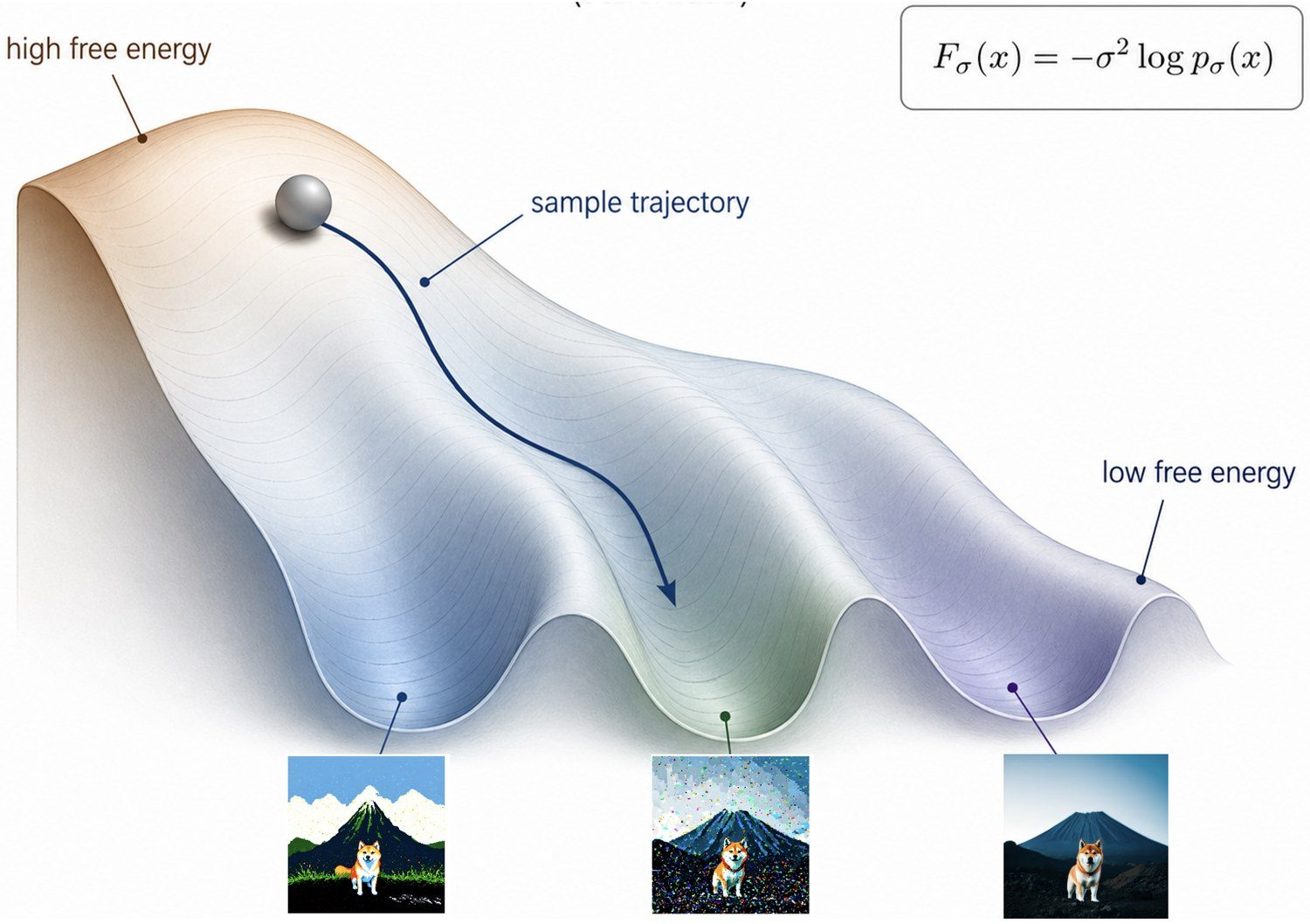
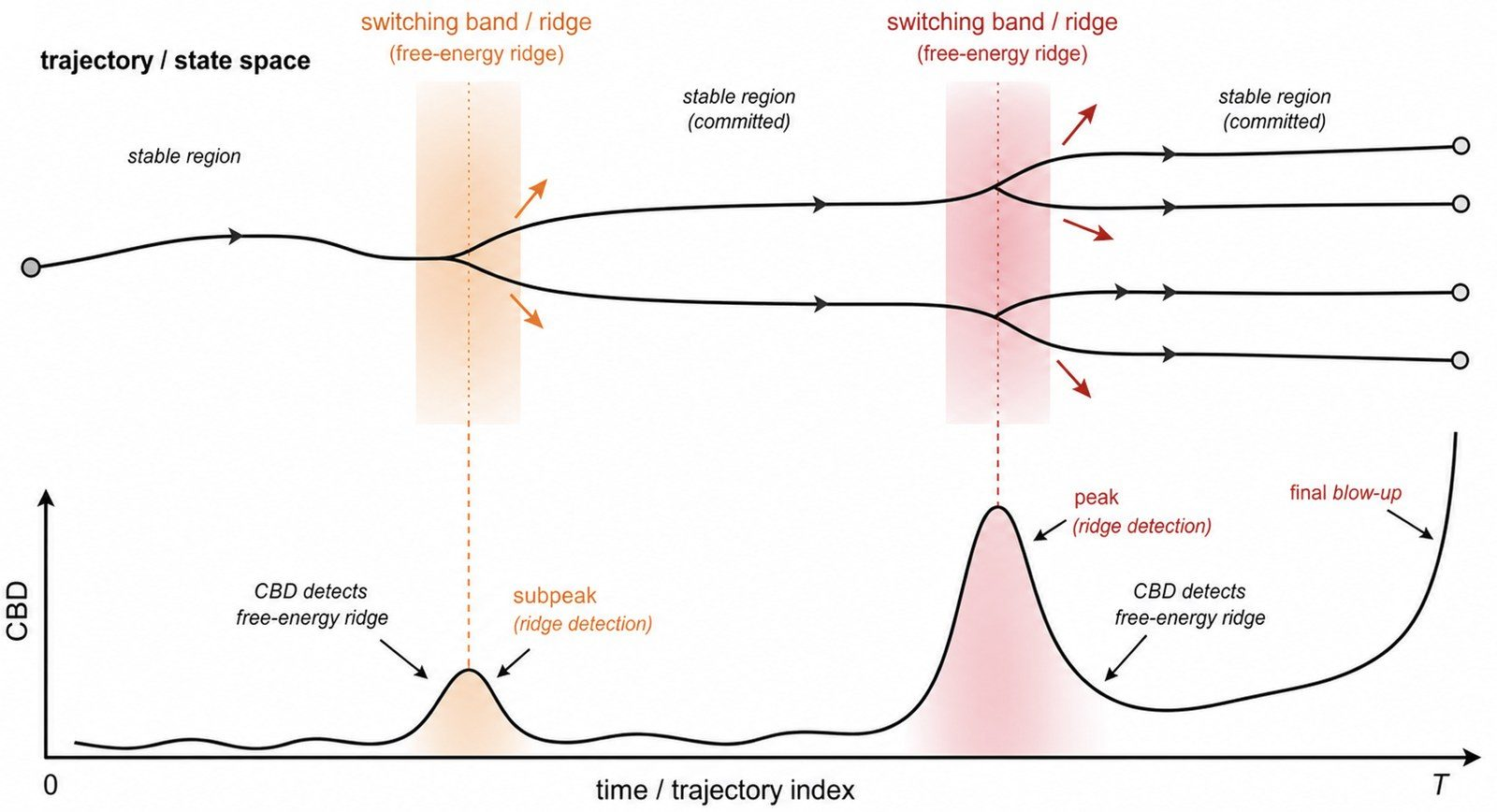

Figure 1: Denoising is interpreted as descent on a free energy landscape. Near projection caustics, multiple branches compete and create free energy ridges.
Mathematically, near a projection caustic C(K) with m branches, the free energy admits an asymptotic expansion:
Fσ(x)≈−σ2log(j=1∑mBj(x)exp(−2σ2Sj(x)))
where Bj(x) are model- and geometry-dependent amplitudes, and Sj(x) are squared distances to each relevant branch. The normalized score is thus a softmax-weighted mixture of branchwise directions, yielding rapid reorientation as x traverses the (finite-width) switching band surrounding the projection caustic.
Critical Boundary Detector (CBD): Operationalizing Direction Instability
Building on this geometric mechanism, the Critical Boundary Detector (CBD) is introduced as a trajectory-local diagnostic for score-direction instability:
CBD(x,t)=∥∇xut(x)∥F
where Fσ(x)=−σ2logpσ(x)0 is the normalized score or effective update direction at time Fσ(x)=−σ2logpσ(x)1. In practice, random-direction finite differences or the trajectory-adapted directional (TAD) proxy are used for large models to estimate when small perturbations in state space induce large changes in trajectory direction. This operationalizes the detection of regions where small interventions can substantially affect final generative outcomes.
Trajectory-level CBD and TAD peaks are demonstrated to coincide with empirical mode selection, semantic branching, and windows of high intervention sensitivity in both low-dimensional toy geometries and high-dimensional pretrained diffusion models (CIFAR-10 DDPM, DiT-XL, EDM2, Stable Diffusion 3.5 Medium).
Empirical Results: Phase-Transition Diagnostics and Control
Toy Geometries
In models trained on synthetic data supports (e.g., transverse cross and cusp), the CBD field exhibits explicit ridges near the projection caustic Figure 2, and targeted interventions within these regions can efficiently control branch selection with minimal intervention steps.
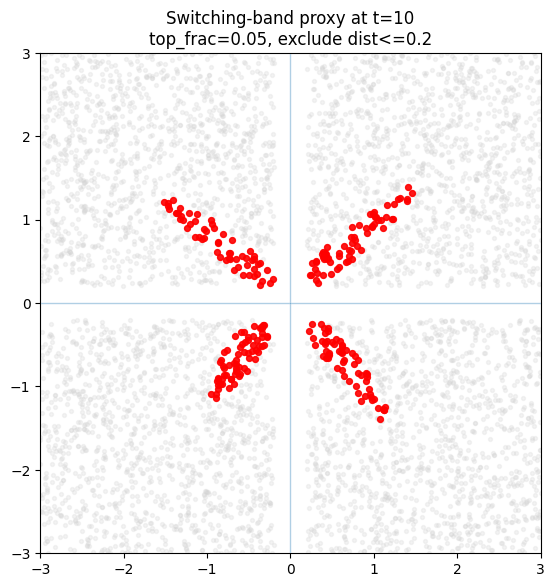
Figure 2: Estimated switching-band proxy for the transverse cross at Fσ(x)=−σ2logpσ(x)2. Red points denote the top Fσ(x)=−σ2logpσ(x)3 of the normalized CBD values among points satisfying a distance threshold from the support.
CBD-guided interventions in high-ridge regions recover most of the effect of always-on interventions while acting only near critical switching regions, confirming the prediction that geometric caustics localize mode commitment and controllable phase transitions Figure 3.
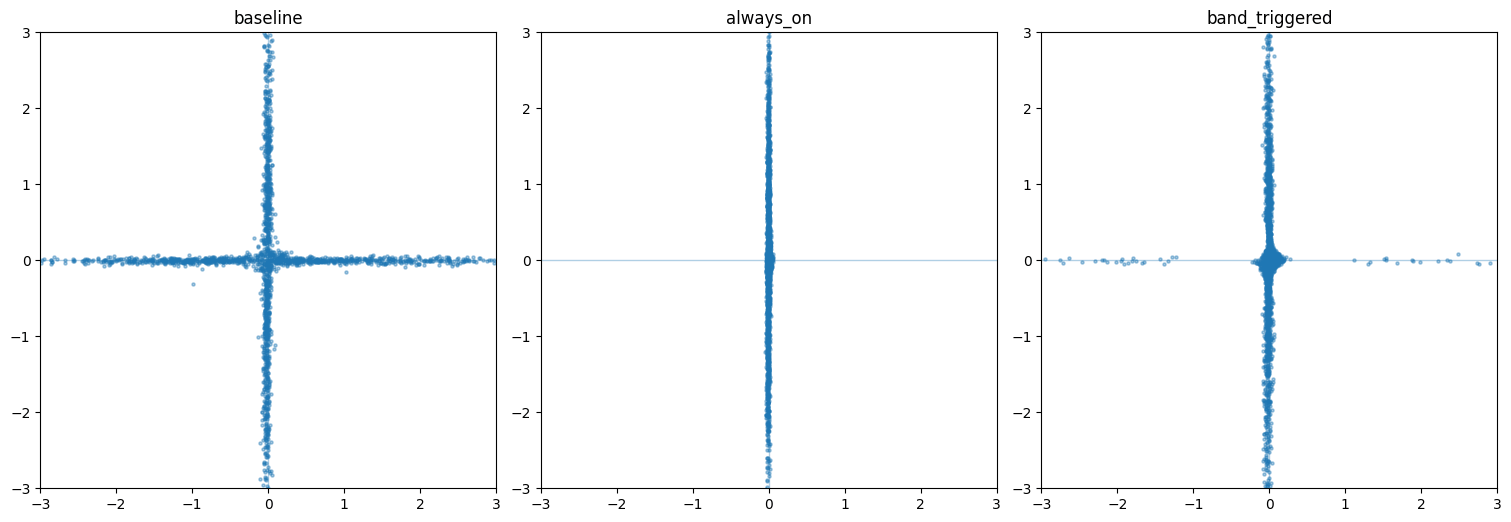
Figure 3: Branch-selection control on the transverse cross. From left to right: baseline sampling, always-on intervention, and intervention triggered only inside the estimated switching band.
Pretrained Diffusion Models
In pretrained DDPMs on CIFAR-10, the TAD profile consistently localizes a narrow instability band aligned with maximal intervention sensitivity Figure 4. Interventions confined to these windows cause significantly higher LPIPS dissimilarity and semantic change in output samples than interventions of equal size outside the band.
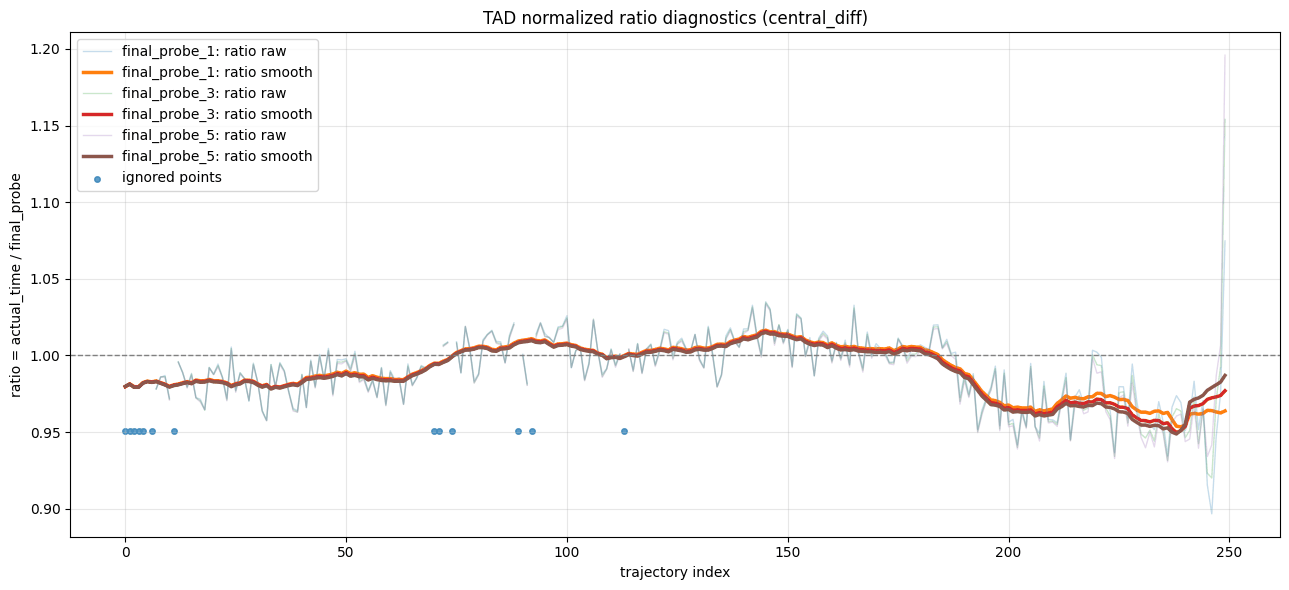
Figure 4: Normalized TAD-ratio diagnostic along a baseline reverse trajectory on CIFAR10. The ratio exhibits an early-time dip over the first Fσ(x)=−σ2logpσ(x)4 saved trajectory steps, coinciding with maximal intervention sensitivity.
A similar structure is found universally across different architectures and datasets (DiT-XL on ImageNet, EDM2-XS on CIFAR-10, SD3.5 Medium) Figure 5, with a shared three-region instability profile: initial stable high-noise regime, a narrow critical band of score-direction instability (the "switching window"), and re-stabilization in the low-noise endpoint.
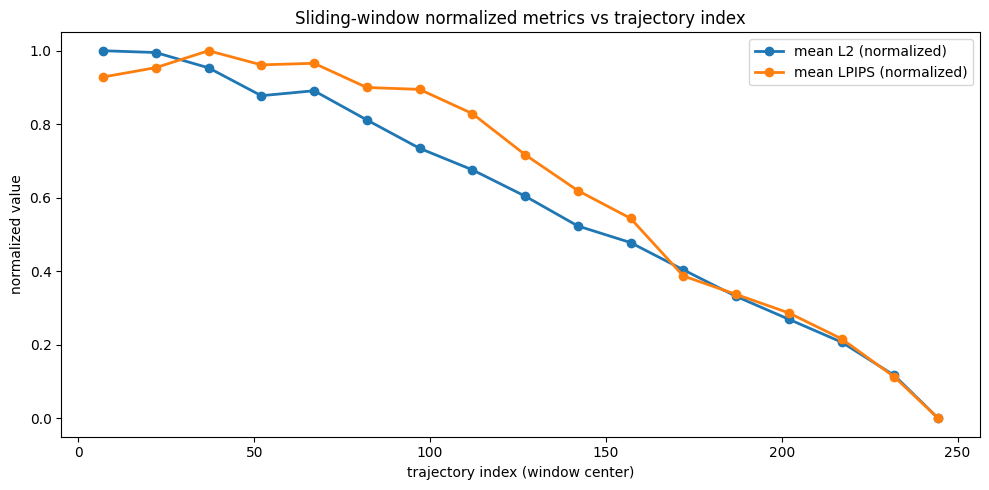
Figure 5: Normalized mean Fσ(x)=−σ2logpσ(x)5 distance and mean LPIPS distance over trajectory indices confirm that the instability band aligns with downstream deviation under perturbation.
In high-capacity text-to-image diffusion models, such as SD 3.5 Medium, the late-phase CBD peak precisely determines the semantic commitment boundary. Intervening before this point can change the global semantic class, while intervening after only modifies within-class appearance or compositional details Figure 6.

Figure 6: Qualitative intervention study on SD3.5 for the prompt ``a cinematic photo of a shiba inu standing in front of a volcano, highly detailed.'' Noise injected in high-TAD windows causes larger output deviations, supporting TAD as a practical ranking signal for intervention sensitivity.
Implications and Theoretical Extensions
Geometry of Data Manifolds and Hierarchical Generation
The projection-caustic mechanism ties the qualitative dynamics of generative sampling directly to the topology and geometry of the data manifold. In smooth regions, denoising is regular and controlled by local normal projections; near stratifications, branch intersections, or self-intersections, transitions become sharply localized, resulting in mode selection and phase transitions.
This aligns with recent work showing phase transitions in diffusion models correspond to hierarchical feature selection and compositionality in the data [sclocchi2025phase]. The geometric interpretation provides a foundation for understanding and predicting the onset of semantic branching, hierarchical emergence, and the practical controllability of generative models.
Phase-Aware Control and Guidance
CBD enables phase-aware, intervention-efficient control in generative modeling. By targeting guidance and interventions only within sensitive windows detected by CBD Figure 3, the same semantic shift or class control can be achieved with orders of magnitude less intervention—improving both efficiency and theoretical predictability.
These findings rationalize recent empirical observations on interval-restricted guidance and classifier-free guidance [kynkaanniemi2024interval, zhang2025stepag, jin2025stagewise], showing that guidance is most effective when applied adaptively at temporally localized, geometrically predicted critical bands.
Future Directions
The geometric theory developed is primarily for nondegenerate (Laplace) regimes; singular cases (focal degeneracies, higher-order caustics) require uniform asymptotic expansions (Airy/Pearcey type [wong2001asymptotic, cho-kamimoto-nose2013]). Empirical extensions to discrete or absorbing-state samplers, autoregressive models, or hierarchical multimodal generation will likely involve analogous geometric switching phenomena. Online phase-aware scheduling, adaptive solver selection, or selective compute allocation based on CBD or related diagnostics is a promising avenue for both practical diffusion model deployment and deeper theoretical insight.
Conclusion
This work provides a comprehensive geometric theory of phase transitions in generative dynamics, operationalizes it with the Critical Boundary Detector, and empirically verifies its efficacy for detecting and controlling semantic commitment and mode selection in both synthetic and large-scale diffusion models. The projection-caustic framework unifies trajectory-level transition phenomena with the intrinsic geometry of data manifolds and the global structure of the generative process, opening new directions for theory-driven control and interpretability of continuous-state generative models.