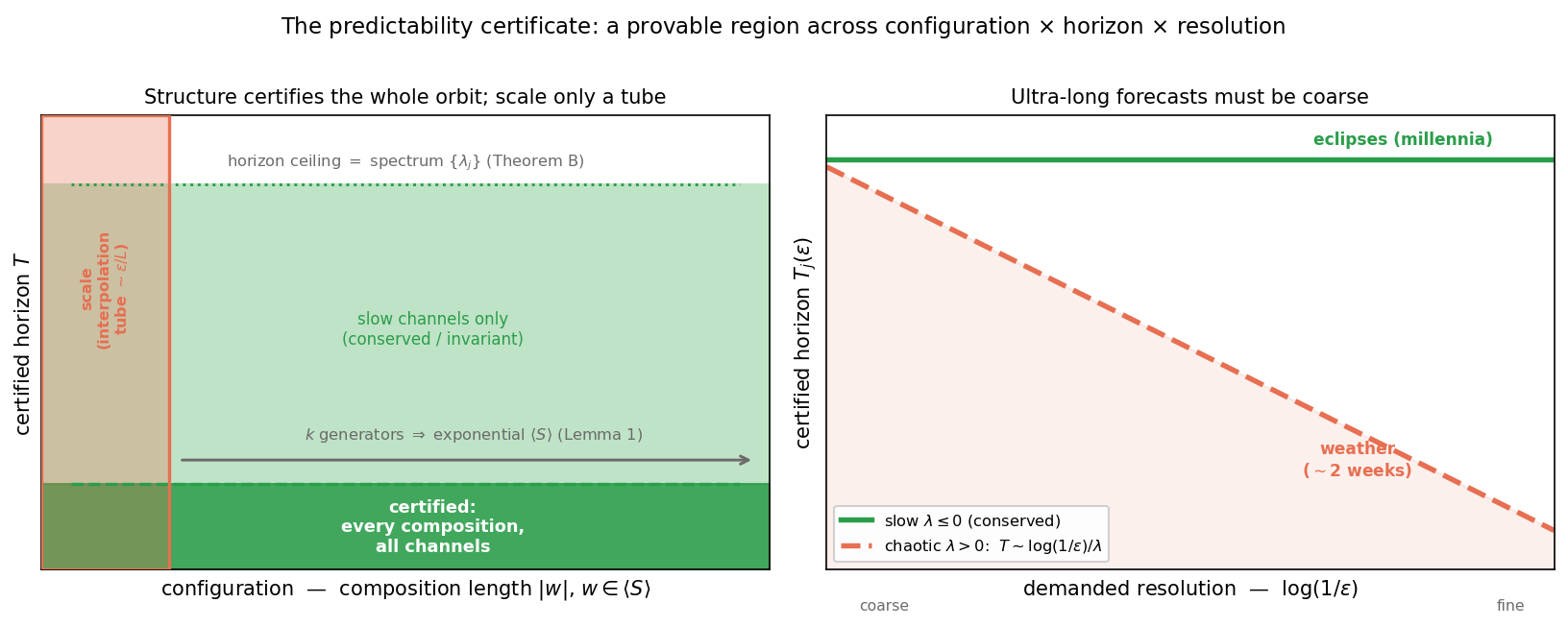
- The paper’s main contribution is demonstrating that structural equivariance enables certified prediction horizons in learned world models.
- It introduces a computable certificate based on the Lyapunov exponents of latent dynamics, establishing tight bounds on multi-step errors.
- Equivariant models empirically outperform scale-only approaches, ensuring reliable planning, auditing, and budgeted sensing in complex systems.
Certified Predictability in Equivariant World Models: Structure Versus Scale
Overview and Contributions
This paper addresses the crucial distinction between average prediction error and actionable predictability in learned world models for planning and control. The central thesis is that model scale alone enables interpolation, whereas structural equivariance enables a certified, actionable prediction horizon, quantifiable in terms of the Lyapunov spectrum of the latent dynamics. The authors formalize and prove tight certification guarantees for equivariant latent world models: multi-step rollout error is orbit-constant and ties directly to the eigenstructure of the predictive Jacobian. The horizon certificate stratifies channels according to their Lyapunov exponents, yielding a computable guarantee of trustworthiness over prediction horizon for each symmetry orbit.
The paper provides:
Theoretical Framework
The central theoretical result is that in models with latent equivariance, rollout errors are constant over group orbits; this property is both necessary and sufficient for equivariance (Theorem A, Lemma 2). The certified prediction horizon Tj(ϵ) for channel j is governed by its Lyapunov exponent λj via the law Tj(ϵ)∼log(1/ϵ)/λj.
Approximate equivariance yields an explicit horizon limitation: a residual equivariance defect is exponentially amplified by channel expansion, matching upper and lower bounds (Proposition 6). Only exact equivariance or conservation (λj≤0) yields horizon-unbounded guarantees.
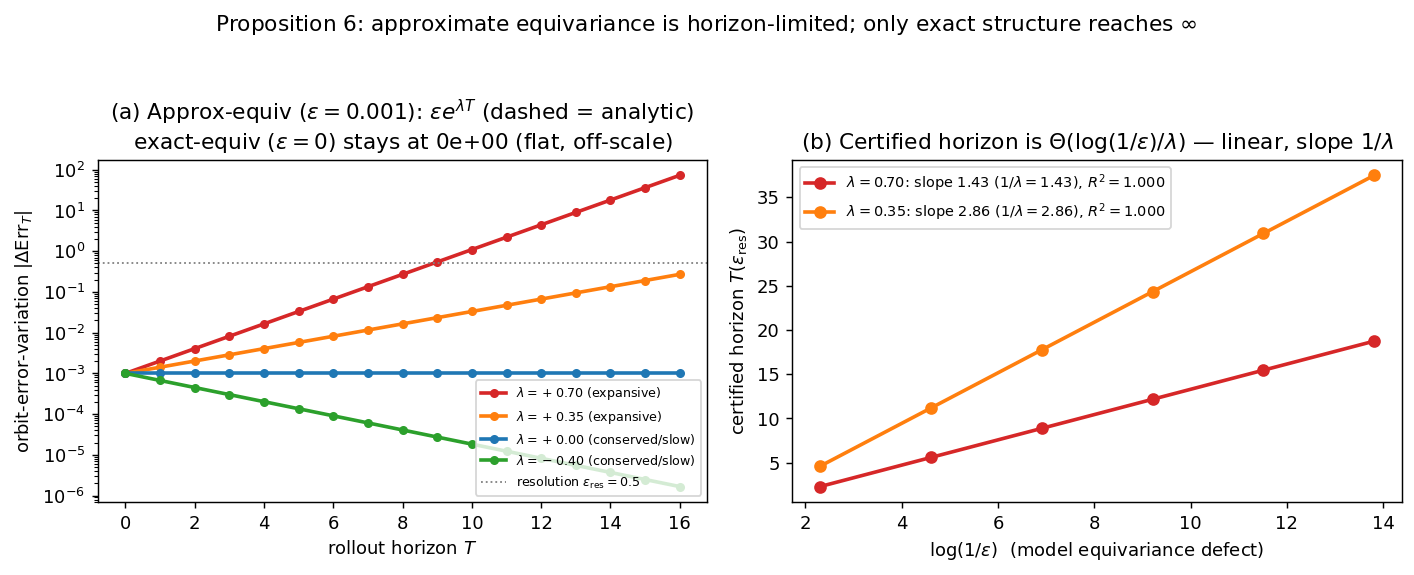
Figure 2: Numerical confirmation of the tight lower bound: orbit-error variation matches the analytic ϵeλT with exceptional precision; channels with λ≤0 remain bounded, confirming infinite certified horizon.
The certification procedure is computable from model-side checks on symmetry generators (Lemma 1), local spectral estimation at query latents, and escalation for conserved channels (Algorithm 1). The prefactor in degradation is the splitting conditioning, computable from the spectral projector angles.
Structural Exclusivity and Empirical Validation
The certificate is structurally exclusive: orbit-constant error is equivalent to equivariance, and cannot be attained in non-equivariant architectures regardless of parameter count or augmentation (Lemma 2, E1, E3, E4). Empirical validation includes:
- Recovery of the full Lyapunov spectrum for chaotic systems only in equivariant models (e.g., $40$-D Lorenz-96, k0) versus dense/recurrent baselines failing spectra estimation (E2).
- Graceful horizon limitation in augmentation-only baselines, with a measured floor at k1, never attaining orbit-exactness (E3).
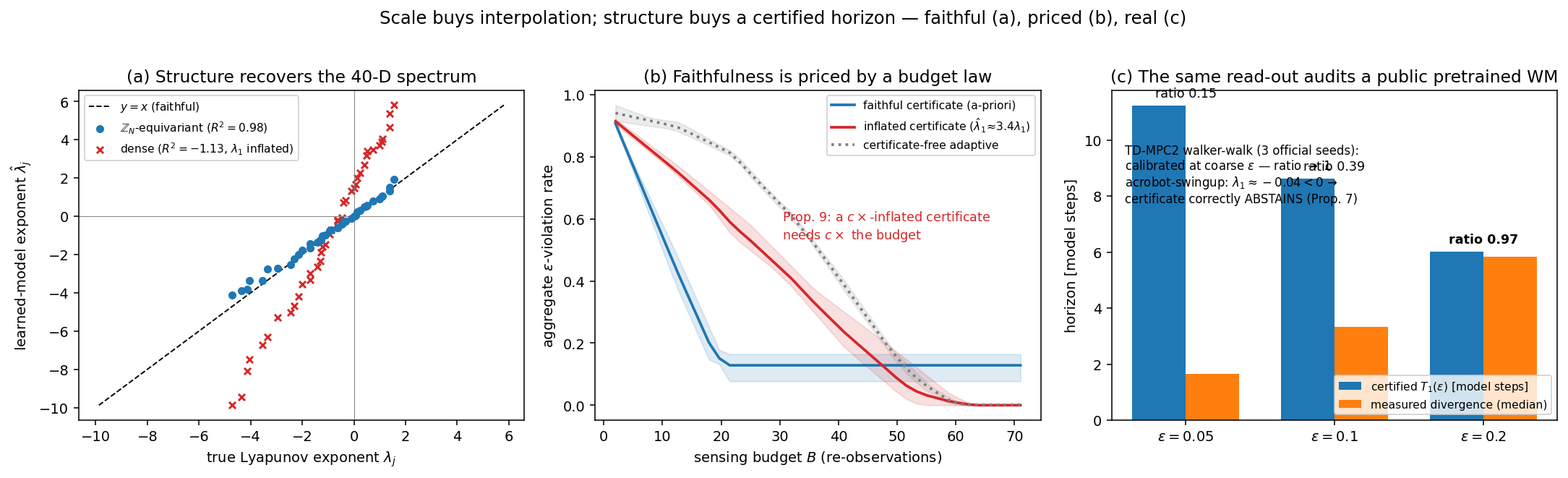
Figure 3: Empirical sweep: (a) k2-D Lorenz-96 spectrum, only k3-equivariant model recovers true exponents; (b) Equivariant certificate meets sensing budget, dense certificate over-allocates; (c) Audit of official TD-MPC2 checkpoints stratified by expansion/contraction regimes.
Conservation Laws and Horizon Stratification
Channels identified by conservation laws are certified for unbounded horizons (Proposition 4, Proposition 5). Representation-theoretic placement ensures that conserved charges are uniquely associated with isotypic blocks. The multi-step horizon law applies generically, but the structure enables hard guarantees for conserved quantities.
Practical Implications: Model Auditing and Budgeted Sensing
The certified horizon is actionable for planning and monitoring: under fixed sensing budgets, structure-faithful certificates achieve budget-minimal calibration, whereas mis-estimated horizons from dense certificates cost proportional budget inflation (Proposition 9, E12). Public world models (TD-MPC2, LeWM, V-JEPA 2-AC) are audited training-free, with cross-validated horizon stratification identifying calibrated, optimistic, abstaining, and bias-driven deployment regimes (E13–E16).
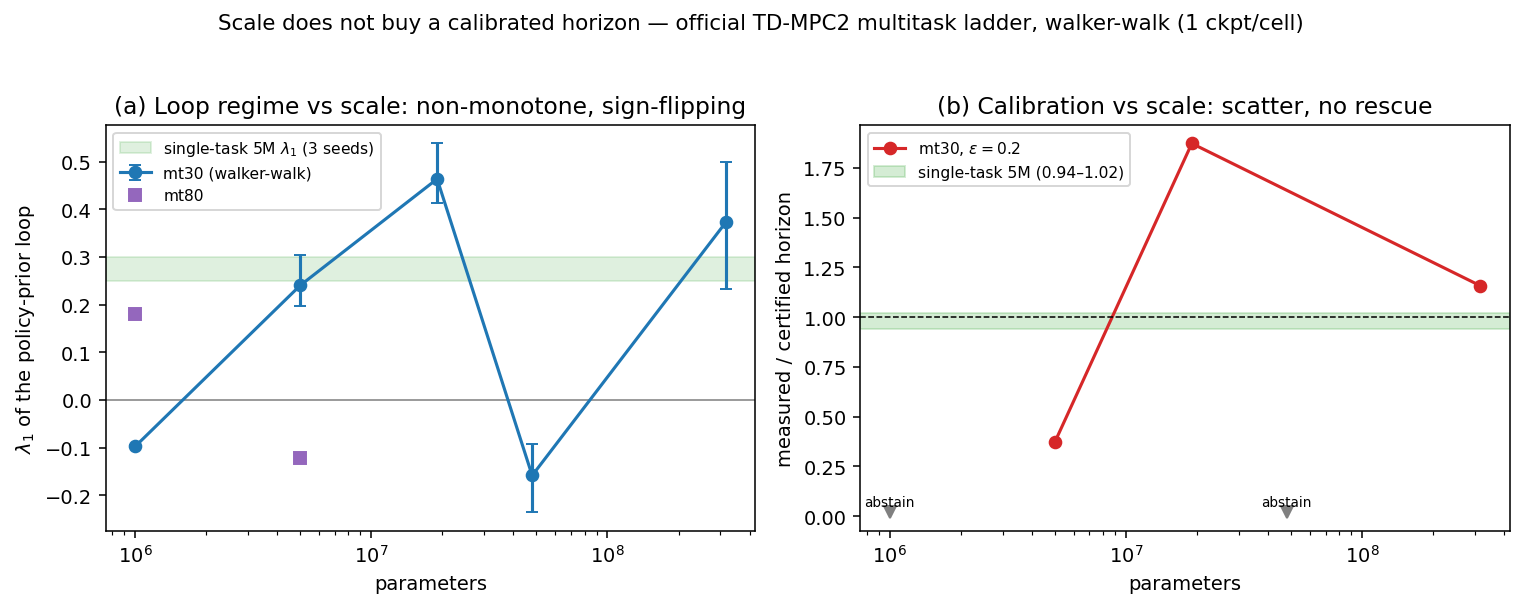
Figure 4: Scale does not buy a calibrated horizon: official multitask ladder sweep shows no monotonic improvement in calibration with parameter count; horizon is a property of model structure, not scale.
Empirical Sweep: Chaotic and High-Dimensional Systems
Experiments validate the horizon staircase law across synthetic chaotic spectra, learned models of real chaotic systems (Lorenz, Hénon, Rössler), and high-dimensional (k4) Lorenz-96, confirming per-channel horizon recovery only in equivariant models. Dense and recurrent baselines fail the spectrum estimation and thus cannot be trusted for horizon calibration.
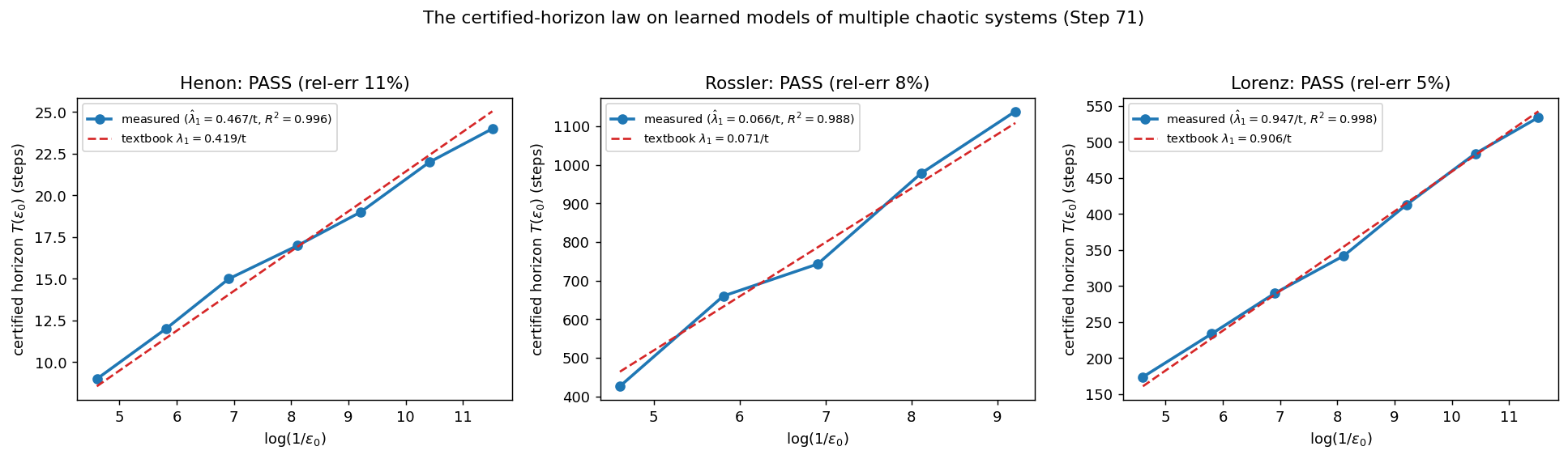
Figure 5: Certified horizon law across chaotic models: measured horizon slope matches textbook Lyapunov exponents to within k5–k6.
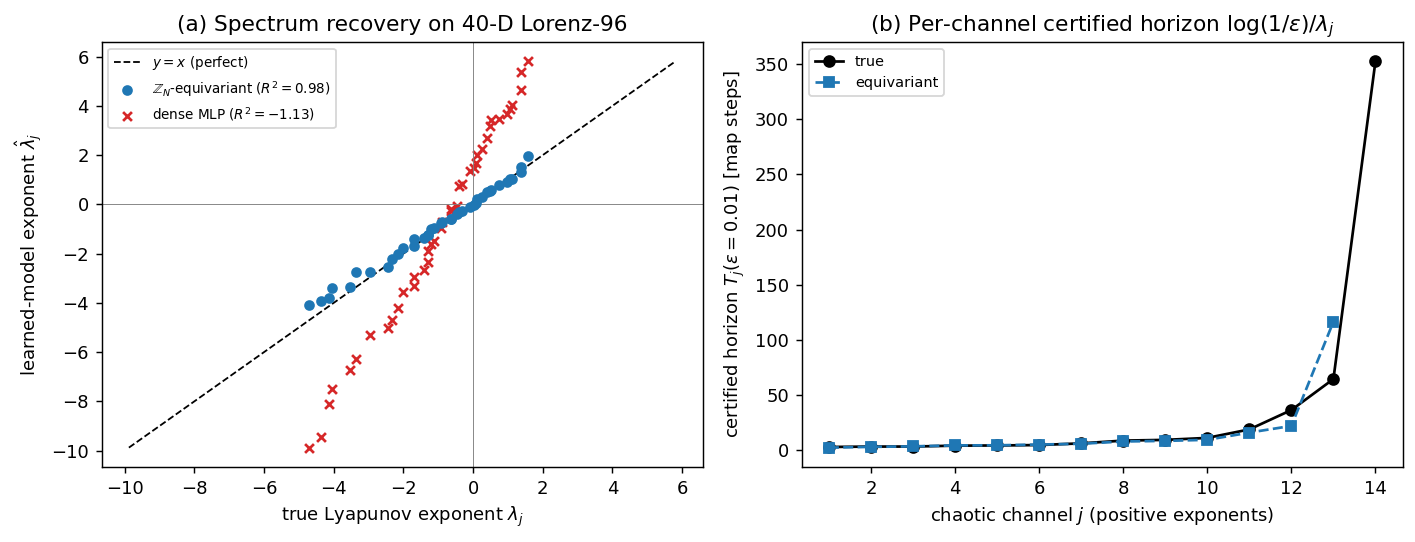
Figure 6: High-dimensional spectral horizon: recovered versus true Lyapunov exponents across k7 channels, equivariant model lies on k8, dense model fails completely.
Decision Value and Deployment Scope
The certificate's deployment value concentrates where decision predicates align with certified quantities; misalignment incurs irreducible penalties (Proposition 11). For monitoring and budgeted re-observation, the certificate delivers actionable cadence with zero new calibration data. Control returns, however, are diluted by map-level task tolerances, and the certificate's value is maximal when the certified predicate is task-aligned.
Limitations and Future Directions
The certificate is exact only for genuine dynamical symmetries and is gracefully approximate elsewhere, with two-sided degradation measured and theoretically bounded. The prefactor's worst-case tail is disclosed, and emergence of the Noether hinge in learned dynamics is open. Scaling and modality transfer exact flatness but do not solve architecture-agnostic pixel prediction. Safety guarantees were inconclusive at the tested scale.
Future directions include the study of symmetry emergence in learned dynamics, task value alignment for certificate deployment, and architecture-independent stabilization for pixel predictors. Extensions to non-uniformly hyperbolic and non-compact group actions will be crucial for further generalizing certified predictability.
Conclusion
The paper establishes a sharp division between interpolation capacity attained by scaling and actionable predictability horizon delivered exclusively by structure. Equivariant world models certify, without retraining or calibration, which situations they can handle and for how long, with a tight bound dictated by the predictor's spectrum. The certified region is structurally exclusive; trust in a rollout is a property of the loop's dynamics and symmetry, not its parameter count. The audit protocol, horizon certificate, and empirical validations demonstrate practical deployment value, particularly for monitoring and budgeted sensing in high-stakes and high-dimensional environments. The actionable horizon is enabled only by structure, not scale.
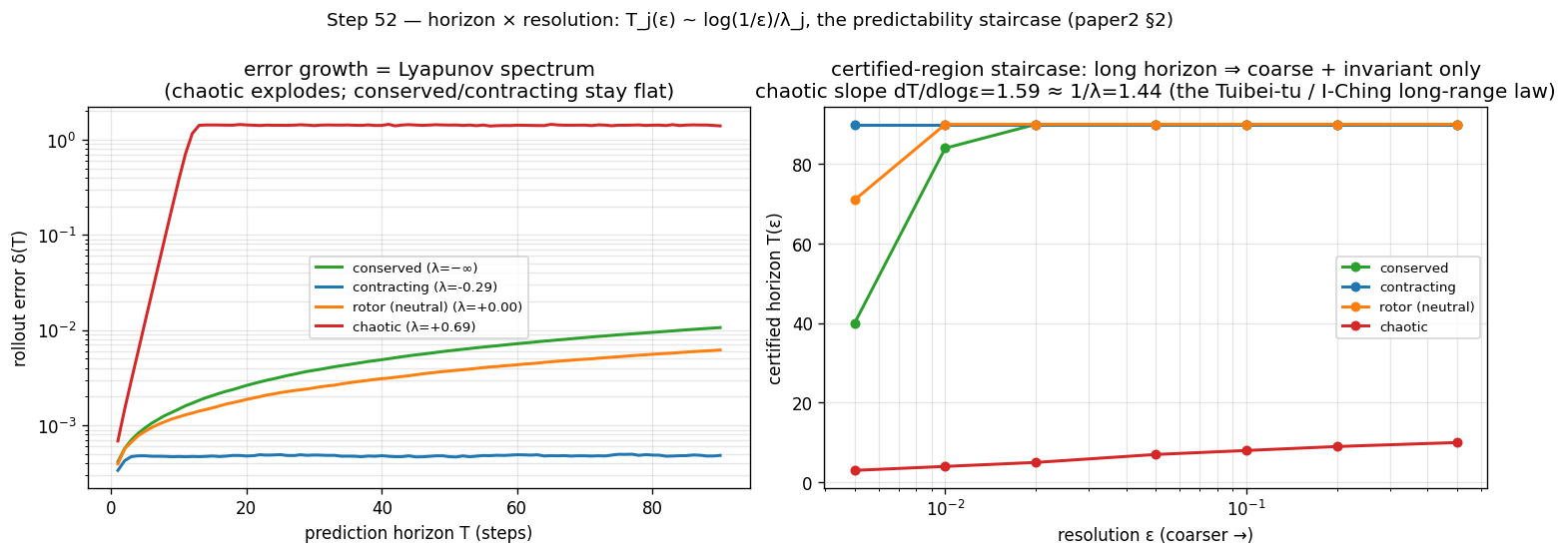
Figure 7: Certified horizon versus demanded resolution across controlled spectrum: the measured staircase matches the predicted law k9, stratifying channels by their dynamical expansion.