- The paper demonstrates that architectural equivariance significantly reduces sample complexity, achieving a 16× improvement over vanilla models.
- It introduces a controlled synthetic task with adjustable cyclic symmetry to isolate alignment effects from data augmentation and regularization.
- Robust statistical methods, including joint pairwise bootstrapping, validate the measured exchange rate against theoretical predictions.
Measuring the Impact of Symmetry Priors on Data Efficiency: An Expert Perspective on "Measuring the Symmetry--Data Exchange Rate" (2606.01090)
Introduction
"Measuring the Symmetry--Data Exchange Rate" addresses a foundational and often unquantified claim in geometric deep learning—namely, that architectural equivariance to known symmetries yields a sample complexity reduction asymptotically proportional to the order ∣G∣ of the symmetry group. While theoretical results have rigorously established this property for kernel models and random feature machines, empirical quantification in parameterized neural settings is comparatively sparse and often methodologically confounded. This work delivers a tightly controlled, task-analytic approach to directly measure this "exchange rate," separating the effects of alignment, constraint, and data augmentation with robust controls, and introducing a methodology for statistically isolating the structural contribution of symmetry priors in neural learning.
Synthetic Task Construction and Diagnostic Value
To expose the structural effect of equivariance in isolation, the paper constructs a parametric family of two-dimensional supervised classification tasks with exact cyclic symmetry Cn. Specifically, input points are sampled from an annulus, and the label is defined as yclean(x)=1[cos(nθ(x))>0] (Figure 1). This design provides four critical diagnostic properties:
- Ground-truth known symmetry: The symmetry group is analytically specified—removing ambiguity in the task’s invariance.
- Parametric control: The group order n is directly adjustable, enabling scaling law analysis.
- Non-trivial complexity regime: Task difficulty increases with n, requiring global decision boundaries that generalize over fine angular alternations.
- Rich adversarial controls: Misaligned-orbit models and augmentation treatments can be directly designed by varying rotation axes, orbit pooling, and augmentation procedures, yielding stringent negative controls for "alignment vs. constraint" hypotheses.
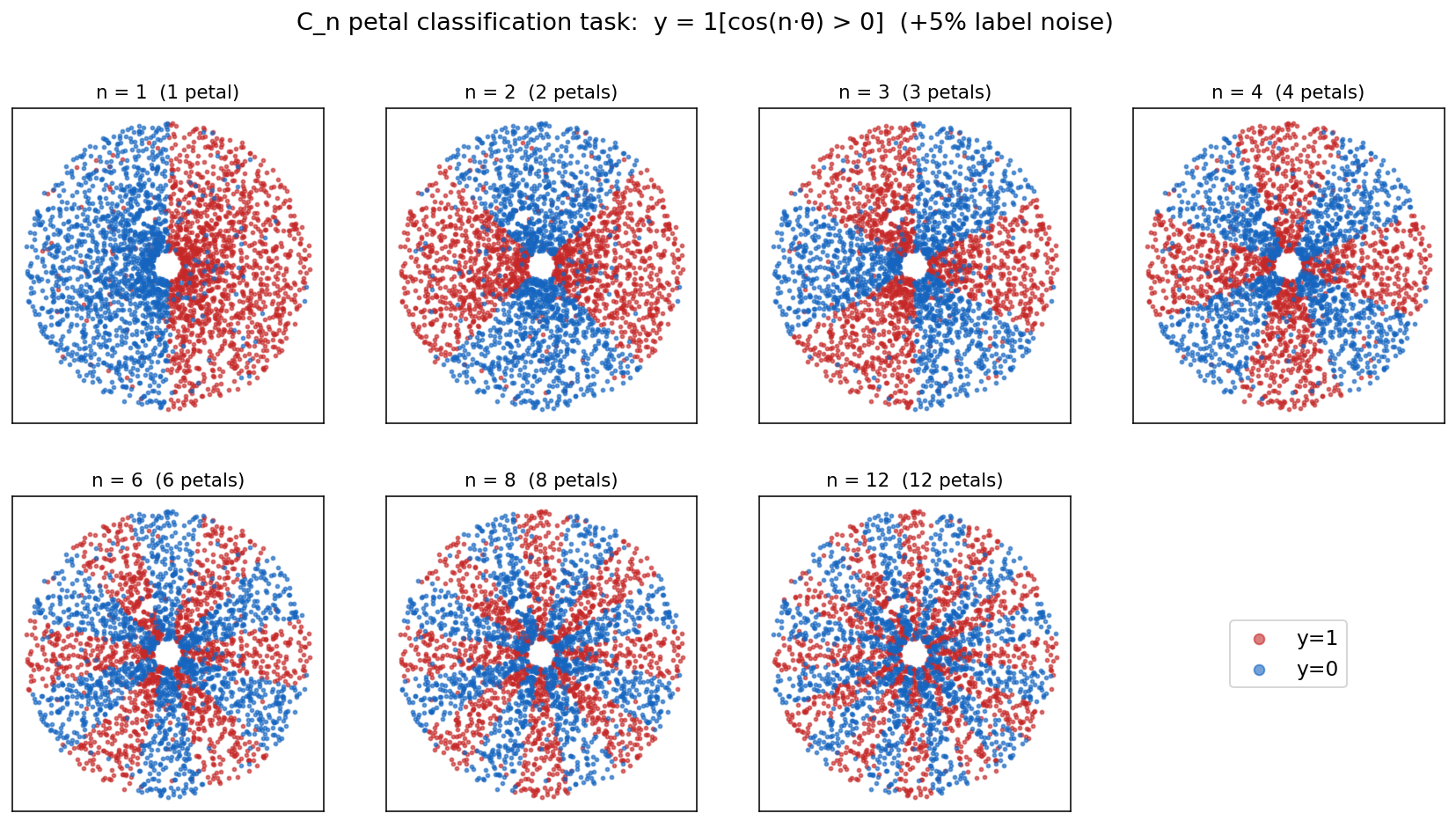
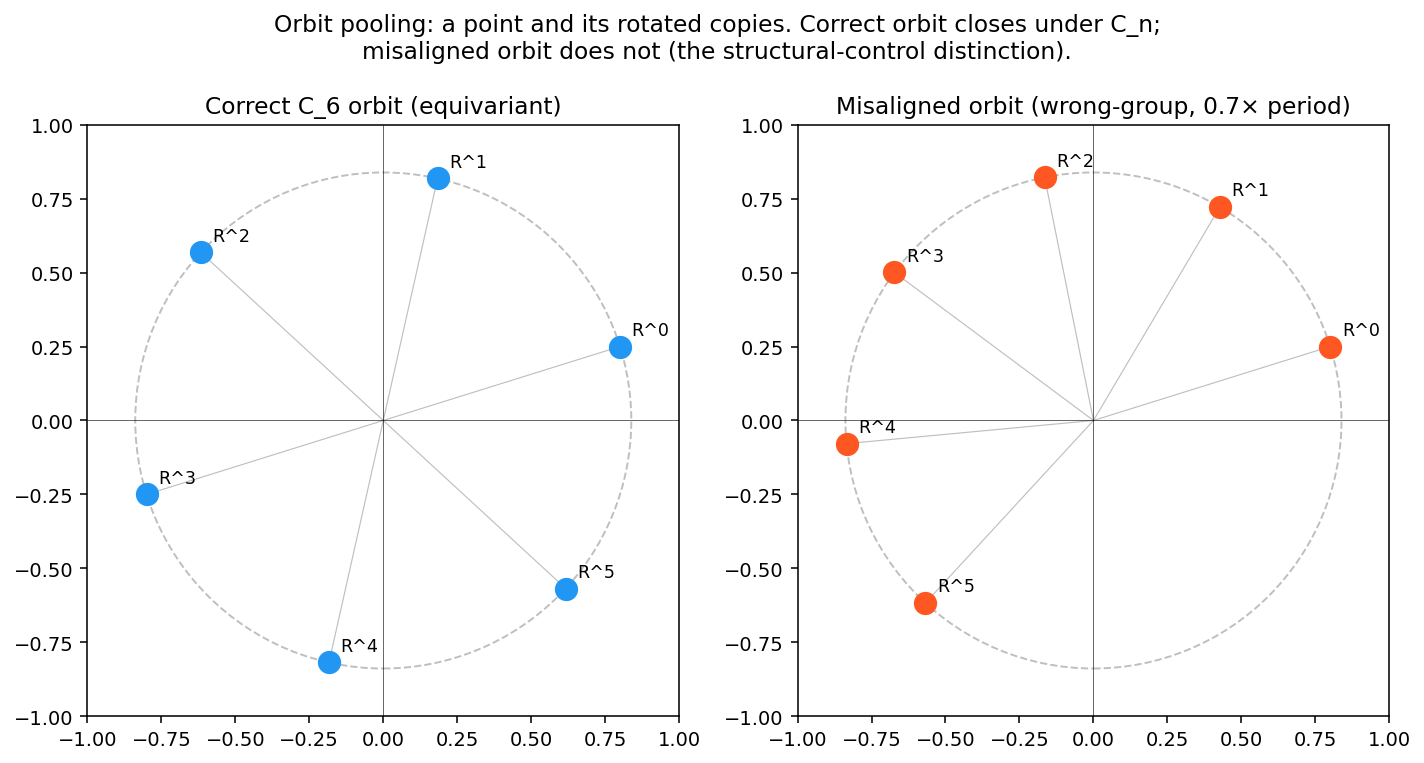
Figure 1: The Cn-petal synthetic classification task displays exact cyclic symmetry, supporting parametric group order scaling and adversarial control construction.
Experimental Design: Families, Controls, and Estimation Methodology
All evaluated models share identical fully connected MLP backbones (two hidden ReLU layers of width 32, 1,185 parameters), differing only in how symmetry information is injected:
- Equivariant (treatment): Implements orbit pooling with respect to Cn.
- Wrong-group control: Orbit pooling over an orbit of identical size but rotation axes misaligned irrationally (factor 0.7).
- Augmented: Data augmentation using all n rotated copies at train time only; evaluation uses a standard forward pass.
- Vanilla: No symmetry prior, same parameter count.
- Regularized: L2 weight regularization calibrated to match the expected reduction in effective DOF from orbit pooling.
The central metric is the sample complexity N∗(T): the minimum number of training samples required for a majority of seeds to achieve a prespecified accuracy Cn0 (here, 0.80). Crucially, the primary estimate is the relative sample-complexity exchange rate:
Cn1
removing any monotonic increase in task difficulty shared between treatment and baseline. Bootstrap-resampled CIs and a taxonomy of pre-specified failure modes provide statistical rigor.
Empirical Results: Quantified Exchange Rate and Failure Analysis
The observed exchange rate for the equivariant model relative to vanilla is Cn2 (single-level 95% bootstrap CI Cn3), with a more conservative two-level (seedsCn4groups) CI of Cn5 (Figure 2). This point estimate aligns, in sign and order of magnitude, with the theoretical value Cn6 predicted by kernel/random feature analyses. At Cn7, equivariant architectures achieve target validation at Cn8 samples, compared to Cn9 for vanilla—a yclean(x)=1[cos(nθ(x))>0]0 improvement, mirroring group size.
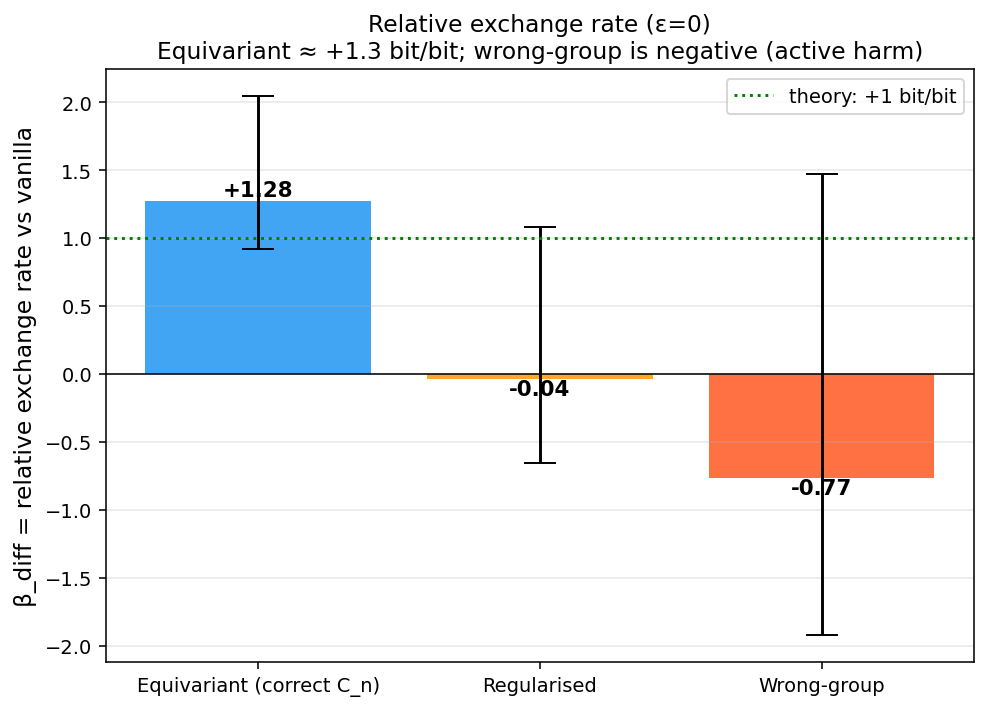
Figure 2: The measured exchange rate quantifies the data efficiency improvement from symmetry priors. Only the correctly-aligned prior yields the predicted positive exchange rate.
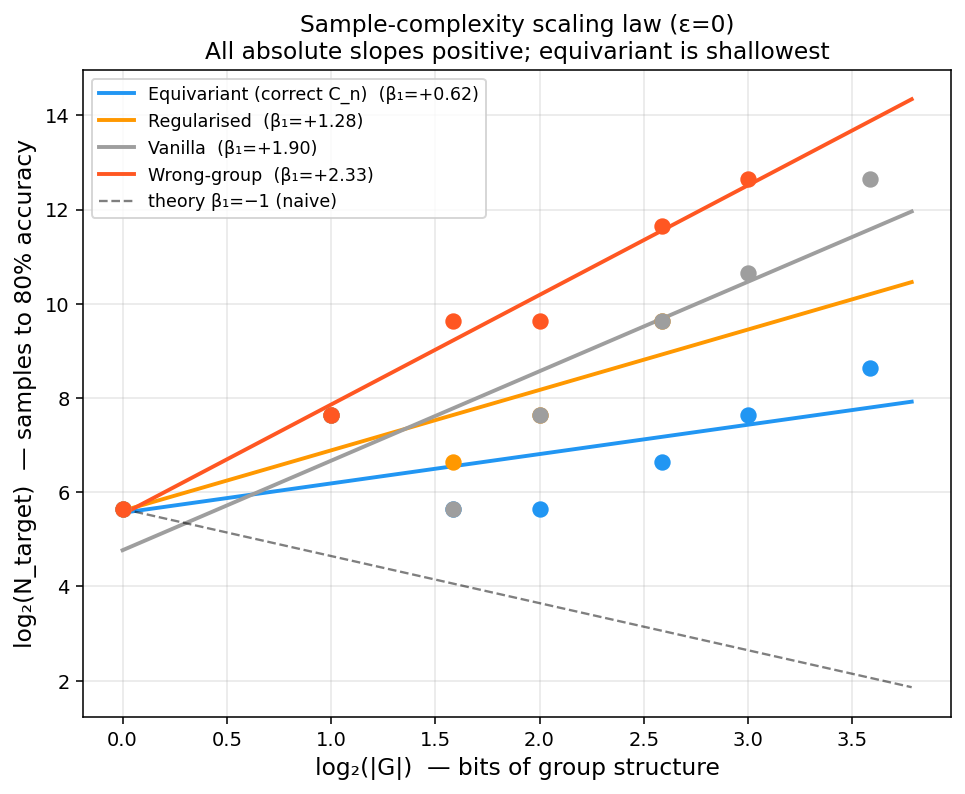
Figure 3: The scaling law (yclean(x)=1[cos(nθ(x))>0]1 vs.\ yclean(x)=1[cos(nθ(x))>0]2) highlights that all models become more sample-intensive with yclean(x)=1[cos(nθ(x))>0]3, but equivariant models have the lowest absolute slope.
The results from wrong-group controls are diagnostic: Their exchange rate is negative (yclean(x)=1[cos(nθ(x))>0]4), showing that imposing a generic constraint of the same size but wrongly aligned is not only unhelpful, but actually detrimental to learnability. Regularized models fail to reach yclean(x)=1[cos(nθ(x))>0]5 at high yclean(x)=1[cos(nθ(x))>0]6, and augmentation-only baselines are unable to achieve the target accuracy for yclean(x)=1[cos(nθ(x))>0]7 without test-time orbit averaging.
Architectural vs. Augmentation Regimes
Standard claims in the literature often suggest augmentation is a practical surrogate for built-in equivariance. This work’s evaluation discriminates precisely between training-time-only augmentation and true architectural equivariance. The empirical result is phase-like: augmentation with single-input test passes fails precipitously for yclean(x)=1[cos(nθ(x))>0]8, unable to achieve accuracy even with large yclean(x)=1[cos(nθ(x))>0]9 (Figure 4). However, using test-time orbit averaging ("test-time augmentation"), the augmented model exactly matches the equivariant model for all n0, with learning trajectories bit-identically identical (Figure 5).
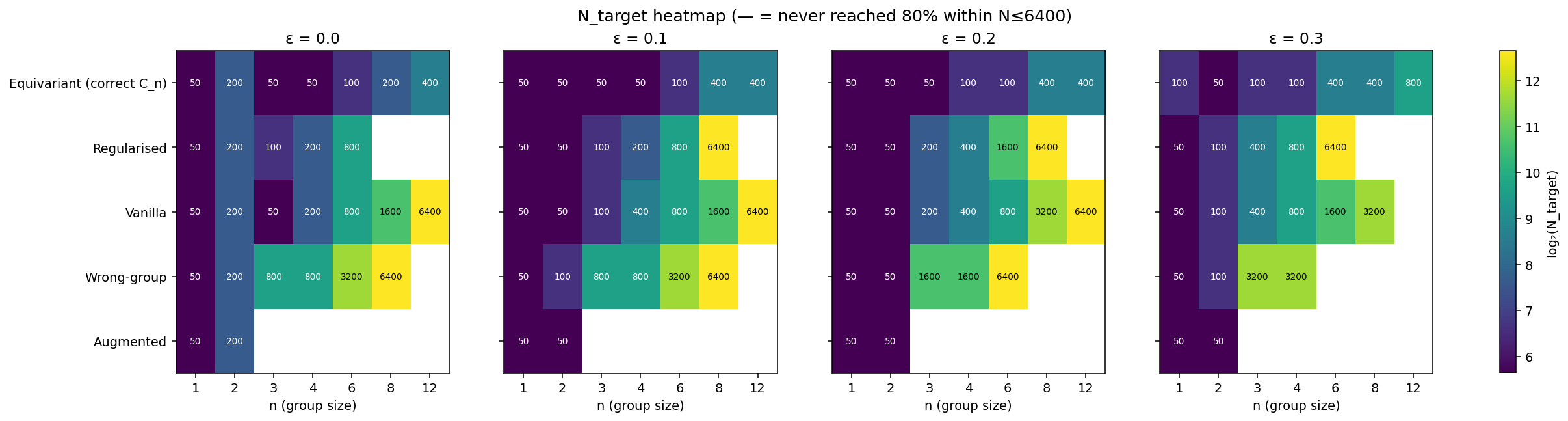
Figure 4: Augmentation fails as a surrogate for equivariance in the asymmetric/test-only mode, leading to a sharp learnability boundary not present with test-time averaging.
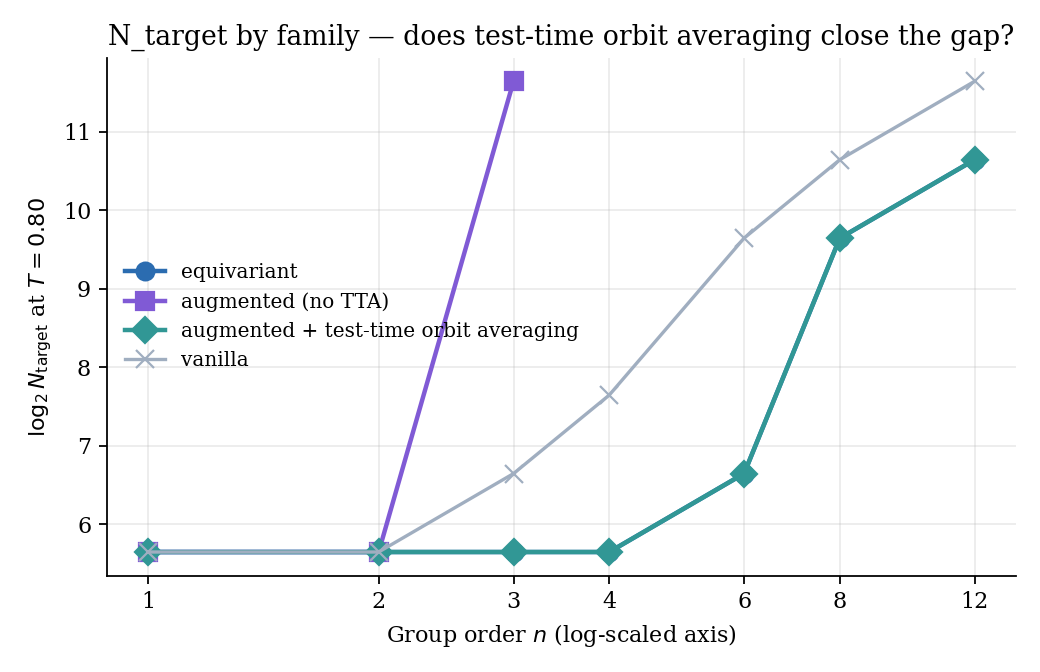
Figure 5: Output from the CPU replication confirms that training-and-test orbit averaging with augmentation collapses to the performance of architectural equivariance.
This distinction sharpens the regime in which explicit architectural priors are provably and operationally superior over data augmentation: when deployment or evaluation cannot benefit from test-time orbit averaging, equivariant architectures are indispensable.
Robustness to Symmetry Breaking
Robustness experiments corrupt up to 30% of training labels with asymmetric alternatives. The exchange rate remains at n1 of the clean-symmetry value, indicating the sample-efficiency benefit of equivariance survives non-trivial levels of label noise that violate the assumed group invariance (Figure 6).
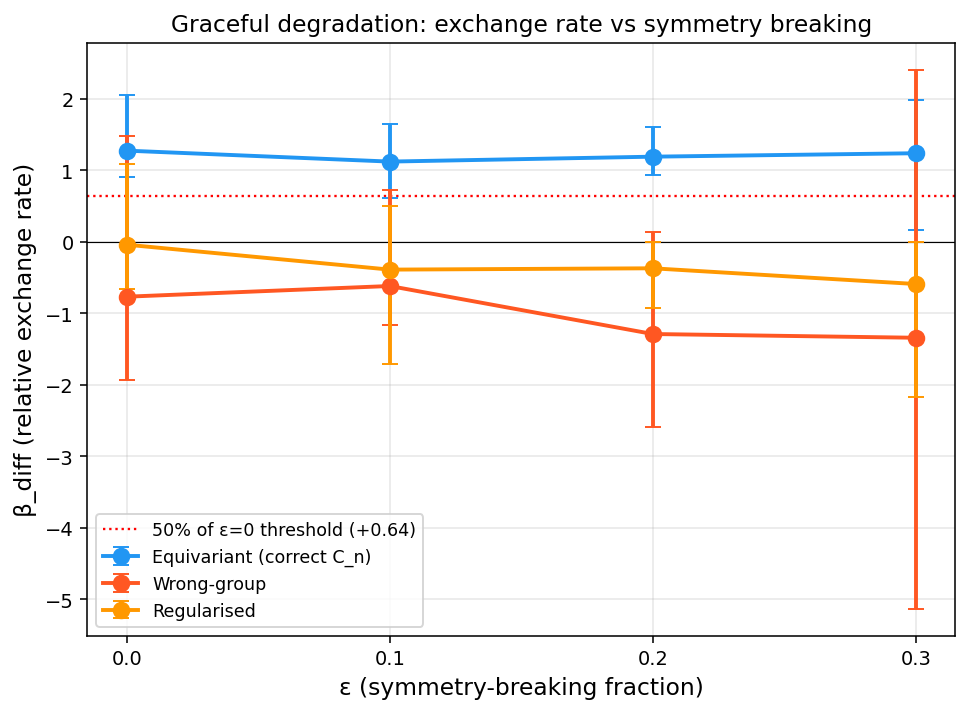
Figure 6: Symmetry-breaking corruption up to 30% barely degrades the measured exchange rate, indicating strong robustness of structural priors to realistic noise scenarios.
Methodological and Statistical Contributions
The methodological apparatus is of general value:
- The relative-rate estimator cancels confounds arising from parallel task-difficulty scaling.
- The wrong-group control isolates true alignment effects.
- Joint pairwise bootstrap provides robust inference even when marginal intervals are wide or overlapping.
- A well-specified failure taxonomy ensures transparent interpretation of negative or ambiguous results.
These transfer directly to any scenario where an inductive bias (depth, locality, hierarchical structure) can be parameterized and need not be restricted to symmetry.
Theoretical Implications and Limitations
Empirical exchange rates roughly match theory—but only in sign and magnitude. The CI does not rule out zero under the strictest bootstrap, highlighting potential deviations from idealized theoretical regimes (i.e., kernel methods) due to finite data, model class, and optimizer artifacts. The synthetic nature of the experiment (2D, fully specified symmetry, explicitly chosen group) maximizes internal but not ecological validity. Results should not be presumed to directly generalize to high-dimensional, weakly symmetric, or learned-symmetry regimes without replication.
Crucially, compute advantages are not implied: The gain is entirely in statistical sample complexity. Both equivariant and vanilla models require similar total FLOPs to reach target accuracy, with equivariant models performing n2 times more forward passes per datum but needing n3-fold fewer labeled examples.
Practical and Future Implications for AI Research
The study’s approach and main findings suggest the following:
- When the symmetry structure of a problem is known and strongly expressed, explicit architectural equivariance delivers substantial label efficiency.
- Simply regularizing models or augmenting data—even extensively—cannot, in general, substitute for correct structural constraints unless test-time computation mirrors symmetry averaging.
- In domains where annotation is the primary bottleneck (e.g., scientific discovery, medical imaging), correctly aligned inductive biases produce operationally significant reductions in required labels.
- The presented estimator and control protocol constitute a transferable toolset for quantifying the value of any parameterizable inductive bias.
- There is a clear need for confirmatory studies extending this methodology to real-world vision, language, or graph domains, especially those featuring approximate or latent symmetries.
Conclusion
"Measuring the Symmetry--Data Exchange Rate" provides a statistically rigorous quantification of the impact of symmetry priors on sample complexity in a precisely controlled experimental regime. The finding that only correctly aligned equivariance provides a substantial and robust reduction in labeled data requirements is strongly supported, while naive or misaligned constraints are deleterious. Data augmentation is advantageous only when applied at both training and test time, underscoring the necessity for architectural priors in deployment-limited contexts. The methodology, especially the pairwise exchange-rate estimator and the explicit control taxonomy, are broadly extensible for evaluating inductive biases beyond symmetry in arbitrary deep learning settings.
The empirical results and accompanying methodological innovations will inform both theoretical analysis and practical architecture design, sharpening understandings of when and how structure can efficiently substitute for data in modern machine learning pipelines. Confirmation across more complex, ecologically valid tasks remains an important open direction.