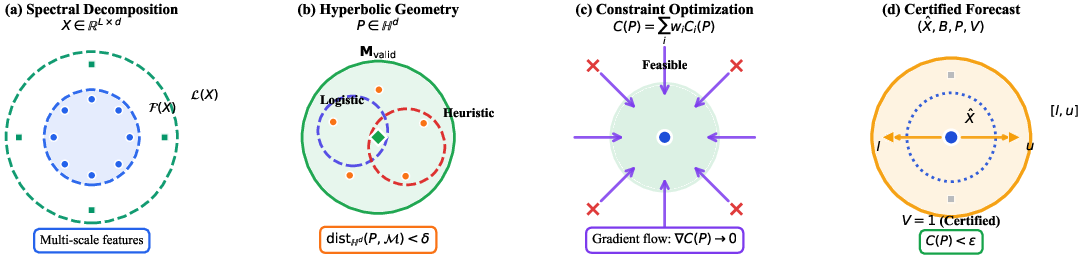
- The paper presents a unified forecasting framework that embeds hyperbolic geometry to simultaneously enforce physical constraints and generate formal certification within a differentiable model.
- It achieves state-of-the-art performance with up to 66% error reduction, rapid convergence in four epochs, and logarithmic certification complexity for real-time applications.
- Empirical evaluations demonstrate robust cross-domain performance under noise and perturbations while maintaining high constraint satisfaction and certification rates.
Certified Geometric Forecasting via Hyperbolic Manifold Integration
Introduction
The GeoCert framework introduces a geometric approach to scientific forecasting that unifies prediction accuracy, physical constraint satisfaction, and formal certificate generation within a single differentiable architecture (2604.23474). Traditional models treat forecasting, constraint enforcement, and verification as separate computational stages, leading to scalability and interpretability limitations. GeoCert resolves this by embedding both constraint feasibility and verification intrinsically into the model architecture, leveraging hyperbolic geometry to induce contractive dynamics and enable logarithmic-time certification.
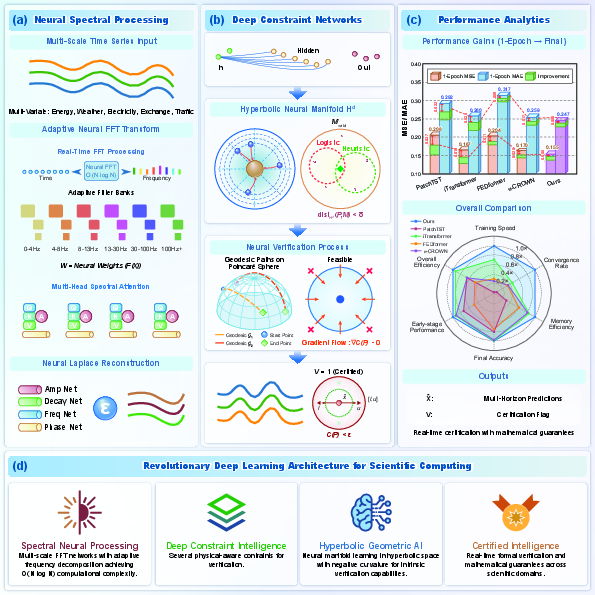
Figure 1: GeoCert architecture combining neural spectral decomposition and hyperbolic manifold constraint enforcement for certified forecasting.
Framework and Geometric Integration
GeoCert formulates forecasting as computation over a hyperbolic constraint manifold Hd, where negative curvature (K<0) induces geometric contraction and robust propagation of uncertainty. Forecasts evolve along geodesic flows on the Poincaré sphere, and constraint satisfaction is separated hierarchically into universal structural laws and domain-specific dynamics. The architecture consists of:
GeoCert achieves state-of-the-art forecasting accuracy with strict empirical feasibility and certification validity across diverse domains—energy (Electricity, Solar-Energy), meteorology (Weather), financial (Exchange), and transportation (PEMS08). Results show:
- Mean squared error (MSE) and mean absolute error (MAE) reductions of 15–66% relative to transformer and linear baselines.
- Constraint satisfaction rates (CSR) of CSRhard=0.924 and CSRsoft=0.988, with certification rates ≥0.92.
- Logarithmic proof length scaling, O(logH), yielding real-time certification (average certificate generation time: 0.205 ms per instance).
- Accelerated convergence: four epochs to convergence (vs. 78 for unconstrained baselines), with computational cost reduced by 97.5%.
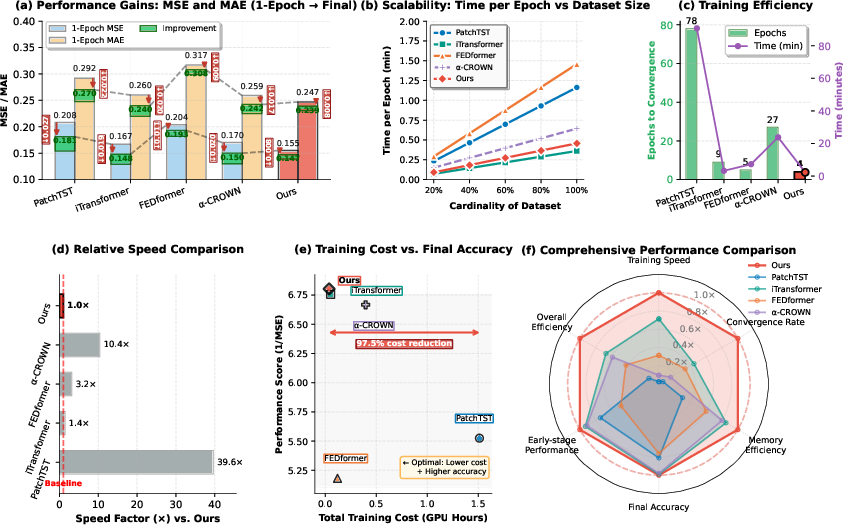
Figure 3: GeoCert empirical benchmarks—prediction efficiency, scalability, rapid convergence, and cost-accuracy trade-off; GeoCert achieves balanced high-efficiency learning across all dimensions.
Robustness and Stability
GeoCert demonstrates exceptional robustness under stochastic noise and distributional perturbations. Under up to 20% additive Gaussian noise, MSE remains the lowest across all intensities with minimal variance; transformer-based models exhibit error amplification proportional to noise. Temporal stability is observed in electrical load forecasting, where GeoCert accurately aligns with physical regularity across morning and evening demand peaks, unlike baselines that overshoot during peak transitions. Certified robustness metrics show a +83% improvement in certification probability relative to α-CROWN, with sustained validity up to perturbation bounds ε=0.20.
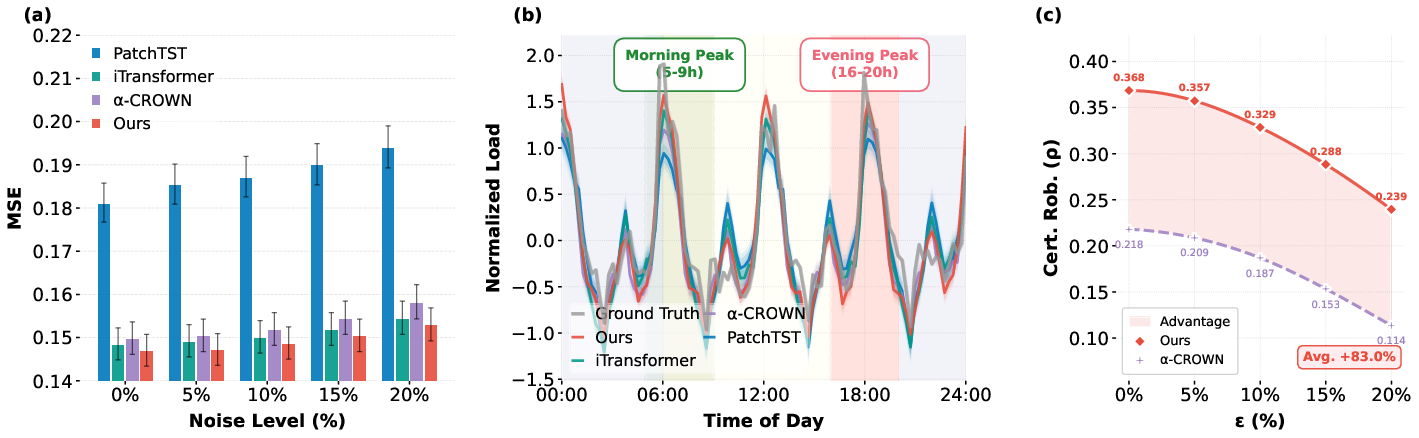
Figure 4: GeoCert robustness to noise, temporal interpretability, and certified validity under adversarial input perturbations.
Theoretical Guarantees
The theoretical analysis rigorously establishes:
- Exponential contraction dynamics in Hd, resulting in rapid convergence (Theorem 1).
- Soundness guarantee: tight bounds on constraint violation proportional to geometric distance to the feasible manifold (Theorem 2).
- Logarithmic certification complexity, K<00 (Theorem 3).
- Necessity of hyperbolic embedding to achieve efficient, valid, and accurate forecasting—Euclidean or spherical manifolds do not admit simultaneous guarantees (Theorem 4).
- Exponential computational advantage over SMT-based certification, scaling as K<01 for GeoCert vs. K<02 for SMT solvers (Theorem 5).
Architectural Ablations and Component Analysis
Ablation studies confirm that both hyperbolic geometry and spectral decomposition are essential for maintaining certified convergence and formal forecasting stability. Removing either module degrades certification reliability and slows convergence; non-hyperbolic baselines fail to sustain K<03-optimal certification and exhibit higher constraint violations.
Practical, Cross-Domain Generalization
GeoCert's hierarchical constraint design enables stable, transferable certified forecasting across heterogeneous physical domains. The logical layer preserves temporal coherence and relational alignment; the physical layer enforces smoothness and autocorrelation consistency. Empirical evaluation shows persistent high certification rates and robust generalization.
Implications and Future Directions
GeoCert transforms scientific forecasting from empirical approximation to formally verified inference. The geometric certification paradigm offers a scalable foundation for reliable, reproducible, and physically interpretable AI in safety-critical domains. As physical constraints are embedded intrinsically into the learning process, certification becomes a continuous property of the representation, not an external check.
Implications include:
- Reliable and real-time forecasting for energy, climate, finance, transportation, and biological systems.
- Extensible geometric certification to stochastic processes, adaptive curvature control, and integration with hybrid symbolic encoders.
- Diagnostic value of certification metrics for constraint adequacy and physical fidelity assessment.
Conclusion
GeoCert presents a unified geometric approach to scientific forecasting, embedding prediction, constraint enforcement, and certificate generation within hyperbolic manifold dynamics. Empirical and formal analyses demonstrate superior accuracy, rapid convergence, robustness, and real-time certification efficiency. The separation of universal constraints from domain-specific physics, achieved via hierarchical geometric projection, enables efficient adaptation and formally guaranteed reliability. GeoCert establishes a scalable and trustworthy foundation for certified scientific AI, integrating mathematical geometry with data-driven prediction and constraint verification within a single model architecture.