The Art of Interrogation: Consistency Amplifies Factuality in Spatial Reasoning
Published 10 Jun 2026 in cs.AI | (2606.11918v1)
Abstract: Current Large Reasoning Models (LRMs) exhibit remarkable general capabilities but significantly underperform in spatial reasoning tasks. Existing approaches treat this gap as a knowledge deficit, relying on supervised fine-tuning (SFT) to ingest labeled spatial data from external vision sources or synthetic engines. In contrast, we argue that for many tasks, spatial reasoning capabilities are already present in pre-trained LRMs but require alignment through logical coherence under geometric 2D and 3D constraints. In this work, we propose a self-supervised reinforcement learning (RL) framework that targets the internal reasoning process without requiring ground-truth annotations. By formalizing the notion of consistency verifiers -- reward functions that check for geometric and semantic consistency under transformations -- we demonstrate that models can improve their spatial reasoning abilities. We use both image transformations, like flipping, and textual transformations, like swapping the order of objects in the question, and propose a new optimal transport-based RL strategy, OT-GRPO, which is a minimal-matching variant of group relative policy optimization tailored to pairwise verifiers. We show that this label-free consistency training approaches the accuracy of models trained with ground-truth supervision and achieves similar generalization across diverse tasks and data domains.
The paper demonstrates that consistency verifiers as label-free rewards in reinforcement learning nearly match supervised performance on spatial reasoning tasks.
It introduces OT-GRPO, an optimal transport-based pairing strategy that robustly penalizes random outputs and enforces logical, geometric consistency.
Empirical results show strong cross-task and domain generalization, along with enhanced resilience against noisy supervision in vision-language models.
Consistency-Based Self-Supervision for Spatial Reasoning in Vision-LLMs
Problem Formulation and Motivation
Despite their scalability and apparent generalization capabilities, large vision-LLMs (VLMs) and large reasoning models (LRMs) continue to show severe deficits in geometric and spatial reasoning. Quantitative assessments reveal 30–40% error margins relative to humans on spatial queries, specifically those requiring understanding of relative location, depth, size, and more complex compositions. Conventional attempts to address this gap predominantly approach spatial reasoning as a knowledge or data bottleneck: either by gathering synthetic data with explicit ground-truth spatial relationships or by constructing large annotated datasets using vision pipelines for proxy labels. However, such approaches have limited scalability and are sensitive to annotation quality. This work advances the hypothesis that the key barrier is not the absence of spatial knowledge in LRMs, but rather the lack of internal logical consistency under geometric and semantic transformations.
Consistency Verifiers: Formalization and Mechanism
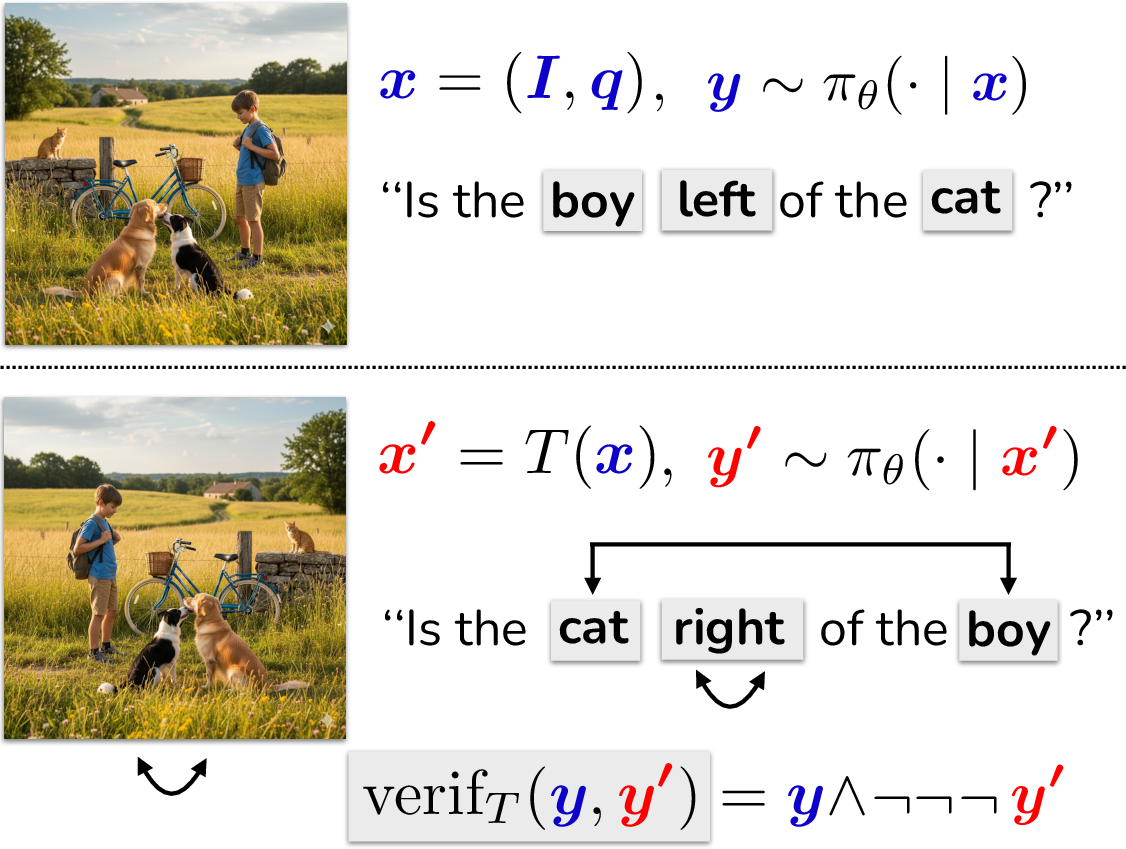
To unlock latent capacity for spatial reasoning, the authors introduce the construct of a consistency verifier—a reward functional that assesses whether the outputs of a model are consistent under known, label-preserving, or label-negating transformations. Given a prompt x=(I,q) and its transformed variant x′=T(x)=(TI(I),Tq(q)), where TI and Tq are image and text transformations, respectively, the mapping ϕT determines the deterministic relationship between their ground-truth answers due solely to the transformation T. For example:
Invariance (ϕT=id): For crops, color jitter, or paraphrasing, which preserve truth value, consistency means answers should match.
Equivariance (ϕT=¬): For horizontal flips, object swaps, or relation inversions, which negate the answer, consistency means answers should differ.
Instead of requiring access to ground-truth answers, the model is trained to maximize agreement with these transformation-induced relationships, detected via the verifier:
Figure 1: A consistency verifier exposes logical relationships between prompt/answer pairs under structured transformations on image and question.
This mechanism transforms the supervision paradigm for spatial reasoning: the model’s reward signal is driven purely by transformation-consistent logical constraints, which are globally specified and label-agnostic.
Reinforcement Learning with Consistency: OT-GRPO
The learning process leverages Group Relative Policy Optimization (GRPO) as the RL backbone. Classical GRPO operates with per-sample rewards; here, rewards are instead pairwise, as each original and augmented prompt generates a completion whose mutual consistency is scored by the verifier. Several pairing strategies are proposed for matching completions, but only optimal transport-based minimal pairing (OT-GRPO) guarantees robustness to reward hacking:
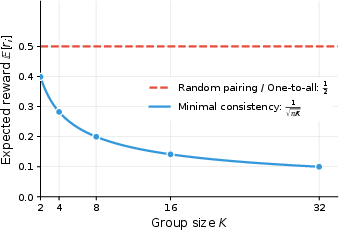
Random/One-to-All Pairing: These pairings are easily exploited by models producing random outputs, as random agreement yields a 50% expected consistency.
Minimal Consistency (OT-GRPO): Uses assignment optimization to match each completion with the partner that yields the least consistency. For random models, expected reward drops as O(1/K) for group size K:
Figure 3: Expected per-completion reward under the random baseline versus group size x′=T(x)=(TI(I),Tq(q))0. Only minimal consistency penalizes random guessing.
This ensures that gains in the reward signal require coherent, systematic improvements in the model’s reasoning process, rather than exploiting statistical artifacts.
Empirical Results: Accuracy, Transfer, and Robustness
The central experimental result is that consistency-based self-supervision achieves performance competitive with fully supervised fine-tuning on spatial reasoning tasks. Specifically:
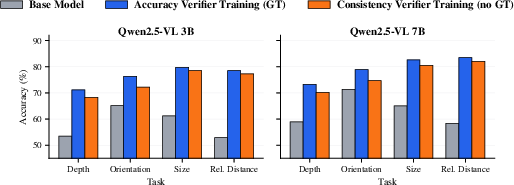
On four canonical spatial reasoning tasks (orientation, depth, size, and relative distance), consistency-trained models reach within 2.3–2.7 percentage points of accuracy-trained counterparts for models of size 3B and 7B.
Figure 4: Same-task accuracy for boolean tasks (SUN RGB-D); consistency-based RL nearly matches accuracy supervision, with gap under 3pp.
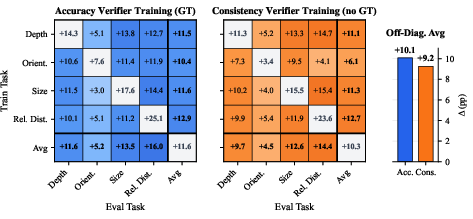
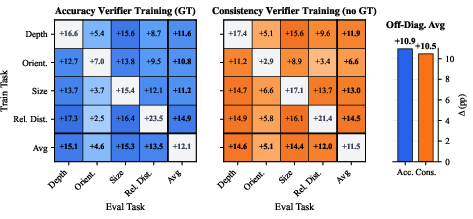
Cross-task transfer: When training on one spatial task and testing on another, consistency-trained models acquire abstract spatial reasoning capabilities that generalize almost as effectively as when using ground-truth supervision. The average transfer gap is under 1pp.
Figure 5: Cross-task transfer matrix for 7B model (SUN RGB-D).
Domain generalization:Consistency training enables transfer from indoor scenes to the outdoor KITTI dataset as effectively as direct supervision. Both within- and cross-task transfer remain robust, with less than 1pp performance loss.
Figure 6: Cross-domain generalization (SUN RGB-D x′=T(x)=(TI(I),Tq(q))1 KITTI) for all four spatial tasks.
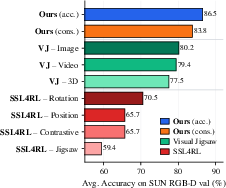
Self-supervised baseline comparison: Consistency outperforms advanced self-supervised pretext tasks (including Visual Jigsaw and SSL4RL) by margins of 3.6–24 percentage points, closing 97% of the accuracy gap to ground-truth labels.
Figure 7: Average accuracy on SUN RGB-D, four boolean tasks. Consistency reward (label-free) is far superior to all tested pretext tasks.
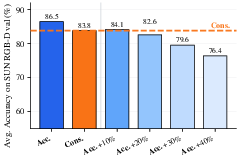
Robustness to noisy supervision: Consistency-based training overtakes accuracy supervision when more than 20% of the training labels are corrupted. This empirically grounds the advantage of label-free RL in scenarios where annotation pipelines are unreliable due to cascading upstream errors from 3D detectors or calibration.
Figure 8: Model robustness under increasing label noise. Consistency is more robust past 20% corruption.
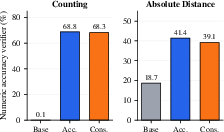
Extension to regression: Consistency verifiers can be adapted for continuous-valued tasks (e.g., object counting, physical distance estimation); here, the label-free reward leads to results within x′=T(x)=(TI(I),Tq(q))22.3pp of the accuracy-trained regime.
Figure 9: Consistency extends to numeric regression (counts, distances) as an invariance objective.
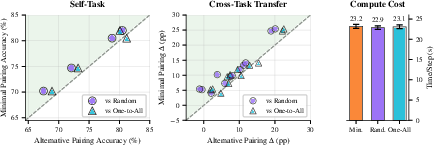
Ablations: Minimal (OT) pairing consistently outperforms one-to-all and random pairing across self-task and transfer settings, justifying the computational investment.
Figure 2: Ablation on pairing: minimal pairing dominates for both accuracy and cross-task transfer.
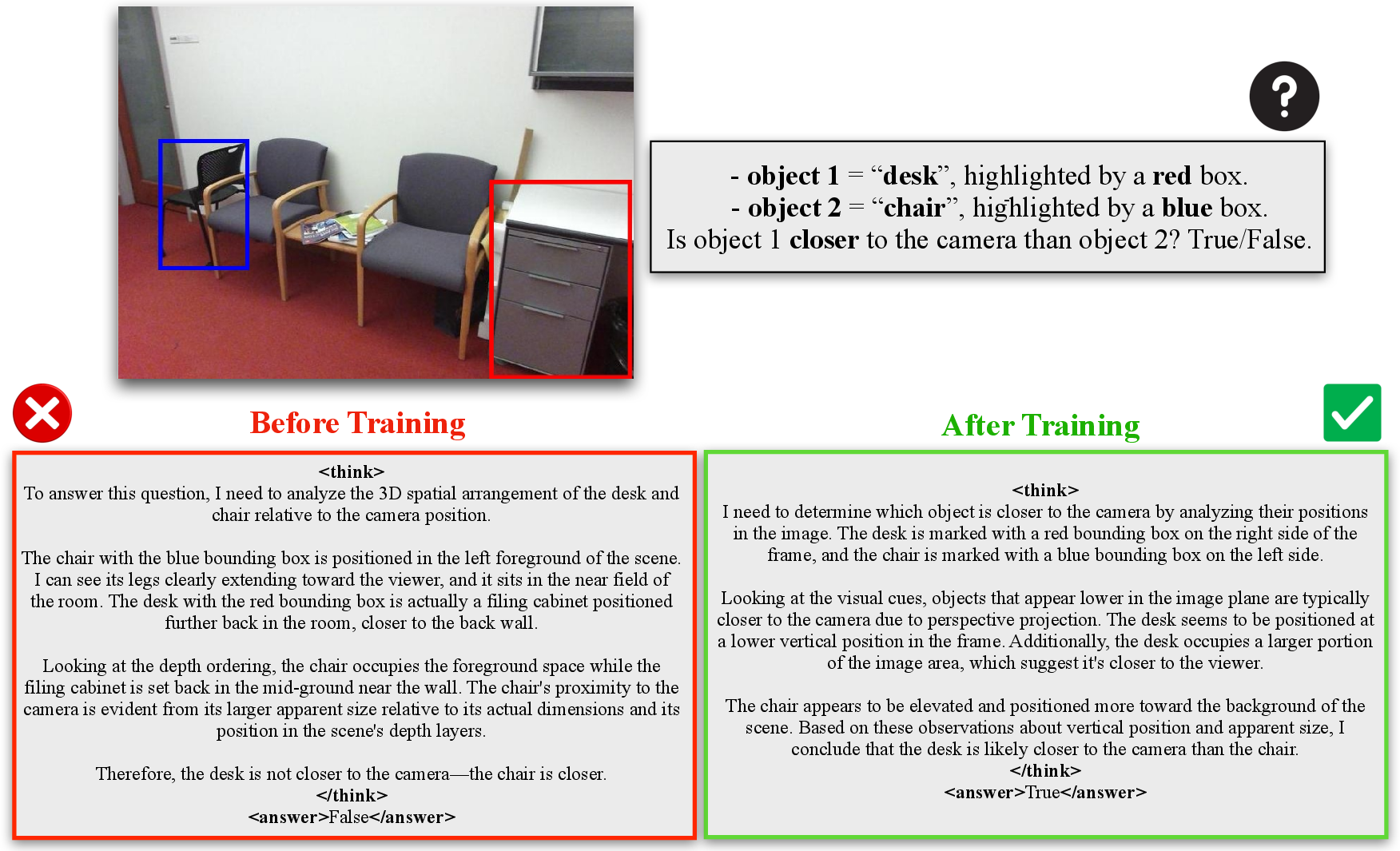
Qualitative Analysis: Post-training completions are more likely to reflect physically plausible and logically sound chains of reasoning, as evidenced by increased success on challenging spatial queries.
Figure 10: Consistency training shifts model reasoning from heuristic cues to explicit geometric structure.
Theoretical Implications and Future Directions
This work demonstrates that internal logical consistency under geometric and compositional transformations constitutes a potent, fully label-free reward for RL-based post-training. The practical value is immediate: expensive, error-prone ground-truth annotation can be partly or entirely replaced by task-general transformation rules. Theoretically, these results reinforce the notion that pretrained VLMs encode (but misalign) significant spatial reasoning, and that alignment via logical constraints (rather than data curation) is a powerful tool.
There are numerous avenues for extension:
Higher-order Consistency: Current verifiers operate on answer pairs; compositional or chain-based verifiers across sequences of transformations may allow richer extraction of geometric relations.
Beyond Spatial Reasoning: The methodology generalizes to any domain where structural consistency under known transformations holds—for example, arithmetic, temporal, or causal reasoning.
Integration with Curriculum RL: Dynamic selection of transformation complexity or chaining may drive better generalization in open-ended embodied AI.
Conclusion
Self-supervised reinforcement learning with minimal-consistency verifiers presents a scalable, resilient strategy for enhancing the spatial reasoning of VLMs without explicit supervision. This label-free paradigm yields accuracy and generalization on par with supervised fine-tuning, with superior robustness to noisy or unavailable annotations. The framework leverages fundamental geometric and semantic symmetries to extract and align latent reasoning ability, establishing a new foundation for advancing spatial and general reasoning in multimodal AI systems.