- The paper introduces a novel bifurcated GNN that integrates an E(3)-equivariant network with a physics-informed Δ-MLP to predict dynamic magnetic exchange couplings.
- It demonstrates high accuracy with energy MAE of 1.1 meV/atom and exchange coupling MAE of 0.18 meV, effectively bridging DFT and large-scale simulations.
- The work enables real-time mapping of FM-to-AFM phase transitions in strained CrI₃, offering insights for nanomagnetometry experiments and 2D device design.
Introduction and Motivation
The emergence of monolayer CrI3 as an intrinsic 2D van der Waals magnet has catalyzed significant interest in understanding and manipulating magnetism at the atomically thin limit. Central to this paradigm is the coupling between local lattice geometry and the sign and magnitude of the isotropic exchange coupling Jij, which determines the competition between FM and AFM order via Goodenough-Kanamori (GK) physics. While DFT studies have revealed the extreme sensitivity of Jij to bond angles and lengths, first-principles approaches are computationally prohibitive for mesoscale, time-resolved simulations involving thousands of atoms and dynamic strain fields.
"DSpinGNN: A Physics-Informed Equivariant Graph Neural Network for Dynamic Magnetic Exchange Prediction in Strain-Deformed Monolayer CrI3" (2606.11685) introduces a bifurcated GNN architecture that overcomes these limitations. The approach couples an E(3)-equivariant GNN (E-GNN) for force-driven Langevin molecular dynamics and a physics-informed Δ-MLP exchange predictor embedding an analytical GK ansatz. This separation enables efficient and interpretable simulation of adiabatic, position-dependent Jij on large supercells, accurately tracking strain-driven magnetic phase evolution inaccessible to direct DFT.
Methodology and Model Architecture
The DSpinGNN framework is predicated on physically motivated architectural decisions to enforce symmetry, transferability, and generalization across length scales. The pipeline is illustrated below.
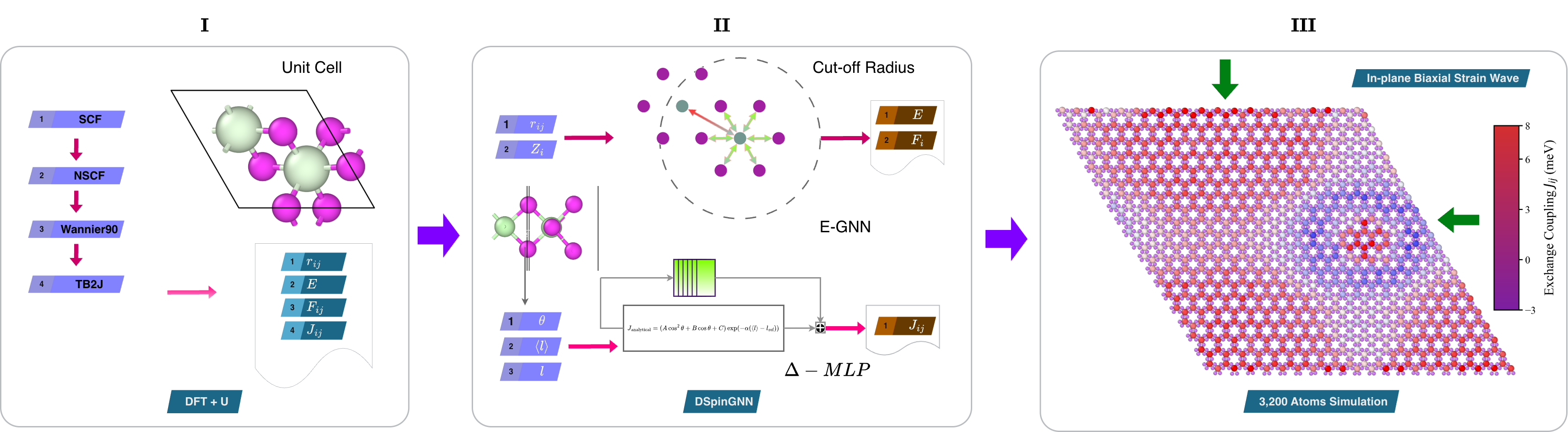
Figure 1: DSpinGNN workflow comprising DFT+U data generation, E(3)-equivariant GNN for structural dynamics, a physics-informed Δ-MLP exchange predictor embedding the GK-ansatz, and mesoscale simulations under dynamic strain.
The E-GNN branch (implemented via NequIP) operates on atomic species and geometric relationships, predicting total energy and atomic forces with explicit 30-equivariance, eliminating the need for rotational data augmentation and ensuring proper transformation under all rigid-body operations. This is a critical design feature facilitating deployment on supercells orders of magnitude larger than the training domain.
The exchange coupling prediction is handled by a physics-informed 31-MLP operating on local Cr-I-Cr subgraphs. The model embeds a GK-inspired analytical block as an inductive bias:
32
Here, 33 is the Cr-I-Cr bond angle and 34 is the mean Cr-I bond length. The MLP predicts a residual correction to this physics-based baseline, stabilizing the prediction in extrapolation regimes and conferring interpretability of the ML output in terms of microscopic exchange mechanisms.
Training leverages 406 DFT+U relaxed configurations of 8-atom primitive cells sampled under biaxial, uniaxial, and shear strain with atomic rattling. Dataset splits are stratified, and the test set is strictly withheld until final evaluation. The decoupled, adiabatic simulation protocol enforces the instantaneous mapping 35 without spin-lattice feedback in the dynamics—appropriate for the targeted timescale separation.
DSpinGNN achieves high accuracy in simultaneous prediction of energies, forces, and exchange couplings. On the withheld 61-configuration test set (unseen during hyperparameter tuning), the model attains an energy MAE of 1.1 meV/atom, force MAE of 6.5 meV/Å, and exchange coupling MAE of 0.18 meV with 36 for 37.
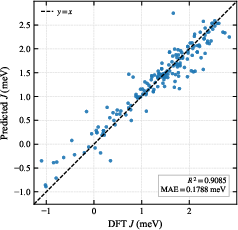
Figure 2: Parity plot of the predicted versus DFT-calculated 38 on the test set, demonstrating generalization and the physical fidelity of the physics-informed exchange predictor.
This level of accuracy, particularly for 39, is comparable to or better than recent equivariant GNN and Jij0-learning approaches applied to magnetic materials, but with the addition of explicit physical inductive bias for robust extrapolation.
Mesoscale Simulation of Dynamic Exchange Textures
Deployed at scale on a 20×20 CrIJij1 supercell (3200 atoms), DSpinGNN simulates the evolution of local exchange couplings under a propagating and reflecting biaxial strain wave at 5 K. Crucially, wave reflection at periodic boundaries generates transient regions of constructive interference where local compressive strain exceeds the DFT-calibrated FM-to-AFM threshold (Jij2 strain).
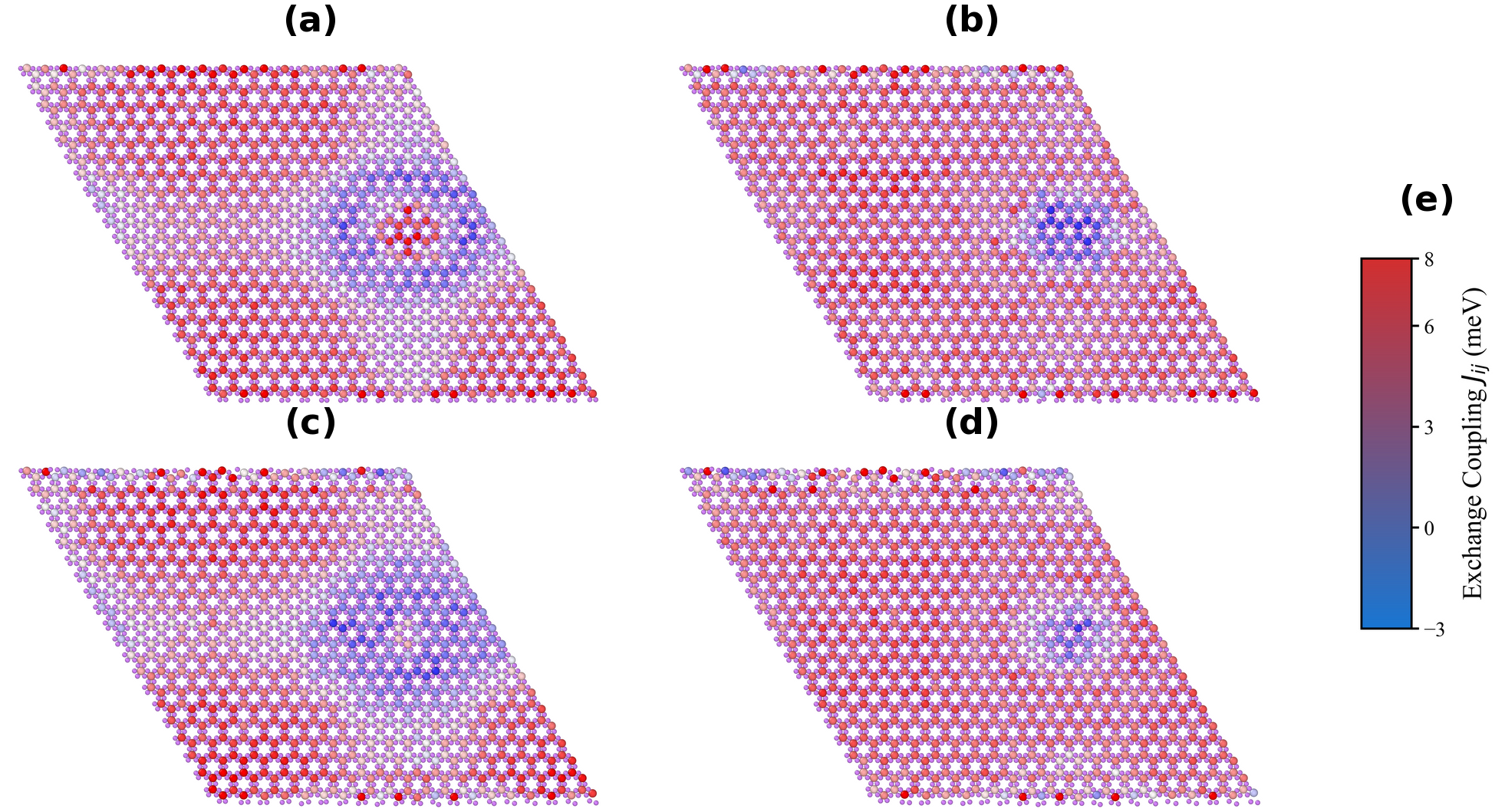
Figure 3: Snapshots of the predicted Jij3 texture during strain wave dynamics reveal nucleation and subsequent contraction of AFM-sign domains embedded in a FM background.
This real-space mapping of Jij4 demonstrates spatial heterogeneity, with nucleated AFM cores and enhanced-FM peripheries cycling during the strain oscillation. The domain wall width between FM and AFM regions is extracted by fitting radial Jij5 profiles to a hyperbolic tangent form.
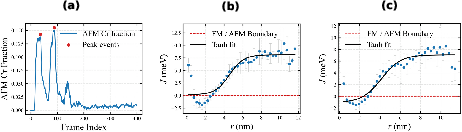
Figure 4: (a) Fraction of AFM-sign Cr atoms over time; (b,c) radial Jij6 profiles and domain wall width fits at two interference events, establishing a mean wall width Jij7 nm and oscillation period Jij8 ps.
These observables, both wall width and oscillation period, are inaccessible to direct ab-initio calculations and are directly testable using nanomagnetometry techniques in strain-driven experiments.
An internal check on the Jij9-MLP’s physical embedding is performed by plotting Jij0 as a function of the Cr-I-Cr bond angle Jij1 over the mesoscale trajectory.
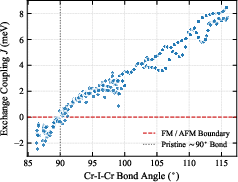
Figure 5: Predicted Jij2 as a function of Cr-I-Cr bridging angle Jij3 tracks the sign change and functional form expected from GK superexchange theory.
The model’s predictions robustly interpolate between FM and AFM regimes in accordance with the GK rules, confirming the analytic ansatz drives the correct qualitative phase physics across the entire simulation domain.
Implications, Limitations, and Outlook
DSpinGNN establishes a reproducible, length-scale-transferable framework for mapping local isotropic magnetic exchange in dynamically strained 2D systems. The explicit Jij4-equivariance and physics-informed inductive bias enable robust generalization beyond the training set, supporting accurate, interpretable, and computationally efficient mesoscale simulations. The extracted domain wall widths and dynamical timescales are significant for design and interpretation of strain-tunable 2D magnetic devices and cryogenic nanomagnetometry experiments.
However, the current model is restricted by its physical approximation set: a collinear Ising constraint (proxying SOC-induced anisotropy required in 2D), omission of SOC in the DFT reference data, first-nearest neighbor isotropic coupling truncation, and adiabatic decoupling of the dynamics—precluding simulation of non-collinear phenomena, magnon spectra, multi-neighbor effects, and magnetoelastic feedback. Extensions incorporating non-collinear DFT data, SOC, higher-order exchange tensors, and coupled dynamics will allow targeting of DMI, Kitaev interactions, and topological spin textures in future ML-enhanced ab initio protocols.
Conclusion
DSpinGNN advances the state-of-the-art in large-scale, physics-constrained simulation of dynamic magnetostructural phenomena in 2D materials. The approach demonstrates that equivariant GNNs augmented with embedded analytical relationships can provide transferable accuracy and interpretability when extrapolating to regimes far outside the direct training set, bridging a critical gap between first-principles electronic structure and experimentally relevant real-space, real-time magnetism. The open-source code and dataset enhance reproducibility and further development in adaptive, physically informed ML for quantum materials (2606.11685).

