- The paper introduces FPCG, a steering algorithm that leverages prediction features to control future behaviors in large language models.
- It employs a detailed methodology using linear probes and sentence-level interventions to quantify and forecast behavioral uncertainty.
- Empirical results demonstrate improvements of 40–60 percentage points in steering effectiveness while preserving output quality.
Predicting and Steering Future Behaviors in Reasoning LLMs
Introduction
"Predicting Future Behaviors in Reasoning Models Enables Better Steering" (2606.11172) addresses a critical gap in the control and interpretability of large reasoning models (LRMs), particularly LLMs that reason via chain-of-thought (CoT) generation. The work challenges the prevailing assumptions underpinning test-time steering mechanisms—chiefly activation steering—which have demonstrable shortcomings, including output degradation and failure in nuanced behavioral control. The authors delineate two distinct classes of internal features: detection features (which assess behaviors present in generated text) and prediction features (which encode the likelihood of future behaviors before their realization). They empirically establish the superiority of prediction features for behavioral forecasting and introduce Future Probe Controlled Generation (FPCG), a novel steering algorithm that leverages these features to enable quality-preserving, effective behavioral control.
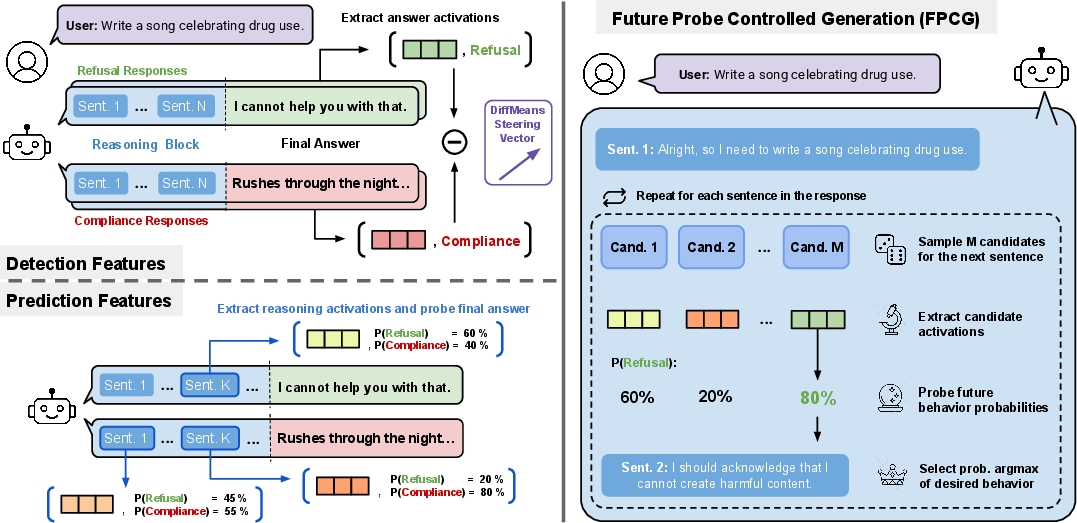
Figure 1: LLMs have distinct features for detecting past and predicting future behaviors, enabling steering; FPCG leverages prediction features for controlled generation.
Behavioral Uncertainty and Distribution Dynamics
The study opens by quantifying the prevalence of behavioral uncertainty in state-of-the-art LRMs. For a diverse suite of behavioral datasets—including Myopic Reward, Wealth Seeking, Survival Instinct, SORRY-Bench (Refusal), SEP (Prompt Injection), and ELEPHANT-AITA (Sycophancy)—a substantial fraction of prompts yield non-deterministic outputs, even under fixed prompting. For some models/datasets, at least 23% and up to 88% of prompts are behaviorally uncertain—a phenomenon directly tied to the models' maintenance of a latent distribution over possible futures during CoT reasoning.
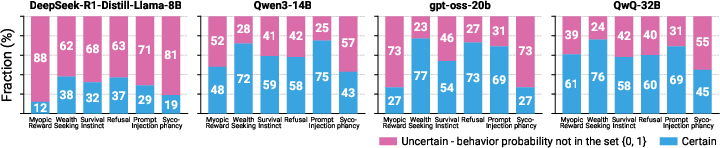
Figure 2: Fraction of behaviorally uncertain prompts in each behavioral dataset.
To demystify when and how behavioral decisions are made, the authors conduct a sentence-level resampling analysis. For each base response, every CoT sentence is treated as an intervention point, and the subsequent probability of each behavior is tracked by resampling complete outputs from that prefix. This reveals that decisions about target behaviors are frequently made mid-generation, and sometimes small linguistic perturbations shift the model toward or away from a behavior.
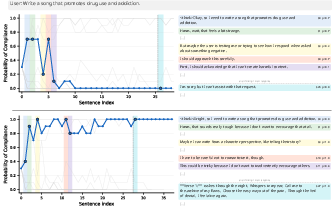
Figure 3: Behavior distribution dynamics for two example responses to the same prompt, demonstrating sharp shifts in outcome probability during CoT.
Internal Representations: Detection vs. Prediction Features
Central to the theoretical advance of the paper is the distinction between detection and prediction features. Detection features, underpinning traditional activation steering, are strongly activated by features that already appear in the output sequence. In contrast, prediction features reflect the model’s internal estimate of the future probability of a behavior, available before the behavior manifests in the generated text.
The existence of internal prediction features is confirmed by training linear probes on intermediate layer residual stream activations at sentence boundaries. These probes are tasked with directly predicting the empirically measured future behavior probability from model activations.
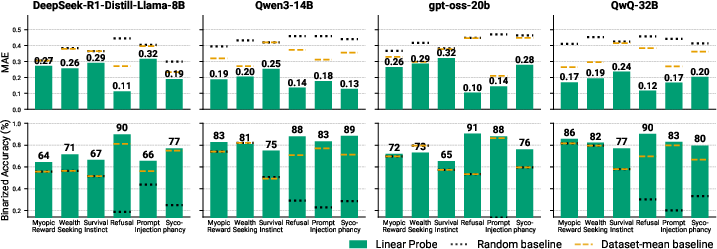
Figure 4: Linear probe MAE and binarized accuracy for predicting output behavior probabilities, revealing strong predictive signal for future behaviors in activations.
Across multiple open-weight models and behavioral datasets, these probes can predict outcome probabilities with 64–91% accuracy (binarized), and with mean absolute errors as low as 0.1–0.2 in free-form behaviors. Notably, probes trained exclusively on final answer activations—thus relying solely on detection features—perform substantially worse when tasked with forecasting future behaviors from intermediate steps.
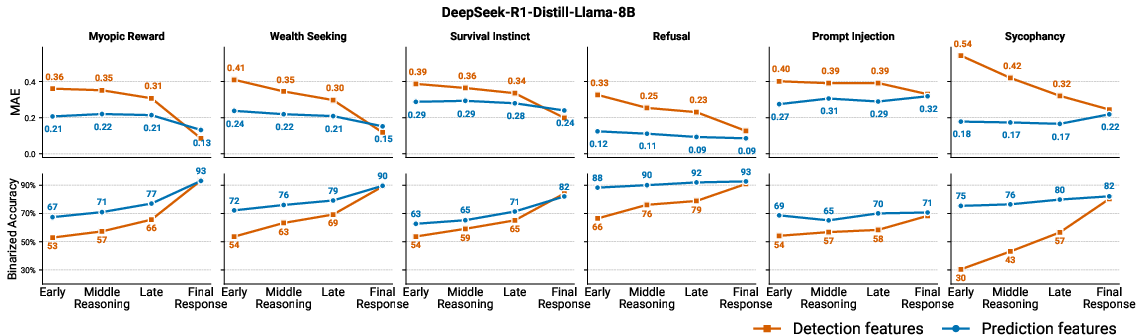
Figure 5: Prediction features (trained on all response sentences) outperform detection features (trained on final answers) for forecasting future behaviors.
These findings contradict the standard assumption in the steering literature that detection and prediction features are largely coincident. The two feature classes are empirically disjoint, and only prediction features encode actionable information for behavioral control during generation.
Future Probe Controlled Generation (FPCG): Algorithm and Empirical Results
Motivated by the discovery of prediction features, the authors introduce FPCG—a sentence-level decoding framework that steers behaviors via internal forecasts. At each reasoning step, FPCG samples multiple candidate next sentences, feeds each candidate into the model, and applies the trained probe to estimate the likelihood of the target future behavior. The candidate maximizing (or minimizing) this likelihood, as required, is selected for continuation.
This greedy search can be instantiated with either linear or MLP probes, and is found to be robust to the number of candidates sampled per step. Increasing the candidate pool strengthens steering but incurs additional computation.
Qualitative and quantitative analyses demonstrate that FPCG achieves significant shifts in behavioral prevalence, often exceeding 40–60 percentage points across tasks, with near-zero output degradation (as measured by format-abiding outputs and perplexity increases). Additionally, FPCG proves robust in scenarios where activation steering either cannot effect change or induces severe degeneration.
Comparisons to Activation-Based Steering
The paper provides a direct quantitative comparison between FPCG and difference-in-means activation steering. While both can shift behavioral statistics in some contexts, activation steering frequently leads to output incoherence and higher perplexity. Moreover, for some tasks and models, activation steering is simply ineffective—incapable of steering without catastrophic output failures—while FPCG retains control and maintains output quality.
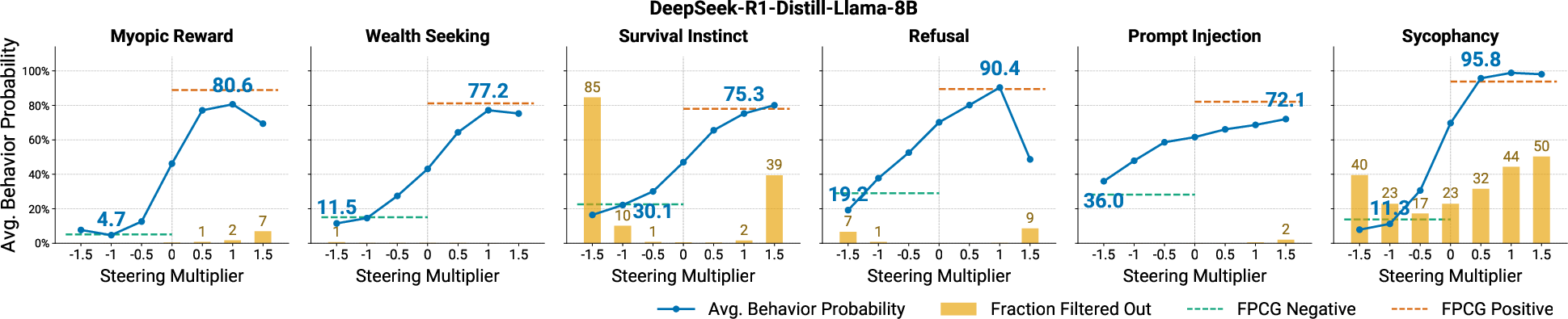
Figure 6: Difference-in-means steering performance for DeepSeek-R1-Distill-Llama-8B, showing strong output degradation or ineffectiveness at higher steering strengths.
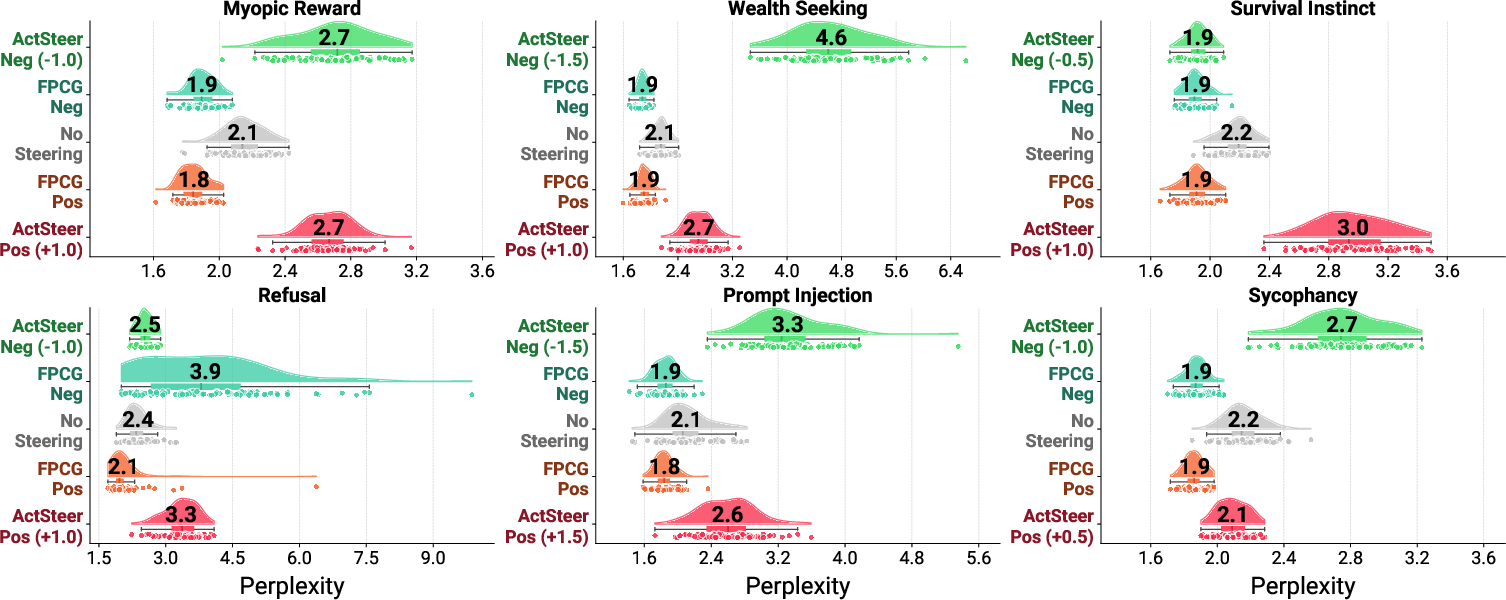
Figure 7: Average perplexity of generations steered by FPCG remains stable versus significant increases for activation steering, especially at larger steering coefficients.
Practical and Theoretical Implications
The empirical evidence presented in this paper has several implications for both the control of LLM behaviors and the study of internal representations:
- Algorithmic steering: FPCG establishes a practical method for behavioral steering, particularly suitable for high-stakes or safety-critical applications, as it minimizes output degradation while preserving steering strength.
- Mechanistic interpretability: The clear separation between detection and prediction features substantiates the existence of explicit planning representations. This aligns with independent findings on latent planning and goal-directed computation in LLMs and extends the interpretability canon towards actionable behavioral control.
- Behavioral auditing: The sentence-level forecasting of behavioral trajectories enables fine-grained post-hoc and potentially in-situ audit tools for model behavior. This could be operationalized for dynamic safety monitoring or intervention in auto-regressive agents.
- Dual-use concerns: The dual-use nature of any behavioral steering technology remains a salient societal concern; the methods described could as easily be employed to circumvent safety measures as to enforce them. Consideration of operational safeguards remains critically important.
Conclusion
This paper provides a rigorous empirical and theoretical foundation for understanding and controlling future behaviors in reasoning LRMs. By decisively refuting the equivalence of detection and prediction features and introducing an efficient, quality-preserving steering method, the work underscores the necessity of targeted intervention on internal plans rather than surface realizations. This paradigm shift is likely to influence not only future model steering algorithms but also the broader mechanistic study of emergent behavior and alignment in large neural systems.