- The paper demonstrates that process-level feedback using the RGI method yields significant score improvements and higher incorporation rates compared to self-reflection.
- The experimental design reveals that iterative revisions often plateau or regress due to aggressive full rewrites and limited validated content preservation.
- Results underscore the need for architectural modifications, such as revision-aware scaffolding, to enhance dependable multi-turn improvements in deep research agents.
Multi-Turn Evaluation of Deep Research Agents Under Process-Level Feedback
Motivation and Problem Framing
The prevailing evaluation methodologies for deep research agents (DRAs) focus on single-shot outputs, ignoring whether these systems can iteratively improve their reports when guided by structured feedback. In practice, users rarely accept the first draft as final; iterative refinement based on feedback is fundamental. This paper addresses two underexplored settings: self-reflection—where the agent attempts to improve its report absent external signals—and process-level feedback—where the agent receives guidance targeting deficiencies in its underlying research strategy, rather than only surface content gaps.
Process-level feedback, enabled by the Research Gap Inference (RGI) method, differs from criterion-level feedback by synthesizing patterns across rubric evaluation axes (factual accuracy, breadth/depth, citation quality) to identify research-process gaps. This higher-level feedback is designed to prompt agents to adapt their searching, source selection, and analytical framing, rather than simply patching content.
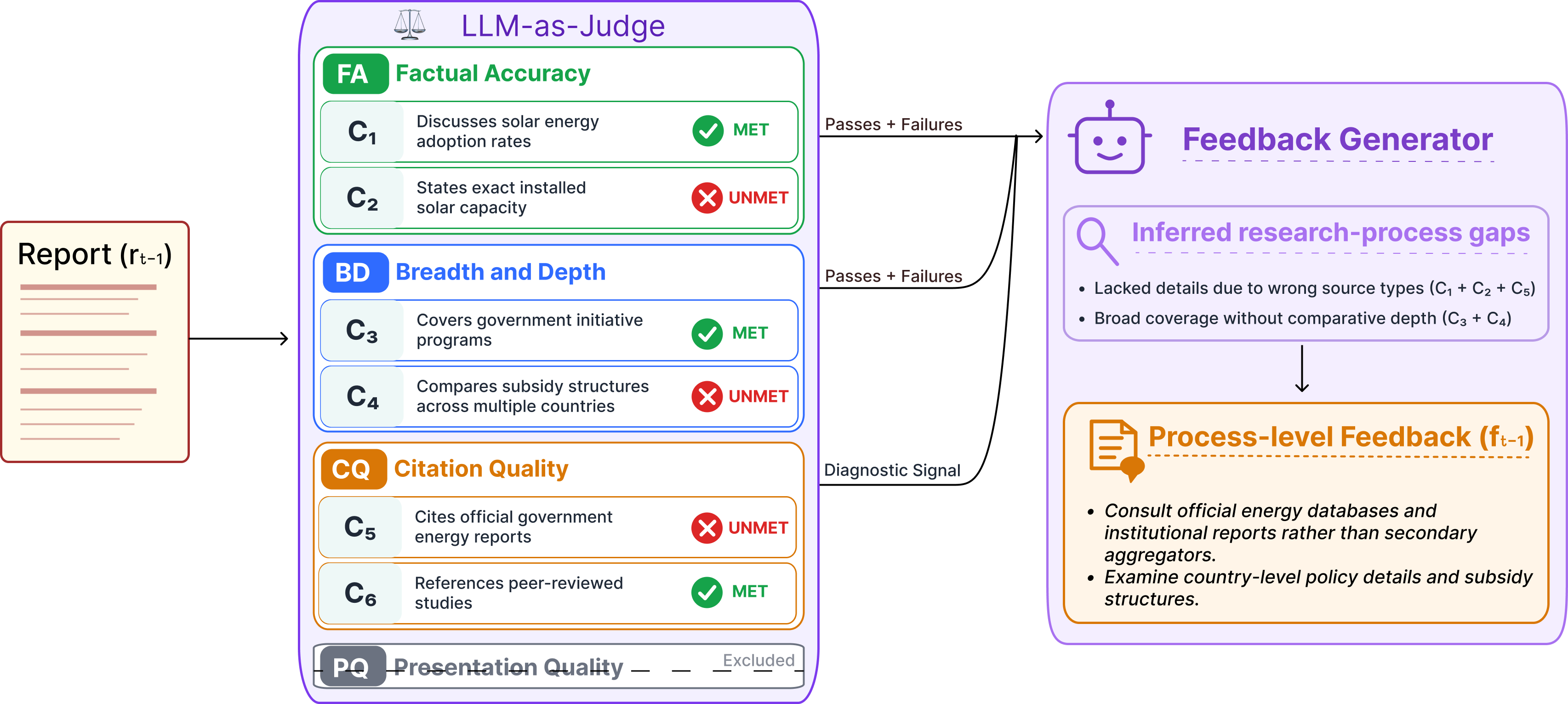
Figure 1: Process-level feedback generation via RGI, analyzing satisfied and unsatisfied rubric criteria in rt−1 to diagnose research-process gaps and generate strategic guidance ft−1.
Experimental Design
Benchmark and Agents
The study evaluates three LLM-based DRAs (GPT-4.1-mini, GPT-4.1, DeepSeek-V4-Flash) under the modular LC-ODR framework, which decomposes tasks into planning, research, supervision, and reporting stages. Fifty tasks are sampled from DRACO, a cross-domain benchmark pairing each task with expert rubrics along factual accuracy (FA), breadth/depth (BD), presentation quality (PQ), and citation quality (CQ). Each criterion is binary (MET/UNMET), weighted, and evaluated by an LLM judge. At each turn, agents receive the query, their previous report, and feedback (self-reflection or RGI process-level) and generate a revised report.
Evaluation Metrics
Performance is measured via rubric-derived normalized scores and pass rates. Additionally, incorporation rate quantifies how many previously unsatisfied criteria are newly satisfied after revision, while regression rate quantifies loss of previously satisfied criteria. Net criterion gain captures overall improvement. Trace-level diagnostics (web-search activity, token usage, citation overlap) are extracted to analyze agent behavior.
Main Empirical Findings
Self-Reflection Versus Process-Level Feedback
Under self-reflection, all models exhibit negligible net improvement: incorporation and regression rates are nearly equal (e.g., GPT-4.1-mini, 15.40% incorporation vs. 12.90% regression; DeepSeek-V4-Flash, 26.18% vs. 15.99%). Agents conduct more searches and consult more sources but fail to target relevant gaps.
In stark contrast, one round of RGI-guided process-level feedback yields substantial gains: normalized scores increase by roughly $8$-$15$ points and incorporation rates reach $35$-40% across models. For instance, GPT-4.1-mini improves from $37.76$ to $53.11$ (normalized score), and DeepSeek-V4-Flash increases from $57.20$ to $65.35$ after the first RGI revision.
Limited Compoundability in Multi-Turn Revisions
Improvements saturate quickly; subsequent RGI-guided turns do not reliably compound gains. Both GPT-4.1 and GPT-4.1-mini regress or plateau: normalized score for GPT-4.1 drops by ft−10 points (ft−11 after Turn 2 but ft−12 after Turn 3). DeepSeek-V4-Flash regresses less and sustains moderate gains (ft−13), explained by its higher prior-content retention. Regression rates at Turn 3 are steep for GPT models (up to ft−14) but much lower for DeepSeek-V4-Flash (ft−15).
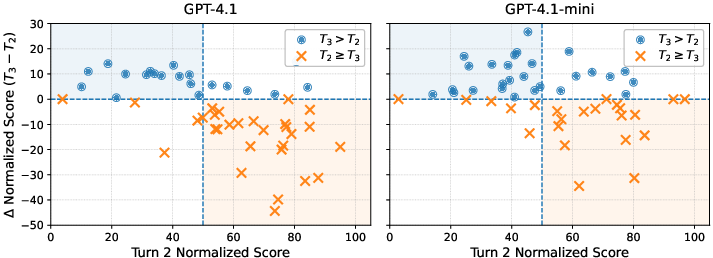
Figure 2: Task-level Turn~3 headroom analysis: Turn~3 gains cluster on tasks with low Turn~2 scores, while regression dominates when Turn~2 scores are high.
Behavioral Analysis and Rewrite Strategies
Process-level feedback selectively drives improvement in coverage and factual grounding (largest gains on BD and FA axes). Citation quality (CQ) improves indirectly via better source selection. Presentation quality (PQ), not targeted by feedback, fluctuates due to rewriting noise.
Full report rewrites expose previously satisfied criteria to loss. DeepSeek-V4-Flash preserves more content and citations across turns (citation retention ft−16 vs. GPT-4.1 ft−17), resulting in lower regression. However, this preservation is implicit and comes at high computational cost: DeepSeek-V4-Flash consumes up to ft−18 the input tokens and operates at more than twice the latency compared to GPT-4.1, with minimal content overlap for GPT models (ft−19 5-gram recall for GPT-4.1 vs. $8$0 for DeepSeek-V4-Flash).
Case studies illustrate divergent outcomes. Strategic feedback can drive recovery (e.g., synthesis of deepfake detection achieves a $8$1 improvement), but if critical evidence is unretrievable, feedback cannot induce recovery and rewrites amplify risk of regression (e.g., financial analysis task regresses by $8$2).


Figure 3: Case studies: process-level feedback drives recovery or, in the case of retrieval bottlenecks, increases regression due to full rewrites.
Theoretical and Practical Implications
These results highlight a structural limitation of current DRA architectures: absence of explicit mechanisms for content preservation across iterative report revisions. Full-rewrite paradigms force agents to re-satisfy all prior criteria, increasing regression risk. While implicit preservation (as in DeepSeek-V4-Flash) can mitigate regression, it is computationally expensive and not guaranteed.
Practically, dependable multi-turn improvement of DRAs will require architectural modifications—introduction of revision-aware scaffolding that explicitly retains validated prior content while prioritizing targeted gap-filling. Mere scaling or increased compute is insufficient for robust iterative enhancement. Theoretically, these findings suggest that error detection remains a bottleneck in self-reflective LLMs, reinforcing the necessity for external diagnostic signals in complex research tasks.
Future Directions
Advancing DRA reliability in iterative settings will require:
- Comparative studies over process-level versus criterion-level feedback modalities
- Adaptive feedback strategies contingent on remaining headroom and report quality
- Systematic evaluation across more diverse benchmarks and agent architectures
- Development of revision modules or memory-based mechanisms explicitly designed for retaining prior content and avoiding unnecessary regressions.
Conclusion
Multi-turn evaluation under process-level feedback exposes fundamental limitations in current DRA report revision strategies. One round of strategic feedback yields significant improvement but fails to compound reliably due to aggressive full rewrites and weak content preservation. Models capable of preserving prior content regress less but at considerable computational expense. Structural advances in agent architectures are required for dependable iterative refinement, motivating future exploration into explicit content retention and adaptive feedback mechanisms for deep research systems.