Statistical and Numerical Convergence in Stochastic Equilibrium
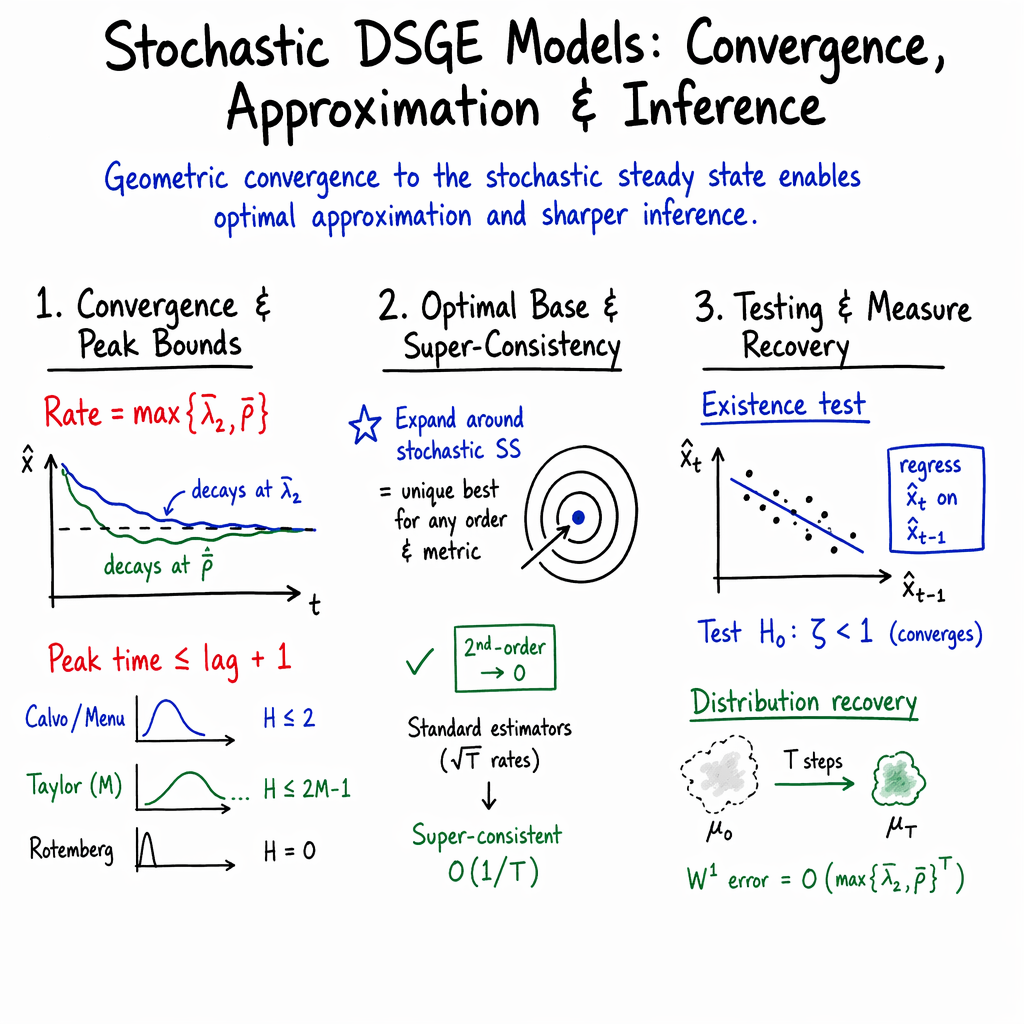
Abstract: This paper sets out the most general computational and econometric implications of the rigorous stochastic equilibrium theory from SELCKE (Staines (2024a)) arXiv:2312.16214. The analytical backbone is the discovery that the system converges geometrically to long-run equilibrium, at a rate given by the greater of the eigenvalue or inverse eigenvalue (from outside) closest to the unit circle and the maximum shock persistence. High-order shocks converge faster. I develop a simulation procedure to test, with asymptotic power, whether stochastic equilibrium exists for a particular model. The fundamental approximation result asserts that, whatever the order of expansion or loss function, the stochastic steady state delivers the most accurate perturbation solution. I also show that super-consistent parameter estimators $O(1/T)$ arise whenever second-order terms vanish. Besides Calvo, I study stochastic equilibrium in two alternative pricing models. Dynamics simplify considerably. I bound the time the impulse response peaks, by the maximum lag in the errors. This lends empirical support to Taylor contracts, although there are issues surrounding unit roots and the strong cost-channel. For menu costs, I demonstrate that the initial price distribution decays away super-exponentially, producing a system equivalent to Calvo with an endogenous reset probability. The impact of idiosyncratic disturbances appears as an additional wedge between actual and efficient output. Blow-up of the objective function at the boundary is proven, with the help of new distributional arguments, so the model meets existing eigenvalue existence conditions for the recursive equilibrium. Along the way, new light is shone on existing theoretical models and statistical procedures.
Paper Prompts
Sign up for free to create and run prompts on this paper using GPT-5.
Top Community Prompts
Explain it Like I'm 14
What is this paper about?
Think of the economy as a giant machine that gets hit by random bumps (shocks) like surprises in demand, oil prices, or policy changes. This paper studies how that machine settles back to “normal” after a bump, how to measure and simulate that settling, and which price‑setting stories (how firms change prices) best match what we see in real data.
The author builds on a theory called “stochastic equilibrium” (a steady pattern the economy hovers around when shocks keep coming) and turns it into practical guidance for computing models, testing them with data, and choosing the right assumptions about how prices adjust.
What questions does it ask?
- How fast does the economy return to normal after a shock, and what sets that speed?
- Where should we “expand” or approximate the model to get the most accurate predictions?
- Can we design simple simulations to test whether a model has a sensible equilibrium?
- Under what conditions can we estimate model parameters much more precisely than usual?
- Which price‑setting story fits “hump‑shaped” reactions (responses that slowly rise and then fall) seen in data on output and inflation?
- Are different price‑setting models (like menu costs vs. Calvo pricing) really different in their big‑picture behavior?
How did the author study this?
The paper uses a mix of math, simulation, and simple model comparisons:
- Stochastic equilibrium (everyday analogy): Imagine a wobbly spinning top constantly nudged by tiny pokes. It never stops wobbling, but it dances around a stable average pattern. That average pattern is the stochastic equilibrium. The paper proves when this stable pattern exists and how quickly the top re‑centers after a nudge.
- Speed of return (no heavy math): The return speed is like the slowest “tightening spring” in the system. Two things matter: the economy’s own internal pull back to normal and how persistent the shocks are. Whichever one is slower sets the overall speed. If shocks fade slowly, they dominate; if they fade fast, the economy’s internal forces dominate.
- Best place to approximate: When you use a calculator to predict the economy, you often use a local “expansion” (like a Taylor expansion) around some point. The paper shows the best place—no matter how fancy your approximation is—is the model’s stochastic steady state (the long‑run average pattern).
- Simple simulation test: The paper proposes running a model with small, random shocks (after giving it time to warm up), then checking if the system repeatedly comes back close to its average. If it does, that’s evidence the model’s equilibrium actually exists.
- Understanding “impulse responses” (everyday analogy): An impulse response is how a variable (like inflation) moves over time after a single bump—like watching ripples after tossing a pebble in a pond. The paper proves a clear rule for how long it takes for the biggest ripple to appear.
- Comparing price‑setting rules:
- Calvo pricing: Each period, a random share of firms gets to change their price.
- Taylor contracts: Firms change prices on a fixed schedule (like once a year).
- Menu costs: Changing prices is costly (like printing new menus), so firms wait until it’s worth paying the cost.
The paper shows where these different stories actually behave similarly and where they differ in ways that matter for matching data.
What did the paper find?
Here are the main takeaways, explained simply:
- The economy snaps back exponentially fast
- The gap from normal shrinks by roughly the same fraction each period (like cutting the distance in half every step). The slowest part of the system (either internal dynamics or how slowly shocks fade) controls this speed.
- Higher‑order or more complex disturbances die out even faster.
- The best approximations come from the stochastic steady state
- If you build any order of approximation (simple or advanced), expanding around the model’s long‑run average gives you the most accurate results.
- This leads to a practical simulation strategy: estimate the model’s behavior with straightforward regressions run on simulated data around that steady state.
- A simple test for whether an equilibrium exists
- After a long warm‑up, hit the model with small, random shocks and check if it consistently returns near its average pattern. If yes, the model’s equilibrium likely exists; if not, there’s a problem.
- Sometimes you can estimate parameters much more precisely than usual
- Normally, estimation error shrinks like 1/√T (T = number of observations). The paper shows that if certain “second‑order” effects are tiny or vanish, errors can shrink like 1/T instead—much faster. This is called “super‑consistency.” It’s especially useful in macroeconomics, where data are limited.
- Caveat: This works best when shocks are small (small‑noise situations).
- Clear rule for “hump‑shaped” responses
- The time it takes for a variable (like inflation) to reach its biggest response after a shock is bounded by the maximum lag in the model’s equations.
- In plain terms: If your equations only look one period back, you can’t get a peak that arrives many periods later. To get slow, hump‑shaped peaks (like what we see in data), you need models with at least two lags—this favors Taylor‑style contracts over basic Calvo pricing.
- Menu costs often look like Calvo with a twist
- When many firms face costs to changing prices, the overall behavior can mimic Calvo pricing—but with a “reset probability” that changes with conditions in the economy. This reduces differences across price‑setting stories, creating a kind of “universality class” of similar New Keynesian models.
- Firm‑specific (idiosyncratic) shocks increase price dispersion, which creates a wedge between actual output and the efficient “ideal” output.
- Better foundations for simulation‑based estimation
- A common approach called “indirect inference” (simulate the model and match simple statistics like a small VAR) gets new long‑run support from the theory here, especially when those second‑order terms are small. In those cases, a standard minimum‑distance estimator is actually efficient.
Why does this matter?
- For policy and forecasting: Central banks rely on these models to forecast and test policies. Knowing the exact speed of return to normal and where to approximate improves both accuracy and reliability.
- For building better models with limited data: Macro data are short and noisy. If you can sometimes get 1/T precision, you can learn more from the same amount of data.
- For choosing realistic price‑setting assumptions: The “hump‑shaped” rule helps decide which price models (like Taylor contracts) better match what we observe in inflation and output after shocks.
- For efficient computation: Exponential convergence and a clear best approximation point simplify how we simulate and solve complex models, saving time and reducing errors.
- For unifying theories: Showing that menu costs can behave like Calvo with an adjustable reset chance helps bring different models under one roof, making results easier to compare and interpret.
Final takeaway
The paper turns a deep idea—stochastic equilibrium—into practical tools: it tells us how fast economies settle, where to approximate for best accuracy, how to test if a model’s steady pattern exists, when we can estimate parameters super‑precisely, and which pricing rules can produce the slow, hump‑shaped reactions we see in real data. In short, it brings stronger math and clearer rules to the models economists use every day.
Knowledge Gaps
Knowledge gaps, limitations, and open questions
The paper makes several strong theoretical claims and sketches promising computational/econometric procedures, but it leaves multiple aspects unaddressed or only partially explored. The following list summarizes the concrete gaps and open questions that merit further research:
- Clarify and generalize the exact conditions under which “second-order terms vanish” and super-consistent rates (Theorem 7) obtain; provide operational diagnostics that an applied researcher can use to verify this condition in a given DSGE specification and calibration.
- Quantify the constants and provide explicit computable bounds in the “geometric convergence” result (Result/Theorem 3, 9): how to compute the dominant rate given the “internal and external” eigenvalues and shock persistence, and how sensitive this rate is to model misspecification.
- Define and operationalize “external eigenvalue (from outside)” in the convergence rate statement; offer a procedure for practitioners to compute or estimate it from a given nonlinear model.
- Extend the convergence and approximation results beyond smoothness to settings with kinks, occasionally binding constraints (e.g., ZLB), and regime changes; the paper presently relies on smoothness and assumptions (e.g., effectively negative nominal rates) that limit applicability.
- Develop versions of the main theorems that allow for indeterminacy and sunspots (i.e., when Blanchard–Kahn conditions fail or multiple equilibria exist); the current “iff” existence claim via BK conditions appears local and excludes important macro settings.
- Provide finite-sample performance analysis for the proposed “super-consistent testing” and the simulation-based existence test; assess robustness to small samples typical in macroeconomics and to measurement error.
- Specify the simulation/testing algorithm in full detail: burn-in selection, sample size requirements, shock scaling for the “small-noise” regime, choice of regressors/auxiliary statistics, and how to handle multiple shocks and observables.
- Investigate robustness of the “optimal approximation at the stochastic steady state” claim (Theorem 8) across loss functions and metrics beyond the asymptotic regime; provide numerical evidence or counterexamples when non-asymptotic approximation error ranking may differ.
- Characterize the domain of validity and selection between the two limiting regimes mentioned near ZINSS (polydromy and the “smaller” limit); offer practical guidance on which limit governs empirical dynamics under typical calibrations.
- Examine how the results change when is not sent to 1; several derivations take for compactness—clarify the quantitative implications at standard discount factors (e.g., 0.99) and whether qualitative conclusions (e.g., on determinacy or slope neutrality) persist.
- Address the identification and empirical implementability of the “existence test using short-term responses to small shocks”: how to isolate a single white-noise shock in data, how to ensure identification restrictions hold, and how to deal with confounding structural shocks.
- Analyze the effect of heavy-tailed, skewed, or non-Gaussian shocks, and structural breaks, on the convergence, super-consistency, and testing procedures; the paper assumes continuous distributions but leaves other empirically relevant cases open.
- Provide a systematic treatment of unit roots, near-unit-root persistence, and the “strong cost-channel” noted as a caveat; spell out conditions under which the IRF peak-time bound or convergence statements may fail or need modification.
- Generalize the “IRF peak time ≤ maximum lag” result (Theorems 5–6) beyond the small-shock regime and linear neighborhood; assess whether nonlinearities, state-dependence, or learning can generate delayed peaks without adding explicit lags.
- Reconcile the IRF bound with empirical hump-shaped responses beyond two periods under widely used features (e.g., habit formation, investment adjustment costs, capital accumulation); identify which structural frictions violate or modify the bound.
- Formalize the role of endogenous state variables that create internal propagation (e.g., capital, habits) versus exogenous shock persistence in determining peak timing; the current bound ties strictly to “maximum lag present in the model.”
- Elaborate on the menu-costs-to-Calvo equivalence: clearly list the “technical conditions” needed to prevent effective price flexibility, and test empirically whether those conditions are plausible; provide conditions under which the equivalence breaks (e.g., strong trend inflation, selection).
- Quantify the “super-exponential decay” of the initial price distribution in the menu-cost model; identify the required distributional assumptions on idiosyncratic shocks (support, tails) and whether the result holds under empirically estimated micro-price shock processes.
- Provide an explicit mapping from the endogenous reset probabilities in menu-costs to equivalent Calvo parameters over the business cycle, and evaluate welfare and policy transmission differences beyond inflation dynamics (e.g., output gap, welfare costs of dispersion).
- Test whether the “additional wedge” from idiosyncratic disturbances in menu costs can be separately identified in macro data and quantify its magnitude; propose an empirical strategy using micro pricing data plus macro observables.
- Clarify the role of “no selection” at the ergodic distribution in menu-costs proofs; explore how selection (e.g., state-dependent repricing) affects aggregation and whether the equivalence to Calvo survives state dependence or trend inflation.
- Specify how trend inflation alters hazard profiles and dynamics; provide a general characterization of hazard functions under different inflation regimes and their mapping to aggregate Phillips curves.
- Detail how to compute and use the ergodic invariant measure in practice for stochastic equilibrium approximations (e.g., required simulation lengths, mixing diagnostics, numerical integration/Monte Carlo error control).
- Expand on how to incorporate regime switching, rational learning, or behavioral frictions (as suggested with Moll’s critique) into the stochastic equilibrium framework; identify which steps of the proofs require redesign.
- Address how to handle heterogeneous-agent models beyond menu costs (e.g., incomplete markets, borrowing constraints) where distributions matter; provide criteria under which low-dimensional recursive summaries still exist and how to compute them.
- Provide explicit guidance on constructing auxiliary models for indirect inference that align with the stochastic equilibrium’s “appropriate auxiliary model”; demonstrate empirically that this alignment improves efficiency over standard VAR-based auxiliaries.
- Develop methods to detect, in estimated models, whether second-order effects are empirically negligible so that minimum distance is (asymptotically) efficient; without such diagnostics, the efficiency claim is difficult to exploit in practice.
- Investigate sensitivity of the main results to alternative demand systems (e.g., Kimball aggregators), variable markups, and strategic complementarities; the paper remarks on possible changes but does not derive the implications.
- Offer computational benchmarks comparing the proposed stochastic-equilibrium-based approximations and tests with standard nonlinear DSGE solvers (perturbation, projection, deep learning) in high-dimensional settings; report runtime, accuracy, and stability.
- Clarify how to set and estimate the AR(1) shock persistence parameter(s) in the small-noise context and how estimation error in persistence interacts with the geometric convergence rate and IRF peak bound.
- Extend the theoretical framework to allow for multiple exogenous shocks with different degrees of persistence and cross-correlation, and determine how the “max persistence” rule aggregates across shocks.
- Examine the robustness of the “output neutrality” calibration (zero slope of the Phillips curve) and its policy implications (e.g., requirement that in certain limits); reconcile with the standard Taylor principle and provide conditions for determinacy.
- Provide practical recipes for handling the ZINSS singularity and the “wall-crossing/three-dimensional hole” noted in the linearization; specify numerical techniques that avoid spurious cancellations near zero trend inflation.
- Give a precise characterization of the class of mean-field-game environments (discrete time, general state spaces, shocks) for which the stochastic equilibrium approach yields existence, uniqueness, and convergence; spell out limitations relative to the continuous-time Brownian literature.
- Address how to measure and calibrate the distribution of idiosyncratic shocks in menu-cost models using micro price data, and how to propagate micro-estimated distributions to macro dynamics within the proposed framework.
- Investigate how measurement error in inflation and output affects the proposed regression-based extraction of the stochastic equilibrium expansion, especially when regressors involve expectations and ratios of ergodic expectations.
- Explore how the proposed framework handles trending economies (growth, non-stationarity) beyond the balanced growth/log utility special case; specify de-trending procedures compatible with the stochastic equilibrium constructs.
- Provide a roadmap for extending the IRF timing bound and convergence results to models with expectations frictions (e.g., sticky information, noisy information) and bounded rationality, which may alter lag structures.
Practical Applications
Overview
Below are actionable, real-world applications that follow from the paper’s findings on stochastic equilibrium, geometric convergence, optimal approximation, impulse-response shaping, menu-cost equivalence, and super-consistent estimation. Each item notes likely users, sectors, potential tools/workflows, and critical assumptions/dependencies.
Immediate Applications
- Stochastic-equilibrium existence diagnostic from short-run responses
- Users/sectors: Policy (central banks), Academia (macroeconomics), Software (DSGE toolchains), Finance (macro research)
- What to do: Implement the paper’s test that uses short-term responses to small shocks (after burn-in) to check whether a DSGE model admits a stochastic equilibrium (asymptotic power). Use this as a pre-check before policy simulations or estimation.
- Tools/workflows: Add a “stochastic-equilibrium existence check” module to Dynare/IRIS/Julia/Python workflows; provide a burn-in recommender.
- Assumptions/dependencies: Small-noise limit; sufficient burn-in; recursive equilibrium with Blanchard–Kahn (BK) conditions; well-identified short-run shocks (e.g., AR(1) errors).
- Burn-in and horizon setting via geometric convergence rate
- Users/sectors: Policy/Academia/Software/Finance
- What to do: Set simulation burn-in lengths and truncation horizons using the derived exponential return rate to the stochastic steady state (max of “eigenvalue distance to the unit circle” and exogenous shock persistence). Improve forecast windows and solver tolerances accordingly.
- Tools/workflows: Convergence-rate estimator; automated burn-in/horizon picker embedded in simulation pipelines.
- Assumptions/dependencies: Correct linearization/eigenstructure near the steady state; stable ergodic dynamics; known or estimable shock persistence.
- Optimal approximation point for perturbations (stochastic steady state)
- Users/sectors: Policy (model development), Academia (theory/estimation), Software (solution libraries)
- What to do: Recenter perturbation solutions at the stochastic steady state (not the deterministic steady state) for any approximation order and loss function. Use the regression-based simulation strategy to estimate the expansion coefficients.
- Tools/workflows: “Stochastic steady-state expansion” mode in solvers; simulation-plus-regression routines to recover polynomial terms; automated centering of approximations.
- Assumptions/dependencies: Existence of an ergodic invariant measure; small-noise approximations; smooth policy functions.
- Super-consistent parameter estimation when second-order terms vanish
- Users/sectors: Policy (limited-sample macro), Academia (econometrics), Finance (short samples)
- What to do: Exploit O(1/T) convergence in parameters in models/limits where second-order terms vanish (small-noise limit). Use minimum-distance/indirect-inference estimators that become efficient in this limit to gain power in short macro samples.
- Tools/workflows: Flag/model-check to detect “second-order vanishing” regimes; switch estimator to minimum distance/indirect inference; tighter CIs and smaller required samples.
- Assumptions/dependencies: Validity primarily in small-noise limits; phenomenon is fragile (measure-zero in a broader sense); care with model misspecification and large shocks/regime shifts.
- IRF peak-time bound as a structural diagnostic and model selector
- Users/sectors: Policy (monetary analysis), Academia (structural identification), Finance (macro trading)
- What to do: Use the bound “time-to-peak ≤ maximum lag in recursive equilibrium” to:
- Reject models that imply peaks later than allowed by their lag structure.
- Prefer Taylor contracts (≥2 lags) when data exhibit hump-shaped IRFs peaking beyond two periods, over Calvo models.
- Tools/workflows: IRF timing analyzer in SVAR/DSGE toolkits; model selection filter based on observed hump shape and peak timing.
- Assumptions/dependencies: Small shocks; accurately identified lags; caution with unit roots and strong cost-channel specifications.
- Menu costs as Calvo with endogenous reset probability
- Users/sectors: Industry (retail/consumer goods pricing), Policy (inflation dynamics), Academia (price setting), Finance (inflation modeling)
- What to do: Map menu-cost environments to an equivalent Calvo model with endogenous reset probabilities that depend on inflation/idiosyncratic shocks. Use this to:
- Calibrate price-adjustment hazard rates conditional on inflation trends.
- Quantify the “dispersion wedge” (extra gap between actual and efficient output) from idiosyncratic shocks.
- Tools/workflows: Pricing cadence planners for firms; hazard-rate dashboards that ingest inflation and price dispersion; welfare wedge trackers for policy.
- Assumptions/dependencies: Idiosyncratic shocks with continuous distributions; sS pricing policies; trend inflation influences hazard rates; the equivalence holds near stochastic equilibrium.
- Reduced dimensionality for forecasting and pedagogy
- Users/sectors: Policy (forecasting with limited data), Academia (teaching), Software (dimensionality reduction)
- What to do: Use the paper’s simplifications (e.g., eliminate dependence on reset-price variables) to compress the state for estimation/forecasting when observations are scarce—especially in Taylor-contract models where dimensionality gains are larger.
- Tools/workflows: Reduced-state VAR/DSGE filters; simplified state-space models for nowcasting.
- Assumptions/dependencies: Valid near the stochastic equilibrium; model structure consistent with the simplifications.
- Numerical solvers with theoretically justified tolerances
- Users/sectors: Software (DSGE solvers, deep-learning solvers), Policy/Academia (simulation)
- What to do: Set solver tolerances and iteration stopping rules using the exponential return rate; tighten error control to reflect faster convergence of higher-order shock components.
- Tools/workflows: Adaptive tolerances; error-budgeting linked to eigenvalues and shock persistence.
- Assumptions/dependencies: Reliable eigenvalue estimates; stability; no binding ZLB/regime-switching during computation.
- Indirect inference with asymptotic backing and correct auxiliary model
- Users/sectors: Policy/Academia (estimation), Software (estimation packages)
- What to do: Treat the paper’s simulation procedure as indirect inference with an auxiliary model aligned to stochastic-equilibrium dynamics; use minimum-distance estimators for efficiency in the appropriate limits.
- Tools/workflows: Indirect-inference modules pre-configured with the “right” auxiliary VAR/ARMA; diagnostics for small-noise regime validity.
- Assumptions/dependencies: Auxiliary model must reflect stochastic-equilibrium expansions; small-noise conditions for efficiency claims.
- Pricing cadence and contract design for firms
- Users/sectors: Industry (retail, manufacturing, services), HR/Payroll (wage contracts)
- What to do: Use the IRF timing result and the menu-cost equivalence to:
- Choose longer contract structures (Taylor-like) when markets exhibit delayed/hump-shaped responses.
- Adjust price-review frequency as inflation rises (hazard increases with trend inflation).
- Tools/workflows: Contract term optimizers; automated alerts to adjust price-review cadence with inflation regime shifts.
- Assumptions/dependencies: Market structure approximates monopolistic competition with love of variety; measurable menu costs and dispersion; stable macro environment.
Long-Term Applications
- Standardized central-bank toolkit for stochastic-equilibrium validation
- Users/sectors: Policy (central banks, IFIs)
- What to build: A unified suite integrating: existence diagnostics, burn-in/horizon setters, IRF timing constraints, stochastic steady-state expansions, and minimum-distance estimation.
- Dependencies: Broad validation across richer models (capital, ZLB, regime-switching), robust identification of shocks, and institutional adoption.
- Market-practice integration of endogenous hazard pricing
- Users/sectors: Industry (omnichannel retail, B2B pricing platforms), Fintech
- What to build: Dynamic pricing systems that estimate inflation-conditional reset hazards and price dispersion in real time; link to ERP/POS data to optimize adjustment timing and costs.
- Dependencies: High-frequency micro price data; robust mapping from micro menu-cost models to macro-equivalent hazard rates; compliance with antitrust and fair-pricing rules.
- Macro forecasting products with reduced-state architectures
- Users/sectors: Software vendors, Policy/Finance clients
- What to build: Commercial forecasting engines that leverage reduced-dimension stochastic-equilibrium representations for better performance with limited data, including nowcasting and scenario analysis under policy counterfactuals.
- Dependencies: Broad benchmarking; plug-ins for VAR/SVAR/DSGE ecosystems; validation under structural breaks.
- Policy evaluation frameworks using IRF timing constraints
- Users/sectors: Policy (monetary and fiscal authorities)
- What to build: Formal guidance that uses the “time-to-peak ≤ lag length” criterion to constrain admissible models in policy evaluations; publish diagnostics alongside IRFs for transparency.
- Dependencies: Consensus on identification strategies; handling unit roots/strong cost channels; communicating uncertainty.
- Measurement and taxation/welfare analysis of the dispersion wedge
- Users/sectors: Policy (finance ministries, competition authorities), Academia
- What to build: Empirical programs to measure the output wedge from idiosyncratic shocks and price dispersion; assess welfare costs of inflation and potential tax/subsidy designs targeting distortions.
- Dependencies: Detailed micro price data; structural estimation linking micro dispersion to macro wedges; robust counterfactuals.
- Cross-domain extensions of the probabilistic mean-field approach
- Users/sectors: Energy (market design), Network industries (telecom), Mobility/logistics, Quant finance (equilibrium models)
- What to build: Apply the paper’s convergence/testing framework to other stochastic equilibrium contexts (e.g., mean-field games in power markets or liquidity models), improving simulation reliability and estimator efficiency.
- Dependencies: Model-specific adaptations; validation of BK-like conditions; domain-specific data and institutional constraints.
- Synergies with machine learning solution methods
- Users/sectors: Software/AI, Academia
- What to build: Training curricula and solver pipelines that guide deep-learning or reinforcement-learning solvers using known convergence rates and optimal expansion points to stabilize training and reduce sample complexity.
- Dependencies: Stable targets near stochastic equilibria; careful treatment of non-differentiabilities/regime shifts; reproducible benchmarks.
- Contracting and wage-setting policy design
- Users/sectors: Policy (labor ministries), Industry (HR/collective bargaining)
- What to build: Evidence-based guidance on contract lengths (favoring multi-period structures when hump-shaped responses are empirically validated) and indexation rules under different inflation regimes.
- Dependencies: Sector-specific IRF evidence; institutional constraints; heterogeneity across labor/product markets.
- Curriculum and training materials
- Users/sectors: Academia, Central-bank training institutes
- What to build: Teaching modules on stochastic steady-state expansions, IRF timing diagnostics, and super-consistent estimation; hands-on labs with simulation-plus-regression workflows.
- Dependencies: Open-source datasets and code; instructor capacity; alignment with existing econometrics curricula.
Notes on common assumptions and dependencies across applications:
- Validity is strongest in small-noise regimes with stable ergodic dynamics; large shocks, ZLB constraints, regime switches, or structural breaks require caution.
- BK conditions and a clean decomposition of states and jump variables are needed for the existence/uniqueness claims.
- Idiosyncratic shocks should be continuously distributed for menu-cost equivalences; trend inflation affects hazard profiles.
- Empirical IRF identification must be robust (e.g., to unit roots and cost-channel effects) when using timing bounds for model selection.
Glossary
- Accelerationist form: A representation of the Phillips curve in which current inflation depends on past inflation and other terms that capture the acceleration of economic activity. "Several simple substitution steps yield the accelerationist form"
- Blanchard-Kahn conditions: Determinacy conditions requiring the number of eigenvalues outside the unit circle to match the number of forward-looking (jump) variables for a unique equilibrium. "conform to the Blanchard-Kahn conditions (matching numbers of eigenvalues inside the unit circle with the total of jump variables)"
- Blow-up: A situation where a function (here, the objective function) diverges to infinity as arguments approach the boundary of the domain. "Blow-up of the objective function at the boundary is proven"
- Brownian motion: A continuous-time stochastic process with independent, normally distributed increments used to model random fluctuations. "the case of Brownian motion (in continuous time) with bounded objective functions."
- Calvo pricing: A model of price stickiness where, in each period, only a random fraction of firms can reset their prices. "Calvo pricing is the most popular approach to inject nominal rigidity into a DSGE model."
- Characteristic equation: A polynomial equation whose roots determine the stability and dynamics of linear difference or differential systems. "Section D focuses on characteristic equation calculations supporting empirical implementation."
- Cohomology: A concept from algebraic topology used here metaphorically to describe structural symmetries in the model’s error terms. "The symmetry in the error structure emerges from the cohomology induced by the efficiency of ZINSS."
- Consumption Euler: The intertemporal first-order condition equating marginal utility today to discounted expected marginal utility tomorrow, adjusted for prices and interest rates. "The consumption Euler is the household's intertemporal optimization condition"
- Dynamic Stochastic General Equilibrium (DSGE): A class of macroeconomic models that combine micro-founded optimization with stochastic shocks and market clearing over time. "Dynamic Stochastic General Equilibrium (DSGE) are the class of models"
- Eigenvalue existence conditions: Criteria based on the spectrum of a system’s transition matrix that ensure an equilibrium exists (and is well-defined). "so the model meets existing eigenvalue existence conditions for the recursive equilibrium."
- Ergodic invariant measure: The stationary probability distribution to which a stochastic process converges and at which expectations are evaluated. "evaluated at the ergodic invariant measure."
- Fixed-point theorem: A mathematical result guaranteeing the existence (and sometimes uniqueness) of a point that is mapped to itself by a function, used here to establish equilibrium. "a version of the fixed-point Theorem 3 (SELCKE)"
- Functional central limit theorem: A result that describes convergence of stochastic processes (properly normalized) to Brownian motion, used to justify asymptotic approximations. "contrasts with the pace offered by a standard functional central limit theorem"
- Green functions: In continuous-time systems, the impulse response functions that solve linear differential operators. "where the are normally called Green functions"
- Hazard rate: The conditional probability that a price is reset at a given age, given it has not been reset before. "where is the hazard rate of a price at age ."
- Idiosyncratic shocks: Random disturbances affecting individual firms or agents rather than the entire economy. "it is necessary to introduce idiosyncratic shocks ."
- Impulse response function: The trajectory of an endogenous variable following an exogenous shock. "The time at which the impulse response function peaks"
- Indirect inference: A simulation-based estimation method that matches model-generated statistics to those from an auxiliary model fitted to data. "indirect inference approach to estimation."
- Inada condition: Boundary conditions on utility (e.g., marginal utility goes to infinity as consumption goes to zero) ensuring interior solutions. "The standard Inada condition for consumption is"
- Mean field game theory: A framework analyzing strategic interactions among a large number of agents by considering the limit of an infinite population. "The second is mean field game theory"
- Menu costs: Fixed costs of changing prices, used to rationalize sticky prices. "Menu costs provide a crucial bridge between classical economics"
- Minimum distance estimator: An estimator that chooses parameters to minimize a distance between empirical and model-implied statistics. "the minimum distance estimator, common in applied work on indirect inference"
- Monopolistic competition: A market structure with many firms producing differentiated products and possessing some price-setting power. "is intrinsic to the love of variety and monopolistic competition."
- New Keynesian models: DSGE models featuring nominal rigidities (such as sticky prices) and micro-founded behavior. "this creates a universality class of New Keynesian models."
- Patient limit: The limiting case where agents become perfectly patient, typically modeled as . "the patient limit ()"
- Phillips curve: A relationship linking inflation dynamics to economic slack and expectations, here derived from micro-foundations. "Benchmark Phillips Curve"
- Polydromy: The presence of multiple branches or paths in a solution near singular points; here used to describe multiple limiting behaviors. "There is polydromy so a second "smaller" limit exists"
- Price dispersion: Variation in relative prices across firms that arises with sticky prices and affects welfare and output. "Price dispersion obeys"
- Recursive equilibrium: An equilibrium characterized by state variables and decision rules that map current states into future states. "Fix a DSGE model with recursive equilibrium"
- Reset probability: The probability that a firm can reset its price in a given period (as in Calvo-type models). "equivalent to Calvo with an endogenous reset probability."
- Stochastic discount factor (SDF): The random variable that discounts future payoffs to present value in a risk-adjusted way. "represents the real stochastic discount factor (SDF)."
- Stochastic equilibrium: An equilibrium concept defined in the presence of randomness, ensuring consistency of decisions and expectations under shocks. "Stochastic equilibrium is a primitive"
- Stochastic steady state: The long-run distribution or mean around which a stochastic system fluctuates. "long-run stochastic steady state"
- Super-consistency: An asymptotic property where estimators converge faster than the usual rate (e.g., at $1/T$). "super-consistency results have been confined to time series or panel with time trends"
- Super-exponentially: Describing decay or convergence faster than any exponential rate. "decays away super-exponentially"
- Taylor contracts: Staggered price-setting agreements where prices are fixed for a predetermined number of periods. "This favors Taylor contracts, although there are issues"
- Taylor expansion: A series expansion of a function around a point, used here for perturbation solutions. "the -order Taylor expansion"
- Taylor pricing: A price-setting scheme where firms adjust prices at fixed intervals (as in Taylor 1979). "the theory of Taylor pricing"
- Taylor rule: A policy rule that sets nominal interest rates as a function of deviations of inflation and output from targets. "This so-called Taylor rule is an ad hoc stabilization condition"
- Transversality condition: A no-Ponzi-game condition ensuring the present value of assets does not explode, guaranteeing optimality. "the transversality condition will bind with equality."
- Unit circle: In stability analysis, the set of complex numbers with modulus one; eigenvalues relative to it determine convergence or divergence. "closest to the unit circle"
- Unit roots: Roots equal to one in a time-series characteristic equation, implying nonstationary behavior. "issues surrounding unit roots and the strong cost-channel."
- Universality class: A set of models that share the same qualitative dynamic behavior despite differing micro-details. "this creates a universality class of New Keynesian models."
- Vector Autoregression (VAR): A multivariate time-series model where each variable is regressed on its own and others’ lags. "like a Vector Autoregression (VAR)."
- ZINSS: The zero-inflation steady state around which certain linearizations are taken in the paper. "at ZINSS"
- Small noise limit: An asymptotic regime in which the variance (or magnitude) of shocks goes to zero, simplifying analysis. "small noise limit alternatives."
Collections
Sign up for free to add this paper to one or more collections.