Self-evolving LLM agents with in-distribution Optimization
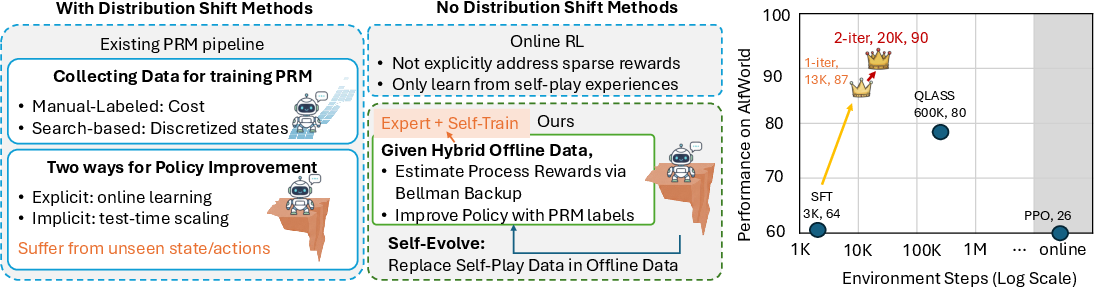
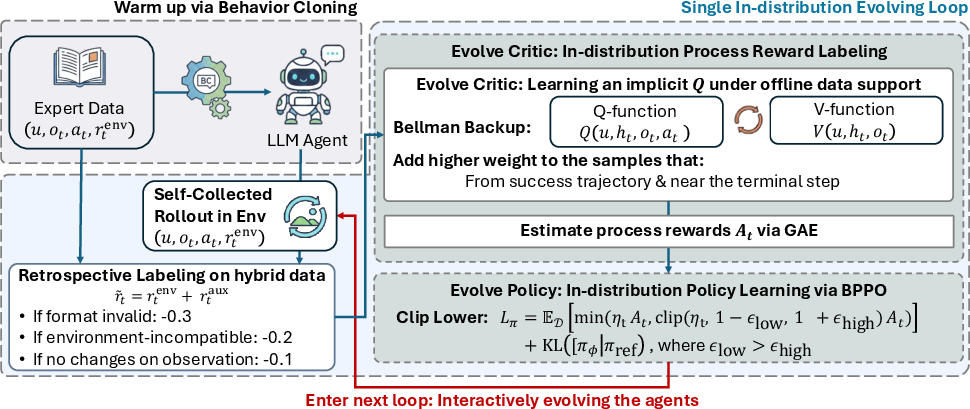
Abstract: LLMs have recently emerged as powerful controllers for interactive agents in complex environments, yet training them to perform reliable long-horizon decision making remains a fundamental challenge. A key difficulty lies in credit assignment: agents often receive delayed rewards only at the end of episodes. In this paper, we propose Q-Evolve, a self-evolving framework for LLM agents that unifies automatic process-reward labeling and policy learning within a principled in-distribution reinforcement learning paradigm. In each evolving iteration, our method learns an in-distribution critic from a hybrid off-policy dataset that combines expert demonstrations with agent-generated trajectories, stabilizing Bellman backups in sparse-reward settings via a weighted Implicit Q-Learning objective. The learned value function is then used to derive step-wise process rewards through advantage estimation, enabling dense and reliable supervision without environment backtracking or human annotation. Leveraging these signals, we perform behavior-proximal policy optimization that evolves the agent over the data used for process reward labeling, allowing iterative self-improvement without exacerbating distribution shift. We evaluate our method on AlfWorld, WebShop, and ScienceWorld, showing Q-Evolve outperforms strong baselines in sample efficiency, robustness, and overall task performance. Our results demonstrate that stable agent self-evolution is achievable through the co-evolution of process-level supervision and policy, both grounded within a shared in-distribution learning loop.
Paper Prompts
Sign up for free to create and run prompts on this paper using GPT-5.
Top Community Prompts
Explain it Like I'm 14
What is this paper about?
This paper introduces Q‑Evolve, a way to train AI assistants that act in the world (called “LLM agents”) to make better, longer plans. The big problem it tackles is that these agents often only find out if they succeeded at the very end of a long task, which makes it hard to learn which steps along the way were good or bad. Q‑Evolve teaches the agent to give itself fair step‑by‑step scores and then improve using those scores, all while staying close to situations it has actually seen before so it doesn’t “drift” into strange, unreliable behavior.
What questions did the researchers ask?
- How can an AI agent figure out which individual steps were helpful when it only gets a reward at the very end?
- Can we create reliable step‑by‑step “process rewards” automatically, without humans labeling every step?
- How can the agent keep improving itself without wandering into actions and situations it was never trained on (a problem called “distribution shift”)?
- Can this be done efficiently, using fewer interactions with the environment?
How did they try to solve it?
Think of the agent as a player and a coach working together in a loop. The player tries tasks; the coach watches and learns to score each move; then the player uses those scores to get better—repeat.
Here’s the idea in everyday language:
- A careful mix of practice data:
- The agent learns from two sources: expert examples (good solutions) and its own past attempts (including mistakes). Expert samples show what success looks like; self‑attempts show where the agent actually struggles. Mixing both keeps learning realistic and stable.
- Quick “common‑sense” step labels from text:
- Many environments tell you when an action was invalid (like pressing a wrong button). The system reads the text feedback and adds small penalties for obvious errors. This gives immediate hints even before the final result.
- A coach that stays in familiar territory:
- They train a “critic” (the coach) that estimates how good each move is, using only actions and states that appear in the dataset. This is called “in‑distribution” learning: stick to scoring things you’ve actually seen, rather than guessing wildly about unknown actions.
- The critic is trained more from useful moments: it pays extra attention to steps later in the task and to successful episodes. This makes the value estimates less noisy when rewards are rare.
- Turning values into step‑by‑step grades:
- From the critic’s predictions, they compute “advantages” for each step—basically, how much better (or worse) a move is than average in that situation. This becomes the process reward: a step‑level score that reflects long‑term success, not just immediate effects.
- Careful policy updates:
- The agent updates its behavior to make good moves more likely and bad moves less likely—but only by a safe amount, so it doesn’t stray too far from known behavior. Think of it as small, controlled improvements instead of big, risky jumps.
- A self‑improvement loop:
- The system repeats this cycle:
- 1) collect some new attempts,
- 2) train the critic on the combined expert + self data,
- 3) compute step‑by‑step advantages,
- 4) update the agent carefully.
- Because both the coach and the player learn from the same kind of data, their feedback stays reliable.
What did they find?
Across three challenging test worlds, Q‑Evolve beat strong baselines in both performance and efficiency:
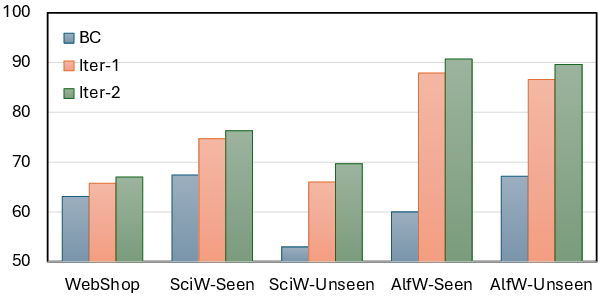
- AlfWorld (text‑based home tasks with long action chains and only a final success/fail reward): Q‑Evolve reached much higher scores than methods like PPO, ETO, and even planning/search‑heavy approaches. It needed far fewer environment steps than some competitors (e.g., thousands instead of hundreds of thousands).
- WebShop (shopping on a website with goals like “buy a red, cheap mug”): Q‑Evolve matched or exceeded top methods.
- ScienceWorld (text‑based science experiments with subgoals): Q‑Evolve achieved strong results on both seen and unseen tasks, showing good generalization.
When they removed parts of the method (an ablation study), performance dropped. That means each piece matters:
- Without the quick error labels from text, it did worse.
- Without the weighted critic (paying more attention to useful steps), it did worse.
- Without turning values into multi‑step advantages, it did worse.
- Without the careful, in‑distribution policy update, it did worse.
Why does this matter?
- More reliable learning from long tasks: The agent can fairly judge its steps even when feedback comes only at the end—like grading each step of a long math solution using the overall outcome.
- Less human effort: It builds step‑by‑step supervision automatically, reducing the need for people to label every step.
- Safer, steadier improvement: By staying “in distribution” (close to what it has seen) and updating carefully, the agent avoids wild guesses that can cause failures.
- Practical and efficient: It needs fewer interactions with the world, making it more feasible for real systems (like software assistants, web agents, or robots) where trial‑and‑error is costly.
In short, Q‑Evolve shows that LLM agents can teach themselves to handle long, tricky tasks by co‑evolving a reliable step‑scoring system and a careful improvement process—all grounded in the same, familiar data.
Knowledge Gaps
Knowledge gaps, limitations, and open questions
Below is a concise list of concrete gaps and open questions that remain unresolved and could guide future research:
- Dependence on expert demonstrations: How does performance degrade with fewer, noisier, or domain-mismatched demos? Can Q-Evolve bootstrap from purely self-collected data (no experts) via curricula or exploration bonuses?
- Retrospective reward labeling assumptions: The rule-based auxiliary rewards depend on explicit textual error messages (format/invalid/repeat). How portable is this to environments without reliable textual feedback, sparse diagnostics, or non-text modalities? Can learned progress/error detectors replace brittle rules?
- Critic–advantage mismatch: The critic is trained on shaped rewards r_env + r_aux, but advantages are computed using r_env with V that was fitted on shaped returns. What bias does this induce? Would training a separate V_env (or de-shaping V) reduce inconsistency?
- Uncertainty-aware supervision: The method lacks explicit uncertainty estimation for Q/V. Can epistemic uncertainty or ensemble variance gate advantage labeling and policy updates to prevent propagating erroneous process rewards?
- Token-level credit assignment: The paper mentions redistributing step-level advantages to tokens and “down-weighting thinking,” but details and ablations are missing. What is the exact token-weighting scheme, its theoretical justification, and its impact on CoT vs action tokens?
- Behavior policy estimation: BPPO uses importance ratios vs a lagged behavior policy, but expert data has unknown behavior. How is π_old defined across mixed sources, and what bias results? Can per-source behavior modeling or implicit behavior cloning correct this?
- Monotonic improvement and convergence: There is no theoretical guarantee that the co-evolution loop (weighted IQL critic + BPPO policy) converges or improves monotonically in language action spaces. Under what assumptions can guarantees be established?
- Hyperparameter sensitivity: Performance may depend on expectile m, GAE λ, KL α, asymmetric clipping bounds (ε_low, ε_high), and weights w_t. Can adaptive schemes (e.g., meta-gradients, line-search, or bandits) stabilize these choices?
- Prioritization scheme design: The step weights w_t are heuristic (favor later steps and successes). Are there more principled priorities (e.g., TD-error, advantage magnitude, uncertainty) that improve stability in sparse-reward settings?
- Iteration depth and stability: Only 2–3 self-evolution loops are evaluated. How does performance behave over many iterations (drift, saturation, or catastrophic forgetting)? What data-refresh schedules or replay strategies preserve stability?
- Data mixture policy: The method lacks an analysis of how to balance expert vs self data during critic training. What mixture ratios and sampling strategies (e.g., prioritized replay, diversity constraints) optimize learning?
- OOD detection and control: While in-distribution learning is emphasized, distribution shift still occurs across iterations. Can OOD detectors or conservative trust-region mechanisms prevent updates on unreliable states/actions?
- Robustness to noisy/self data: Self-generated failures may dominate early iterations. How resilient is the critic to label noise and spurious correlations (e.g., late-step mistakes receiving large weights)? Can robust regression or noise-aware objectives help?
- Partial observability and context limits: The approach relies on long textual histories. How do context-window truncation, memory mechanisms, or retrieval strategies affect critic/policy quality on very long-horizon tasks?
- Non-stationarity and stochastic dynamics: Experiments focus on text-based benchmarks; real web and robotics are non-stationary and stochastic. How does Q-Evolve handle evolving UIs/APIs, delayed effects, and non-determinism?
- Modality and action-space generality: Can the framework extend to multi-modal observations (vision), continuous/low-level actions (robotics), or tool-rich interfaces where actions are parameterized and compositional?
- Safety and constraints: Self-evolution can amplify unsafe behaviors or degenerate strategies. How to incorporate constraints, risk measures, or shielded policy updates to guarantee safe improvement?
- Process reward validation: There is no direct evaluation of process reward quality (e.g., correlation with subgoal completion, human judgments). Can benchmarks and metrics for process reward accuracy and calibration be established?
- Fairness and bias: Mixing expert and self data may encode biases from experts or environments. How to detect and mitigate demographic or content biases in process rewards and policy updates?
- Compute and cost reporting: The paper does not report detailed compute/wall-clock costs per iteration (critic + policy). What is the cost–performance trade-off vs online RL and PRM-based search under standardized budgets?
- Breadth of baselines and parity: Comparisons omit some learned PRMs/progress models and step-level RLHF variants. Can broader, compute-matched comparisons clarify where Q-Evolve’s advantages stem from?
- Scaling behavior: Results are shown for 7–8B models; how do gains scale with larger models (e.g., 70B) or different instruction-tuning regimes? Are there diminishing returns or stability issues at scale?
- Reproducibility details: Clarify the reference policy π_ref, expectile level m, exact token-level redistribution, and dataset sizes/ratios per iteration. Public ablations on these choices would enhance reproducibility and adoption.
Practical Applications
Immediate Applications
Below are concrete, near-term uses that can be deployed with current tooling, especially where environments provide textual feedback and historical logs or demonstrations are available.
- Software and IT operations (DevOps/SRE runbook automation)
- What: Automate multi-step runbooks (e.g., service restarts, log triage, config rollbacks) with an agent that learns from expert scripts and tickets, and self-improves via offline logs.
- How (tools/workflows):
- Hybrid dataset builder (expert runbooks + historical terminal sessions).
- Retrospective reward labeler parsing shell/CLI error messages (format/invalid/repeat commands).
- In-distribution critic (weighted IQL) + BPPO policy updates.
- Sector: Software/IT
- Assumptions/dependencies: Structured logs/CLI outputs; access to expert runbooks; sandboxed staging for limited online rollout; governance to prevent unsafe commands in production.
- Enterprise RPA and GUI/web automation
- What: Automate form-filling, CRM updates, invoice processing, and browser workflows; agent reduces invalid/duplicate actions using retrospective labels.
- How:
- Use historical RPA logs and a small set of expert demos to create a hybrid buffer.
- Parse UI error messages and unchanged DOM states for auxiliary penalties.
- Self-evolution iterations with minimal online steps to adapt to site/app changes.
- Sector: Software/Back-office automation
- Assumptions/dependencies: Stable selectors or accessible UI text; monitoring for site updates; ability to safely collect new rollouts.
- E-commerce shopping and procurement assistants
- What: Product discovery and purchase workflows (e.g., internal procurement portals); improve attribute-matching and purchase success using process rewards.
- How:
- Train on past sessions + curated demos; penalize invalid searches/clicks, repeated pages.
- Offline critic + GAE-derived step rewards; policy updates with asymmetric clipping to suppress harmful actions.
- Sector: Retail/E-commerce; Enterprise procurement
- Assumptions/dependencies: Logs with final purchase outcomes; parsable UI feedback; exception handling for non-determinism (inventory/price changes).
- Customer support tooling (agent-assisted case resolution)
- What: Agents navigate ticketing systems, knowledge bases, and CRM records to execute multi-step resolution flows with reduced invalid steps.
- How:
- Build offline datasets from resolved tickets and agent attempts; label invalid actions by parsing system messages.
- Iterate with limited online trials; use critic-derived advantages for reliable step-wise learning.
- Sector: Customer service/CRM
- Assumptions/dependencies: Access to historical case flows; integration with helpdesk systems; safeguards for data privacy and escalation to humans.
- Scientific workflow assistance in digital labs/LIMS
- What: Guide experiment planning and inventory checks in lab management systems, minimizing invalid steps (e.g., missing reagent actions).
- How:
- Use LIMS logs and expert protocol demonstrations; label invalid tool calls via textual feedback.
- Offline critic to propagate sparse end-of-experiment rewards.
- Sector: R&D/Pharma/Materials
- Assumptions/dependencies: Structured LIMS outputs; simulation or sandbox for online samples; domain-specific constraints and safety checks.
- Coding/Dev agent for CI workflows
- What: Agents propose patches, run tests, and perform CI-actions (lint/build/deploy) with process-level supervision from build/test logs.
- How:
- Hybrid dataset from prior CI runs and expert patches; retrospective penalties for build failures and invalid commands.
- Weighted IQL critic + BPPO to upweight steps leading to green builds.
- Sector: Software engineering
- Assumptions/dependencies: Access to CI logs and test outcomes; secured environment to limit harmful actions; careful scope around production deployment steps.
- Education: stepwise practice assistants for structured tasks
- What: Interactive tutors for problem sets with terminal correctness feedback (e.g., code exercises, formal proofs, structured STEM problems).
- How:
- Build datasets from solved examples and student attempts; treat final correctness as episodic reward; parse tooling/compiler feedback for auxiliary labels.
- Derive process rewards with GAE to guide stepwise solution hints.
- Sector: Education/EdTech
- Assumptions/dependencies: Tasks with verifiable end rewards and interpretable tool feedback; ethical guardrails; alignment with curriculum goals.
- Governance tooling for safer agent training
- What: Risk-aware training pipelines that constrain policy updates to in-distribution data and explicitly suppress negative-advantage actions.
- How:
- Add BPPO with asymmetric clipping; maintain reference policies; audit trails per iteration (datasets, critics, process labels).
- Sector: Cross-industry (AI governance)
- Assumptions/dependencies: MLOps infra to version datasets/models; policy for update cadence and human review.
- Internal analytics: log-driven process reward labeling
- What: Turn enterprise logs into stepwise rewards to train assistive agents, reducing need for human PRM labeling.
- How:
- Retrospective reward labeling engine that parses error codes/status changes; pipeline for weighted IQL and advantage computation.
- Sector: Analytics/Platform engineering
- Assumptions/dependencies: High-quality, text-rich logs; domain-specific parsers; privacy/compliance controls.
- AgentOps: self-evolving agent lifecycle management
- What: End-to-end platform to collect rollouts, learn critics, derive process rewards, and update policies on a schedule.
- How:
- Iterative “data refresh → critic learn → GAE → BPPO → minimal online rollout” loop; dashboards for sample efficiency and regression detection.
- Sector: Software/AI platforms
- Assumptions/dependencies: Compute resources for offline RL; staging environments for safe rollouts; integration with existing observability.
Long-Term Applications
These use cases require further research, scaling, safety validation, or integration with non-textual, high-stakes environments.
- Physical robotics for household and industrial tasks
- What: Long-horizon manipulation/navigation where feedback is sparse; agents learn from demos and self-rollouts, with step-level supervision derived offline.
- How:
- Combine expert teleoperation demos with simulated/self-collected trajectories; extend retrospective labeling to sensor/vision feedback; bridge to continuous control.
- Sector: Robotics/Manufacturing/Logistics
- Assumptions/dependencies: High-fidelity simulators; robust perception-to-text abstractions; safety layers and fail-safes; sim-to-real transfer.
- Clinical workflow assistance and order sets
- What: Multi-step EHR workflows (orders, documentation) optimized for correctness and policy compliance using process rewards from terminal outcomes and system feedback.
- How:
- Offline learning from de-identified EHR process logs + curated clinician demos; retrospective penalties from order validation errors.
- Sector: Healthcare
- Assumptions/dependencies: Rigorous validation, oversight, and approvals; bias/fairness analysis; strict privacy/security; limited or no online exploration in production.
- Financial back-office and compliance procedures
- What: KYC/AML onboarding and exception remediation; stepwise improvement with sparse end-state approvals and rich textual error codes.
- How:
- Hybrid datasets from historic cases; critic-driven step supervision to reduce rework; conservative policy updates to remain in-distribution.
- Sector: Finance/FinOps/Compliance
- Assumptions/dependencies: Regulatory constraints; auditability; human-in-the-loop; risk management; change management for evolving policies.
- Industrial operations and energy grid control assistants
- What: Plan/execute long-horizon control sequences with sparse rewards (e.g., grid stability, maintenance scheduling) using offline learning and process rewards.
- How:
- Train in simulators with expert traces; parse alarms and system messages as auxiliary labels; use conservative in-distribution updates to ensure safety.
- Sector: Energy/Utilities/Process industries
- Assumptions/dependencies: High-fidelity simulators; strict safety gating; certified procedures; real-time constraints beyond current LLM latencies.
- Multi-application desktop OS agents for knowledge workers
- What: General-purpose agents that orchestrate across apps (email, calendars, spreadsheets) and self-improve from session logs.
- How:
- Centralized hybrid datasets; retrospective labeling of invalid app actions; KPI-based episodic rewards (e.g., task completion).
- Sector: Productivity/Enterprise software
- Assumptions/dependencies: Robust tool integrations; privacy controls; dynamic UI changes; extensive evaluation to prevent destructive actions.
- Scientific discovery planning (multi-step experiment and simulation orchestration)
- What: Agents plan sequences of simulations/experiments with sparse success metrics (e.g., hitting target properties).
- How:
- Offline RL over lab simulation logs and expert plans; auxiliary labels from simulator errors; iterative self-evolution with human review.
- Sector: R&D/Materials/Pharma
- Assumptions/dependencies: Reliable simulators; accurate reward design; alignment with scientific goals; human oversight.
- Autonomy in dynamic, non-deterministic environments
- What: Agents that remain robust despite environment changes by re-grounding each policy update in the latest offline data.
- How:
- Frequent iteration cycles; drift detection; adaptive retrospective labeling; critic retraining.
- Sector: Cross-industry (dynamic web/apps, fast-changing ops)
- Assumptions/dependencies: Continuous data pipelines; monitoring and rollback; governance policies for update frequency.
- Safety and policy frameworks for self-evolving agents
- What: Standards for constraining updates to in-distribution data, auditing process-reward derivation, and bounding online interactions.
- How:
- Regulatory guidance on “closed-loop” training; requirements for logs, versioning, and negative-action suppression.
- Sector: Policy/Regulation
- Assumptions/dependencies: Multi-stakeholder input; alignment with sector-specific regulations; independent evaluations.
- Generalist tool-using agents with self-improvement
- What: Agents that combine search, planning, and tool use while learning process rewards across heterogeneous tasks and tools.
- How:
- Unifying critic/value estimation across tools; shared hybrid datasets; modular retrospective labeling per tool.
- Sector: General AI platforms
- Assumptions/dependencies: Tool APIs with interpretable feedback; scalable critic training across domains; catastrophic error prevention mechanisms.
- Long-horizon optimization in recommendation/operations
- What: Optimize sequences of decisions (e.g., promotion pipelines, supply chain steps) with episodic outcomes.
- How:
- Offline RL over operational histories; advantages as process rewards to refine intermediate actions toward long-run KPIs.
- Sector: Retail/Operations/Supply chain
- Assumptions/dependencies: Careful reward shaping to avoid proxy gaming; counterfactual evaluation; tight oversight to prevent unintended feedback loops.
Notes on feasibility across applications:
- Core assumptions in Q-Evolve: availability of a hybrid dataset (expert demos + agent rollouts), episodic/terminal rewards (even sparse), and parsable feedback for retrospective labeling. The framework minimizes but does not eliminate online interactions; safe staging/sandboxing remains essential.
- Dependencies that impact deployment include the quality and coverage of expert data, non-determinism of environments, stability of UI/text feedback, compute for offline RL, and strong governance (auditing, versioning, and human-in-the-loop policies) to avoid model drift and unsafe behavior.
Glossary
- Advantage estimation: A technique for computing step-wise advantages to guide policy updates by comparing expected returns to a baseline. "derive step-wise process rewards through advantage estimation"
- advantage-weighted regression (AWR): A policy learning method that weights log-likelihood updates by the exponentiated advantage to favor better-than-average actions. "perform advantage-weighted regression (AWR) for policy learning"
- anchor-state grouping: A heuristic that clusters similar states into anchor groups to estimate step-level advantages more reliably. "GiGPO introduces anchor-state grouping to calculate step-level advantages."
- Bellman backups: Recursive value updates using the Bellman equation to propagate terminal rewards back through earlier steps. "stabilizing Bellman backups in sparse-reward settings via a weighted Implicit Q-Learning objective."
- behavior cloning (BC): Supervised imitation of expert actions from demonstrations to initialize a policy. "Behavior cloning (BC) offers a simple yet effective approach to initializing agents by replicating expert demonstrations."
- behavior proximal policy objective (BPPO): A clipped objective that constrains policy updates relative to a behavior policy while using signed advantages. "we adopt an alternative behavior proximal policy objective (BPPO)"
- behavior-proximal policy optimization: Policy optimization constrained to remain close to the data-generating behavior policy to reduce distribution shift. "perform behavior-proximal policy optimization that evolves the agent"
- bootstrapping: The use of value estimates as targets for other value estimates, which can amplify noise under sparse rewards. "the bootstrapping mechanism is prone to significant stochastic noise"
- critic: A value-estimating model (e.g., Q-function or V-function) used to assess action quality for learning. "learns an in-distribution critic"
- credit assignment: The problem of attributing delayed outcomes to earlier decisions in long-horizon tasks. "A key difficulty lies in credit assignment"
- DPO: Direct Preference Optimization; a learning objective that optimizes policies from preference comparisons instead of explicit rewards. "which updates policies via constructing trajectory-level preference pairs and DPO"
- distribution shift: A mismatch between the training data distribution and the policy’s deployment distribution that undermines learned signals. "might leading to a catastrophic distribution shift that invalidates the PRM's feedback."
- episodic rewards: Rewards provided at or tied to episode terminations rather than at every timestep. "episodic rewards are extremely sparse"
- expectile: A generalized quantile-like statistic; in IQL, the value function approximates an expectile of the action-value distribution. "approximates an expectile of the action-value distribution"
- extrapolation errors: Errors that arise when a value function or policy is evaluated on actions or states outside the data support. "help mitigate extrapolation errors in training with offline trajectories."
- Generalized Advantage Estimation (GAE): A variance-reduced estimator for advantages that mixes multi-step returns with a value baseline. "via Generalized Advantage Estimation (GAE)"
- hybrid off-policy dataset: A dataset mixing expert demonstrations with agent-generated trajectories for robust offline learning. "a hybrid off-policy dataset that combines expert demonstrations with agent-generated trajectories"
- Implicit Q-Learning (IQL): An offline RL method that learns value functions without explicit maximization over out-of-distribution actions. "Implicit Q-Learning (IQL) is to learn a critic without explicitly maximizing over out-of-distribution actions."
- importance ratio: The likelihood ratio between the current policy and the behavior policy used to weight updates. "is the importance ratio between the current policy and a lagged behavior policy"
- in-distribution critic: A value estimator trained and used strictly on the data distribution to avoid out-of-support errors. "learn an in-distribution critic"
- KL regularization: A constraint using Kullback–Leibler divergence to keep the policy close to a reference or behavior policy. "controls KL regularization strength"
- max-Q operator surrogate: A value function V that approximates the maximum over action-values under data support, used in IQL. "a max-Q operator surrogate V(u, h_t, o_t)"
- off-policy dataset: Collected trajectories generated by policies different from the one currently being optimized. "given a shared off-policy dataset"
- potential-based shaping: Reward shaping that adds the difference of a potential function across timesteps without changing optimal policies. "potential-based shaping $r^{\text{env}+\gamma V' - V$"
- Process reward models (PRMs): Models that assign rewards to intermediate steps (process) rather than only final outcomes. "Process reward models (PRMs) have been studied mainly for multi-step reasoning problems"
- Q-function: The action-value function Q(s,a) estimating expected return from taking action a in state s. "as well as a Q-function "
- Q-values: Scalar estimates of expected return for state-action pairs. "estimate Q-values as process reward labels"
- Retrospective Reward Labeling: Post-hoc relabeling of trajectory steps with auxiliary rewards based on textual feedback and rule checks. "perform Retrospective Reward Labeling"
- self-evolving agents: Agents that iteratively improve by generating experience, updating supervision, and refining policies in loops. "self-evolving agents have gained significant attention"
- sparse rewards: Reward signals that occur infrequently, making learning and credit assignment difficult. "persistent issues such as sparse rewards"
- target network: A slowly updated copy of a value network used to stabilize temporal-difference learning. " denotes a slowly-updated target network"
- test-time scaling: Improving performance at inference by expanding search or sampling (e.g., beam search) guided by auxiliary models. "enable test-time scaling via beam search"
- value function: A function V(s) estimating expected return from a state, used as a baseline or for bootstrapping. "The learned value function is then used to derive step-wise process rewards"
- weighted IQL objective: A reweighted loss in IQL that prioritizes informative transitions (e.g., later steps, successes) for critic learning. "weighted IQL objective"
Collections
Sign up for free to add this paper to one or more collections.