- The paper's main contribution is the GQS pipeline, integrating physics-based filtering, semantic embedding, and complexity weighting to select high-quality motion data.
- The methodology demonstrates that a curated 3% motion subset outperforms full-data baselines by improving success rates and reducing MPJPE in both simulated and real-world deployments.
- Empirical results validate that balancing physical feasibility with dynamic richness accelerates learning and enhances cross-domain generalization for robust humanoid tracking.
Data-Centric Motion Tracking: An Expert Review of "LIMMT: Less is More for Motion Tracking"
Introduction and Motivation
"LIMMT: Less is More for Motion Tracking" (2606.06953) challenges the prevailing assumption in simulation-based humanoid motion tracking that indiscriminate scale-up of motion capture (MoCap) datasets will ensure improved generalization and tracking performance. Instead, the authors propose that data quality—via physics feasibility, semantic diversity, and dynamic complexity—shapes the critical early optimization trajectory for imitation reinforcement learning (RL) and ultimately yields more robust tracking systems. To operationalize this principle, they introduce the General Quality Selection (GQS) pipeline, a modular three-stage data curation framework shown to outstrip the benefits of dataset volume on both simulated and real-world actors.
General Quality Selection (GQS) Pipeline
The core technical contribution is the GQS pipeline, consisting of three sequential operations:
- Physics-Based Feasibility Filtering: Each candidate motion trajectory is replayed in a rigid-body simulator, and its feasibility is scored based on multi-factorial penalties (floating, ground penetration, velocity violations, foot sliding, self-collision, jerk). Only trajectories above a strict threshold are retained, ensuring downstream learning is not polluted by physically implausible artifacts.
- Semantic Motion Embedding: Surviving motions are mapped to a harmonic semantic manifold using a Periodic Autoencoder (PAE), parameterizing each sequence in terms of amplitude, frequency, and phase. This produces a phase-invariant global descriptor capturing nuanced rhythmic/structural similarity, enabling real coverage of the behavioral space.
- Complexity-Weighted Subset Selection: Using a hybrid of diversity maximization (via farthest-point sampling on the semantic manifold) and complexity-aware ranking (favoring dynamically rich motions quantified by kinetic and acceleration energy), a compact yet information-dense training set is assembled.
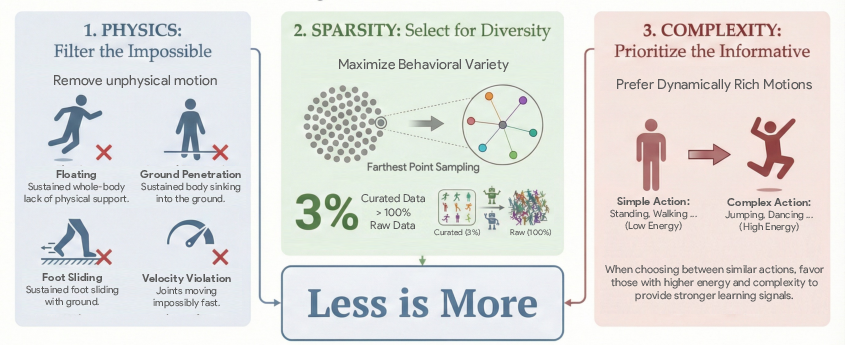
Figure 1: The GQS pipeline sequentially operationalizes motion data quality via physics filtering, semantic mapping, and complexity-weighted subset selection.
The strictly sequential ordering is empirically justified: failed physical motions can dominate diversity selection if filtering is not first, and high-energy artifacts should not be prioritized before feasibility and coverage are ensured.
Empirical Analysis and Main Results
The authors conduct extensive experiments on AMASS and PHUMA datasets, using Any2Track and TWIST2 RL pipelines, with rigorous multi-seed protocol and GPU infrastructure. The critical findings are as follows:
- Subsampling vs. Curation: Random 3% subsampling induces catastrophic degradation (success rate (SR) drops up to 20 points); in sharp contrast, GQS-curated 3% subsets outperform full-data baselines in both SR and MPJPE. This demonstrates that the less-is-more effect is not a trivial artifact of overfitting reduction, but a strict function of information density and the removal of toxic samples.
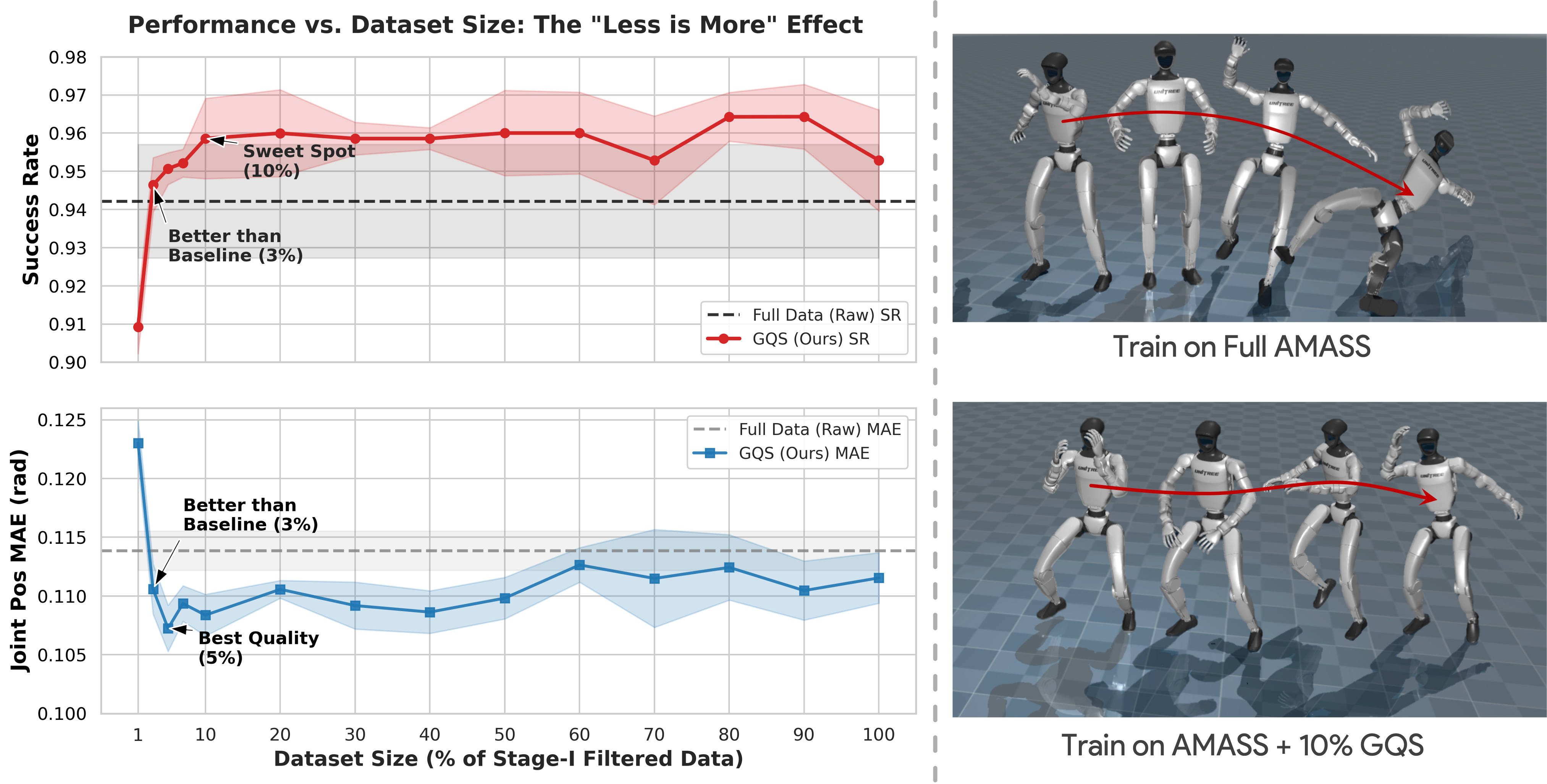
Figure 2: GQS achieves higher SR and lower error than full-data training, even when using just 3% of the reference data.
- Data Efficiency and Optimization Dynamics: GQS not only raises the final plateau of tracking metrics but also accelerates reward gain and error reduction in early training, evidencing improved optimization trajectory due to less noisy gradient estimates.
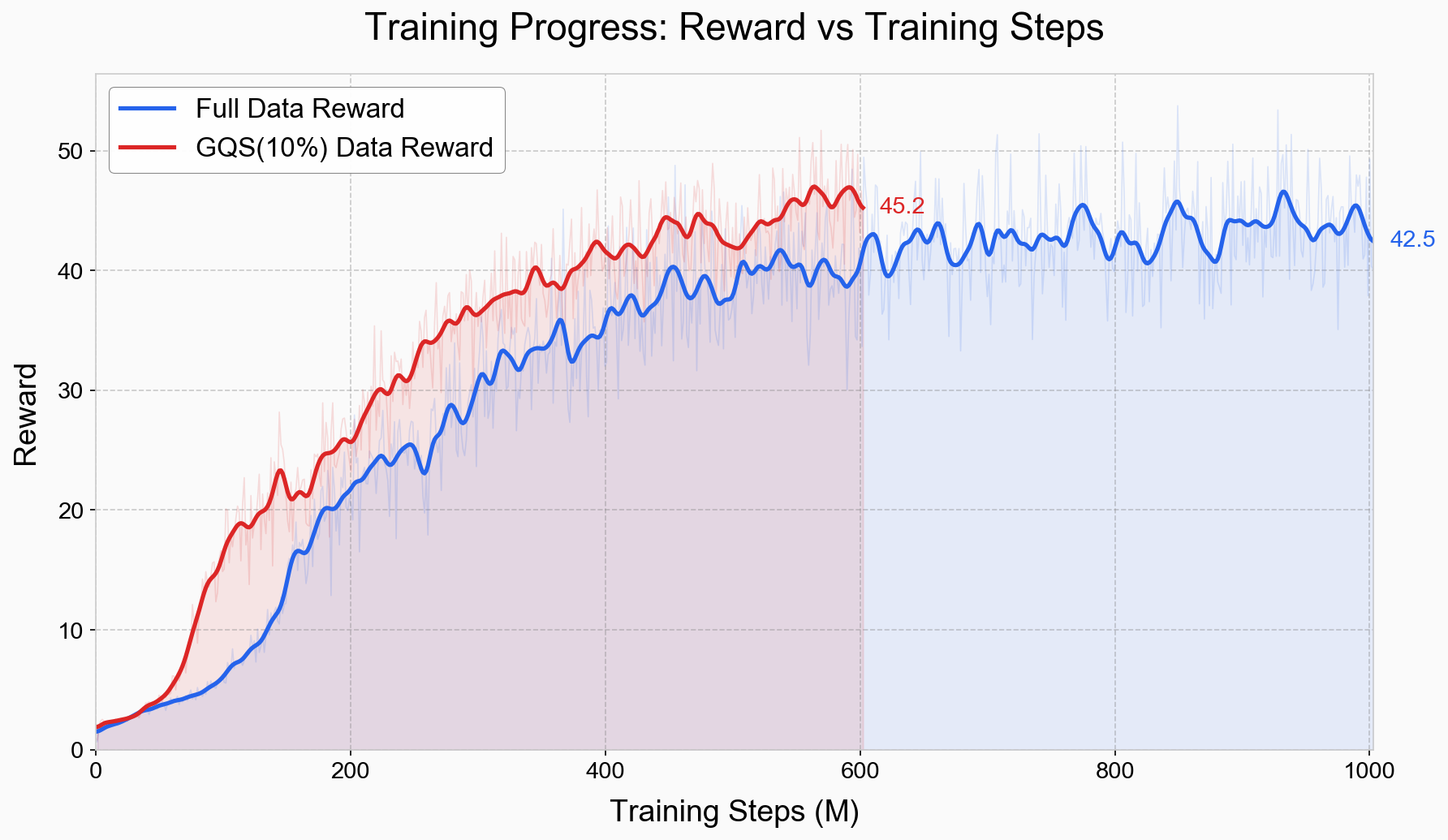
Figure 3: GQS-cured policies achieve higher rewards and lower errors than full-data policies across all training stages.
- In-Domain and Cross-Domain Generalization: On physically curated PHUMA, GQS persistently reduces MPJPE (versus the already-strong full set) across a wide range of data ratios, and further improves zero-shot transfer success when training on PHUMA and evaluating on AMASS.
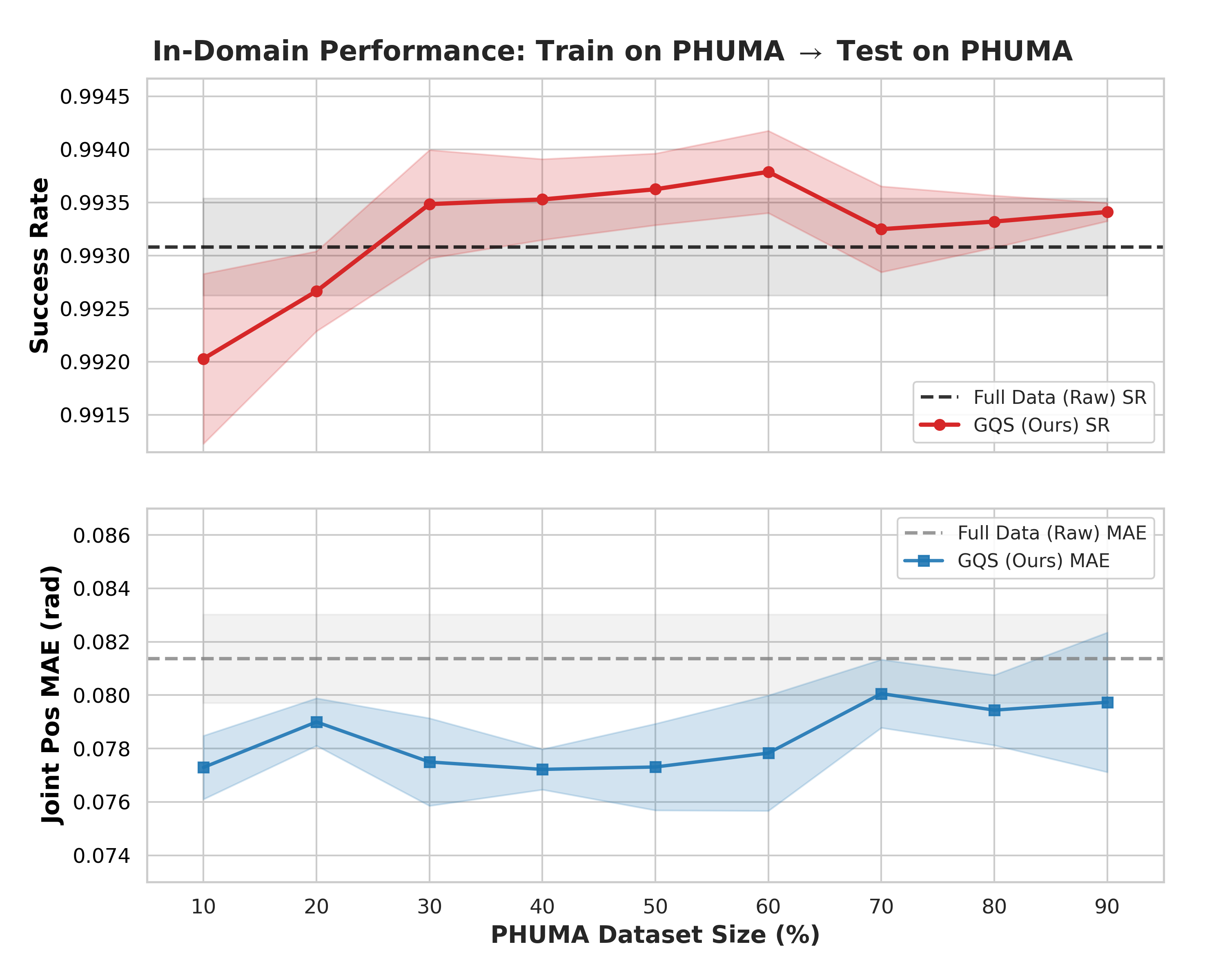

Figure 4: GQS delivers lower error than full data even on physically curated PHUMA, demonstrating robustness of the pipeline.
- Component Ablation: Each GQS pipeline stage is shown to be synergistically necessary—physics filtering is critical to avoid outliers, diversity drives success more than complexity alone, and complexity weighting further boosts SR and error reduction when combined with the prior two.
Analysis of Motion Data Characteristics
A key insight is that filtering solely by physical plausibility does not maximize downstream utility. Sorting motions by their physics score percentile, the authors find that SR peaks not at the top 0-10% most physically 'perfect' motions, but at the 60-70% percentile—illustrating that static/conservative motions dominate the physical upper tail, while maximum tracking value is achieved with intermediate dynamic richness, balancing feasibility and complexity.
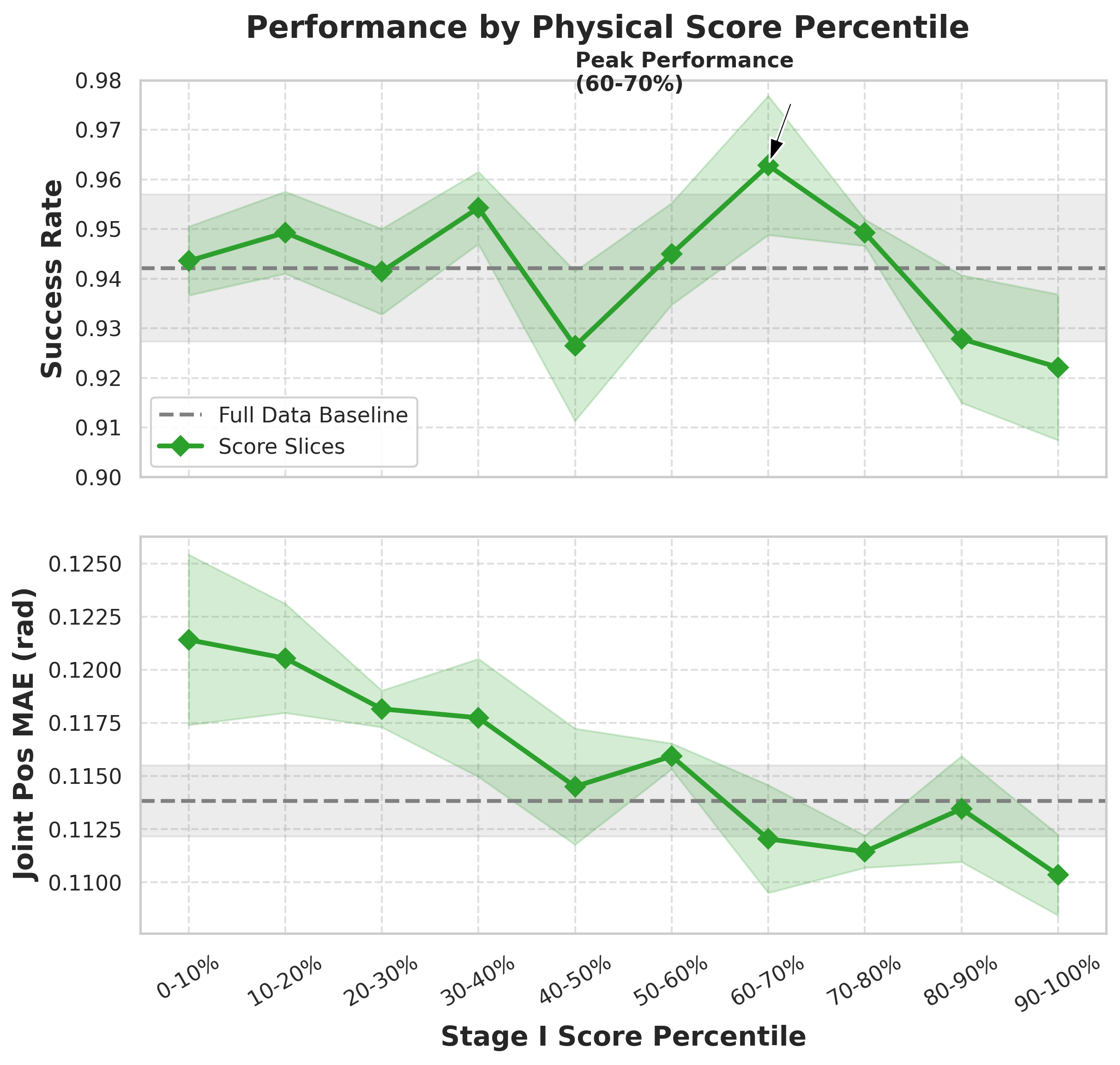
Figure 5: Highest tracking performance is not reached with the most physically plausible motions, but with those balancing feasibility and dynamic richness.
To calibrate the multi-factor penalty weighting in physics filtering, a sensitivity analysis is employed. Filtering out motions with high floating or foot sliding yields notable SR/MPJPE improvements (justifying low tolerance), while overly suppressing high-velocity or high-jerk motions actually degrades generalization, confirming their importance for robust dynamic learning.

Figure 6: Artifact features such as floating and foot sliding are highly toxic and should be penalized; dynamic features (velocity, jerk) should be preserved.
Global vs. Cluster-based Selection
Through additional analysis, global farthest-point selection (properly leveraging manifold geometry) is shown to outperform cluster-based sampling which inherits dataset imbalances. The global approach rebalances across behaviors and non-redundantly populates underrepresented high-value dynamics.
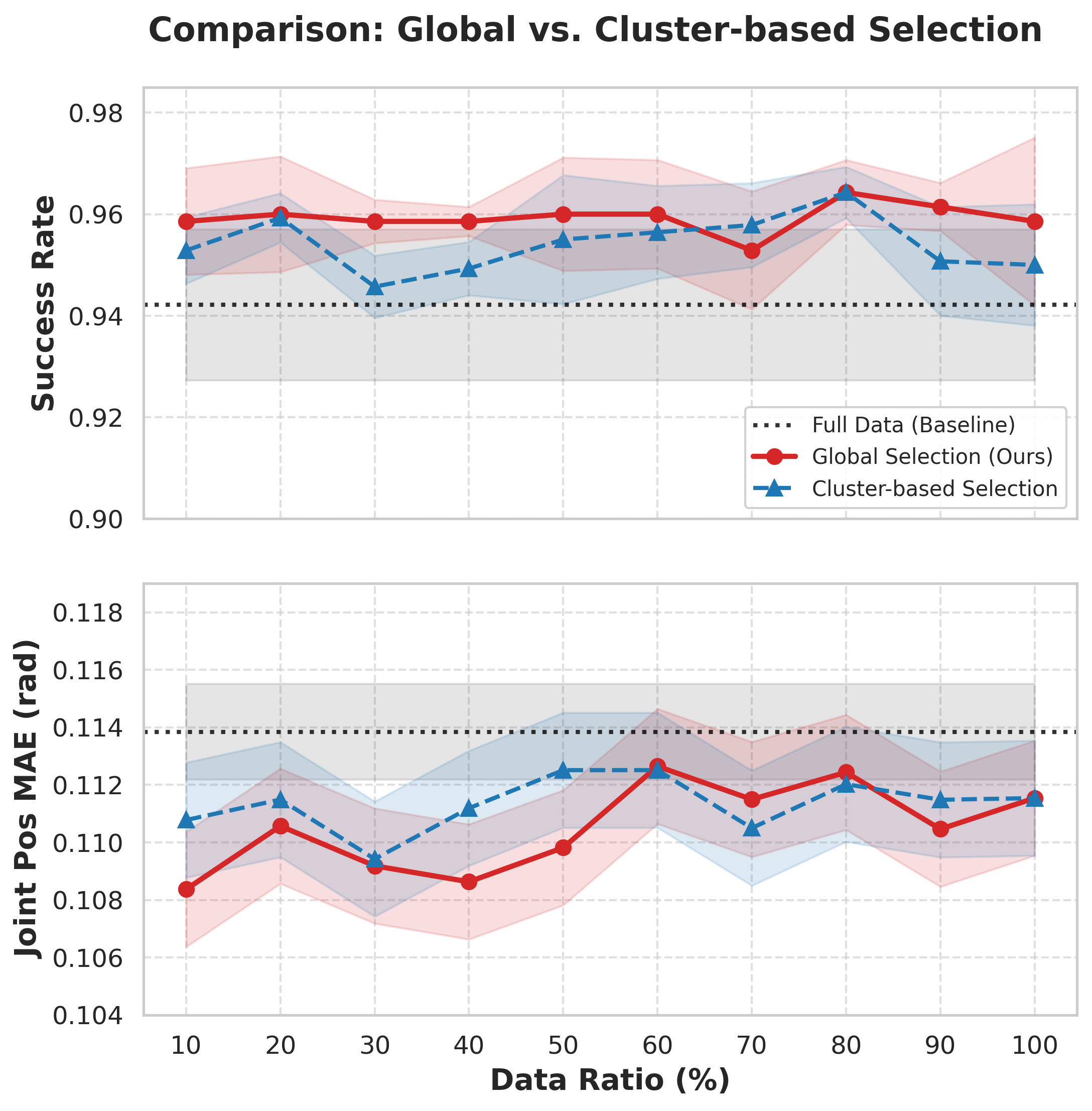
Figure 7: Global selection redistributes coverage naturally, yielding higher performance than cluster-based approaches that echo dataset biases.
Real-World Deployment
Perhaps most compelling, policies trained with as little as 10% GQS-curated data successfully transfer to real Unitree G1 hardware in diverse categories (walking, dancing, athletics), without any fine-tuning. Empirical SR/MPJPE metrics in real deployments strictly match or exceed full-data trained policies, with the largest gains in highly dynamic or contact-sensitive tasks.
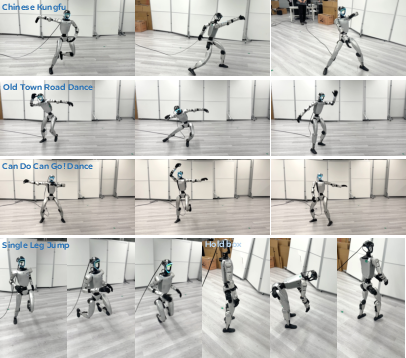
Figure 8: GQS-trained policies generalize to real hardware, achieving robust performance across broad action categories without fine-tuning.
Implications and Prospects
The findings in "LIMMT: Less is More for Motion Tracking" forcefully contradict the assumption that dataset scaling alone guarantees progress in physics-based motion tracking. Instead, the work formalizes and empirically substantiates that physically grounded, semantically diverse, and dynamically rich core sets suffice for superior optimization, generalization, and transfer.
From a practical standpoint, this enables orders-of-magnitude reductions in training cost while improving real-world deployability. From a theoretical perspective, the paper illustrates the primacy of data-centric approaches for RL and imitation in continuous control—implying that model design, architectural innovations, or reward shaping may be secondary to proper data curation at scale. The approach also sets a precedent for future data engine pipelines in RL and robotics, where automated, three-stage, physically and semantically-aware pruning strategies are integrated upstream of agent policy training.
Looking forward, this paradigm is readily extensible to broader embodied AI domains, where multi-modal, multi-agent, and multi-environmental data curation could further magnify efficiency and robustness. The GQS framework could form the basis for automated, programmable MoCap acquisition systems, or generalize to other continuous imitation domains suffering from data artifacts and redundancy.
Conclusion
"LIMMT: Less is More for Motion Tracking" delivers a strongly substantiated challenge to motion dataset scaling dogma and defines a principled, validated data-centric methodology for robust humanoid tracking. The GQS pipeline—anchored in physics, semantics, and complexity—provides clear, reproducible paths to high-fidelity, generalizable, and physically consistent control with minimal data. The implications for future RL, control, and embodied AI system design are profound.