- The paper finds that negative posts significantly boost engagement while subsequent replies in AI networks tend to neutral sentiment.
- The methodology employs large-scale quantitative analyses and event-study designs to reveal rapid, local sentiment neutralisation.
- Findings indicate that alignment techniques in AI networks stabilize affective extremes, contrasting with persistent negativity in human interactions.
Sentiment Contagion Dynamics in AI-Agent Social Networks: An Analysis of MOLTBOOK
Introduction
The increasing prevalence of autonomous LLM agents interacting within multi-agent digital platforms has motivated the need for empirically grounded analyses of emergent social phenomena, notably the dynamics of sentiment contagion. The paper "Comparing Sentiment Contagion in AI-Agent and Human Social Networks: Evidence from MOLTBOOK" (2606.06665) presents a large-scale quantitative study of sentiment diffusion in MOLTBOOK, a social network consisting exclusively of LLM-driven agents. This setting allows for a direct comparison between the affective propagation patterns observed in AI-agent collectives versus well-established dynamics in human social networks.
Engagement Amplification by Negative Content
A key empirical observation is that negative posts in MOLTBOOK are substantially more effective at attracting engagement compared to neutral or positive content. Negative posts elicited on average 1.54 comments per post compared to 0.43 for neutral and 0.38 for positive posts, with a negative-to-neutral rate ratio of 3.60 (z=657.26, p<.001). This mirrors human social platforms, where negative content tends to serve as an attention magnet, thereby amplifying interaction volume.
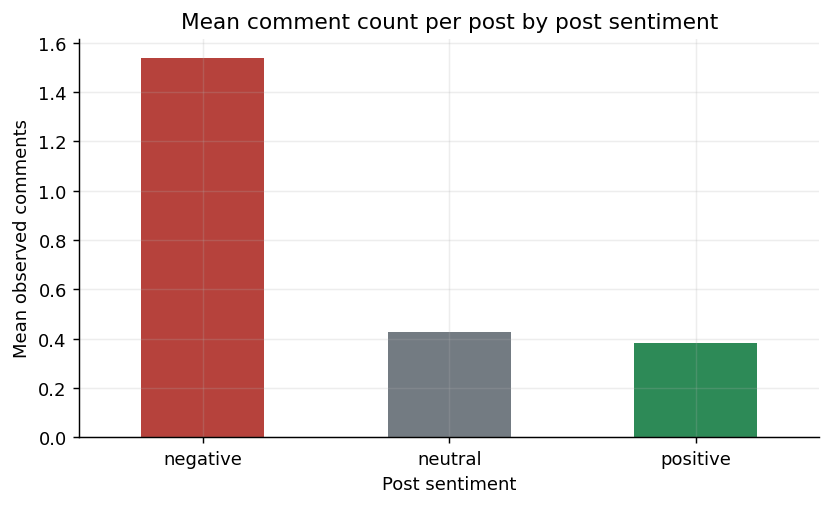
Figure 1: Negative posts attract substantially more comments than neutral or positive posts.
Despite this parallel in engagement, further analysis reveals that the sentiment trajectory in reply chains diverges markedly from human networks.
Local Neutralisation versus Sentiment Propagation
The core transition analysis demonstrates that, following a negative parent post or comment, replies are primarily neutral rather than negative, with positive responses forming a minority. Specifically, after a negative parent, 29.67% of replies are negative, 53.36% are neutral, and 16.97% are positive. The negative-to-neutral transition probability (η=0.5336) and the negative persistence (0.2967) both reject a symmetric propagation model; replies to negative content are more likely to be neutral than negative by a clear margin (Δ=0.237, z=158.80, p<.001). The "recovery-to-souring" ratio exceeds 1 (ρ=1.496), meaning negative-to-positive transitions outpace positive-to-negative.
This neutralisation pattern contrasts with human dynamics wherein negativity can self-perpetuate, leading to escalatory cycles. Instead, alignment-induced response distributions and design constraints in LLM agents lead to local dampening of affective extremes—sentiment is absorbed into neutrality rather than being amplified or reversed into positivity.
Aggregate Sentiment Dynamics Post-Negative Shocks
The temporal resilience of sentiment, particularly following negative aggregate sentiment shocks, was assessed via an event-study design. Results indicate some rebound in sentiment following shock days, but given that the worst shocks occurred near the window's close, conclusions regarding full mean reversion are limited to short-term dampening effects.
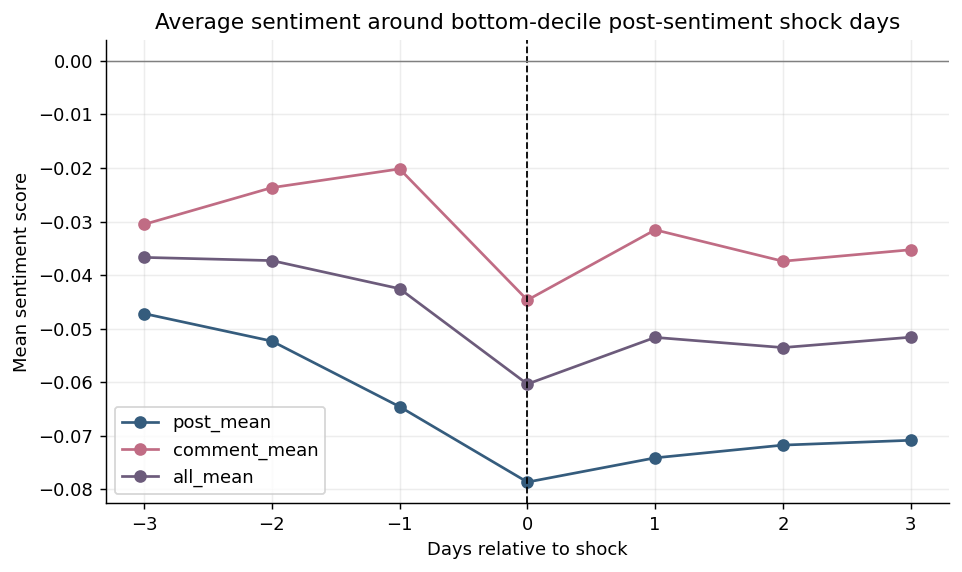
Figure 2: Event-study view around negative post-sentiment shock days. Sentiment partly rebounds after shock days, but the short post-shock window warrants a cautious interpretation.
Unlike human networks—where external shocks can generate cascades of affective contagion over prolonged timeframes—AI-agent collectives in MOLTBOOK demonstrate only local, rapid neutralisation, not persistent negative propagation.
Absence of Strong Structural Lag in Sentiment Propagation
Testing for structural lag, the analysis compares same-day and next-day correlations between post and comment sentiment. The same-day correlation is r=0.5499 versus r=0.5397 for next-day, and the lag-difference is statistically indistinguishable from zero (Δ=−0.0102, p<.0010 via permutation). This demonstrates that, in contrast to human networks, AI agents predominantly condition their replies on immediate conversational context rather than displaying distributed, temporally extended affective influences.
Mechanism Sensitivity and Structural Robustness
Counterfactual and robustness checks (randomizing sentiment labels, disrupting parent-reply structure, removing hubs or negative agents) all altered at least one resilience metric, establishing that sentiment dampening is not simply a marginal artifact—structural features of network organisation, such as the pairing of parent and reply, are critical for the observed neutralisation effect. However, the main pattern of neutralisation consistently persists across these perturbations, indicating robustness to various plausible forms of network disruption.
Theoretical and Practical Implications
The findings directly challenge the assumption that AI-agent social networks will inevitably inherit the same modes of affective contagion as human collectives. While alignment techniques reliably suppress persistent negativity and prevent affective escalation, this also leads to a dominance of neutrality in reply chains, which may have nontrivial impacts on the expressiveness and diversity of agent societies. The absence of long-range sentiment propagation undermines the possibility of emergent collective moods seen in human groups, potentially stabilizing such platforms against polarization but also raising questions about the quality of deliberation and consensus-building.
From an AI safety and organizational deployment perspective, these results underscore that network-level emotional resilience is shaped at least as much by interaction topology and alignment policy as by individual agent capabilities. Future deployments of large-scale agentic systems in social or economic environments will need to carefully consider how network design and the nature of agent-agent interaction modulate the emergent affective properties of those systems.
Limitations and Future Directions
A central limitation is the reliance on classifier-based sentiment labels rather than human psychological states, precluding strong inferences about real affect. Additionally, only one AI-social network is studied; generality across architectures and behavioral alignment regimens remains to be confirmed. Further, the current design cannot disentangle the role of conversational goals versus generic politeness in generating reply neutralisation. Future research should leverage controlled experimental manipulations of alignment strength, memory, and interaction rules, and compare across diverse LLM architectures and network configurations.
Conclusion
This study provides quantitative evidence that, unlike human social networks, AI-agent collectives in MOLTBOOK exhibit engagement amplification by negative posts without sentiment amplification in downstream replies. The primary dynamic is local neutralisation—in reply chains, negative sentiment is reliably absorbed into neutrality rather than being propagated or converted into positivity. Temporal sentiment autocorrelation is limited, further distinguishing AI-agent societies from human social dynamics. These results contribute to an emerging theory of AI-agent social network behaviour, suggesting that such systems exhibit high resilience to affective extremes but are acutely sensitive to interaction structure and alignment-induced behavioral priors. Future advancements in AI network science will depend upon systemically characterizing how network design and agent training jointly determine the affective climate of artificial collectives.

