- The paper presents a verification-driven framework where formal counterexamples guide iterative refinement of AI agent skills.
- It integrates semantic contracts with model checking to automatically regenerate skills, achieving over 97% compliance with temporal specifications.
- Empirical results on robotic platforms demonstrate rapid convergence in under 20 minutes per skill and robust safety-task completion rates.
Introduction and Motivation
The integration of foundation models with robotics has enabled the rapid synthesis of reusable skills from open-ended, high-level natural language prompts, drastically lowering the cost of skill authoring. However, this ease of synthesis does not extend to assurance: generated skills may appear semantically plausible but mask execution-time violations with significant safety ramifications, particularly in untested contexts. Existing approaches to skill evolution in embodied agents predominantly leverage execution feedback, offline sample rollouts, or LLM self-critique. These protocols are limited to trace-level evidence, where skills are only evaluated against sampled executions—failing to guarantee specification satisfaction in the entirety of the possible operational space.
To address these limitations, "VASO: Formally Verifiable Self-Evolving Skills for Physical AI Agents" (2606.05395) introduces a verification-guided framework that closes the optimization loop using formal counterexamples as corrective feedback. By doing so, VASO leverages formal verification not merely as a final pass/fail filter, but as the core driver of skill contract optimization.
Framework Overview
VASO defines each skill as a semantic contract that couples a formal specification interface with a planner-facing behavioral template. The formal interface maps robot states, observations, and commands to logical atomic propositions suitable for model checking, while the behavioral interface guides task-oriented plan generation. Plans induced from skills are compiled into symbolic transition systems using these proposition-aligned labelings.
The optimization proceeds in two nested verification loops:
- Skill-Level Verification: Generated skills are first screened for logical feasibility: local skill rules are checked for consistency against global safety specifications. Feasibility is determined by verifying the satisfiability of the conjunction of global and local specifications across all possible executions. Infeasible contracts are pruned before investment in plan optimization.
- Plan-Level Verification and Iterative Refinement: For each feasible skill, a foundation model planner instantiates executable plans which are then symbolically verified against global and local temporal logic constraints. Should the verification fail, a counterexample trace is produced; this is translated to a natural language "textual gradient" which is supplied as corrective feedback to the frozen foundation model, prompting regeneration of the semantic contract. This loop is repeated until specification satisfaction is attained.
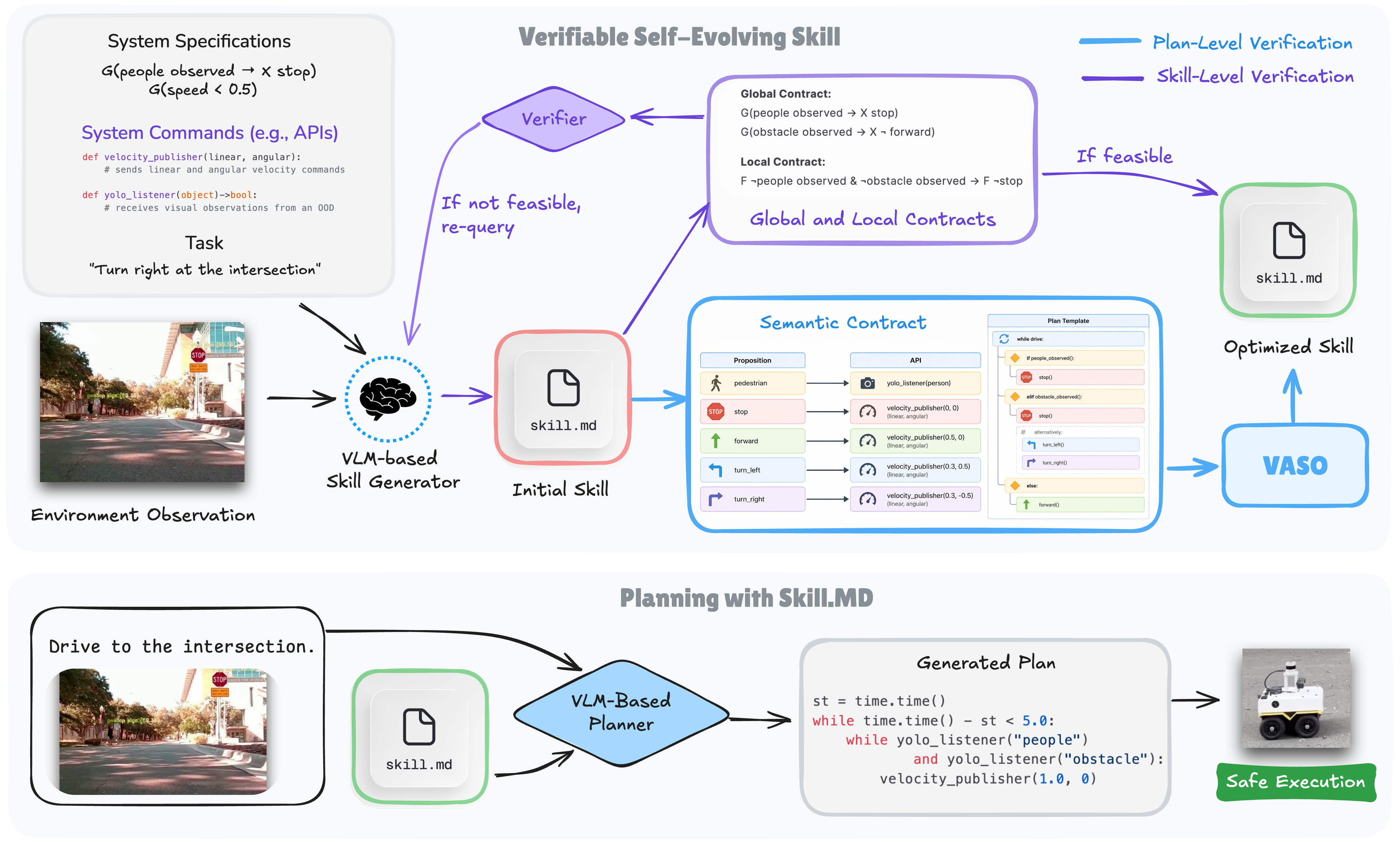
Figure 1: Overview of the VASO self-evolution loop; task prompt yields a skill, which undergoes feasibility checks, plan verification, and counterexample-guided refinement.
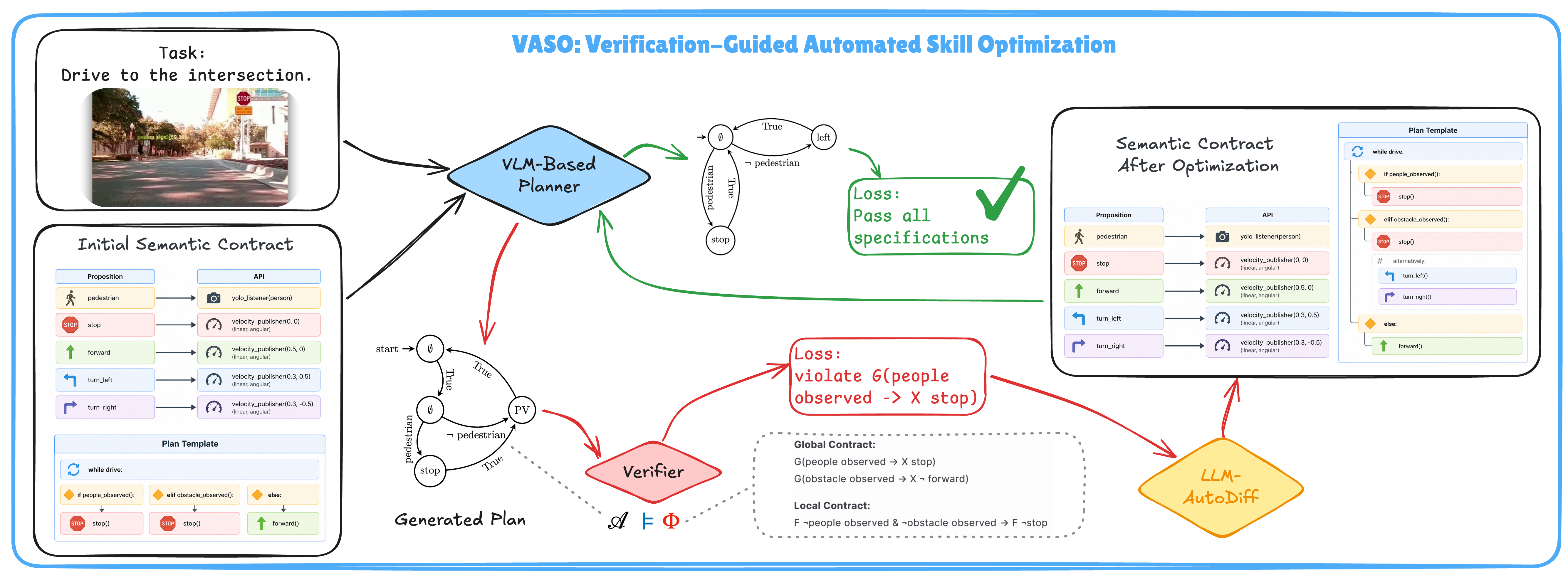
Figure 2: VASO overview. Plans are generated and verified in a closed loop, with feedback used to iteratively refine the semantic contract.
A skill in VASO is defined by a tuple (G,ψsk,Csk) where:
- G: a set of global LTL temporal specifications,
- ψsk: a local skill-specific LTL rule,
- Csk=(Lsk,Cskp): the semantic contract,
- Lsk: proposition-aligned labeling function mapping execution traces to atomic propositions,
- Cskp: a behavioral plan template guiding the planner.
Proposition alignment bridges the high-level logical interface demanded by model checking tools and the low-level API or control command structure required for execution. VASO employs foundation models to auto-generate these proposition mappings, reducing the domain engineering burden.
Verification-Guided Self-Evolution Process
The central innovation of VASO is its use of formal counterexamples as actionable optimization signals at the skill contract level—distinct from methods focusing solely on prompt tuning or parameter finetuning. When a generated plan violates specifications, the verifier supplies a minimal trace demonstrating the failure. This is converted into a tailored textual gradient fed into the prompt for contract regeneration using LLM-AutoDiff-inspired procedures, but crucially, the contract structure itself is the optimization target, not the planning prompt or underlying model parameters.
This closed-loop process guarantees that improvements are not merely incidentally correlated with observed rollouts, but are reflected in contract domains explicitly exposed to model checking.
Empirical Results
VASO is evaluated on Clearpath Jackal (ground) and PX4 quadcopter (aerial) platforms, encompassing 11 distinct temporal logic specifications and 400 generated plans. Strong empirical results are reported:
- Skill Compliance: VASO-optimized skills reach 97.2% compliance with all formal temporal specifications using fewer than 100 optimization iterations.
- Efficiency: The framework converges in under 20 minutes per skill, freezing foundation model weights throughout.
- Skill Representation Advantage: Comparison with baseline prompt-level optimization methods (e.g., LAD-VF) demonstrates a substantial improvement; flat prompt optimization plateaus near 85% safety, whereas VASO surpasses 90% within 7 refinement steps and achieves 95%+ compliance.
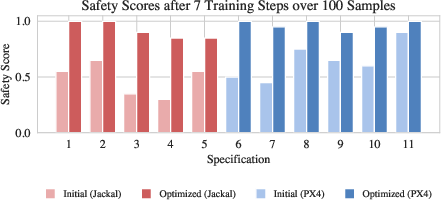
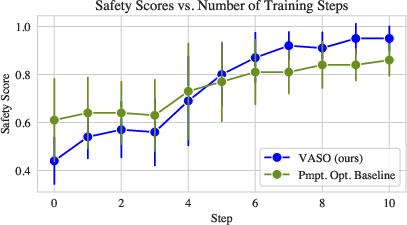
Figure 3: Left plot: Safety score across 11 specifications. Right plot: VASO vs. baseline prompt optimization—VASO achieves stronger and faster convergence.
VASO also consistently outperforms both zero-shot and verification-finetuned learning-based planning baselines, attaining stronger safety-task completion trade-offs while incurring a fraction of the computational cost.
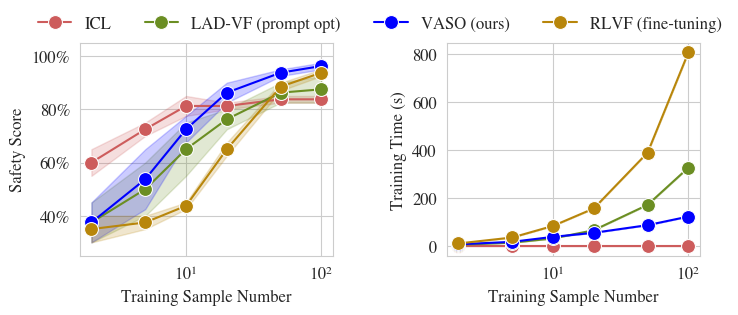
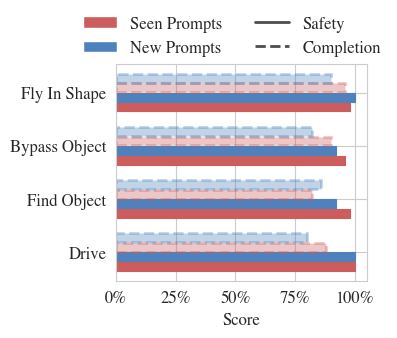
Figure 4: Left/middle: Safety and training time comparison; Right: Generalization performance to seen/unseen task prompts demonstrating skill reuse.
Optimized skills generalize robustly, attaining 92–100% safety and 80–96% task completion on previously unseen prompts. Automatically generated proposition-aligned labeling functions achieve parity with handcrafted labelings in practice, substantially reducing engineering requirements.
Implications and Future Directions
VASO elevates formally verifiable closed-loop skill learning from sample-based, empirical validation to rigorous contract-level assurance. The explicit structure and reuse of semantic contracts open new avenues for certified modular planning in safety-critical robotics and trustworthy physical agent deployment. The skill-level abstraction also enables rapid skill adaptation and reuse without costly retraining or prompt engineering.
Practical limitations include the residual reliance on correctness in the AI-generated proposition alignment; abstraction errors here may result in spurious verification outcomes. Current scope is limited to sequential (non-concurrent) skill execution; future directions include compositional and multi-agent contract reasoning, as well as probabilistic grounding validation for alignment functions.
Conclusion
VASO presents a systematic approach to synthesizing and refining formally verifiable skills for physical AI agents. By leveraging semantic contract abstraction and verification-driven counterexample-guided optimization in a closed loop—without gradient backpropagation or model retraining—VASO achieves high compliance with temporal logic specifications and efficient convergence, advancing the safety and reusability of LLM-generated robotic skills. The framework substantiates the potential for integrated formal methods and foundation model planning workflows in scalable, certifiable autonomous systems.