- The paper introduces a hierarchical evidential tree for person understanding that consolidates raw events into durable persona claims.
- It leverages schema-based writing and Bayesian updates to ensure interpretability and robust alignment over prolonged interactions.
- Empirical results across benchmarks validate PersonaTree’s superior performance in abstraction, preference tracking, and context compaction.
Structured Lifecycle Memory for Person Understanding: An Expert Analysis of PersonaTree
Introduction and Motivation
PersonaTree presents a structured approach to lifecycle memory for LLM agents, directly targeting the explicit formation and grounding of person understanding across prolonged user interactions. A key demand for persistent agents is to move beyond recall of scattered user facts towards modeling the user’s preferences, habits, states, and abstract persona claims in a way that is inspectable and grounded in interaction history. Existing methods that focus on record/summary-based retrieval lack mechanisms for schema abstraction and evidential grounding that are crucial for interpretability, robust alignment, and adaptation over time.
PersonaTree conceptualizes agent memory as a three-level evidential persona tree—leaves for raw events, mid-level nodes for behavioral/state patterns, and root nodes for durable persona-level claims—interconnected via support edges that trace abstraction paths for any user claim. The framework operationalizes lifecycle memory management via schema-based writing, consolidation routines, evidence/confidence propagation, and dynamic retrieval conditioned on query granularity and context budgets. This model explicitly instantiates schema theory principles for AI memory.
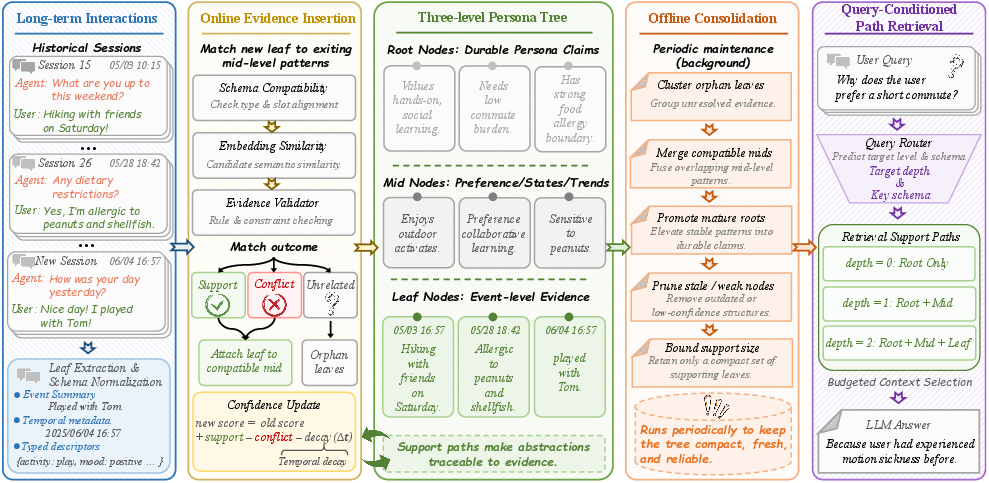
Figure 1: Overview of the PersonaTree framework, illustrating hierarchical abstraction from event leaves, through recurring patterns, to stable persona claims, with support paths enabling evidential grounding for query answering.
Methodology
PersonaTree represents each user’s memory state as a typed directed graph, Tu=(VuL,VuM,VuR,Eu), partitioned into leaf nodes (event evidence), mid nodes (patterns/states), and root nodes (persona claims). Each node aggregates content, type attributes, embedding, and confidence—serving both as memory and as an interpretable linkage between history and abstraction.
Online/Offline Memory Operations
New interactions are first inserted as schema-typed leaves. Matching and consolidation with existing mid-level patterns is contingent on explicit schema compatibility, content similarity, and validation (support/conflict/unrelated), driving a Bayesian confidence update. Orphan leaves are periodically recombined offline; clusters with sufficient compatible evidence are abstracted into mid nodes, which—upon passing stricter criteria—can promote to root persona claims.
Node confidence is regulated via a log-odds update mechanism with decay, integrating time and new evidence dynamically, parallel to psychological memory decay. The system enforces conservative promotion and pruning strategies to curb spurious abstractions and memory bloat.
Query-Conditioned Path Retrieval
Queries are routed to the appropriate abstraction level predicted via a learned routing model, and candidate memory paths are then selected under a token budget. Retrieval favors support chains—root → mid → leaf—aligning the answer depth with user intent while limiting extraneous context. This explicit support path not only serves as a fact basis but also as a rationale trail.
Experimental Validation
PersonaTree is evaluated on six major benchmarks: KnowMe (person understanding), RealPref (preference following), CUPID (contextual alignment), LongMemEval (long-term recall), RealMem (project-driven memory), and LoCoMo-Plus (cognitive memory). The suite is deliberately diverse and targets both raw retention and high-level user modeling. Comparison spans multiple answer backbones, including Qwen3-32B, Gemini 3 Flash, and GPT-5.4 Mini.
Empirically, PersonaTree ranks first in 12 of 18 benchmark/configuration pairs and occupies the top two in 16/18, showing consistent improvements in abstraction-requiring tasks. The advantage is especially pronounced on person-level reasoning (e.g., KnowMe T7, RealPref generation/alignment metrics, CUPID F1 and generation), where prior systems relying solely on patternless retrieval or naive summaries falter.
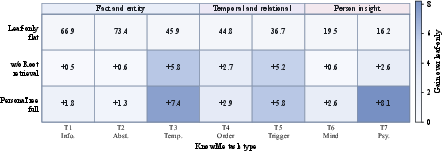
Figure 2: KnowMe hierarchy ablation shows strong gains in abstract person understanding tasks, with the complete hierarchy yielding the highest improvements.
Path retrieval analysis indicates marked gains in answer quality and preference alignment versus flat retrieval—even when context budgets are matched—supporting the claim that evidentially structured retrieval contributes distinct, not just more, information.
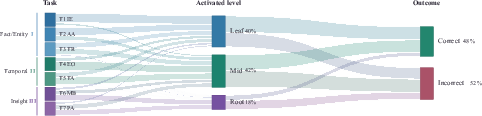
Figure 3: Task-type to memory layer activation in KnowMe, evidencing that deeper task abstraction reliably activates higher abstraction levels in PersonaTree.
Efficiency analysis on long histories demonstrates substantial gains in context compactness: e.g., for RealPref, PersonaTree reduces the P95 answer context from 30.2k to 2.99k tokens over flat/history baselines, with stabilized model performance and minimal added latency.
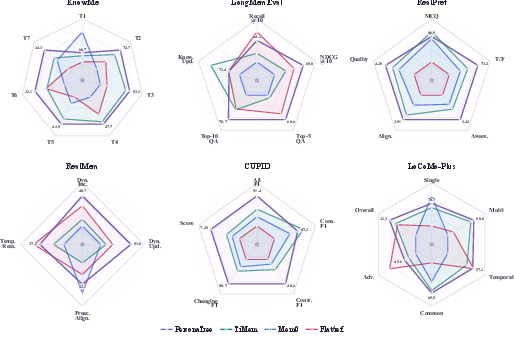
Figure 4: Breakdown of benchmark metrics under Qwen3-32B confirms consistent advantage across person understanding and cognitive memory metrics.
Mechanism and Ablation Insights
Hierarchy ablation experiments confirm that each added memory layer (mid/root) contributes independently to abstract person understanding, especially evident in complex motivation and identity inference. The explicit structuring, rather than just inclusion of more context, yields the metric improvements. Support path retrieval, when compared to flat pooling over available nodes, boosts preference tracking and answer quality with no increase in context size.
Task activation traces show that PersonaTree dynamically traverses the hierarchy in accord with the cognitive demand of the task: factual/temporal logic questions activate leaves/mids, while insight/persona questions leverage root nodes and their evidential chains.
Implications and Future Directions
PersonaTree’s structured lifecycle memory sets a new operational paradigm for memory-augmented LLM agents—one in which interpretability, abstraction, and evidential grounding are intrinsically designed, not post hoc, features. Practically, this supports more trustworthy, debuggable, and adaptive agents, with clear rationale trails for every persona-level interpretation or recommendation. Theoretically, it aligns AI memory research with classical schema theory and cognitive modeling, providing a tractable abstraction path that can be extended or adapted to multimodal and higher bandwidth interaction streams.
Potential avenues for extension include multilingual and multimodal schema adaptation, further integration with agentic planning architectures, and exploration of richer evidential links (e.g., causal, temporal, affective).
Conclusion
PersonaTree formalizes person understanding memory as a structured, multi-level lifecycle process, demonstrating strong empirical improvements in both efficacy and efficiency on demanding benchmarks. The framework’s architectural choices—evidential linking, schema-based abstraction, and conservative memory management—are validated by both numerical results and targeted ablations. These outcomes support the central premise: effective agent memory for person modeling must be structured, inspectable, and evidentially grounded throughout its lifecycle.
Reference: "PersonaTree: Structured Lifecycle Memory for Person Understanding in LLM Agents" (2606.04780).