NextMotionQA: Benchmarking and Judging Human Motion Understanding with Vision-Language Models
Abstract: Reliable evaluation of human motion understanding is fundamental to advancing embodied AI, robotics, and animation. However, existing benchmarks suffer from coarse semantic granularity, undifferentiated difficulty, limited annotation quality, and pervasive answer ambiguity, leaving them unable to diagnose where current models fail. To bridge this gap, we introduce NextMotionQA, a comprehensive benchmark that leverages vision-LLMs (VLMs) for semi-automated, expert-verified dataset. NextMotionQA features three complementary tasks: multiple-choice question answering, video captioning, and fine-grained error correction. Each task is systematically structured across three core semantic axes and stratified into three task complexity levels. Our extensive evaluation of twelve representative VLMs uncovers critical capability gaps and weakness that remain invisible under conventional, single-task evaluations. In a complementary direction, recent work has begun using VLMs as judges for text-to-motion evaluation; we ask whether they show the same degradation under harder tasks. We find that VLMs align strongly with expert ratings on coarse criteria (Cohen's κ=0.70) but break down on fine-grained, part-level judgment (κ=0.10), validating the paradigm in its strong regime while clarifying its limits.
Paper Prompts
Sign up for free to create and run prompts on this paper using GPT-5.
Top Community Prompts
Explain it Like I'm 14
Explaining “NextMotionQA: Benchmarking and Judging Human Motion Understanding with Vision-LLMs”
Overview: What is this paper about?
This paper builds a new test called NextMotionQA to check how well AI systems understand human movements. Think of short 3D “stick-figure” videos of people moving. The AI has to watch these clips and:
- recognize what’s happening,
- describe it clearly,
- and spot and fix mistakes in a wrong description.
The authors also test whether these AIs can act like “judges” to score other AI-generated motions, and compare their judgments to human experts.
Goals: What questions are the researchers trying to answer?
The paper focuses on five simple questions:
- Why do current tests for motion understanding often give confusing or unreliable results?
- Can we build a better, clearer benchmark that shows exactly where AIs are strong or weak?
- How do popular vision-LLMs (AIs that read text and watch videos) perform on this new benchmark?
- Where do these AIs struggle most (for example, with body parts, directions, or actions)?
- Can these AIs be trusted as “judges” to rate motion quality like humans do, especially when the task gets harder?
Methods: How did they do it?
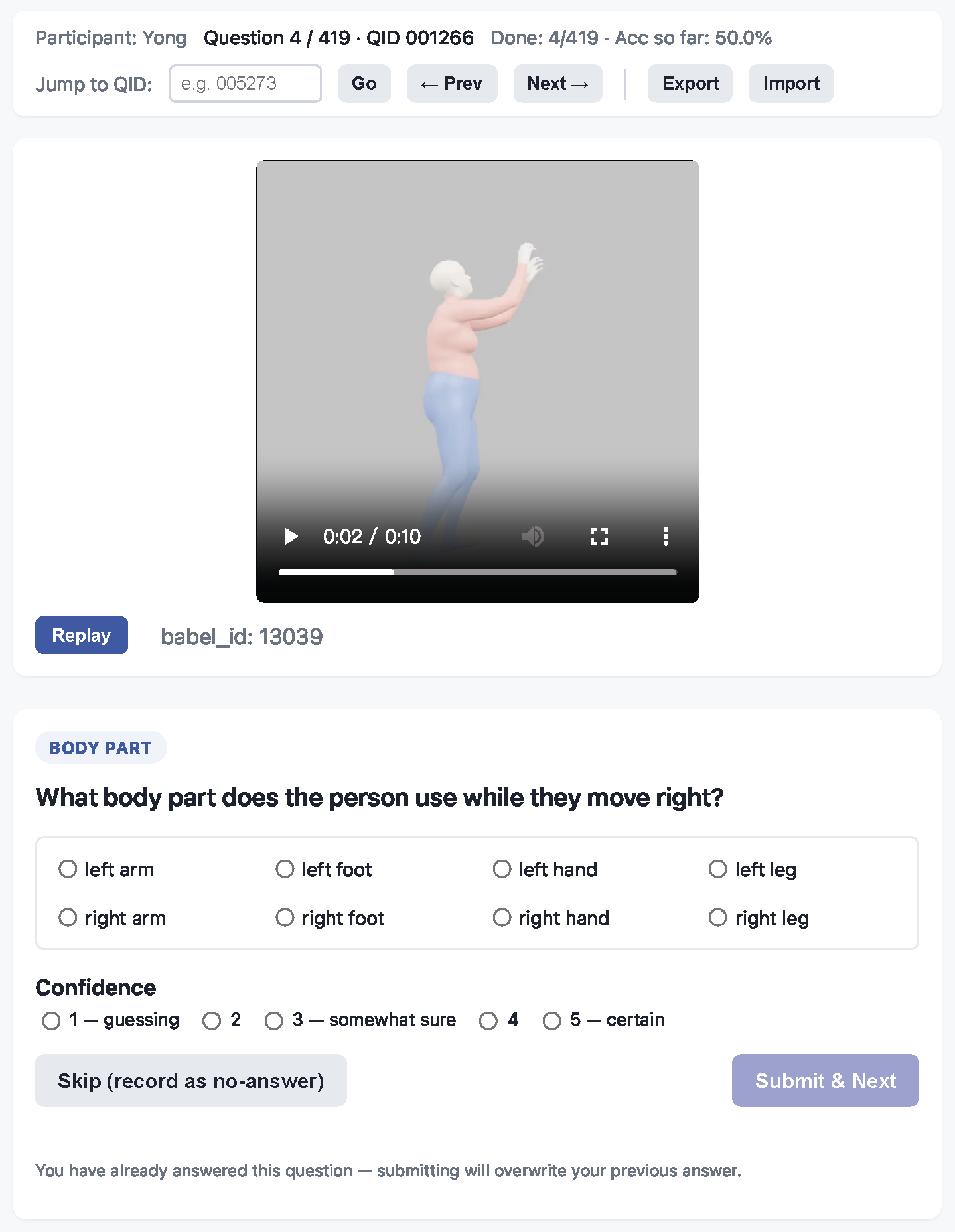
First, the authors ran a pilot study on an older motion benchmark. They asked three motion experts to answer its questions. The experts often disagreed, and even their average accuracy was low. This showed the older test could be ambiguous, so it wasn’t a fair way to judge AI.
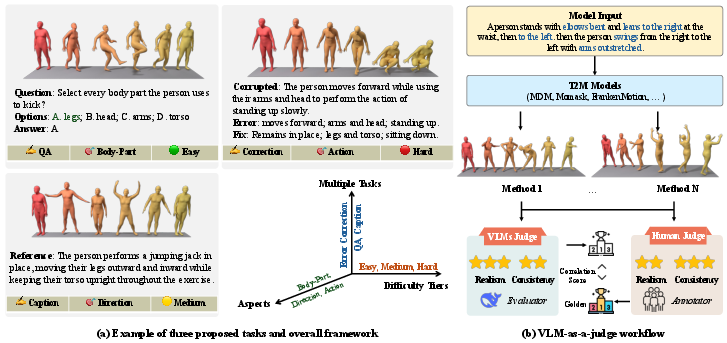
Then they built NextMotionQA with three simple ideas: different tasks, clear categories, and levels of difficulty. To make it both large and reliable, they used a “AI drafts, humans verify” pipeline:
- An AI drafts questions and answers using trusted labels from existing datasets.
- The same AI revises the draft after actually watching the video.
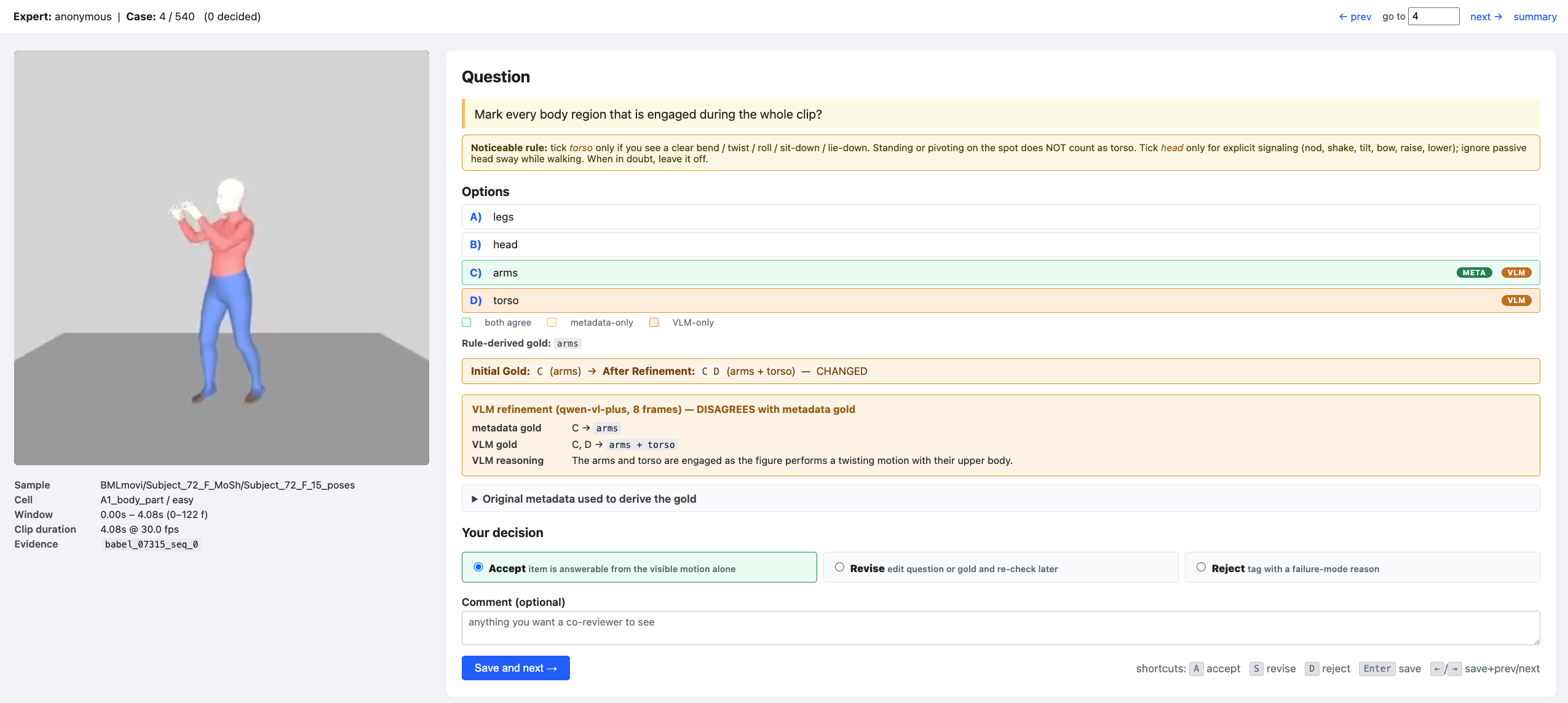
- Human motion experts then check every item and only keep those all three agree are clear and correct.
To make the test balanced and diagnostic, every video clip is labeled across:
- Three task types (think of a coach testing a player in different ways):
- Multiple-choice questions (recognize): pick all correct answers from four options.
- Captioning (describe): write a clear sentence describing the motion.
- Error correction (critique): fix specific mistakes in a wrong caption.
- Three motion “axes” (the key aspects of motion):
- Body parts (which parts are used).
- Direction (which way the person is moving).
- Action (what the person is doing).
- Three difficulty levels:
- Easy: one simple action, no extra twists.
- Medium: two actions.
- Hard: three or more actions and modifiers (like direction or speed).
In total, NextMotionQA includes 1,307 expert-verified items.
Finally, they tested 12 well-known AI models on this benchmark and also tried using some of these models as “judges” for rating text-to-motion results from other systems. They compared the AI judges’ ratings to human experts at three levels from simple to fine-grained.
Main findings: What did they discover, and why does it matter?
Here are the big takeaways:
- Older benchmarks had label problems: In a pilot check of an earlier dataset, experts only unanimously agreed with the “correct” answers about 34% of the time. That means some reported AI accuracy was really measuring label confusion, not true understanding.
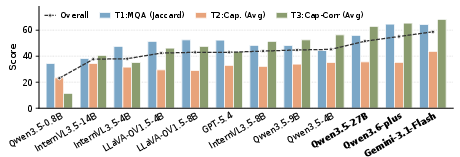
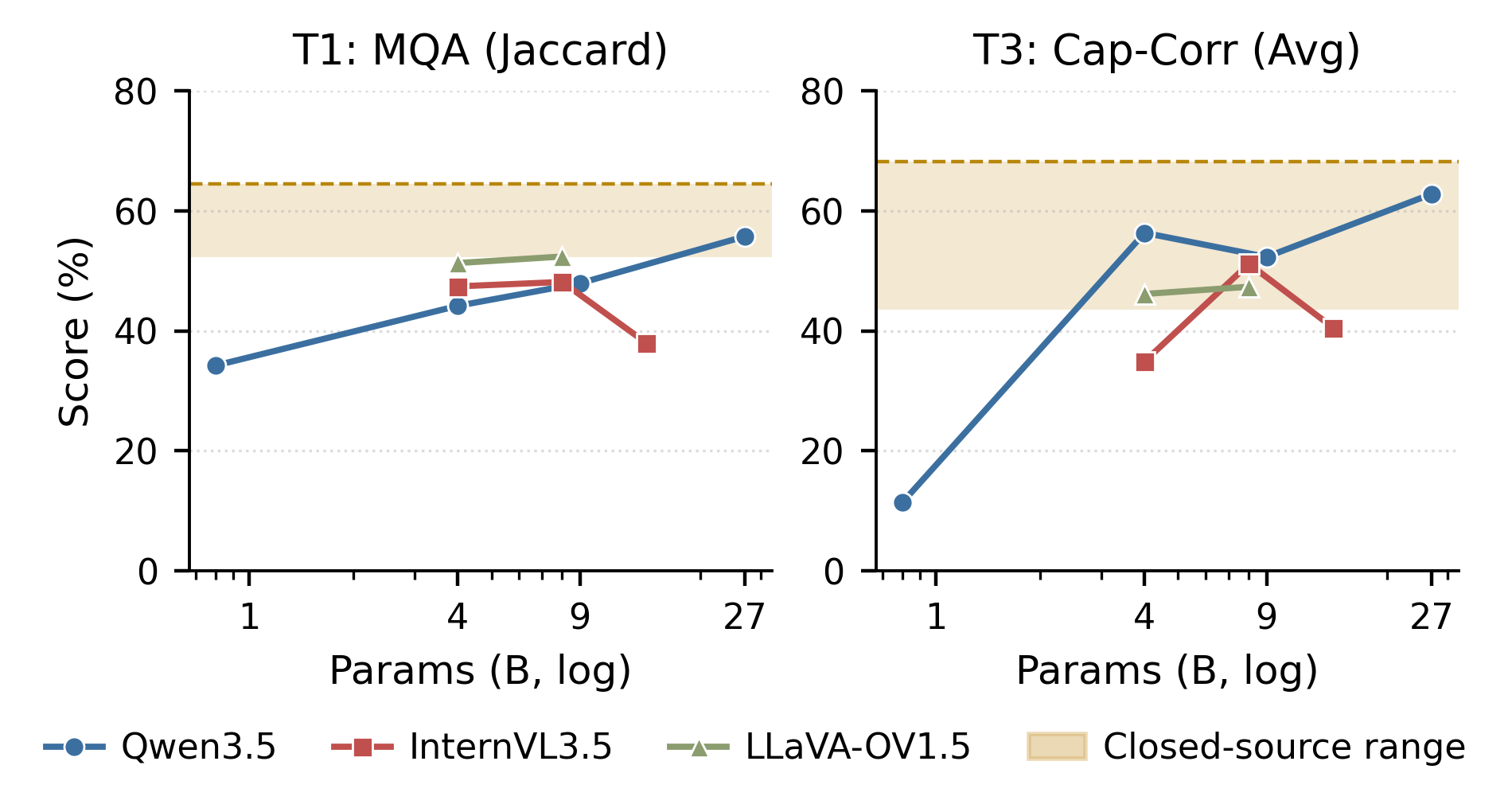
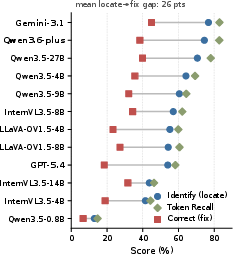
- No single AI is best at everything: Across the three tasks (recognize, describe, critique), different models shine in different places. There isn’t one model that wins across the board.
- Describing is hardest: Free-form captioning (describing the motion in your own words) is tougher for AIs than picking from multiple choices or fixing a local mistake.
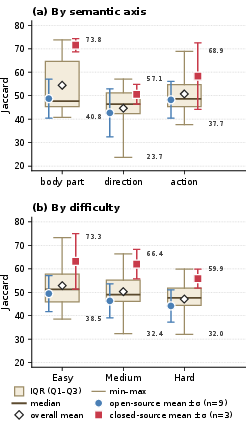
- Direction is the weakest axis: Across almost all models, figuring out motion direction (like left/right or forward/backward) is the hardest part. This suggests AIs struggle with camera-view and time-based grounding—basically, keeping track of where the body is moving over time and from which viewpoint.
- Harder clips lead to lower scores (as they should): Stronger models clearly drop from Easy to Hard items. Weaker models sometimes fail even on the easy ones.
- AIs as judges: When AIs are used to rate motion quality—
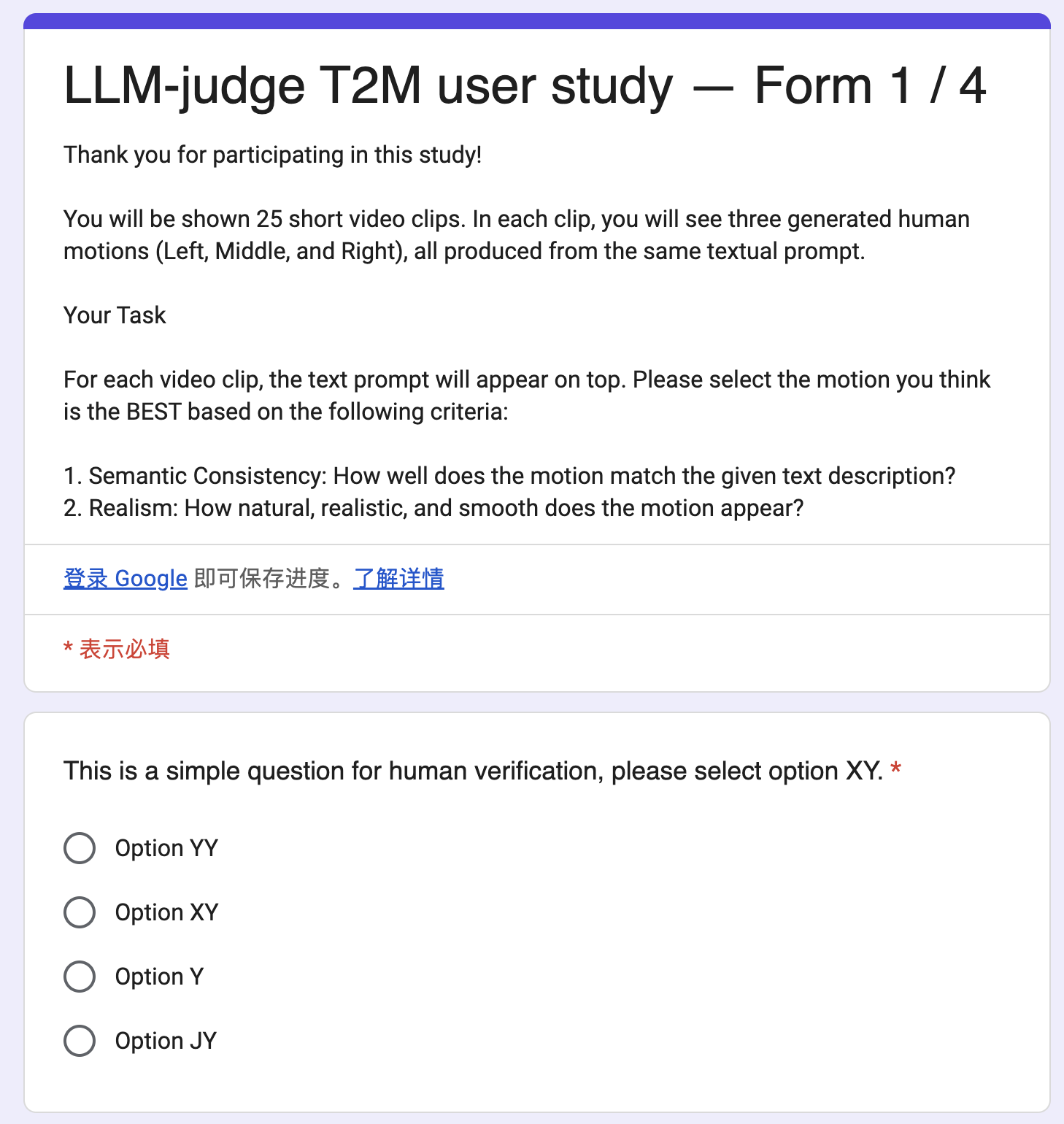
- They agree with humans quite well on simple, big-picture questions (like “Does this look realistic?”), with strong agreement (Cohen’s kappa around 0.70).
- But they break down on fine-grained, part-level details (like “Did the left hand move at the right moment?”), where agreement falls near 0.10. In other words, AI judges are reliable for overall impressions and ranking systems, but not for detailed, part-by-part checking.
Why this matters: If you’re building robots, animations, or fitness coaching tools, you need AIs that understand how people move—what they did, which body parts they used, and where they moved. This benchmark shows exactly where current AIs fall short, especially with direction and detailed timing.
Implications: What could this change in the future?
- Better training targets: The results point to specific weaknesses to fix—especially direction, temporal grounding (understanding how things change over time), and part-level awareness (knowing exactly which body parts moved).
- Smarter evaluation: NextMotionQA gives a clearer, fairer way to measure progress. It helps researchers see not just how good a model is, but where it fails and why.
- Careful use of AI judges: It’s fine to use AI judges for quick, coarse checks or to compare entire systems. But for precise, part-level feedback (what professional animators and robotics engineers often need), human experts—or better-trained AI judges—are still necessary.
- Future improvements: The authors plan to release code and data. They also note limitations: the dataset uses a single source (so some real-world motions aren’t covered yet), mostly single-view videos (multi-view could help), and the benchmark size is modest (growing it will need more expert-in-the-loop methods).
In short: This work builds a clearer, more reliable test for motion understanding, shows where today’s AIs struggle (especially with direction and detailed timing), and explains when AI can safely act as a judge—and when it can’t.
Knowledge Gaps
Below is a concise, actionable list of the paper’s remaining knowledge gaps, limitations, and open questions.
- Dataset scope: All motions come from AMASS/SMPL-H renderings; generalization to in-the-wild videos, egocentric views, multi-person interactions, hand–object manipulation, and non-rigid body deformations is untested.
- Camera/viewpoint coverage: Single-view renderings under-specify back-of-body and occluded configurations; the impact of multi-view or egocentric/allocentric camera setups on direction understanding remains unexplored.
- Difficulty calibration: The clip-level difficulty formula (derived from counts of action labels and modifiers) is not validated against human difficulty judgments; its monotonicity and construct validity remain unproven.
- Human baseline on NextMotionQA: The benchmark does not report human expert performance or inter-annotator agreement on the final items, leaving the solvability and label reliability of the released set unquantified.
- Residual label noise: Although expert verification is used, the remaining incidence of F1–F4 failures (granularity, frame-of-reference, temporal-scope, composite-action issues) is not quantified on the final dataset.
- Dataset size and scalability: With 1,307 instances and heavy expert verification, statistical power and coverage of long-tail motion phenomena are limited; concrete active-learning or semi-automatic scaling strategies are not evaluated.
- Drafting-model dependence: A single VLM (Qwen3.6-Plus) drafts/refines items; sensitivity of item phrasing, semantic distribution, and downstream model rankings to the choice of drafting VLM remains unknown.
- Potential circularity/bias: The same family of VLMs used for dataset creation (Qwen) is also evaluated; whether this confers stylistic or distributional advantages is not assessed via counterfactual pipelines (e.g., alternate drafting models).
- T2 (caption) scoring validity: T2 captions are scored by a VLM judge (Qwen3.6-Plus) without a human-annotated ground truth for scoring; the extent of judge bias and agreement with human ratings for T2 is not measured.
- T3 correctness adjudication: The “Correct” metric in T3 relies on Gemini judgments for semantic equivalence; robustness to paraphrase, synonym choice, and adversarial rewrites is not validated against human adjudication.
- Prompt and decoding sensitivity: The anomalous behavior of InternVL3.5-14B is attributed to generating multiple answers, but systematic studies of prompt design, output constraints, decoding strategies, and calibration across models are missing.
- Frame sampling and input standardization: Video frame sampling strategies and temporal input limits differ across VLMs; the fairness and sensitivity of results to frame rate, clip length, and sampling policies are not controlled or ablated.
- Clip length confound: Difficulty tiers correlate with longer clips; performance drops may reflect temporal length rather than compositional complexity—no length-controlled ablation is provided.
- Direction axis ambiguity: Direction is a universal weak axis, but the root cause (camera-frame vs egocentric vs world coordinates) is not disentangled via controlled manipulations of viewpoint and explicit frame-of-reference cues.
- Missing axes: Only body-part, direction, and action are evaluated; other critical dimensions (e.g., speed/rhythm, style, physical plausibility, contact dynamics, balance/foot sliding) are not explicitly probed.
- Skeleton vs pixel evidence: The benchmark uses rendered meshes; whether feeding explicit 2D/3D pose streams or scene coordinate tracks improves temporal grounding and part localization is not studied.
- Fine-grained judge reliability: VLM-as-a-judge fails on V3 (part-level, temporally segmented) evaluations; it remains open whether careful prompting, rationale requirements, or lightweight judge fine-tuning can restore reliability.
- Judge diversity and ensembling: Only a single base-prompt judge (Gemini) is analyzed for V1–V3; cross-judge consistency, prompt engineering, chain-of-thought, self-consistency, or ensemble judges are not explored.
- Sample size for judge study: The VLM-as-a-judge experiments use 20/50/20 clips per setting; confidence intervals and stability of correlations/kappa under larger samples or more T2M systems are not reported.
- Generalization to other languages: All items and prompts are English; multilingual robustness of both understanding tasks and VLM-as-a-judge protocols is unknown.
- Category/actor diversity: Potential demographic and action-distribution biases in AMASS/BABEL/HumanML3D (e.g., body shapes, genders, cultural actions) are not analyzed for downstream performance disparities.
- Cross-benchmark transfer: It is unknown whether training/tuning on NextMotionQA improves performance on other motion/video benchmarks (e.g., MotionBench, Video-MME) or vice versa.
- Specialized motion models: The benchmark largely evaluates general VLMs; comparison against motion-specialized models (e.g., MotionLLM variants) on the same tasks is not provided to establish gaps beyond VLMs.
- Robustness to distractors/adversaries: T3 corrupted captions vary in difficulty, but there is no controlled study of distractor strength, paraphrase distance, or adversarial phrasing and their effects on correction performance.
- Metric sensitivity in T1: Jaccard vs exact-match differences are highlighted, but the influence of gold subset cardinality (number of correct options) and class imbalance on these metrics is not quantified or normalized.
- From evaluation to training: The paper does not explore whether targeted pretraining (camera-frame grounding, temporal localization, part-aware supervision) measurably closes the identified gaps on direction and fine-grained judgment.
- Release and reproducibility: Code/data are promised upon publication; until release, independent replication and broader community stress-testing (e.g., alternative drafting/judging pipelines) remain open.
Practical Applications
Context Summary
NextMotionQA introduces a 3×3×3 benchmark (tasks × semantic axes × difficulty) for evaluating human motion understanding in vision-LLMs (VLMs). It includes:
- Three tasks: multi-select QA (recognize), free-form captioning (describe), and caption error correction (critique).
- Three semantic axes: body-part involvement, translation direction, and action semantics.
- Three difficulty tiers tied to motion complexity.
Findings:
- No model dominates across all tasks; captioning is the bottleneck.
- Translation direction is a universal weak axis.
- Performance drops with difficulty.
- As “VLM-as-a-judge”, strong alignment with humans for coarse criteria (Cohen’s κ≈0.70) but breakdown on fine-grained, part-level judgments (κ≈0.10).
Below are practical applications derived from these findings, methods, and innovations.
Immediate Applications
The following use cases can be deployed now with clear constraints and best practices.
- Benchmark-driven model selection and regression testing
- Sector: Software, Media/Entertainment, Academia
- Use case: Adopt NextMotionQA as a diagnostic suite to select VLMs/T2M models for production or research; integrate T1/T2/T3 metrics by axis and difficulty as CI/CD regression tests when updating models.
- Tools/workflows:
- “NextMotionQA dashboard” to report per-axis (body-part, direction, action) gaps and per-task performance.
- Model-gating criteria that require minimum Jaccard on T1 and minimum T3 correction score on Easy/Medium tiers before deployment.
- Assumptions/dependencies: Availability of the released code/data; compute resources to run evaluations; awareness that results are AMASS-distribution-bound.
- Coarse VLM-as-a-judge to triage motion generations
- Sector: Media/Entertainment (animation, games, AR/VR), Research competitions
- Use case: Use a strong VLM (e.g., Gemini-3.1-Flash, Qwen3.6-Plus) as a coarse, first-pass judge for realism and semantic consistency to filter poor text-to-motion (T2M) outputs; reserve human evaluation for finalists.
- Tools/workflows:
- “Judge-based triage service” that ranks generations by coarse scores; sampling policy to audit edge cases with humans.
- Assumptions/dependencies: Restrict use to coarse criteria and system-level comparisons; maintain human-in-the-loop for fine-grained or safety-critical decisions.
- Asset library QA/QC and metadata correction
- Sector: Media/Entertainment, Software
- Use case: Apply T3 (caption error correction) to flag and propose fixes for mislabeled or ambiguously captioned motion assets in mocap libraries and production asset databases.
- Tools/products:
- DCC plugins (Blender/Maya/Unreal) that highlight inconsistent descriptors and suggest corrected tags.
- Assumptions/dependencies: Human review remains mandatory for fine-grained, part-level edits; library needs basic captions/labels to bootstrap.
- Pre-deployment perception tests for human-robot interaction (HRI)
- Sector: Robotics (manufacturing, service robots)
- Use case: Use T1/T2/T3 stratified tests—especially on the direction axis—to stress-test robot perception modules that interpret human motion (e.g., for proximity, handover, or yield behaviors).
- Tools/workflows:
- “HRI perception test suite” emphasizing direction and temporal composition cases; pass/fail gates per difficulty tier.
- Assumptions/dependencies: Current VLMs underperform on direction and fine-grained judgments; ensure multi-sensor validation and human oversight.
- Dataset curation and annotation quality control using the rejection rubric
- Sector: Academia, Software (data platforms), Standards
- Use case: Adopt the paper’s rejection criteria (body-part granularity, frame-of-reference, temporal scope, composite actions) to audit and refine motion datasets; reduce label ambiguity before model training.
- Tools/workflows:
- “Annotation assistant” that checks queries/captions for ambiguous frames of reference and granularity collisions.
- Assumptions/dependencies: Requires expert review processes; depends on institution-specific annotation guidelines.
- Curriculum and instructional labs for motion understanding
- Sector: Education/Academia
- Use case: Teaching modules that illustrate motion understanding pitfalls (e.g., directional ambiguity) and hands-on labs benchmarking VLMs across tasks/axes/difficulty.
- Tools/workflows:
- Course assignments that replicate the pilot study and evaluate multiple VLMs with NextMotionQA.
- Assumptions/dependencies: Access to compatible GPUs and licensed VLMs.
- Procurement and evaluation best practices for motion-aware AI
- Sector: Policy, Enterprise IT
- Use case: Require reporting by task/axis/difficulty in vendor evaluations; forbid reliance on VLM-as-a-judge for fine-grained criteria in safety-critical settings until validated.
- Tools/workflows:
- Vendor scorecards that include T1 Jaccard by axis, T3 correction rates, and judge-vs-human alignment metrics (κ, Pearson r).
- Assumptions/dependencies: Organizational willingness to standardize evaluation; adherence to disclosure requirements.
- Semi-automated dataset construction pipeline transfer
- Sector: Software/Data Ops, Academia
- Use case: Reuse the paper’s two-pass VLM drafting + video-conditioned refinement + expert verification pipeline to build higher-quality benchmarks in related domains (e.g., sign-language, sports drills).
- Tools/workflows:
- Prompt templates; flag/review loop for metadata-video mismatches.
- Assumptions/dependencies: Availability of expert verifiers; careful domain adaptation to avoid compounding biases.
Long-Term Applications
These use cases require further research, scaling, or system development before dependable deployment.
- Fine-grained, part-level motion coaching and rehabilitation
- Sector: Healthcare, Sports, Education
- Use case: Automated assessment and corrective feedback for physiotherapy, athletic training, and dance with reliable part-specific, temporally localized guidance.
- Potential products:
- “AI motion coach” with clinically validated per-joint feedback and progression tracking.
- Dependencies/assumptions: Improved VLMs with camera-frame grounding, temporal localization, and part-aware pretraining; multi-view sensors; regulatory approvals and clinical trials.
- Safety-certified HRI perception for collaborative robots
- Sector: Robotics, Manufacturing, Logistics
- Use case: Robots that robustly understand human motion direction and actions to adjust plans in real time (e.g., yield to moving workers, anticipate reach into shared space).
- Potential workflows:
- Certification pipelines using NextMotionQA-like tiered tests plus multi-view and multi-sensor (RGB, depth, IMU) validation.
- Dependencies/assumptions: Robust generalization beyond AMASS (dyadic interactions, hand-object manipulation); standards development with industry bodies; fail-safe design and safety audits.
- High-fidelity VLM-as-a-judge for fine-grained evaluation
- Sector: Media/Entertainment, Research/Competitions, Software
- Use case: Replace or complement human raters for part-level T2M evaluation and iterative refinement loops when judge-human alignment is validated on difficult, fine-grained criteria.
- Potential tools:
- “Judge-in-the-loop optimizer” that pinpoints failure spans and drives generator updates.
- Dependencies/assumptions: Substantial gains in fine-grained alignment (κ well above 0.10 for part-level); benchmarks extended to 104+ items with active learning; multi-view rendering to resolve occlusions and back-of-body configurations.
- Motion understanding standards and compliance regimes
- Sector: Policy/Standards, Certification bodies
- Use case: Sector-specific standards for motion understanding (e.g., minimum tier scores for deployment in healthcare or HRI), with audit trails and periodic recertification.
- Potential frameworks:
- Difficulty-stratified score thresholds per axis; mandated human oversight where performance falls below fine-grained thresholds.
- Dependencies/assumptions: Cross-industry coordination; public benchmarks with transparent provenance; legal/ethical guidelines for surveillance and data privacy.
- Scalable benchmarking and monitoring services
- Sector: Software (MLOps/SaaS), Enterprise
- Use case: Commercial SaaS that provides continuous, difficulty-aware motion evaluation and drift monitoring of deployed perception or generation systems.
- Potential products:
- “Motion QA SaaS” with API endpoints for T1/T2/T3; auto-alerts when direction-axis or captioning performance degrades.
- Dependencies/assumptions: Dataset and protocol expansion (multi-view, multi-domain); standardized reporting; customer data integration with privacy safeguards.
- Advanced content creation pipelines with automated refinement
- Sector: Media/Entertainment, AR/VR
- Use case: Text-to-motion generation with automatic critique and targeted fixes (e.g., correct directionality, adjust body-part involvement) in iterative loops until metrics pass per-shot thresholds.
- Tools/workflows:
- “Generator–Judge–Editor” loop integrated into DCC tools; per-axis score gates.
- Dependencies/assumptions: Reliable fine-grained judges; domain adaptation to complex scenes and interactions; efficient sampling to keep iteration latency low.
- Smart home and elder-care monitoring
- Sector: Healthcare, Smart Devices
- Use case: Detect and characterize daily activities and risky motions (e.g., near-falls) with directional and part-level context, enabling proactive interventions.
- Potential products:
- Multi-sensor home hubs that provide explainable alerts with action/direction/part tags.
- Dependencies/assumptions: Strong privacy/security; validated models on out-of-domain activities; high reliability in fine-grained, real-world environments.
- Enriched datasets and pretraining regimes for motion understanding
- Sector: Academia, Software
- Use case: Curate large-scale, multi-view datasets covering dyadic interactions and hand-object manipulation; pretraining strategies that explicitly teach camera-frame grounding and temporal localization.
- Potential outcomes:
- New foundation models that close the direction and part-level gaps, enabling the above applications.
- Dependencies/assumptions: Funding and partnerships for data collection; ethical sourcing; standardized annotation with clear frames of reference.
Cross-cutting Assumptions and Dependencies
- Dataset scope and generalization: Current benchmark is AMASS-based; real-world deployment will require coverage of interactions, objects, and varied environments.
- Sensing and rendering: Multi-view inputs and better sensing (e.g., depth, IMUs) are likely necessary for reliable fine-grained judgments.
- Human oversight: For the near term, human-in-the-loop remains essential for fine-grained and safety-critical decisions.
- Compute and licensing: Access to high-quality VLMs (open/closed) and sufficient compute budgets are prerequisites.
- Ethics and privacy: Especially for monitoring and healthcare, strong governance on data collection, consent, and model use is required.
Glossary
- AMASS: A large unified archive of motion capture data providing 3D human mesh sequences for research. "The dataset is built on motion sequences from AMASS (Mahmood et al., 2019)"
- BABEL: A dataset that adds action and behavior labels to human motion sequences. "metadata from BABEL + HumanML3D"
- BABEL-QA: Rule-based question-answer templates derived from BABEL labels for motion understanding tasks. "the rule- based QA templates of BABEL-QA (Endo et al., 2023)"
- Cohen's kappa: A chance-corrected statistic for measuring agreement between two raters. "Cohen's k = 0.70"
- Compositional modifiers: Attributes that refine base actions (e.g., direction, speed, manner, body-part specificity) to characterize motion complexity. "compositional modifiers (direction, speed, manner, fine-grained body part)"
- Diffusion-based systems: Generative models that synthesize data by iterative denoising, here used for motion generation. "Diffusion-based systems such as MDM (Tevet et al., 2023)"
- FID: Fréchet Inception Distance; a feature-space metric assessing generative model quality. "feature-space metrics (FID, MM- Dist, Diversity)"
- Fleiss' kappa: A chance-corrected agreement measure for multiple raters. "Inter- annotator agreement (IAA) is moderate (Fleiss' K = 0.46)"
- HumanML3D: A dataset providing natural-language captions aligned with 3D human motions. "metadata from BABEL + HumanML3D"
- HumanMotionQA: A benchmark for multi-step motion question answering based on motion sequences and QA templates. "Taking HumanMotionQA (Endo et al., 2023) for example"
- Inter-annotator agreement (IAA): The degree of consistency among multiple annotators evaluating the same items. "Inter- annotator agreement (IAA) is moderate"
- Jaccard: The Jaccard index measuring set overlap (intersection over union), used to score multi-select predictions. "with Jaccard as the headline metric"
- Likert scale: A psychometric rating scale with ordered response levels for subjective judgments. "on a 5-point Likert scale"
- MM-Dist: A motion-domain feature-space distance metric for evaluating generated motion against references. "feature-space metrics (FID, MM- Dist, Diversity)"
- Open vocabulary: An evaluation or generation setting without a fixed answer list, allowing free-form language. "in open vocabulary?"
- Quantization loss: Information loss incurred when discretizing continuous signals into discrete tokens. "to avoid quantization loss"
- Rejection sampling: A sampling strategy that discards samples to meet a target distribution or quota. "over-generation is rejection-sampled down"
- SMPL-H: A parametric 3D human body model with articulated hands used for representing motion. "992 unique SMPL-H clips (30 fps)"
- Spatial frame of reference: The coordinate system (e.g., egocentric, camera, world) used to interpret directions. "ambiguous spatial frames of refer- ence"
- Temporal grounding: Associating events or attributes with the correct time spans in a sequence. "camera-frame temporal grounding"
- Text-to-motion (T2M): The task of generating human motion from natural-language descriptions. "text-to-motion generation (T2M)"
- Vision-LLM (VLM): A multimodal model that jointly processes visual and textual data for understanding or generation. "vision-LLMs (VLMs)"
- VLM-as-a-judge: Using a vision-LLM to automatically evaluate the quality of other systems’ outputs. "LLM- and VLM-as-a-judge protocols have be- come common"
Collections
Sign up for free to add this paper to one or more collections.