- The paper demonstrates that coherent, single-category data composition enhances cross-category transfer and visual stability in few-step distillation.
- It introduces a step-wise multi-teacher guidance protocol that effectively stabilizes training by combining base and specialized teacher insights.
- Balanced task mixtures for T2I and editing not only optimize individual performance but also yield auxiliary improvements, outperforming longer-step models.
Qwen-Image-Flash: Systematic Analysis of Few-Step Distillation Beyond Objective Design
Introduction
Qwen-Image-Flash interrogates the structure of few-step distillation in modern visual generative models, shifting focus from distillation objectives alone to a comprehensive analysis of how the broader training recipe impacts student performance. The work utilizes the Qwen-Image-2.0 backbone to systematically dissect three axes: data composition, teacher guidance, and joint task mixtures spanning text-to-image (T2I) generation and instruction-guided image editing. The paper advances a unified $4$-NFE generative model, Qwen-Image-Flash, capable of maintaining high-quality synthesis across both T2I and editing, revealing key practices that surpass naïve objective engineering.

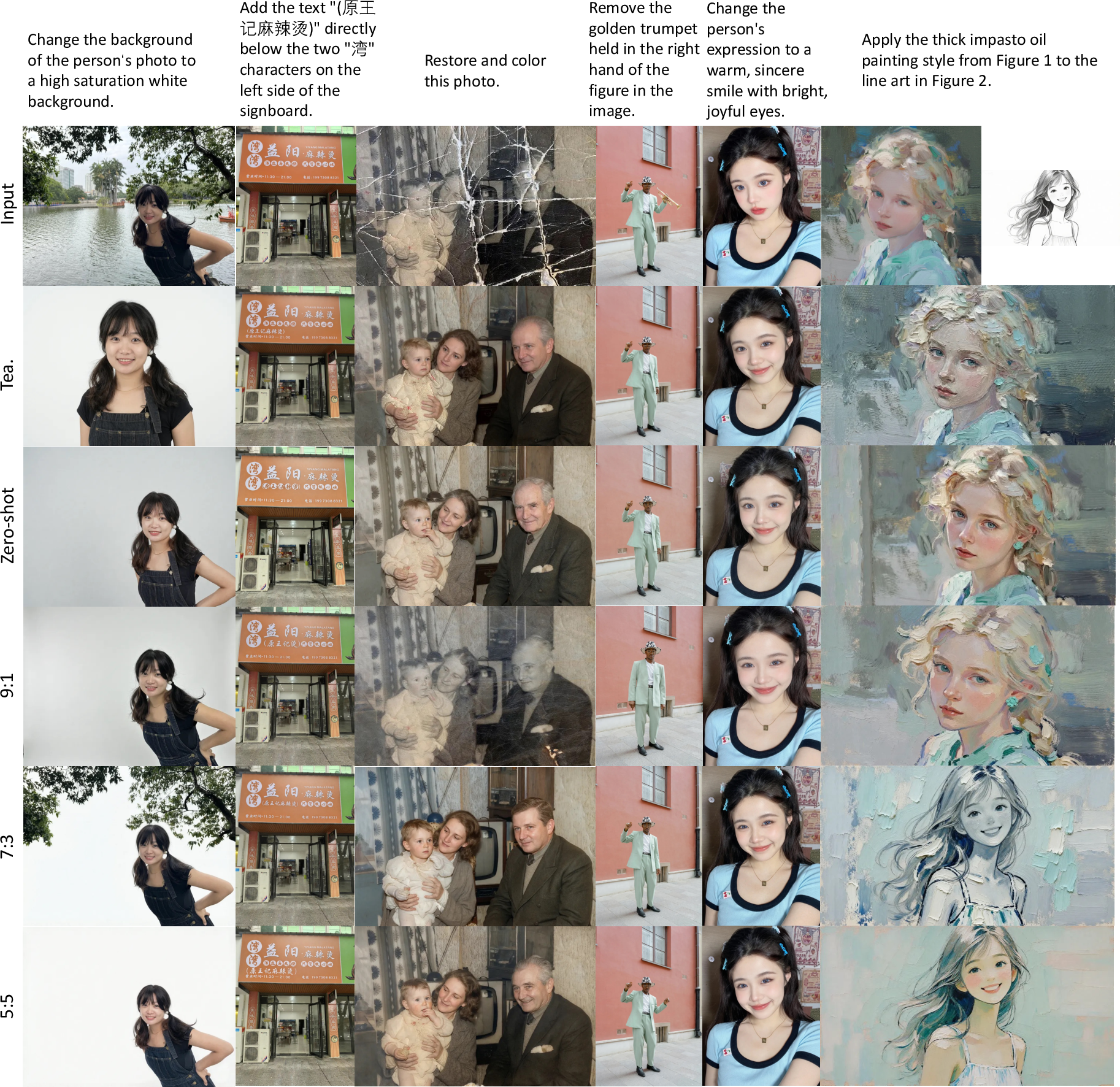
Figure 1: Qwen-Image-Flash examples. T2I and instruction-guided editing results with only 4 NFEs, showing unified few-step generation-editing capability.
Analysis of Data Composition in T2I Distillation
A foundational contribution is the empirical demonstration that the composition of distillation data, rather than mere diversity or explicit domain coverage, is the critical determinant of distilled student performance in T2I settings.
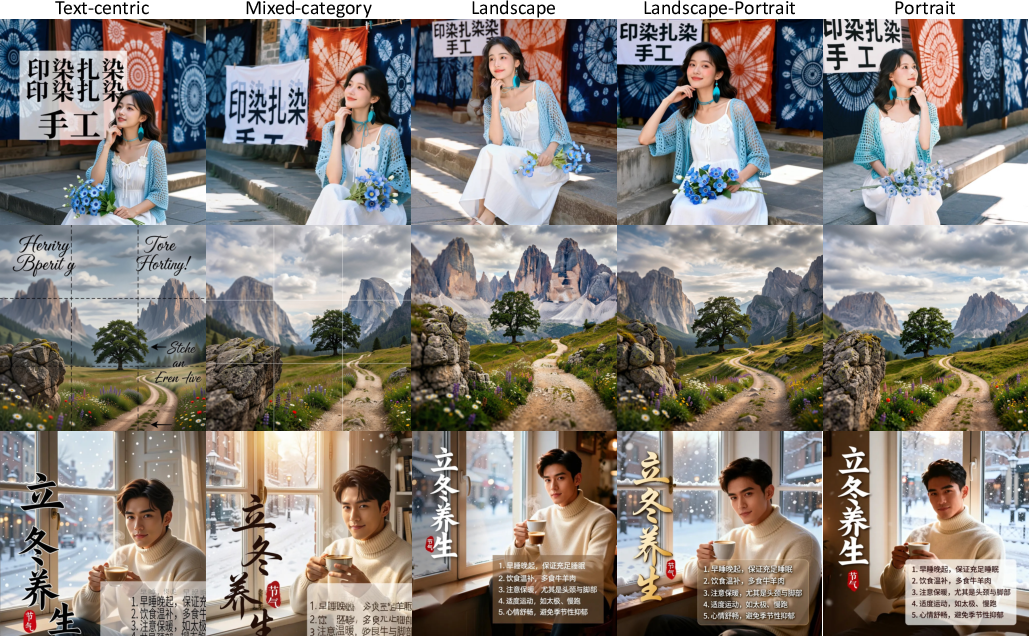
The experiment contrasts five training data configurations: landscape-only, portrait-only, text-centric-only, a landscape-portrait union, and a fully mixed-category set. Quantitative evaluations on T2I-Bench—leveraging both Gemini 3.1 Pro and GPT 5.5 evaluators—establish counterintuitive patterns:
This decisively disrupts the commonly held axiom from large-scale pretraining—where diversity and scale monotonically improve results—demonstrating that in the few-step distillation regime, optimizing for distributional clarity and coherence in training data supports better transfer and stability.
Multi-Teacher Guidance for Distillation Stability
The second axis interrogated is teacher guidance. Directly distilling from task-specialized teachers with superior downstream performance (e.g., text-centric capabilities) induced destabilized optimization, progressive misalignment, and visual collapse in the student. This is attributed to sharp, narrow teacher distributions being fundamentally difficult to track for trajectory-constrained students.
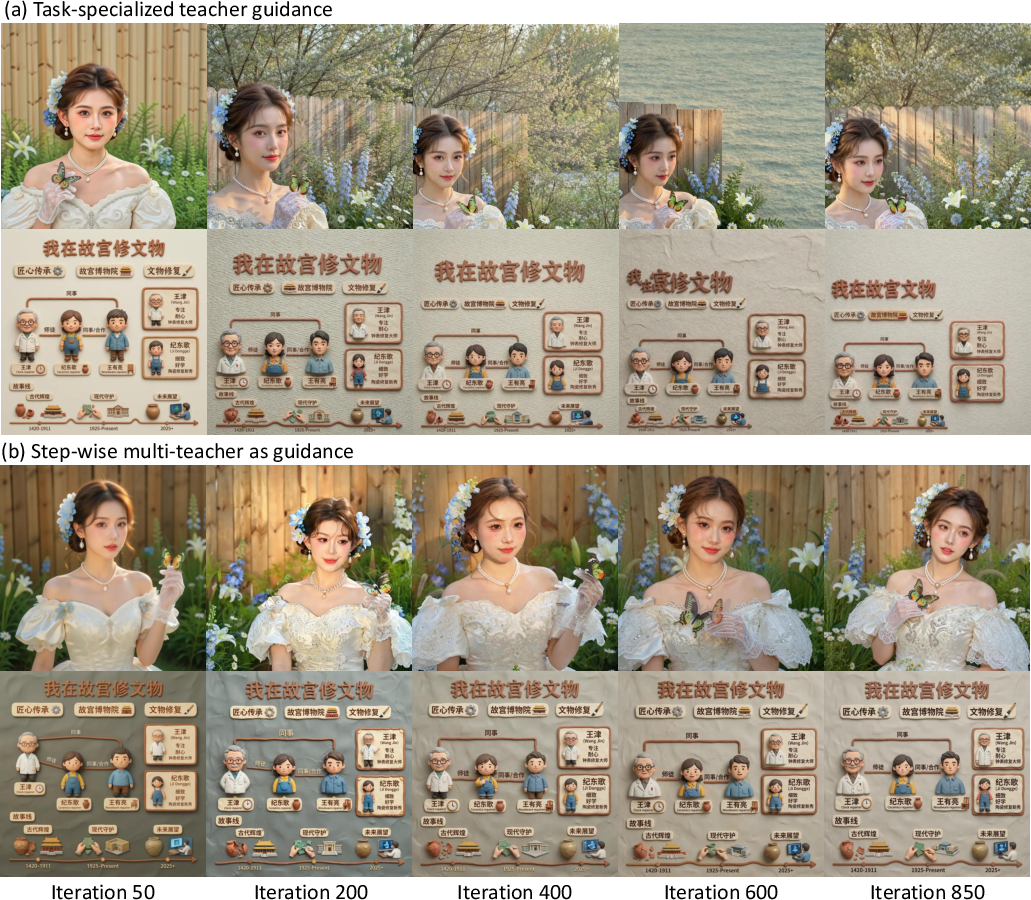
Figure 3: Comparison of teacher guidance; direct use of task-specialized teachers destabilizes distillation, while step-wise multi-teacher guidance maintains alignment and fidelity.
To resolve this, the authors propose a step-wise multi-teacher guidance protocol: A base teacher anchors stable training in early steps, and specialized teachers are selectively and adaptively mixed in as per the target condition and training phase. This produces:
- Stable optimization: No collapse or drift throughout training.
- Effective capacity transfer: Students inherit complementary capabilities from multiple teachers without overfitting to narrow modes.
- Simplicity and universality: The protocol is minimally invasive and compatible with practical DMD pipelines.
This mechanism allows Qwen-Image-Flash-T2I to outperform the 80-step base teacher at only $4$ NFEs in overall downstream ranking.
Task Mixture and Unified Generation-Editing Distillation
Distilling a unified model for both T2I synthesis and instruction-guided editing is nontrivial. Critical here is the T2I:Edit data mixture:
Surprisingly, editing data is not a distractor but an auxiliary signal, improving T2I synthesis by enforcing fine-grained prompt following and visual-textual alignment. In all successfully evaluated configurations, the joint distillation process directly benefits from editing supervision, disproving any inherent zero-sum trade-off between tasks for optimal mixtures.
Technical Implications and Insights
The study strictly demonstrates that:
- Structural choices in data composition, guided by coherence rather than naive coverage, yield generalization superior to more diverse or “in-domain” data.
- Stability in teacher guidance—via anchored base teachers and selective adaptation—is more important than raw teacher performance, especially in few-step, trajectory-limited models.
- Task mixture ratios, when optimally balanced, not only enable effective multitasking but also positively transfer auxiliary capabilities across tasks.
These findings suggest that future advances in efficient generative foundation models will require joint optimization of objectives, data curation, and distillation curriculum, rather than isolated improvements to loss design or network scale.
Limitations and Future Directions
The authors note persistent difficulties in fine-grained text rendering and residual noise artifacts—especially in synthetic compositions and clean backgrounds—during extremely few-step generation. The quest for artifact-free, ultra-consistent text and clean layouts at minimal computational cost remains a challenging open problem. Experiments with first-step regularization (e.g., DP-DMD) conferred stability but traded off some perceptual quality, indicating a delicate balance between structure and fidelity.
Further research is warranted in designing data- and curriculum-driven protocols to robustly transfer typographic and compositional expertise and in developing new denoising and regularization approaches for ultra-few-NFE regimes.
Conclusion
Qwen-Image-Flash redefines efficient visual generative model distillation as a systems-level design task governed by data selection, teacher orchestration, and judicious task mixing—not by loss design in isolation. The simplicity and generality of the main findings position them as immediately actionable recipes for practitioners seeking stable and capable few-step models underpinning contemporary content generation and editing pipelines.
In aggregate, the study makes a compelling case for systems-level design as the next critical lever in generative vision, motivating a new wave of research into principled recipe construction for universal, low-latency, high-quality visual foundation models.