- The paper introduces SPAWN, a training-free technique that swaps the context-memory anchor to inject user-defined concepts during video generation.
- It employs deterministic windowed injection to maintain spatial, temporal, and stylistic consistency across interactive scenes.
- Empirical results show SPAWN outperforms baselines in fidelity and dynamic interaction, enhancing applications in virtual worlds and storytelling.
Training-Free Concept Spawning in Autoregressive World Models: The SPAWN Method
Introduction
The paper "From Zero to Hero: Training-Free Custom Concept Spawning in World Models" (2606.02575) addresses a persistent limitation in autoregressive world models for interactive video generation: the incapacity for explicit, controllable introduction of custom visual concepts into generated environments during inference. While current models such as WorldPlay and GameGen support interactive navigation and text-prompt conditioning, they lack mechanisms for spatially precise, user-driven content insertion—particularly for novel visual entities specified at runtime via either an image or textual description. This restricts their utility for domains like virtual world creation, story-driven content authoring, and embodied AI, where fine-grained, real-time world composition is essential.
Method: Swapping the Pinned Anchor via Windowed Injection
Central to the proposed SPAWN methodology is the exploitation of a structural feature endemic to image-to-video autoregressive models: the first context-memory slot, often pinned to the original reference frame, acts as an immutable anchor that strongly conditions all subsequent generations throughout the rollout. Drawing on analogies with “attention sink” phenomena in Transformer-based models, SPAWN performs deterministic substitution of this anchor slot with a latent corresponding to the user-specified concept, over a small, controlled injection window (typically spanning five chunks).
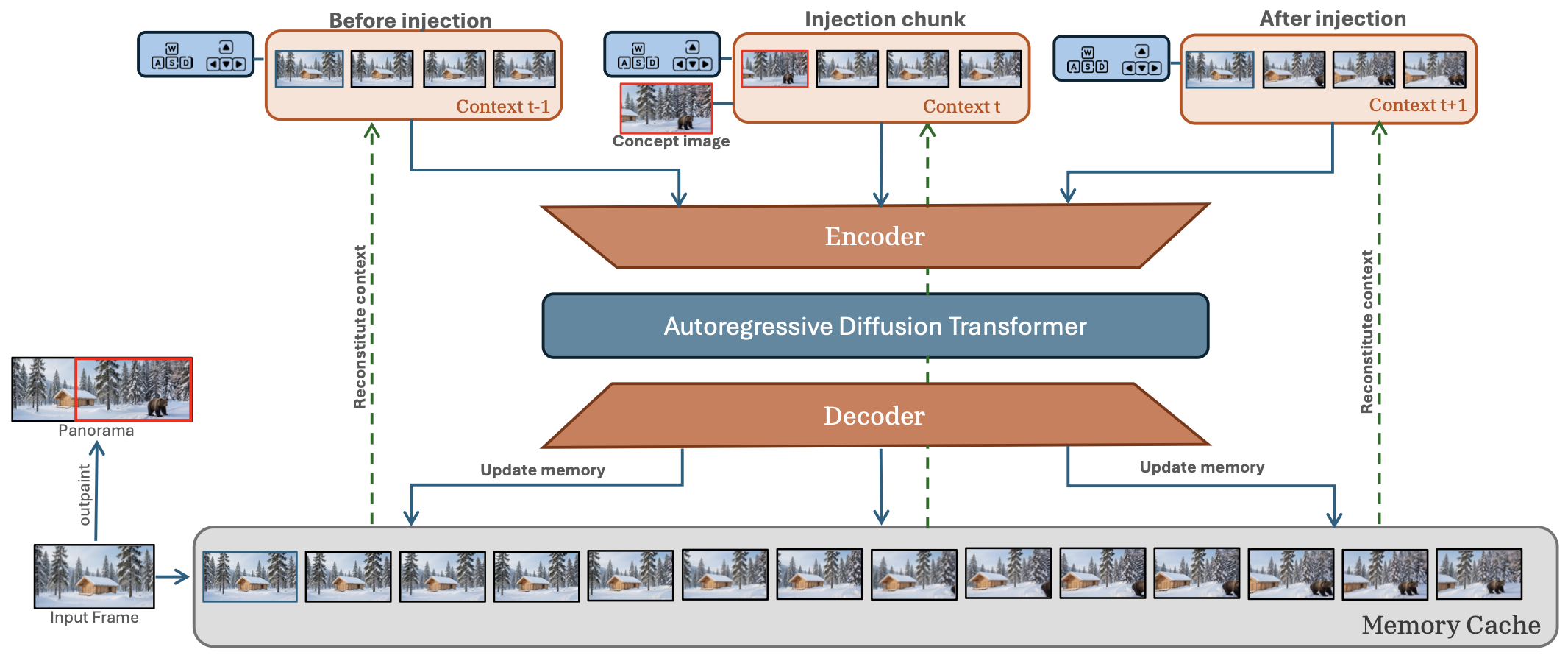
Figure 1: SPAWN workflow overview—at specified time steps, the anchor in context memory is temporarily swapped with the concept latent, propagating the new content through the world via the native model memory mechanisms.
During this injection period, queries in the denoising transformer attend to the substituted concept, with all other context slots remaining unchanged, preserving both the spatial and temporal integrity of the generated sequence. After reinstituting the original anchor, the injected concept persists through two architectural pathways: it enters short-term temporal context via generated chunks, and resurfaces dynamically via spatial retrieval whenever the camera revisits the affected scene region.
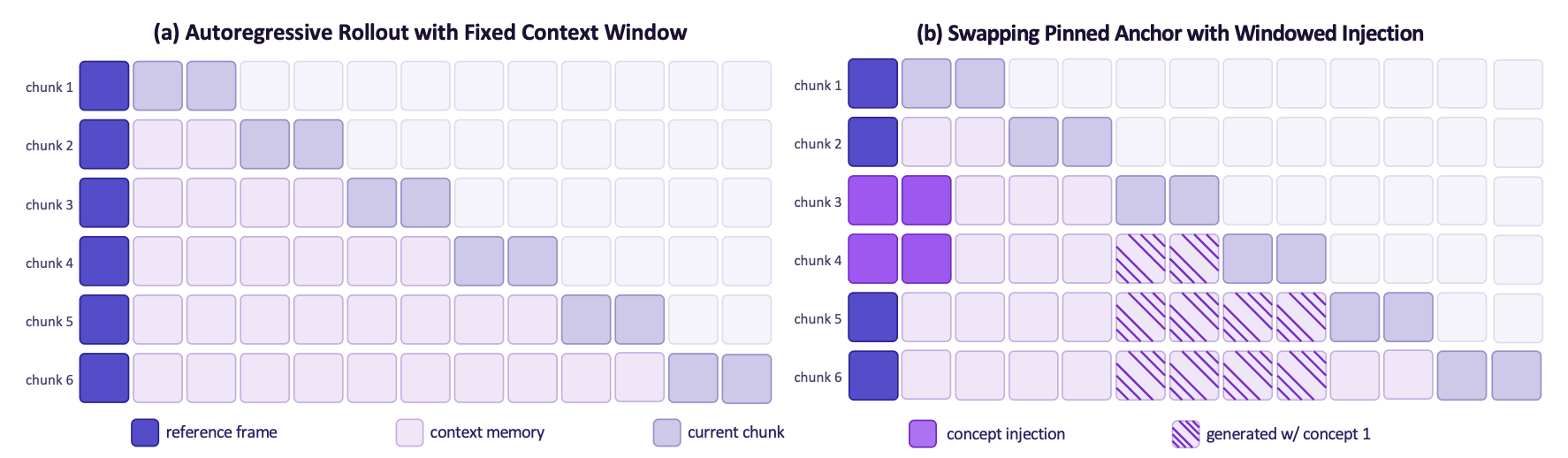
Figure 2: (a) Standard rollout propagates context memory from the original anchor. (b) Under SPAWN, the anchor is swapped with a concept latent, ensuring persistent, controlled propagation of the new concept.
Capabilities: Image- and Text-Based Concept Control
A salient practical attribute of SPAWN is modality-agnostic control: the method accepts both image and textual specifications for the concept, leveraging existing pretrained visual/textual encoders for latent formation. Image-driven injection enables fine-grained control, including exact identity preservation, while text-driven modes facilitate semantic-level world editing.
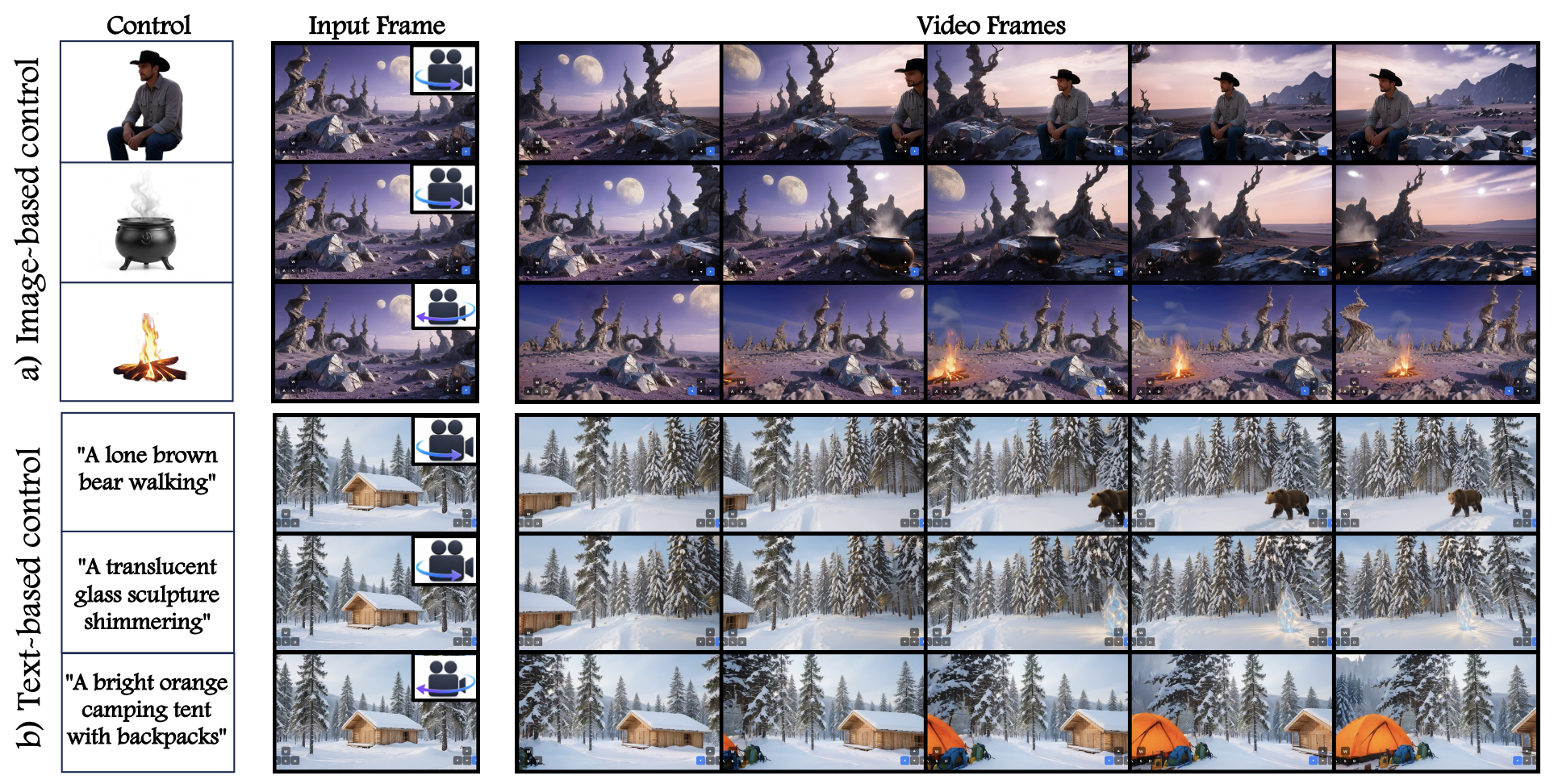
Figure 3: SPAWN enables both image-based and text-based spawning. Each injection preserves viewpoint, lighting, and world coherence.
SPAWN supports diverse operational workflows, including the sequential or simultaneous injection of multiple concepts, expansion to storytelling scenarios where panoramas are dynamically traversed, and scene diversity augmentation far beyond baseline model priors.
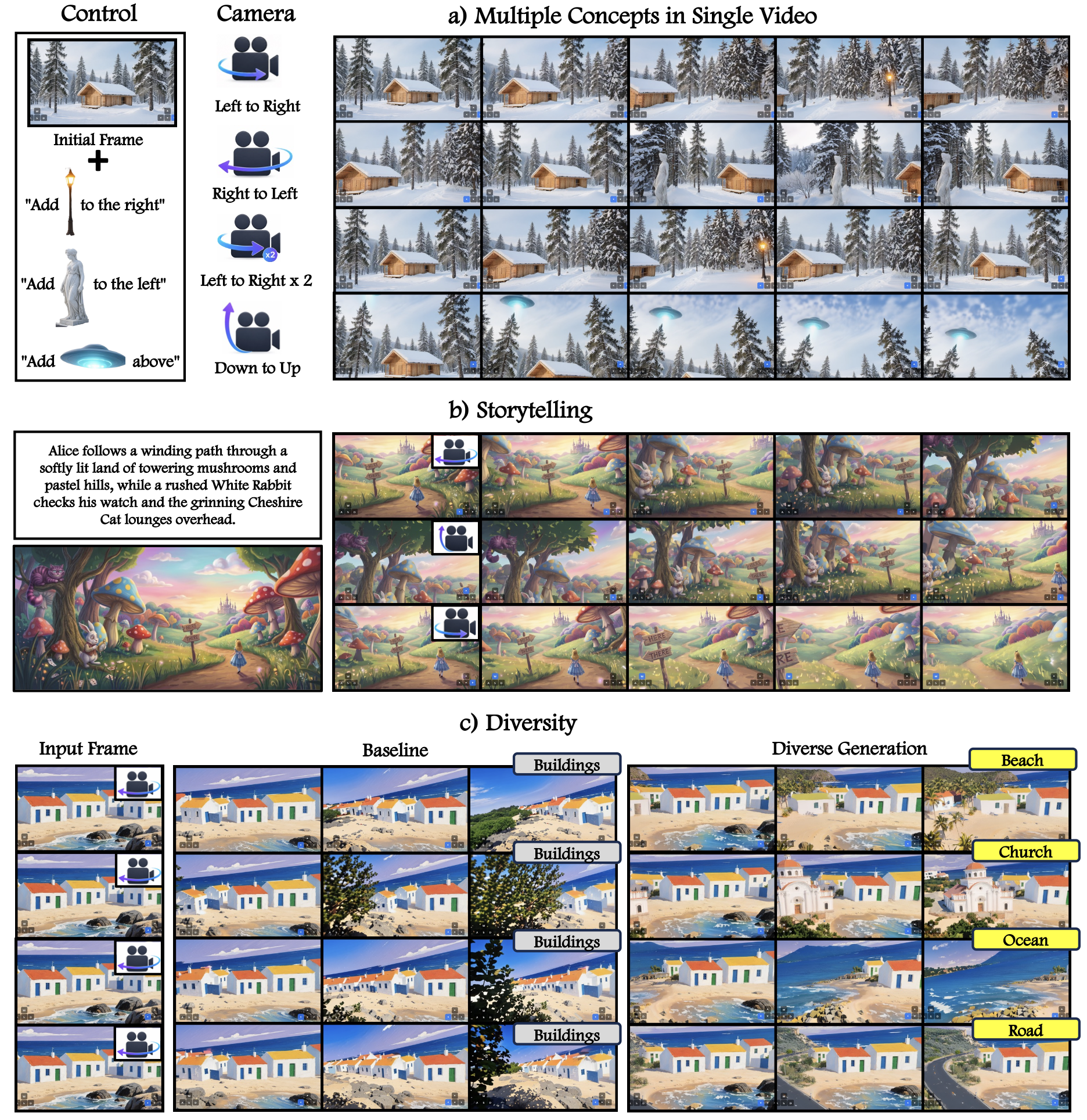
Figure 4: Use cases: multi-concept spawning, narrative-driven panorama expansion, and enhanced world diversity.
Empirical Findings
Qualitative Comparison
Compared to state-of-the-art video generation baselines (HunyuanVideo, Wan 2.2, WorldPlay), SPAWN demonstrates robust spatial placement, persistent visual identity, and temporal coherence of injected entities. Notably, other models typically disregard prompt content out-of-view or hallucinate entities with erroneous location, perspective, or style.
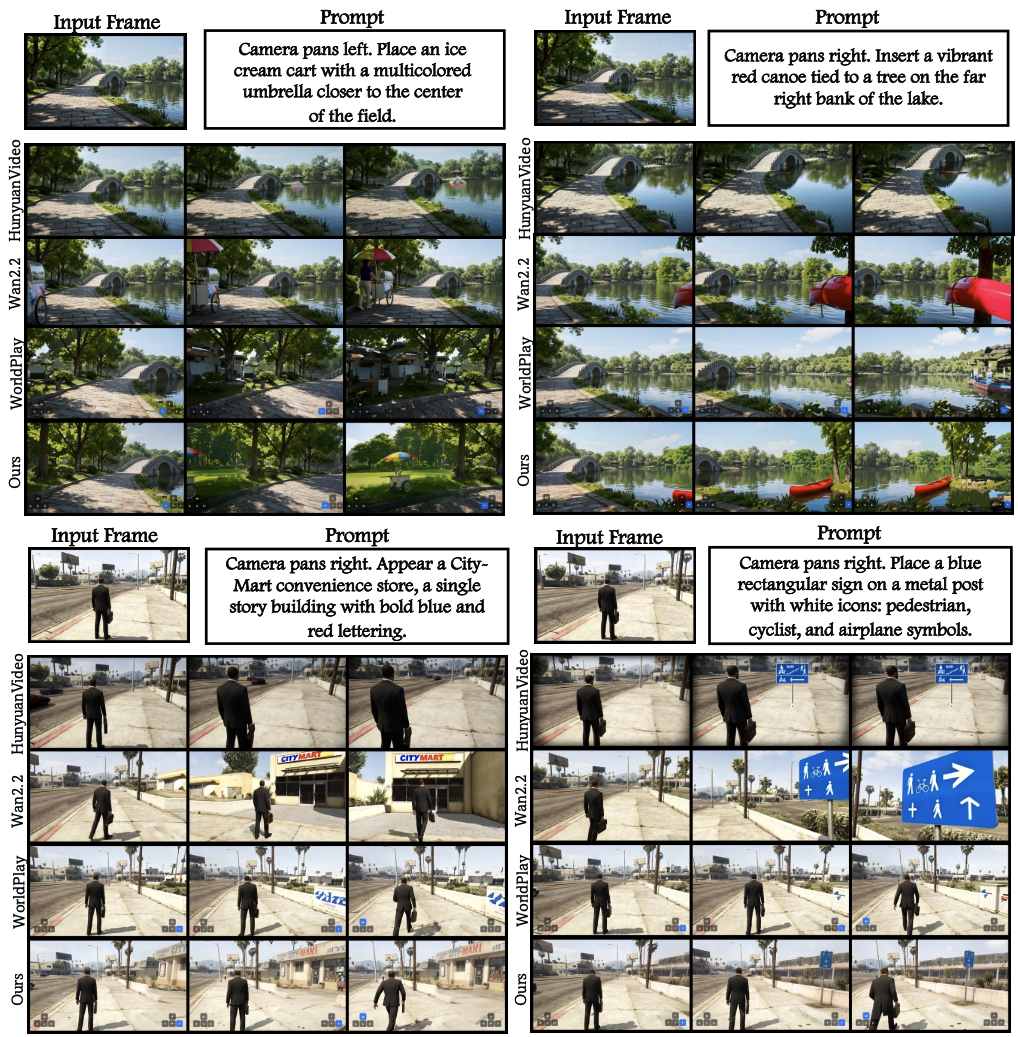
Figure 5: Qualitative comparison: only SPAWN provides faithful, located, and integrated rendering of requested concepts, while baselines either omit or misplace the concept.
On the VBench suite, SPAWN achieves the highest overall metric (0.901, outperforming Wan 2.2 and WorldPlay), with particularly strong results in “Dynamic Degree” and “Camera Motion”—indicative of robust interaction handling and action conditioning. SPAWN’s concept-image fidelity, as measured by subject and background consistency against the explicit concept image, exceeds 0.88, while alternative methods do not admit such conditioning.
Ablation studies further indicate that the combination of multi-slot (slots 0 and 1) anchor replacement and panoramic grounding yields optimal trade-offs between concept fidelity and global world integrity. Excessively long injection windows or non-anchor slot replacements attenuate performance, underscoring the necessity of structural anchoring for effective concept propagation.
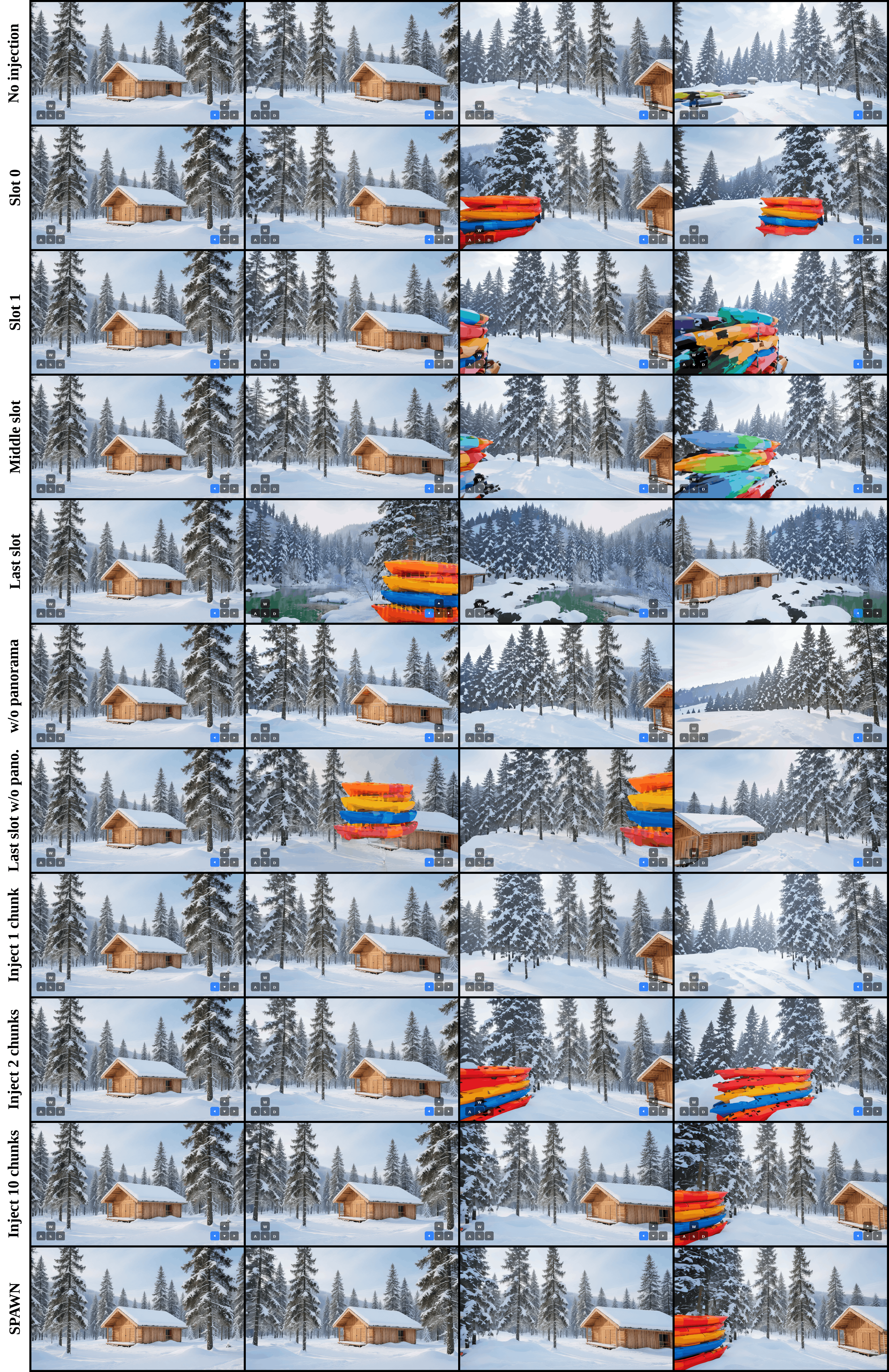
Figure 6: Ablation across slot replacement and configuration. Identity is best preserved through joint replacement of slots 0 and 1, with short, panoramic-grounded windows.
User Study
A human evaluation with 30 raters substantiates the automatic metrics: SPAWN is rated highest on all axes—visual quality, prompt adherence, motion control, and, uniquely, concept-image fidelity.

Figure 7: Example user study interface for visual quality and prompt fidelity assessment.
Implications and Future Directions
SPAWN's capacity for training-free, runtime concept spawning dramatically enhances the expressivity and practical applicability of autoregressive world models without requiring resource-intensive model retraining, architectural changes, or curated datasets. From a theoretical perspective, the results establish that context-memory anchors possess sufficient representational malleability to support persistent scene-level interventions—suggesting a broader class of inference-time control strategies for generative modeling.
Practically, SPAWN’s compositional approach enables author-driven world editing, interactive storytelling with persistent custom content, and facilitates rapid prototyping workflows in simulation and virtual reality design. It also provides a path for adapting massive pretrained models to custom environments, where fine-tuning is infeasible or cost-prohibitive.
Future work may investigate mechanisms for finer spatial localization, hierarchical or sequential concept layering, interaction with generalized agent controls, and the extension of anchor-based editing to additional model classes (e.g., non-autoregressive, 3D, or reinforcement-learning driven world models). The proposed benchmarks and released code further lower the barrier for systematic analysis of real-time, controllable generative systems.
Conclusion
The SPAWN algorithm presents a principled, training-free strategy for custom concept spawning in autoregressive world models, enabling both image- and text-driven content insertion with strong spatial, temporal, and stylistic integration. By leveraging the structural anchoring of context memory, SPAWN demonstrates that inference-time interventions alone suffice for persistent world editing—substantially advancing the controllability and practical deployment of large-scale generative environments.