DynaFLIP: Rethinking Robotics Perception via Tri-Modal-Dynamics Guided Representation
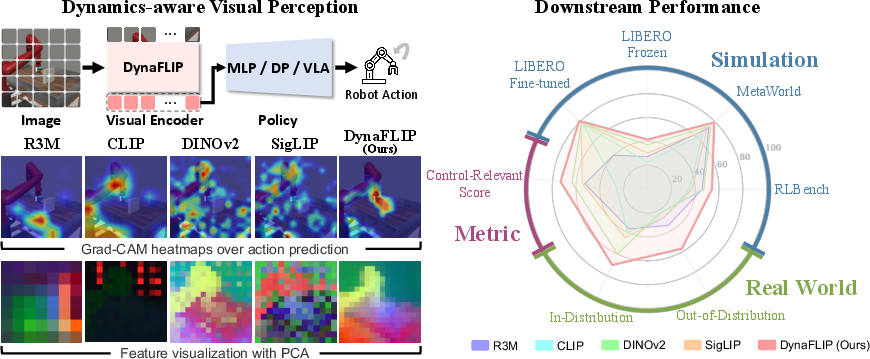
Abstract: Robot manipulation critically depends on perception that preserves the action-relevant aspects of a scene. Yet most robot learning pipelines are built upon visual encoders pre-trained for static recognition or vision-language alignment, leaving motion understanding to downstream policies. We introduce DynaFLIP, a dynamics-aware multimodal pre-training framework that pushes motion understanding upstream into perception. We construct image-language-3D flow triplets from heterogeneous human and robot videos, and use these triplets as training-time supervision to shape an image-only encoder. Our key idea is to encourage the three modalities to span a small simplex volume in the shared hyperspherical space -- a smaller simplex volume indicating stronger alignment. To avoid the geometric ambiguity and trivial collapse of naive volume minimization, we combine simplex-volume minimization with a cosine regularizer and a contrastive objective. Our analyses show that DynaFLIP focuses on control-relevant regions critical for manipulation. The resulting dynamics-aware representations serve as reusable visual backbones and consistently outperform baselines across diverse downstream policies, including VLAs. We validate this across diverse simulation and real-world setups, with gains reaching +22.5% under out-of-distribution scenarios. Our results suggest that robot generalization improves when visual representations are trained to encode not just what is present, but how the world changes under action.
Paper Prompts
Sign up for free to create and run prompts on this paper using GPT-5.
Top Community Prompts
Explain it Like I'm 14
What is this paper about?
This paper introduces DynaFLIP, a new way to teach robots “what matters” in a scene for doing tasks with their hands (like picking up, pouring, or folding). Instead of only learning what objects are, DynaFLIP helps a robot see how the world changes when it acts. The goal is to build a vision system that notices the parts of the scene that are important for control—like the object being grasped or the contact point—so the robot can do better on many tasks, even in new, unfamiliar situations.
What questions are the researchers asking?
The researchers focus on four simple questions:
- Can we train a robot’s vision system to pay attention to things that matter for action (not just what looks interesting)?
- Will this kind of “motion-aware” vision help robot controllers learn faster and perform better?
- Does this approach work in the real world, and does it handle surprises (new objects, new layouts, new instructions)?
- Which parts of the method are actually responsible for the improvement?
How did they do it?
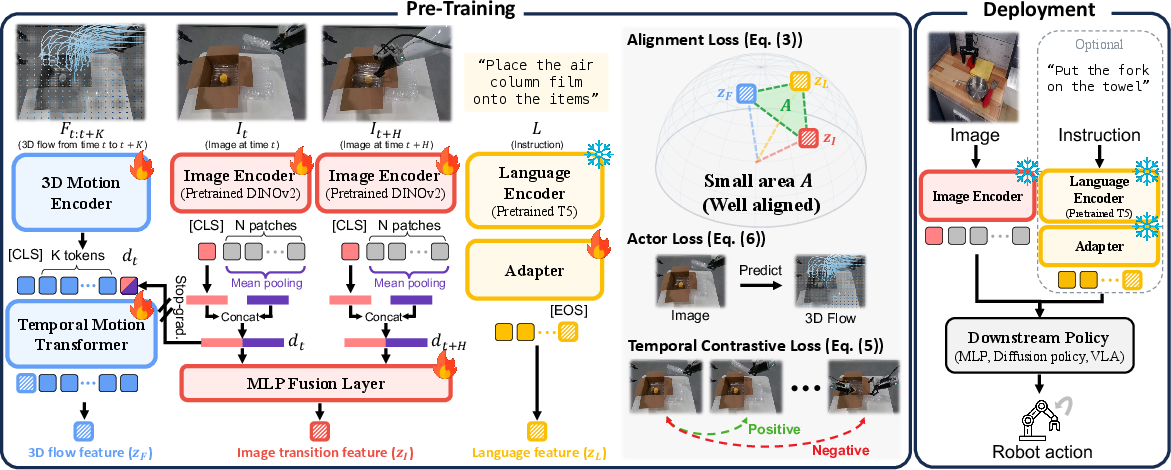
Think of teaching a robot using three clues that all describe the same change in the world:
- Images before and after: like two photos showing what changed (e.g., a drawer moved from closed to open).
- Language: a simple sentence describing the goal (e.g., “open the drawer”).
- 3D flow: tiny arrows showing how points in the scene moved in 3D (e.g., the drawer moved forward).
During training, the robot sees all three clues together for many short video moments. Later, at test time, the robot uses only the image (no language or 3D arrows are required). The extra clues are used only to shape what the vision system pays attention to.
To make the three clues agree, the authors map them into a shared “idea space” (a place where each clue becomes a vector). You can imagine drawing a triangle whose corners are the three clues (image-change, language, 3D flow). If the triangle is small, it means the clues agree about what changed and where. The method tries to make this triangle small for matching triplets and large for mismatched ones, which teaches the vision system to focus on action-relevant parts.
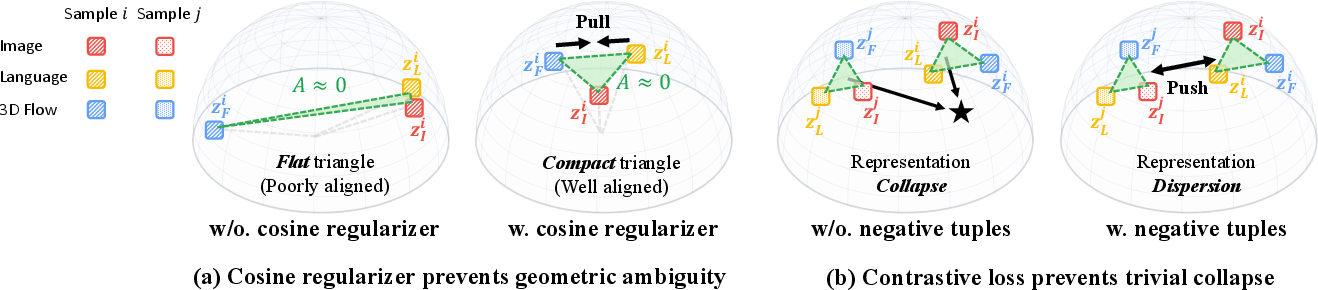
They also solve two problems that could break this idea:
- Flat triangle problem (geometric ambiguity): The triangle can be tiny even if one clue is still far away but lined up with the others. To fix this, they add a “pull-together” nudge for specific pairs (a cosine regularizer) so the clues truly meet, not just line up.
- Collapse problem: If you only shrink triangles, everything could collapse to the same point (which is useless). To prevent this, they use contrastive learning with “negative” examples (mismatched triplets), so the model must keep different situations apart while bringing matching clues together.
They also add two helpful training signals:
- Temporal contrast: clips that are close in time should have more similar features than far-apart clips from the same video—this helps the model understand how scenes evolve smoothly.
- Actor loss: from a single image, predict short, immediate 3D motion. This encourages the vision system to encode motion-relevant details right in the image features.
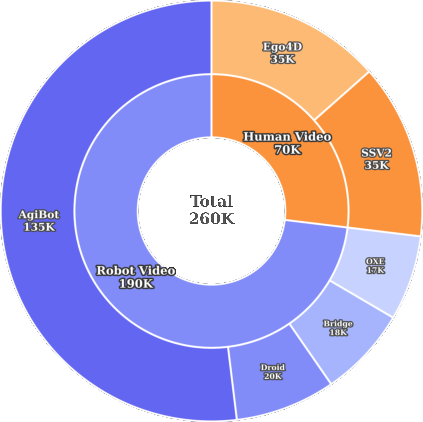
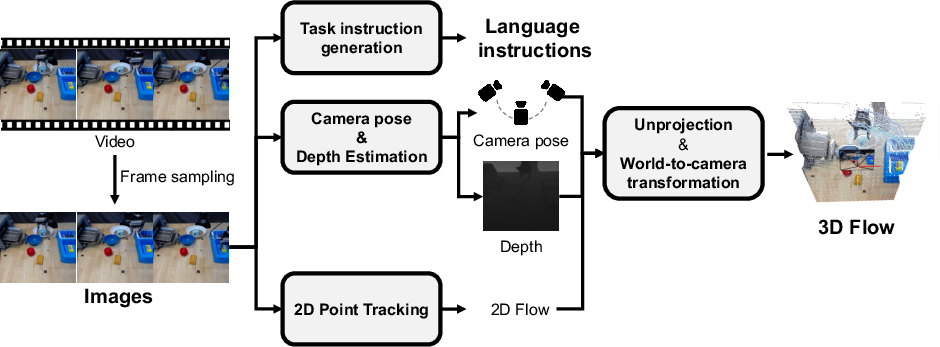
Finally, they build a large training set (about 260,000 short video segments) from both human and robot videos. They automatically:
- pick image pairs,
- estimate 3D flow from video (tracking points and estimating depth), and
- generate short language descriptions with a vision-LLM.
What did they find, and why is it important?
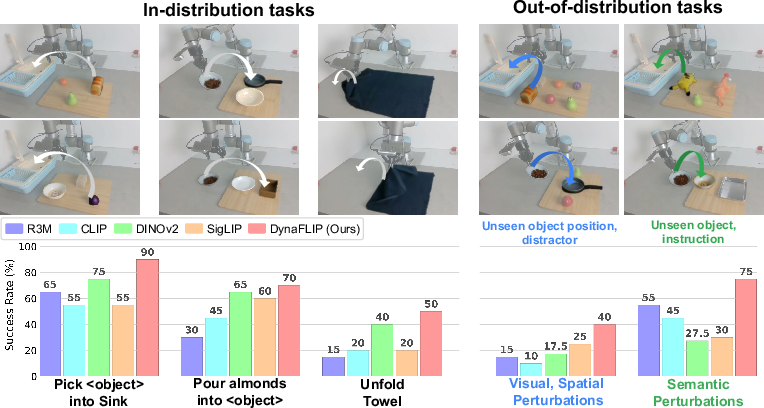
Across many tests—in simulation and on a real robot—DynaFLIP helped robots perform better than popular vision backbones like CLIP, SigLIP, DINOv2, and robotics-specific models like R3M and VC-1.
Here are the key takeaways:
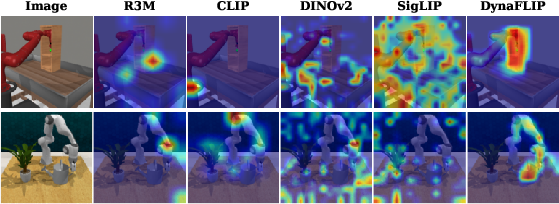
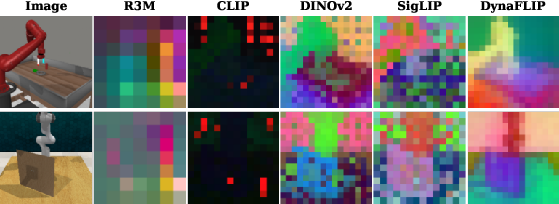
- Focus on the right places: Visualizations (like Grad-CAM heatmaps) show DynaFLIP looks at the manipulated object and contact areas, not random or flashy parts of the image. Its features are more “object-shaped” and consistent across space.
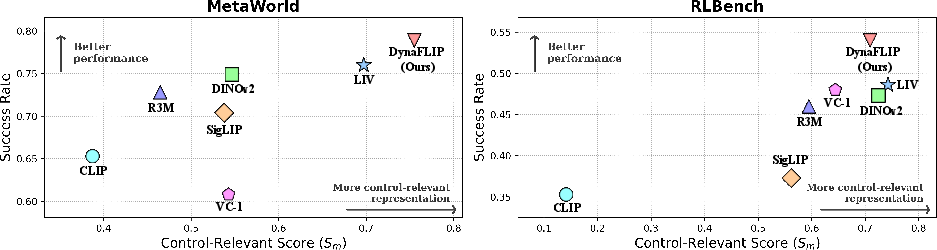
- Keeps control information: A special score that measures how much action-relevant state is preserved by the vision features is higher for DynaFLIP—and higher scores go along with higher task success.
- Works with different controllers: Whether the downstream policy is a simple MLP, a diffusion policy (a modern imitation-learning method), or a big Vision-Language-Action (VLA) model, DynaFLIP’s image features plug in and improve results.
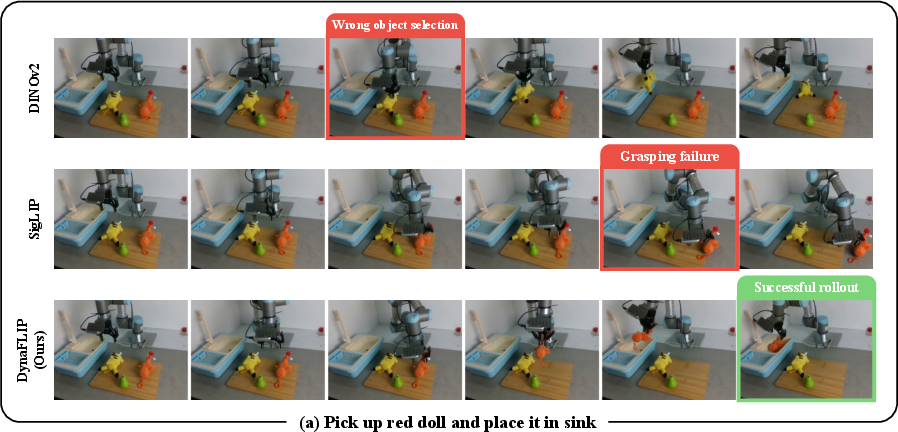
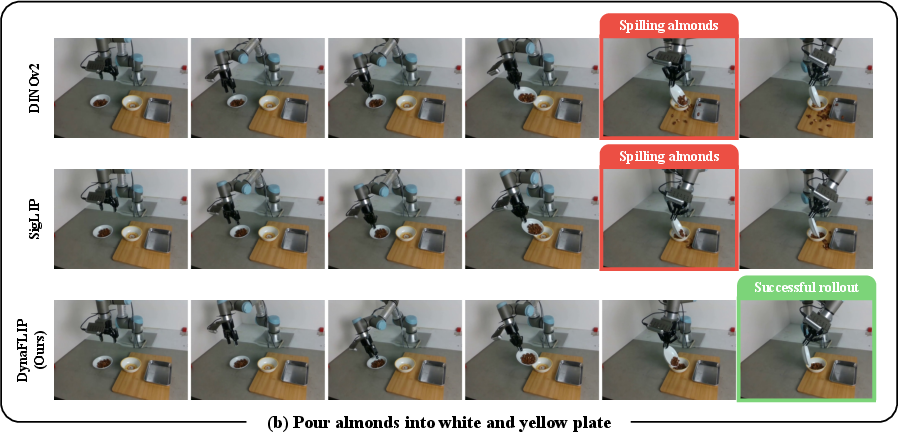
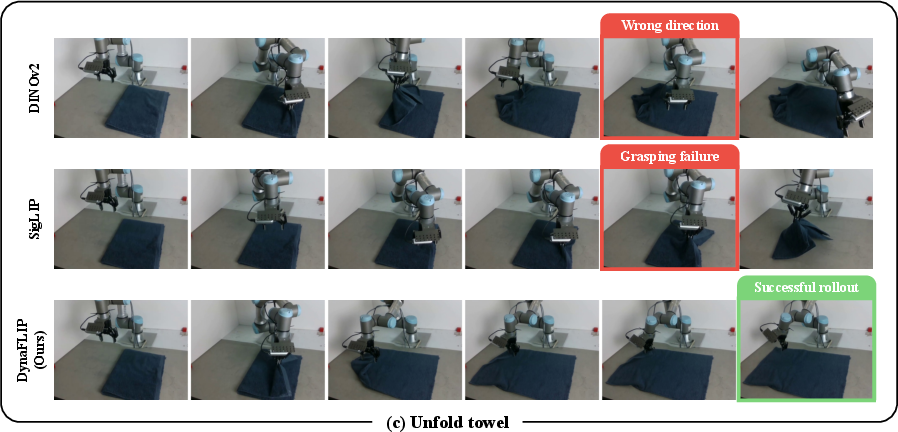
- Handles surprises: In the real world (UR3 robot arm), DynaFLIP did best not only on tasks it trained for (like putting objects in a sink, pouring almonds, or unfolding a towel) but also when things changed—new object positions and distractors (visual/spatial shifts) or even new objects and instructions (semantic shifts). Reported gains reached up to +22.5% in out-of-distribution tests.
- Strong frozen performance: Even when the vision backbone is kept frozen (not fine-tuned for the new task), DynaFLIP often outperforms others. That means the learned features are truly reusable.
Why is this important? Robots need to generalize—work reliably in new homes, with new objects and layouts. A vision system that encodes “how the world changes under action” gives the robot a head start, making it easier for the controller to succeed with fewer examples and more robustness.
What could this change in the future?
This work suggests a simple but powerful shift: don’t just teach robots what’s in a scene—teach them what changes when they act. By moving motion understanding “upstream” into perception, robots can:
- learn faster from demonstrations,
- stay focused on what matters for control,
- handle new situations more reliably, and
- serve as a stronger base for many robot policies.
The authors note two limitations and future directions:
- Data scale: They trained on 260K trajectories, which is smaller than some giant vision datasets. Scaling up could make it even better.
- Noisy 3D motion: Their 3D flow tracks a grid of points, which can include irrelevant motion (like background movement). Smarter selection of motion points (focusing on hands and task-relevant objects) could reduce noise.
Overall, DynaFLIP shows that teaching perception to understand action-driven change can make robots more capable and adaptable in the real world.
Knowledge Gaps
Knowledge gaps, limitations, and open questions
Below is a consolidated list of specific gaps and unresolved questions to guide future research:
- Sensitivity to 3D flow estimation quality: quantify how errors from depth estimation, point tracking, occlusions, fast motion, and imperfect camera-motion compensation affect pre-training and downstream performance.
- Fixed 20×20 keypoint grid: investigate adaptive/object-centric keypoint selection, grid resolution trade-offs, and learned keypoint sampling for flow extraction.
- Language supervision noise: assess robustness to VLM-generated instruction hallucinations, mislabeling, and underspecification; explore filtering, calibration, and confidence-weighted losses.
- Triplet time alignment: measure impacts of misalignment between language, image transitions, and 3D flow; develop automatic alignment or synchronization strategies.
- Regularizer choice: justify why the cosine term is applied only to language–flow pairs; compare against symmetric pairwise regularization (L–I, F–I, or all pairs) and alternative higher-order constraints.
- Simplex objective theory: provide stronger theoretical guarantees or diagnostics for avoiding geometric degeneracies beyond empirical cosine regularization and contrastive negatives.
- Negative sampling strategy: analyze false negatives within a batch (semantically similar but unmatched tuples), batch-size dependence, and benefits of hard negative mining or curriculum negatives.
- Hyperparameter sensitivity: systematically study α (cosine weight), τ (temperature), temporal offsets H/K, and λ weights for auxiliary losses; report stability ranges and best practices.
- Image transition embedding design: compare feature difference z_I with learned temporal encoders, concatenation, cross-attention over (I_t, I_{t+H}), or multi-frame encoders.
- Temporal contrastive configuration: clarify which embeddings are contrasted, evaluate window/stride choices, and explore long-horizon or hierarchical temporal objectives.
- Actor loss formulation: validate whether predicting future 3D flow from a single frame induces spurious priors; test conditioning on short frame stacks and/or actions, and compare against multi-step forecasting.
- Flow target fidelity: avoid self-consistency by evaluating against higher-quality ground truth (e.g., motion capture, multi-view scene flow) and by stress-testing with synthetic noise.
- Scaling laws: characterize performance vs. dataset size, domain diversity, and data mixtures (human vs. robot videos); identify diminishing returns and optimal curation.
- Dataset composition and bias: report and analyze the human/robot ratio, embodiment mismatch effects, and domain-specific generalization (industrial vs. household scenes).
- Missing modalities: evaluate benefits of adding tactile/force/proprioception/audio and extending the simplex objective to m > 3 modalities.
- Viewpoint invariance: directly test robustness under camera pose changes and multi-view setups; quantify invariance attributed to 3D flow.
- Task coverage: expand to contact-rich, deformable, and long-horizon tasks with complex multi-object dependencies and partial observability.
- Real-world scope: validate on more robots (arms, mobile manipulators), end-effectors, and sensors to assess cross-hardware transferability.
- Policy integration breadth: test with additional VLAs (e.g., OpenVLA variants, RT-family), reinforcement learning algorithms, and end-to-end visual fine-tuning in the real world.
- Runtime constraints: profile encoder latency, memory footprint, and throughput on robot hardware; explore lighter backbones and distillation for real-time control.
- Spatial precision: quantify pixel-level localization and contact-region fidelity; compare CLS/mean pooling vs. dense feature maps and spatial attention taps.
- Robustness breadth: evaluate under lighting changes, motion blur, heavy clutter, adversarial distractors, extreme textures, and occlusions beyond current OOD tests.
- Failure modes: perform systematic error analyses linking failures to noisy flow/language, mis-attention, or temporal misalignment; derive mitigation strategies.
- Control-relevant metric validity: probe sensitivity of S_m to probe design and labels; triangulate with alternative metrics for control relevance and causality.
- Baseline fairness: control for model size, capacity, pre-training data scale, and fine-tuning budgets to ensure rigor in comparative claims.
- Language encoder choice: ablate different LMs (e.g., T5 sizes, LLaMA-based), adapters, and multilingual settings; measure instruction-following robustness.
- Inference with video: test using short video clips or recurrence at test time vs. single-image inputs; quantify gains in dynamics-heavy scenarios.
- Safety and physical robustness: study behavior under force disturbances, compliance needs, and collision risks; integrate safety-aware perception objectives.
- Reproducibility: clarify code, model, and dataset release; address licensing of source videos and reproducibility of triplet generation pipelines.
- Uncertainty-aware training: incorporate per-triplet uncertainty (from flow and language) into the loss, e.g., via weighting, robust estimators, or outlier rejection.
Practical Applications
Overview
DynaFLIP introduces a dynamics-aware, tri-modal (image–language–3D flow) pretraining method that yields an image-only encoder focused on control-relevant visual features for manipulation. It is deployable as a frozen visual backbone across diverse policies (MLP, diffusion policy, VLA), shows strong OOD robustness, and can be trained from RGB videos alone by deriving language and 3D flow. Below are concrete applications organized by time horizon.
Immediate Applications
The items below can be fielded today with existing tools and modest engineering, leveraging the provided encoder as a drop-in backbone.
- Robust bin-picking, kitting, and small-parts assembly in variable environments — Sectors: robotics, manufacturing, logistics
- What to deploy: Replace existing encoders (e.g., CLIP/DINOv2) in imitation-learning or VLA-based industrial arms with DynaFLIP’s frozen visual backbone; add lightweight injection module (PVI-style) for VLA controllers.
- Why it helps: Encoder focuses on contact regions and manipulated parts, improving grasp success under clutter/lighting/background changes; demonstrated real-world gains and OOD robustness.
- Dependencies/assumptions: RGB camera with stable calibration; on-board GPU for ViT-scale inference; access to policy framework (e.g., Diffusion Policy/OpenVLA); safety interlocks for human–robot interaction.
- E-commerce order fulfillment and parcel sorting under distribution shift — Sectors: logistics, retail automation
- What to deploy: Retrofit existing pick-and-place lines by swapping the perception backbone; fine-tune only the lightweight policy head if needed.
- Why it helps: Better generalization to unseen SKUs, packaging styles, and distractors via dynamics-aware features.
- Dependencies/assumptions: Throughput constraints compatible with encoder latency; integration with warehouse WMS and error-recovery routines.
- Household service robots for pick, place, pour, and fold — Sectors: consumer robotics, eldercare
- What to deploy: Use DynaFLIP as the visual encoder in existing home-robot stacks for tasks like pouring, towel unfolding, sink/basket placement.
- Why it helps: Improves precision at contact and resilience to visual clutter and novel objects/instructions (as shown on UR3 tasks).
- Dependencies/assumptions: On-device compute or efficient model distillation; user safety and privacy controls; robust language grounding for open-vocabulary tasks.
- Teleoperation assistance and operator training — Sectors: industrial robotics, defense, remote inspection
- What to deploy: Grad-CAM overlays from DynaFLIP to highlight control-relevant regions in the operator UI; use features to auto-suggest grasps or subgoals.
- Why it helps: Attention maps emphasize contact regions and moving parts, aiding situational awareness and reducing operator burden.
- Dependencies/assumptions: Stable streaming pipeline; human-factors validation; latency budgets.
- Sim-to-real transfer with reduced fine-tuning — Sectors: robotics R&D, OEMs, integrators
- What to deploy: Train policies in simulation using DynaFLIP features and transfer to real robots with only policy-head adaptation.
- Why it helps: Encoder is robust to visual shifts and preserves control-relevant state, narrowing the sim–real gap.
- Dependencies/assumptions: Similar camera viewpoints; small real-world calibration/adaptation dataset.
- Video-only dataset expansion for robot learning — Sectors: academia, industry R&D
- What to deploy: A pipeline that converts web/human/robot RGB videos into image–language–3D flow triplets (auto-generated captions + 3D flow), then pretrains DynaFLIP variants for specific domains.
- Why it helps: Scales supervision without robot-collected action data; broadens object/environment diversity.
- Dependencies/assumptions: Accurate monocular depth/point-tracking and camera-motion compensation; basic captioning quality; data governance for licensing/consent.
- Drop-in backbone for instruction-following VLAs — Sectors: software, robotics
- What to deploy: Plug DynaFLIP features into OpenVLA- or pi-series–style action models via a lightweight projection module (kept trainable) with frozen encoder.
- Why it helps: Improves grasp/contact reasoning without end-to-end visual fine-tuning, preserving model stability.
- Dependencies/assumptions: VLA codebase access; modest training to fit the projection layer; language encoder optionally included for instruction grounding.
- Inspection and rework that requires light manipulation — Sectors: electronics, automotive, pharma
- What to deploy: Use DynaFLIP as perception in tasks that require “touch-and-check” (e.g., probe insertion, connector seating).
- Why it helps: Emphasis on action-relevant cues improves success where fine spatial reasoning matters.
- Dependencies/assumptions: Process-specific fixtures; compliance control; precise end-effector calibration.
- Educational kits and research baselines — Sectors: education, academia
- What to deploy: Provide a ready-to-use PyTorch/ROS package with frozen DynaFLIP features, training scripts, and evaluation metrics (e.g., control-relevant score Sm).
- Why it helps: Lowers barrier to entry for courses and labs; standardizes comparisons across policies and tasks.
- Dependencies/assumptions: Open licensing, reproducible pretraining checkpoints; GPU availability.
- Policy benchmarking and auditing for OOD robustness — Sectors: policy, standards, safety engineering
- What to deploy: Add OOD test suites (visual, spatial, semantic shifts) to acceptance tests; use control-relevant metrics as proxy indicators of safe manipulation.
- Why it helps: Encoders trained to attend to control-relevant regions correlate with better OOD behavior; provides measurable robustness targets.
- Dependencies/assumptions: Agreement on OOD protocols; sector-specific safety thresholds and reporting practices.
Long-Term Applications
These directions require further scaling, validation, or regulatory clearance but are technically grounded in the paper’s methods and findings.
- Generalist, cross-embodiment robot perception from massive video corpora — Sectors: robotics, software platforms
- What could emerge: Foundation perception backbones trained on billions of human/robot videos, transferable across manipulators and environments.
- Enablers: Scalable 3D flow estimation at web scale; higher-quality auto-captioning; efficient simplex-guided multimodal training.
- Assumptions/risks: Data licensing/consent; compute and energy costs; bias and domain-coverage gaps.
- Surgical and medical-assist manipulation — Sectors: healthcare, medtech
- What could emerge: Dynamics-aware encoders for precise tissue manipulation, suturing assistance, or tool handovers.
- Enablers: Domain-specific video pretraining from surgical recordings (with flow/captions); integration with tele-surgery/VLA policies.
- Assumptions/risks: Stringent safety/efficacy trials; explainability and failure mode analysis; HIPAA/GDPR compliance; haptics/tactile fusion.
- Agricultural and food-handling robots for delicate items — Sectors: agriculture, food processing
- What could emerge: Robust picking of deformable, variable produce and precision pouring/sorting in changing environments.
- Enablers: Training on large outdoor/greenhouse video datasets; adaptation to seasonal shifts and occlusions.
- Assumptions/risks: Weather/lighting extremes; contamination control; hardware durability.
- Disaster response and field robotics — Sectors: public safety, defense
- What could emerge: Encoders that retain performance in dust, debris, and novel object layouts for opening valves, clearing obstacles, or tool use.
- Enablers: OOD-hardened pretraining with extreme-shift videos; integration with compliant control and tactile sensing.
- Assumptions/risks: Communications constraints; ethical deployment; rigorous field validation.
- Human-in-the-loop AR guidance using control-relevant attention — Sectors: training, maintenance, manufacturing
- What could emerge: AR overlays highlighting where to act (screws, clips, connectors) based on dynamics-aware attention from video of the task.
- Enablers: On-device or edge inference; mapping from attention to actionable steps; instructional language grounding.
- Assumptions/risks: User trust/ergonomics; liability if guidance is wrong; privacy in workplace capture.
- Standardized “control-relevance” metrics and certification — Sectors: policy, standards bodies, insurance
- What could emerge: Sector-wide benchmarks where encoders must achieve threshold control-relevant scores and OOD performance for deployment in collaborative settings.
- Enablers: Shared datasets with annotated OOD conditions; consensus on proxy metrics tied to safety outcomes.
- Assumptions/risks: Avoiding metric gaming; ensuring metrics correlate with real-world safety.
- Multimodal sensor fusion beyond video (tactile, force, event cameras) — Sectors: robotics hardware, sensing
- What could emerge: Extended simplex-guided objectives aligning image, language, 3D flow, and tactile/force cues to further improve contact-rich manipulation.
- Enablers: Unified training pipelines; synchronized multi-sensor datasets.
- Assumptions/risks: Sensor cost/complexity; calibration drift; increased model size/latency.
- Privacy-preserving, on-device pretraining from home/enterprise video — Sectors: consumer, enterprise IT
- What could emerge: Federated or differential privacy–aware pipelines generating language/flow supervision locally to refine encoders in-situ.
- Enablers: Efficient on-edge depth/flow/captioning; lightweight contrastive training at the edge.
- Assumptions/risks: Robustness of on-device estimators; privacy guarantees vs. utility; device heterogeneity.
- Tooling ecosystem and services — Sectors: software, MLOps
- What could emerge:
- Turnkey “DynaFLIP-as-a-service” for 3D flow/caption generation from video archives.
- ROS2 nodes that publish control-relevant features/attention maps to downstream planners.
- Evaluation harnesses for OOD manipulation and control-relevant scoring.
- Enablers: Stable APIs and model checkpoints; enterprise data connectors.
- Assumptions/risks: Vendor lock-in; SLA for latency/uptime; data residency requirements.
- Energy- and compute-efficient variants for edge deployment — Sectors: embedded systems, green AI
- What could emerge: Distilled or quantized DynaFLIP encoders running on low-power SOCs for mobile or collaborative robots.
- Enablers: Knowledge distillation from tri-modal supervision; sparsity/low-rank adapters; hardware-aware NAS.
- Assumptions/risks: Performance–efficiency trade-offs; maintaining OOD robustness after compression.
Notes on broad feasibility across applications:
- The paper shows immediate gains with a frozen encoder across MLP, diffusion policy, and VLA policies, suggesting low-friction integration into existing stacks.
- Core dependencies include reliable 3D flow estimation during pretraining, decent auto-caption quality, and careful camera-motion compensation. Where these are weak (e.g., heavy ego-motion or task-irrelevant motion), supervision noise can limit benefits; domain-specific data curation or keypoint selection can mitigate this.
- Safety-critical sectors (healthcare, collaborative industrial settings) require rigorous validation, explainability (e.g., attention map auditing), and compliance with data governance and operational standards.
Glossary
The following terms are extracted from the paper, with brief definitions and verbatim usage examples.
- 3D flow: A per-point 3D motion field that describes how the scene moves in physical space across time. "3D flow then adds what neither image transitions nor language can provide: an explicit, viewpoint-invariant account of how the scene moves in physical space, decoupled from 2D appearance."
- anchor-based contrastive learning: A multimodal alignment strategy that aligns each modality independently to a designated anchor modality. "A common strategy for aligning multiple modalities is anchor-based contrastive learning, where one modality serves as a reference and each auxiliary modality is independently aligned to it"
- auxiliary actor loss: An additional training objective that predicts motion from a single frame to explicitly encourage dynamics-aware features. "we introduce an auxiliary actor loss via a single-step 3D flow prediction objective"
- behavior cloning: A supervised imitation-learning approach that trains a policy to mimic demonstrated actions. "in the spirit of behavior cloning"
- CLS token: The special classification token used by Vision Transformers to aggregate global image information. "via CLS and mean-pooled patch tokens"
- control-relevant score: A probing metric that quantifies how well a visual representation preserves information necessary for control. "We measure how well each encoder preserves control-relevant information using the control-relevant score () proposed in~\cite{dong2026capturing},"
- cosine regularizer: A term that encourages pairwise cosine similarity to reduce geometric ambiguity during multimodal alignment. "we augment the triangle area with a cosine regularizer between language and 3D flow embeddings"
- DINOv2: A self-supervised vision model trained with self-distillation and masked image modeling on large curated image datasets. "DINOv2~\cite{oquab2024dinov2} combines self-distillation with masked image modeling on large-scale curated image data."
- diffusion policy: An imitation-learning backbone that generates actions via diffusion-based generative modeling. "using Diffusion Policy~\cite{chi2025diffusion} as the imitation-learning backbone."
- diffusion transformer: The transformer network inside a diffusion model that processes and generates temporally coherent action sequences. "the hidden feature space of the diffusion transformer of "
- DynaFLIP: A tri-modal, dynamics-aware pre-training framework aligning image transitions, language, and 3D flow to learn control-relevant visual representations. "We introduce DynaFLIP, a dynamics-aware multimodal pre-training framework that pushes motion understanding upstream into perception."
- end-effector pose: The 6D pose (position and orientation) of a robot’s tool or gripper used for manipulation. "to predict robot joint angles, end-effector pose, and the 6D pose and shape of task-relevant objects;"
- Grad-CAM: A gradient-based method for visualizing which image regions influence a model’s predictions. "Grad-CAM shows DynaFLIP attending to manipulated objects and interaction regions, while PCA reveals coherent object-level structure."
- hyperspherical space: An embedding space where vectors are normalized to lie on a unit sphere, facilitating cosine-based comparisons. "Three modalities are encoded into embeddings in a shared hyperspherical space."
- InfoNCE-style contrastive objective: A loss that contrasts positive pairs against negatives to prevent collapse and enforce discriminative alignment. "we embed the joint alignment energy into an InfoNCE-style contrastive objective"
- LIBERO: A multi-task, language-conditioned robotic manipulation benchmark. "LIBERO~\cite{liu2023libero} is a multi-task, language-conditioned manipulation benchmark."
- LoRA: Low-Rank Adaptation; a parameter-efficient fine-tuning technique that inserts trainable low-rank adapters into pretrained models. "in which LoRA~\cite{hulora} adapters on both encoders are trained jointly with the diffusion policy."
- mean-pooled: Averaged across tokens or patches to obtain a single summary feature vector. "via CLS and mean-pooled patch tokens"
- MetaWorld: A simulated robot manipulation benchmark with diverse tasks and object interactions. "MetaWorld~\cite{yu2020meta} uses a Sawyer arm with a two-finger gripper."
- multimodal alignment (simplex-guided): Aligning multiple modalities jointly by minimizing the simplex volume spanned by their embeddings to enforce higher-order consistency. "a simplex-guided multimodal alignment objective that aligns image transitions, language, and 3D flow into a shared embedding space"
- negative tuples: Mismatched modality combinations used as contrastive negatives to avoid representational collapse. "we construct a set of negative tuples by mismatching one or more modality embeddings across the batch"
- Open Motion Planning Library: A motion planning framework used to generate robot trajectories for data collection and evaluation. "collected via the Open Motion Planning Library~\cite{sucan2012open}"
- out-of-distribution (OOD): Evaluation conditions involving shifts in visuals, spatial layouts, or semantics beyond the training distribution. "achieving up to 22.5\% improvement over the strongest baseline under real-world OOD perturbations."
- PCA: Principal Component Analysis; a dimensionality-reduction method used to visualize feature structures. "while PCA reveals coherent object-level structure."
- patch tokens: Tokenized image patches in a Vision Transformer serving as local features. "via CLS and mean-pooled patch tokens"
- plug-in visual injection (PVI): A method to inject features from a frozen visual encoder into a downstream model via a lightweight adapter. "similar to plug-in visual injection (PVI)"
- proprioception: Internal robot sensing (e.g., joint angles) that describes the robot’s own state. "to multimodal alignment with language, action, or robot proprioception"
- R3M: A robotic visual representation learned from human videos using time-contrastive and language alignment objectives. "R3M~\cite{nair2022r3m} trains a ResNet~\cite{he2016deep} on human videos via time-contrastive learning and video-language alignment."
- RLBench: A simulated robotic manipulation benchmark using a Franka Panda arm with varied tasks. "RLBench~\cite{james2020rlbench} employs a Franka Panda arm."
- SigLIP: A vision-LLM trained with a pairwise sigmoid loss rather than CLIP’s multinomial objective. "SigLIP~\cite{zhai2023sigmoid} replaces CLIP's multinomial cross-entropy objective with a pairwise sigmoid loss."
- simplex volume: The volume (or area in 3-modal case) spanned by modality embeddings; smaller volume indicates stronger joint alignment. "to span a small simplex volume in the shared hyperspherical space"
- stop-gradient: An operation that blocks gradient flow through a branch to prevent shortcut learning. "with stop-gradient () to preserve semantic grounding while blocking trivial shortcut solutions through the image branch."
- T5: A pretrained text-to-text Transformer used here as a language encoder (with a learnable adapter). "A frozen T5 with a learnable adapter produces from the EOS token of "
- temporal contrastive loss: A loss encouraging embeddings of nearby frames to be closer than distant frames within the same trajectory. "we adopt a temporal contrastive loss"
- temperature parameter: A scaling factor in contrastive softmax that controls the sharpness of distributions. "where is the temperature parameter."
- triangle area: In the 3-modal case, the area of the triangle formed by embeddings; used as a proxy for joint alignment quality. "(a triangle area in our three-modal setting)."
- unit sphere (ℓ2-normalized embedding): Normalizing embeddings to have unit length so they lie on the surface of a hypersphere. "We map each modality to an -normalized embedding on the unit sphere:"
- Vision-Language-Action (VLA): Models that integrate visual input, language instructions, and action generation for robot control. "ranging from imitation learning to Vision-Language-Action (VLA) models"
- visual backbone: A pretrained visual encoder reused across downstream policies to provide general-purpose features. "The resulting dynamics-aware representations serve as reusable visual backbones"
Collections
Sign up for free to add this paper to one or more collections.