Recovering Diversity Without Losing Alignment: A DPO Recipe for Post-Trained LLMs
Abstract: Many open-ended instructions have multiple valid answers that users can benefit from seeing, but post-training often narrows an LLM's output space toward a small set of canonical responses. We introduce REDIPO, an offline DPO data-construction pipeline for recovering distinct valid answer modes while preserving the alignment benefits of the instruct model. For each prompt, REDIPO samples responses from both base and instruct models, rewrites base-model responses with the instruct model, filters candidates for safety and instruction-following quality, and builds preference pairs that favor marginally diverse responses among candidates with similar instruction-following reward. Across Qwen3-4B, OLMo-3-7B, and LLaMA-3.1-8B, REDIPO improves NoveltyBench distinct_k by 134%, 33%, and 44% relative to the instruct checkpoints, while DivPO changes diversity by 0%, -6%, and -4% on the same models. These gains largely maintain MTBench, IFEval, and Arena-Hard performance, and reduce direct-category HarmBench attack success rate. Ablations show that marginal-diversity pair selection and base-response rewriting drive the diversity gains, while filtering and quality-bounded pairing help maintain alignment. Overall, our results show that diverse valid answers from base-model generations can be reintroduced through carefully constructed preference data while retaining the alignment benefits of post-training. We release our code and data at https://github.com/vsamuel2003/RiDiPO.
Paper Prompts
Sign up for free to create and run prompts on this paper using GPT-5.
Top Community Prompts
Explain it Like I'm 14
Recovering Diversity Without Losing Alignment: A simple guide to ReDiPO
1) What is this paper about?
The paper tackles a common problem with AI assistants: after they’re trained to be helpful and safe, they often start giving very similar answers over and over, even when many different answers would be equally valid. The authors propose a method called ReDiPO that teaches a model to produce a wider variety of good answers without becoming unsafe or ignoring instructions.
Think of it like brainstorming: instead of hearing the same idea ten times, you want ten different good ideas. ReDiPO helps the AI do that.
2) What questions are the researchers asking?
They ask:
- Can we bring back the “variety” of answers (diversity) that gets lost when a model is tuned to be a polite assistant?
- Can we do this without losing the good parts of tuning—like following instructions well and staying safe?
- Can we achieve this using a training process that’s practical and doesn’t slow down the model when you use it?
3) How did they do it? (Methods in plain language)
First, a few simple terms:
- Base model: the “raw” AI, which is creative but not always safe or on-topic.
- Instruct model: the “polite assistant” version, which follows instructions and is safer, but often less varied.
- DPO (Direct Preference Optimization): a way to train a model using pairs of answers where one is marked “better,” so the model learns to prefer answers like that.
ReDiPO is a recipe for building smart training data for DPO so the model learns to favor diverse answers that are still good and safe.
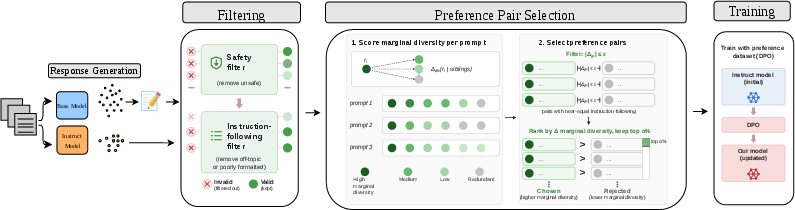
Here’s the pipeline, step by step:
- Generate ideas from both versions:
- For each prompt (question), they sample several answers from the base model and several from the instruct model.
- Restyle the base-model ideas:
- They ask the instruct model to “rewrite” each base-model answer in a clear, helpful assistant style, while keeping the original idea. This keeps the creativity but fixes tone and format.
- Filter out bad or unsafe answers:
- A safety checker removes harmful content.
- A quality checker removes answers that don’t follow instructions well enough.
- Measure how different each answer is:
- They compute a “marginal diversity” score for each answer: basically, “How different is this answer from the other answers for the same prompt?”
- Technically, they turn answers into number vectors (embeddings) and measure similarity; less similar means more diversity. You can think of it like measuring how different songs sound on a playlist.
- Build training pairs that isolate diversity:
- They only pair answers that have similar instruction-following quality (so the comparison is fair).
- In each pair, they label the more different (less redundant) answer as the “preferred” one.
- This way, the model learns: “When quality is similar, pick the answer that adds something new.”
- Train with standard DPO:
- Using these pairs, the model learns to prefer diverse-but-still-good answers. No special tricks at test time, so it’s fast to use.
4) What did they find, and why does it matter?
Main results across three models (Qwen3-4B, OLMo-3-7B, LLaMA-3.1-8B):
- Much more diversity:
- On a diversity test called NoveltyBench, ReDiPO increased the number of distinct valid answers by about +134%, +33%, and +44% compared to the original instruct models. Competing methods (standard DPO and DivPO) did not improve diversity on these models.
- Safety stayed good or got better:
- On HarmBench (a safety test), ReDiPO lowered the rate of harmful responses compared to the instruct models in all three cases.
- Instruction-following mostly preserved:
- Scores on tasks like MTBench and IFEval stayed close to (and sometimes above) the original instruct models. In other words, the model didn’t forget how to follow directions.
A concrete example:
- When asked to invent a monster for a game, the original instruct model kept giving nearly the same “translucent child-spirit” monster with similar names. ReDiPO produced many different monster types and backstories instead of repeating one formula—exactly what you want for brainstorming.
What made the biggest difference?
- Choosing training pairs where both answers are equally good, but one is more unique, strongly boosted diversity.
- Rewriting base-model answers into a clean assistant style also helped.
- The safety and quality filters protected helpfulness and safety while allowing diversity to grow.
5) What’s the big picture? (Implications and impact)
- Better brainstorming and creativity: ReDiPO makes AI assistants more useful for open-ended tasks like idea generation, creative writing, and hypothesis brainstorming by showing multiple good, different answers—not just the same safe template.
- No slowdown at use time: All the “diversity work” happens during training, so the model is just as fast when you ask it questions.
- Safe and aligned: The model stays polite, helpful, and safe while being more varied.
Caveats and future directions:
- The paper tests on medium-size models (around 4–8B parameters) and uses a low-cost training method (LoRA). It’s promising, but results should be checked on larger models and other kinds of diversity (like style over long documents).
- The method uses external tools (for safety, quality, and diversity scoring), which can change over time or carry biases. These need careful monitoring.
- Tuning the “quality similarity” setting matters: pushing too hard for diversity can hurt instruction-following if not balanced.
In short: ReDiPO shows a practical way to bring back the variety of valid answers that gets lost during alignment—while keeping the good parts of alignment—so AI assistants can be both helpful and genuinely creative.
Knowledge Gaps
Knowledge gaps, limitations, and open questions
Below is a concise list of concrete gaps and uncertainties that remain unresolved and could guide future research:
- Scaling to larger models: Does ReDiPO’s diversity–alignment trade-off hold for ≥70B models and frontier LLMs, where post-training dynamics and safety tooling differ?
- Full-parameter fine-tuning: How do results change under full fine-tuning vs LoRA (magnitude of diversity recovery, stability, safety interactions)?
- Domain generalization: Does ReDiPO transfer to domains underrepresented in Dolly-15k (e.g., coding, math, tool use, retrieval-augmented tasks, multimodal prompts)?
- Multilingual applicability: How does the pipeline perform for non-English prompts and multilingual settings, including cross-lingual embedding reliability for diversity scoring?
- Multi-turn training: Can pair construction over single-turn utterances generalize to multi-turn conversational diversity without harming coherence or safety across turns?
- Set-level utility: Do ReDiPO models deliver higher user-perceived utility when producing sets of answers, beyond increased NoveltyBench distinct_k (human-in-the-loop set evaluation is missing)?
- Diversity metric validity: How sensitive are results to the chosen embedding model and the max-cosine (1–max sim) marginal-diversity definition (e.g., alternative metrics: clustering coverage, MMD, topic diversity, semantic equivalence detectors)?
- Metric gaming risks: To what extent does ReDiPO encourage superficial lexical variation rather than substantive content diversity, especially on long-form or factual tasks?
- Broader diversity axes: Beyond distributional diversity, how does ReDiPO affect stylistic, syntactic, narrative-structure, or ideational diversity (no targeted evaluations provided)?
- Reward-model dependence: How robust are outcomes to the choice of instruction-following reward model (R_IF), including calibration, drift, and alignment with human judgments?
- Safety filter reliability: What are precision/recall trade-offs of the LLM-as-judge safety filter, and how do different safety judges affect both retained data and final safety outcomes?
- Proprietary components: Reproducibility and bias implications of relying on closed-source safety judge and embedding models; can comparable results be achieved with open components?
- Rewriting fidelity and bias: The base-to-instruct rewrite preserves topic only 70–93% in a small study; how often does it alter factual content or safety posture, and does using the same instruct model to rewrite induce style bias or homogenization?
- Edge-case safety: Effects on jailbreak robustness, indirect harm, obfuscated instructions, and multi-step deception are untested (only “direct” HarmBench category evaluated).
- Over-refusal vs under-refusal: Does ReDiPO increase inappropriate refusals on benign prompts or, conversely, reduce justified refusals on sensitive-but-allowed requests (granular safety auditing is missing)?
- Hyperparameter sensitivity: Limited sweeps only on OLMo-3-7B for ε and α; sensitivity to k (number of samples), δ (filtering tolerance), per-item pair caps, and sampling temperatures remains underexplored, especially across model families.
- Pair-construction design: Does using prompt-level mean R_IF from instruct generations as the quality anchor bias which base candidates are retained, and are alternative anchors (e.g., quantile thresholds, per-source normalization) better?
- Alternative diversity sources: What happens when sourcing candidates from other base models (cross-family base→instruct), mixtures-of-bases, or retrieval-augmented pools to broaden available modes?
- Complementarity with decoding: How do ReDiPO-trained models interact with inference-time diversity methods (e.g., G2, routing, diverse beam search)—are gains additive or redundant?
- Baseline parity and breadth: The DivPO and DDPO implementations may differ from originals; broader comparisons (offline DPP approximations, other diversity-aware RLHF/DPO variants, instruction-programming prompts) and careful hyperparameter parity are needed.
- Mechanistic understanding: No theoretical or mechanistic analysis explains why marginal-diversity pairings shift probability mass across modes; can we characterize logit/entropy changes and typicality bias reduction?
- Quality–truthfulness trade-offs: Does preferring more diverse responses increase factual errors or hallucinations on underspecified vs factual tasks (targeted truthfulness/knowledge evaluations are absent)?
- Fairness and representational harms: Do recovered modes amplify stereotypes or demographic biases; how does diversity recovery interact with fairness metrics and sensitive content?
- Data efficiency and cost: The pipeline samples and rewrites 2k responses per prompt (k=16 base + 16 instruct) and filters aggressively; what are compute and data-efficiency trade-offs at larger scales?
- Failure modes characterization: Systematic analysis of prompts where ReDiPO hurts MTBench/IFEval or safety (beyond a few qualitative cases) is missing; actionable diagnostics are needed.
- Robustness across seeds/runs: Results are reported from single training runs; variance across seeds, checkpoints, and data subsamples is unknown.
- Long-form outputs: Diversity and quality effects on long documents (stories, essays, plans) are not evaluated; does marginal-diversity pairing over short segments translate to long-form coherence and novelty?
- Instruction granularity: On tightly constrained prompts, does the method induce semantically diverse but constraint-violating outputs; criteria to detect and gate such cases during pair construction are not explored.
- Open-sourcing constraints: With external APIs and fast-moving model versions, long-term reproducibility and artifact preservation are uncertain; guidelines for frozen baselines and versioning are needed.
Practical Applications
Immediate Applications
The following applications can be deployed with today’s open-source models and tooling, leveraging the ReDiPO pipeline (base/instruct sampling, rewrite, filtering, marginal-diversity scoring, and standard DPO). They benefit from the paper’s demonstrated gains in distributional diversity without sacrificing instruction-following or direct-category safety.
- Multi-idea brainstorming mode in writing and design tools
- Sectors: media, advertising, gaming, product design
- Tools/workflows: “Generate 5 distinct options” button in ideation UIs for character concepts, slogans, taglines, level/monster ideas; batch copywriting with diverse angles
- Assumptions/dependencies: access to sibling base/instruct models (e.g., Qwen, LLaMA, OLMo), embedding service for diversity scoring, safety/reward models; applicable to open-ended prompts, not constrained factual queries
- Creative writing assistants that avoid mode collapse
- Sectors: entertainment, publishing, game studios
- Tools/workflows: story beats/plots/character arcs produced as diverse sets; “style-preserving rewrite” using the instruct model to restyle base-model alternatives
- Assumptions/dependencies: domain-appropriate safety filters; human-in-the-loop selection remains necessary for publication
- Product/UX ideation co-pilots
- Sectors: software, e-commerce, SaaS
- Tools/workflows: generate multiple solution concepts, onboarding flows, error messages, and microcopy variants in a single pass; export to A/B test pipelines
- Assumptions/dependencies: reward model thresholds calibrated to preserve tone/brand; rely on prompt-type gating to focus on subjective/creative tasks
- Marketing A/B and multivariate copy generation
- Sectors: marketing tech, growth teams
- Tools/workflows: batch generation of distinct ad copies, email subject lines, landing page headlines; automatic de-duplication via cosine-embedding diversity checks
- Assumptions/dependencies: accurate brand/safety guardrails; editorial review for regulated claims
- Software engineering assistants proposing alternative approaches
- Sectors: software
- Tools/workflows: “show n distinct implementations” (e.g., DP vs greedy; library A vs B); seed code review with diverse refactoring options
- Assumptions/dependencies: diversity ≠ correctness—requires unit tests, static analysis, or verification in the loop; exclude security-sensitive code-gen where needed
- Customer support response template diversification
- Sectors: customer service, contact centers
- Tools/workflows: produce several aligned resolution templates per ticket category, tuned to tone/policy; reuse highest-performing variants
- Assumptions/dependencies: strict refusal and policy filters; human approval before deployment
- Education: multi-explanation and lesson-plan variants
- Sectors: education technology
- Tools/workflows: generate multiple pedagogical explanations, analogies, and practice sets per concept; lesson-plan alternatives for different student levels
- Assumptions/dependencies: factuality checks for STEM content; restrict “diversity-optimization” to subjective/explanatory tasks, not scored fact recall
- Search and assistant “multi-view answers” for subjective queries
- Sectors: search, personal assistants
- Tools/workflows: for brainstorming/subjective questions, return several distinct, safety-aligned candidate answers; UI supports quick comparison
- Assumptions/dependencies: query-classification gate to avoid using diversity on factual or safety-critical questions
- Legal and policy drafting: clause alternatives
- Sectors: legal services, public policy
- Tools/workflows: create multiple aligned clause phrasings or policy options for a given objective; preserve house style via instruct rewrite
- Assumptions/dependencies: domain-tuned reward/safety models; attorney/policy expert review required; jurisdictional compliance
- Defensive cybersecurity ideation (non-offensive)
- Sectors: cybersecurity
- Tools/workflows: diverse defensive mitigation playbooks, monitoring hypotheses, logging strategies; preserves refusal for harmful requests
- Assumptions/dependencies: strict red-teaming and refusal reinforcement; limit prompts to defense-only workflows
- Open-source model maintainers: diversity-preserving post-training
- Sectors: AI/ML infrastructure
- Tools/workflows: integrate ReDiPO into TRL/Axolotl fine-tuning as a “diverse DPO” recipe for 4B–8B models; publish diverse, safe checkpoints
- Assumptions/dependencies: availability of base+instruct pairs; embedding and reward/safety evaluators; compute for offline DPO (single L40S-class GPU feasible per paper)
- Community dataset curation for diversity
- Sectors: research, open-source communities
- Tools/workflows: run the paper’s pipeline to produce shareable preference datasets that encode “marginal diversity at comparable quality” for different tasks/domains
- Assumptions/dependencies: licensing compliance (prompts, models, generated data); stable access to judges/embeddings or OSS substitutes
Long-Term Applications
These opportunities require further scaling, domain adaptation, or integration with additional systems, but align with the paper’s core finding: it is possible to systematically reintroduce distributional diversity while maintaining alignment and safety.
- Scaling to larger, multimodal foundation models
- Sectors: general AI, media
- Tools/workflows: apply ReDiPO to 30B–400B LMs and to text–image/audio models to diversify captions, storyboards, and audio takes without sacrificing safety
- Assumptions/dependencies: substantial compute; multimodal reward and safety models; verification that diversity benefits persist at scale
- Healthcare: option-aware clinical decision support (CDS)
- Sectors: healthcare
- Tools/workflows: generate multiple evidence-linked care pathways or patient-communication scripts; present ranked, diverse options with citations
- Assumptions/dependencies: medical-domain reward models, strict safety/guardrails, clinician-in-the-loop approval, compliance (HIPAA, FDA/EMA guidance); not for autonomous use
- Finance: scenario planning and portfolio strategy variants
- Sectors: finance
- Tools/workflows: produce diversified investment theses or risk-mitigation options across macro scenarios; governance-friendly “multi-option memos”
- Assumptions/dependencies: regulatory compliance; robust risk disclosures; data provenance; alignment models tuned to avoid speculative/fabricated claims
- Robotics and planning: diverse plan proposals for LLM planners
- Sectors: robotics, logistics
- Tools/workflows: generate multiple high-level task plans or recovery strategies, then verify/score with simulators before execution
- Assumptions/dependencies: grounding and execution-checking; integration with motion planners; safety constraints dominate selection
- Government and enterprise governance: “multi-option by default” decision support
- Sectors: public sector, highly regulated enterprises
- Tools/workflows: assistants that surface distinct, policy-aligned alternatives for procurement, policy design, or compliance remediations
- Assumptions/dependencies: transparency/audit trails; standardized diversity metrics; procurement and security reviews
- Personalized diversity tuning
- Sectors: productivity software, consumer assistants
- Tools/workflows: per-user diversity controls (e.g., conservative vs adventurous option sets); online preference learning over marginal-diversity bands
- Assumptions/dependencies: safe online learning (bandits/RLHF extensions), privacy-preserving telemetry, guardrails to prevent quality regressions
- Multi-agent systems with intentional idea heterogeneity
- Sectors: research, enterprise analytics
- Tools/workflows: ensembles of agents trained with ReDiPO-like signals to reduce convergence on the same solution; improves coverage in brainstorming and red-teaming
- Assumptions/dependencies: orchestration for de-duplication and consensus; human adjudication for final selection
- Knowledge management and epistemic diversity preservation
- Sectors: knowledge bases, enterprise search
- Tools/workflows: periodic post-training with ReDiPO to counter homogenization, maintaining diverse answer modes across topics
- Assumptions/dependencies: monitoring with NoveltyBench-like metrics; safeguards so diversity does not degrade factual accuracy
- Diversity auditing and release QA for model providers
- Sectors: AI/ML infrastructure
- Tools/workflows: add distributional-diversity checks to CI/CD; block releases if diversity or safety regressions exceed thresholds; produce “diversity reports”
- Assumptions/dependencies: benchmark suites (e.g., NoveltyBench) and robust safety evaluation; reproducible judges/embeddings
- “Diverse Completions” API products
- Sectors: AI platforms
- Tools/workflows: managed API that returns a set of non-redundant, alignment-preserving candidates, with quality bands and diversity scores
- Assumptions/dependencies: server-side embedding and safety pipelines; SLA for response time despite k-sampling
- Standards and policy for safe diversity in LLM outputs
- Sectors: standards bodies, regulators
- Tools/workflows: define metrics and best practices for when/where diversity-optimized generation is appropriate (e.g., subjective ideation vs factual QA)
- Assumptions/dependencies: cross-industry consensus; public benchmarks; documented failure modes and mitigations
Cross-cutting dependencies and assumptions
- Model pairing: availability of base+instruct versions within a family to source suppressed modes from the base while preserving aligned style via rewrite.
- Judges and scorers: access to a safety judge, an instruction-following reward model, and an embedding model for diversity scoring; secure OSS or on-prem alternatives may be needed in sensitive settings.
- Prompt-type gating: apply diversity-optimization to open-ended/subjective tasks; avoid or down-weight for constrained/factual tasks to prevent semantically incorrect variety.
- Hyperparameter tuning: ε (quality band), δ (quality filter), and α (pair keep-rate) require validation to maintain the quality–diversity–safety balance.
- Compute and licensing: offline DPO requires modest but non-trivial GPU time; ensure data/model licenses and proprietary API terms permit intended use.
- Human oversight: for regulated domains (healthcare, finance, legal), human review remains mandatory; outputs are recommendations, not autonomous decisions.
Glossary
- Arena-Hard: A benchmark that evaluates alignment with human preferences via judged pairwise comparisons on difficult prompts. "Arena-Hard measures alignment with human preferences on 500 difficult real-world prompts via pairwise LLM-as-Judge comparison against a baseline model."
- Attack Success Rate (ASR): A safety metric indicating how often a model complies with harmful requests instead of refusing. "reporting Attack Success Rate (ASR)âthe fraction of harmful behaviors that elicit a harmful completion rather than a refusal."
- Bradley–Terry preference learning: A probabilistic model for pairwise preferences, often used to learn from preference data. "typicality bias in preference annotation propagated through Bradley-Terry preference learning"
- Chain-of-thought tokens: Tokens representing intermediate reasoning steps that some setups suppress during training or inference. "to suppress chain-of-thought tokens."
- Cosine similarity: A measure of vector similarity based on the cosine of the angle between embeddings. "cosine similarity function."
- DDPO: A variant of preference optimization that weights the DPO loss by the diversity score of the winning response. "DDPO weights each DPO loss term by the diversity score of the winning response."
- Determinantal Point Process (DPP) regularizer: A diversity-promoting regularizer that encourages repulsion among items (e.g., responses) via DPPs. "or DPP regularizers over response embeddings"
- Direct Preference Optimization (DPO): A method that trains models from chosen–rejected pairs to align outputs with preferences. "We target standard offline DPO"
- Distribution-level prompting: A prompting strategy aimed at influencing the distribution of outputs to increase diversity. "distribution-level prompting"
- Distributional diversity: Variability across the distribution of a model’s outputs for a prompt, not just single-response variety. "recovers distributional diversity lost during instruction tuning."
- DivPO: A diversity-aware preference optimization method that selects winners and losers based on reward and diversity. "DivPO is the closest diversity-aware pair-construction baseline."
- Embedding model: A model that maps text to vector representations used for similarity and diversity computations. "where is an embedding model"
- Epsilon-bounded pairing constraint: A constraint ensuring paired responses have similar reward scores within a tolerance ε to isolate diversity effects. "the -bounded pairing constraint"
- Functional-equivalence classes: Groups of responses that are considered equivalent in meaning or function for diversity evaluation. "the number of functional-equivalence classes among generations."
- HarmBench: A safety benchmark focused on harmful or risky prompts and the model’s refusal or compliance. "HarmBench evaluates safety robustness"
- IFEval: A benchmark that tests instruction following with verifiable constraints and rule-based evaluation. "IFEval measures instruction following on 500 prompts with verifiable constraints (length, format, keyword)"
- LLM-as-Judge: Using a LLM to evaluate or score other models’ outputs. "scored 1--10 via LLM-as-Judge."
- LoRA: A parameter-efficient fine-tuning method that adapts models via low-rank updates instead of full tuning. "all training is conducted in the LoRA setting rather than full fine-tuning"
- Marginal diversity: A score capturing how different a response is from other candidates for the same prompt. "we measure the marginal diversity of "
- MTBench: A benchmark measuring conversational instruction-following quality across varied tasks. "MTBench measures conversational instruction-following quality"
- Mutual-information decoding objectives: Training or decoding objectives that maximize mutual information to preserve diverse content. "through mutual-information decoding objectives"
- NoveltyBench distinct_k: A metric counting distinct functional-equivalence classes among k generations to assess diversity. "We report , the number of functional-equivalence classes among generations."
- Offline preference optimization: Learning from static (pre-collected) preference datasets without online rollouts. "modifies offline preference optimization directly."
- Preference pairs: Chosen–rejected response pairs used to train preference-optimized models. "After filtering, we construct preference pairs from the remaining responses"
- Reverse-KL regularization: A regularization that can be mode-seeking, potentially reducing diversity in learned distributions. "mode-seeking property of reverse-KL regularization"
- Sequence-classification head: A model head producing a scalar score for a whole sequence, often used for reward scoring. "from a sequence-classification head rather than a normalized probability"
- Token log probability (length-normalized): A per-token log-likelihood measure normalized by length, sometimes used as a proxy for diversity. "negative length-normalized token log probability"
- Typicality bias: A bias toward common or prototypical responses in preference data that can reduce diversity. "typicality bias in preference annotation"
Collections
Sign up for free to add this paper to one or more collections.

