- The paper introduces cyclical entropy eruption as a recurring instability in agent RL, showing that policy entropy undergoes sharp eruptions due to high representation similarity.
- It empirically demonstrates that this similarity leads to gradient interference, which degrades trajectory likelihoods and amplifies degenerate patterns like sentence duplication.
- The paper proposes SEAL, an auxiliary loss that enhances representation separation, thereby stabilizing training dynamics and improving downstream task performance.
Cyclical Entropy Eruption in Agent Reinforcement Learning: Dynamics and Stabilization
Introduction and Motivation
Agentic LLMs are increasingly deployed as interface layers between foundation models and real-world tasks, supporting complex multi-step reasoning, tool invocation, and interactive environment manipulation. While agent RL frameworks such as GRPO and GIGPO optimize long-horizon decision quality, policy distribution evolution during training in this setting remains inadequately characterized. Existing analyses focused primarily on single-turn reasoning RL, where entropy quickly collapses and remains low, are insufficient for multi-turn agentic RL, which involves structured actions, tool use, and validity gating.
This paper identifies and analyzes a recurring instability in agent RL, termed cyclical entropy eruption, which is unique to agent training: the policy entropy exhibits repeated sharp increases (eruptions) and gradual subsidence, forming non-monotonic cycles throughout training. The work decomposes this dynamic into three phases, elucidates causal mechanisms—specifically high representation similarity and gradient interference—and empirically validates the link to degenerate generation patterns such as sentence duplication and hallucination. Motivated by these insights, the authors propose SEAL (Separation-Enhanced Agent Learning), an auxiliary objective encouraging explicit separation between correct and incorrect trajectories in embedding space, thereby stabilizing training and improving downstream agent performance.
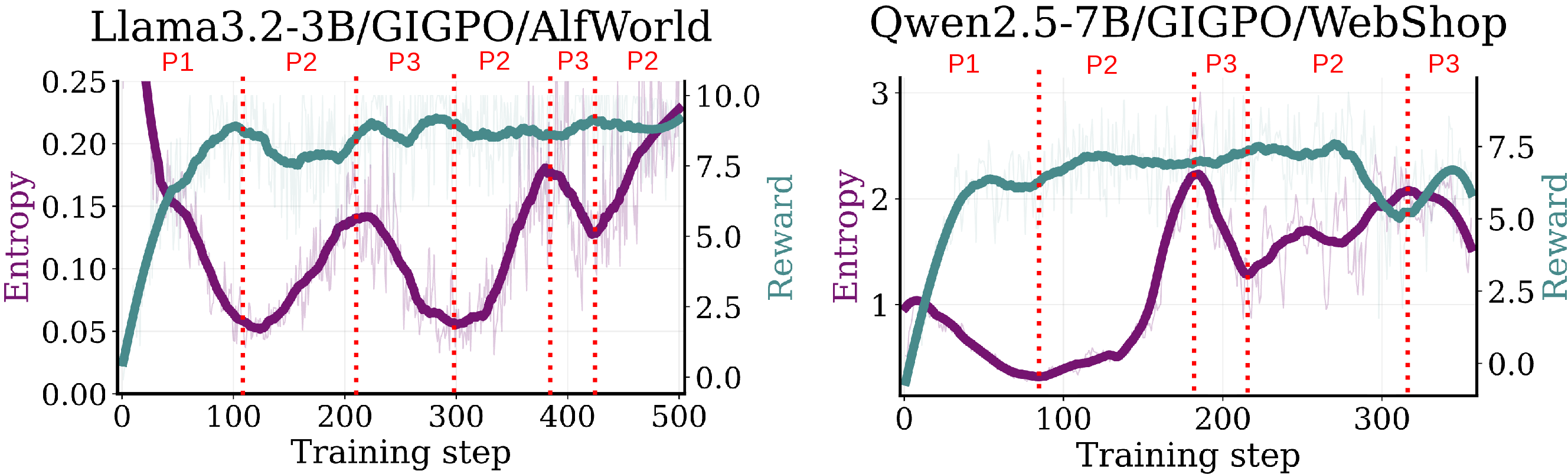
Figure 1: Cyclical entropy eruption in agent RL across models, tasks, and algorithms, with distinct descent, eruption, and subsidence phases.
Entropy Dynamics: Three Phases and Their Mechanisms
Agent RL training begins with rapid entropy descent as the policy reallocates probability mass toward format-valid trajectories. Empirical metrics show a surge in valid action ratios during initial steps, reflecting protocol-level adaptation for tool invocation and schema compliance. Theoretical analysis demonstrates that when the format-validity probability is lower than semantic-correctness probability (i.e., pθfmt(x)<pθsem(x)), early RL updates are dominated by correcting formatting deficiencies rather than semantic mistakes. This gating effect causes rapid concentration of the trajectory distribution and policy entropy reduction.
Phase 2: Entropy Eruption Triggered by Representation Similarity
After format validity is achieved, entropy diverges from monotonic decay and instead undergoes sharp eruptions. The core mechanism is high representation similarity between correct and incorrect trajectories in embedding space, as visualized by significant cluster overlap.
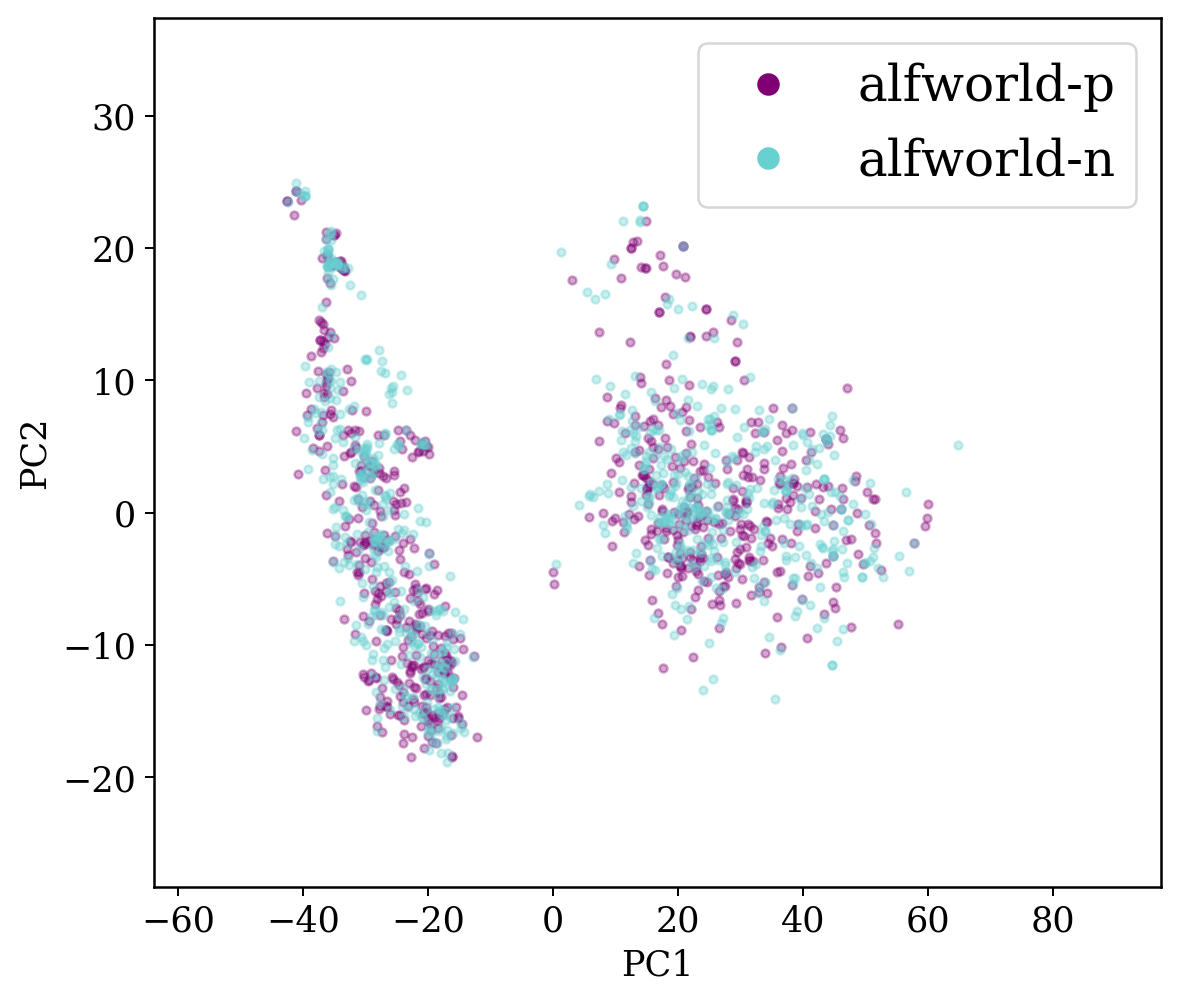
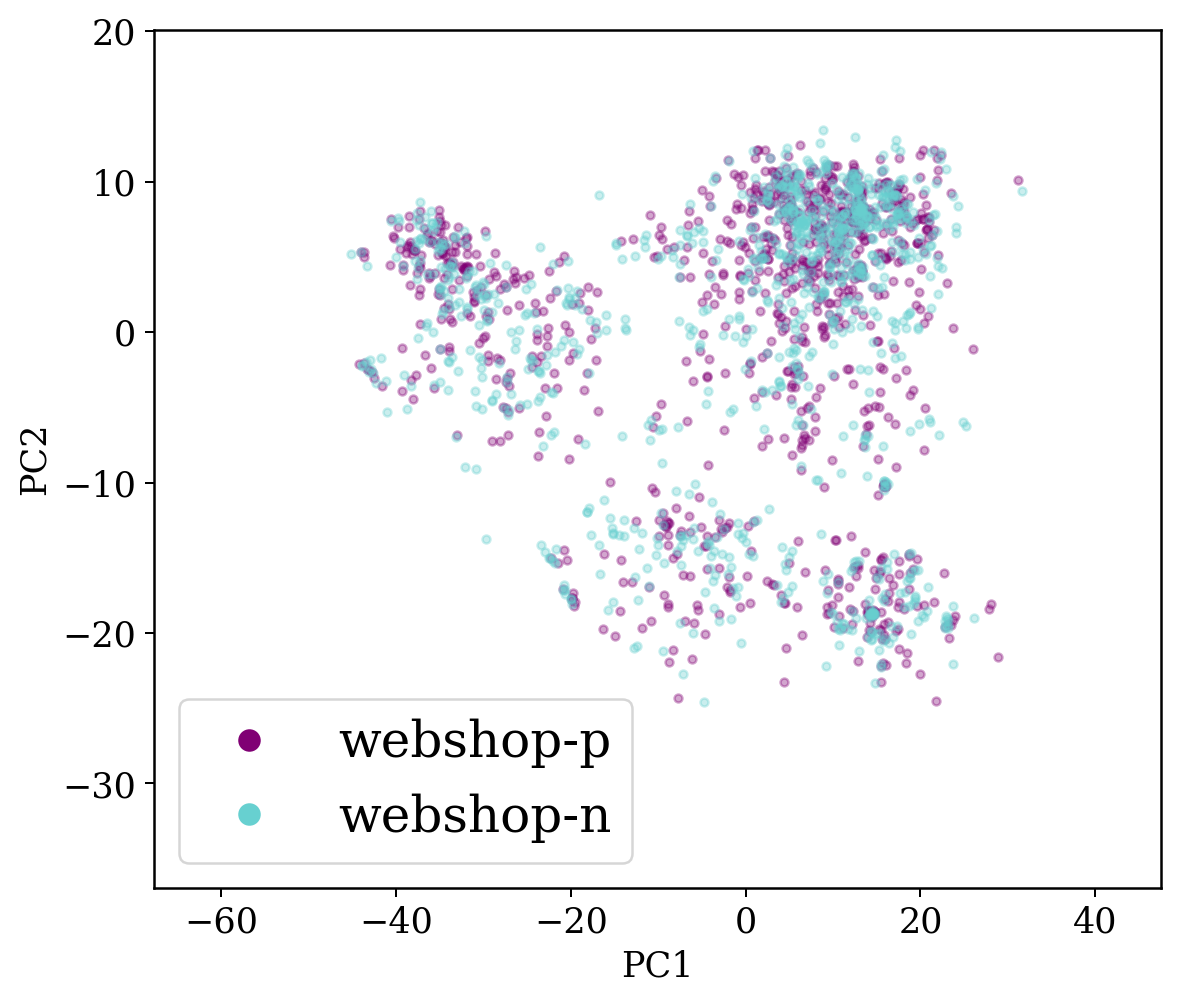
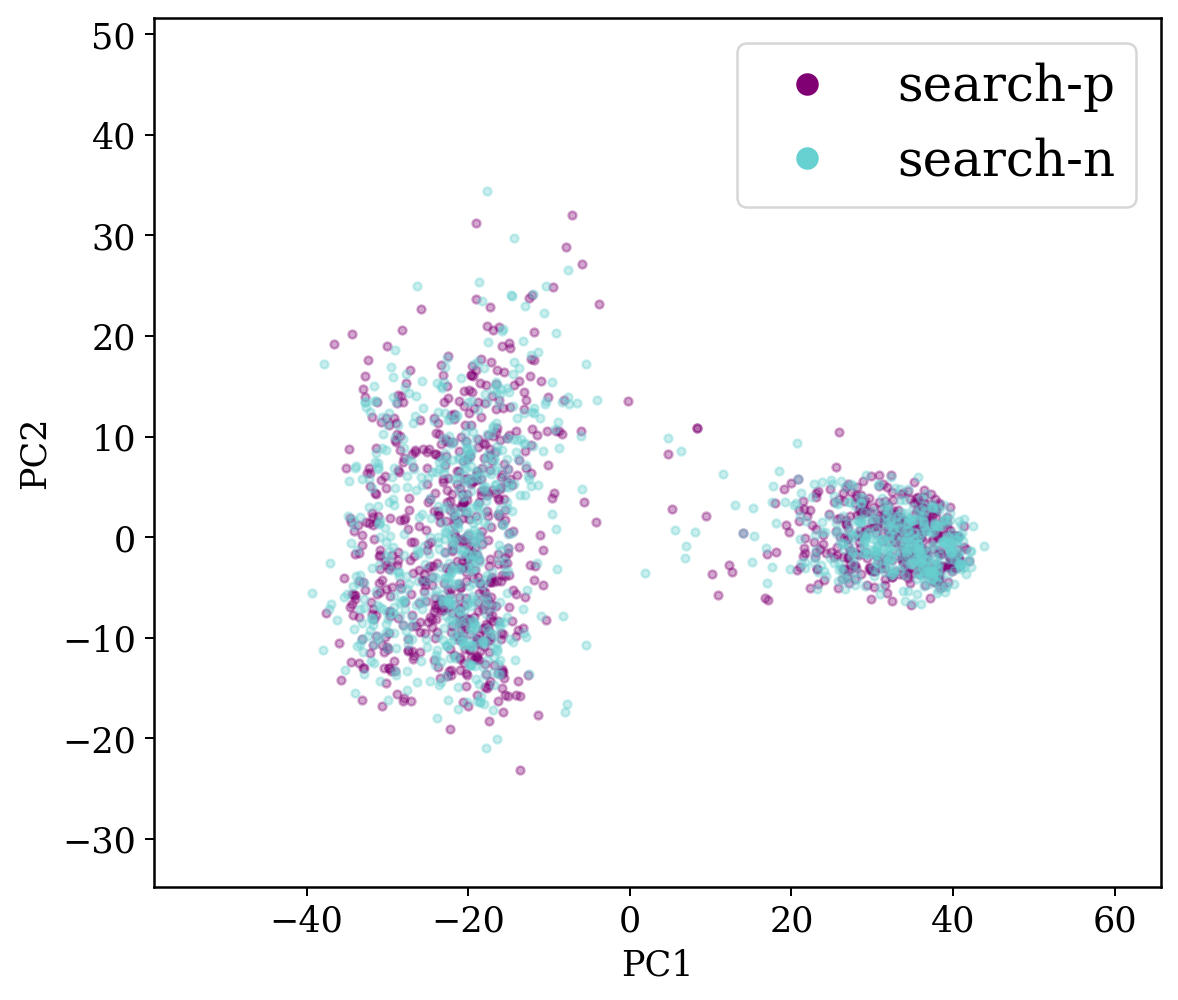
Figure 2: Representation distribution shows substantial overlap between correct and wrong trajectories across agent tasks, illustrating harmful similarity.
Such similarity induces strong gradient interference: suppressing the likelihood of negatively advantaged trajectories reduces the probability of semantically similar, often correct, trajectories. This effect is formally captured by the trajectory-level interaction kernel, showing that gradient updates for suppression of incorrect trajectories inadvertently degrade likelihoods assigned to valid responses. The theoretical model confirms that this likelihood decrease on high-probability responses increases entropy, flattening the policy distribution.
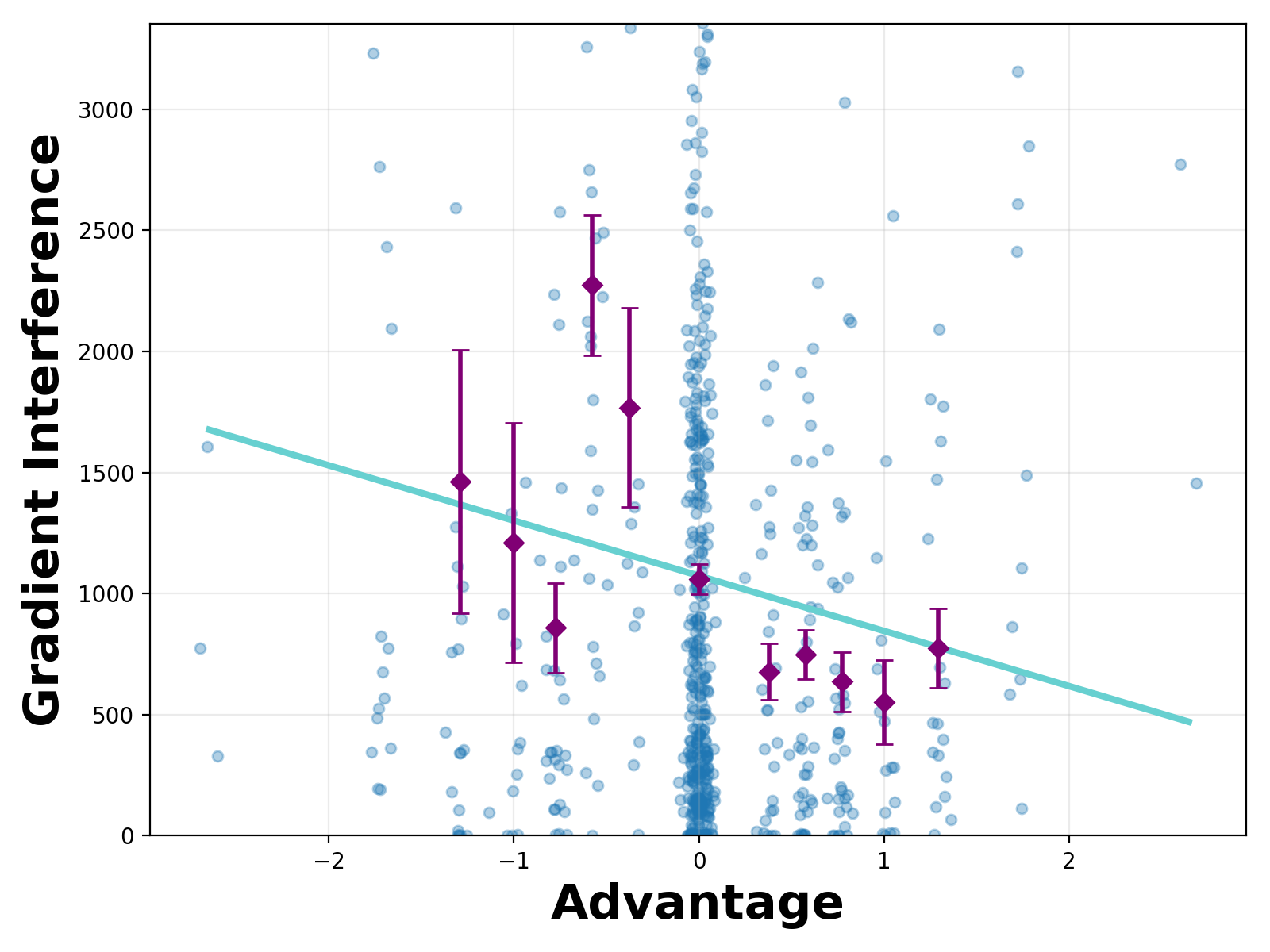
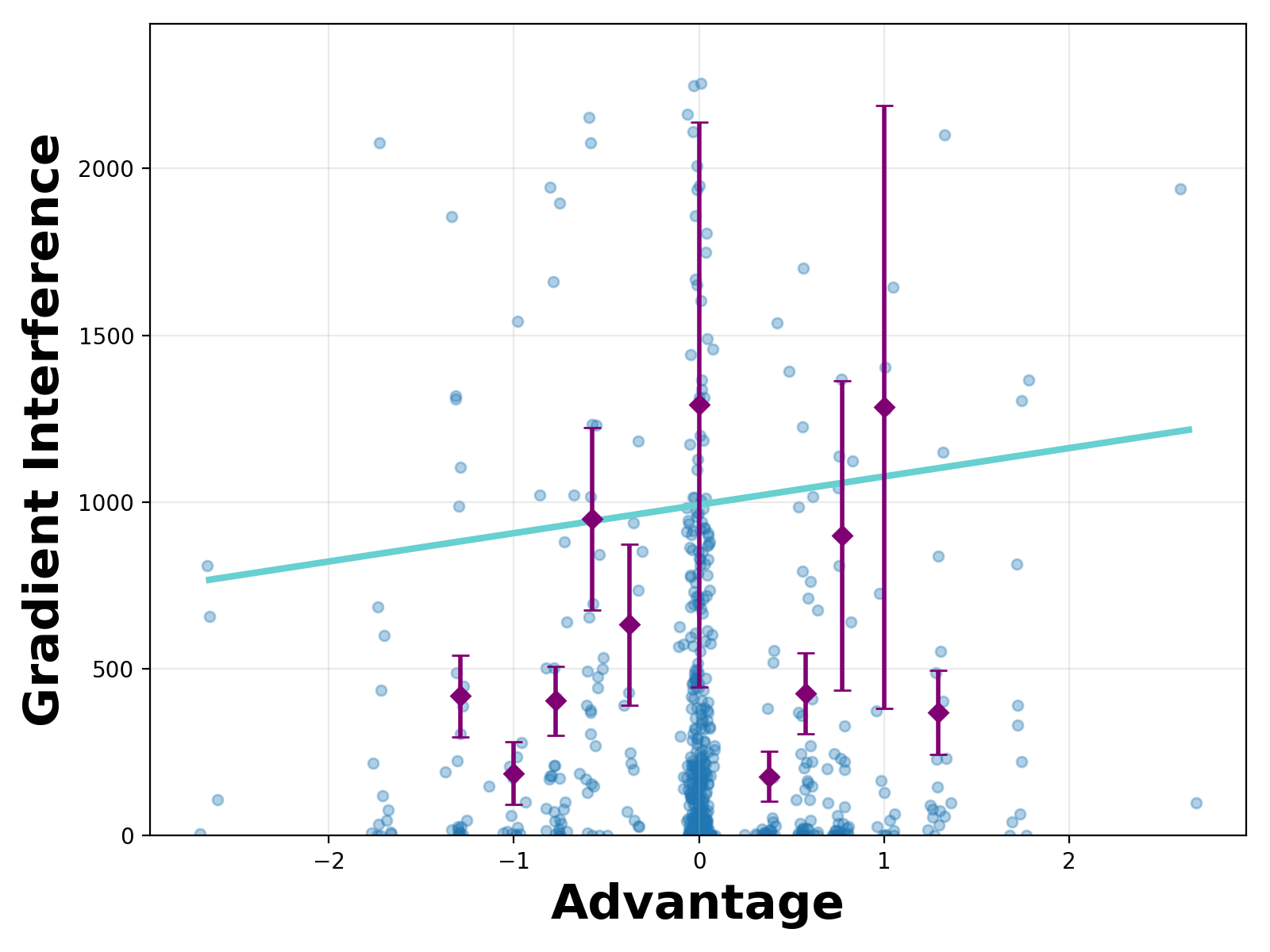
Figure 3: Gradient interference of Llama3.2-3B on WebShop before and after an entropy-eruption event, illustrating stronger interference associated with negative advantage prior to eruption.
Empirical tracking of trajectory log-probabilities confirms that the likelihood for valid and correct responses declines during training, especially in the eruption phase.
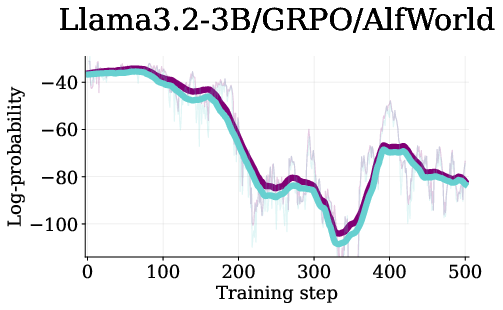
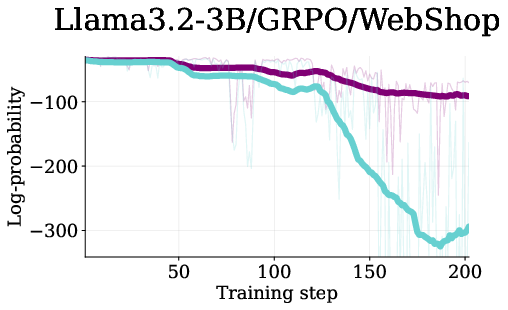
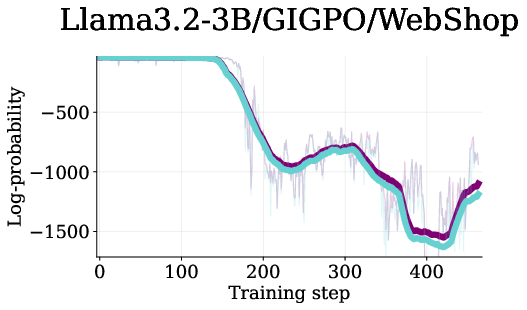
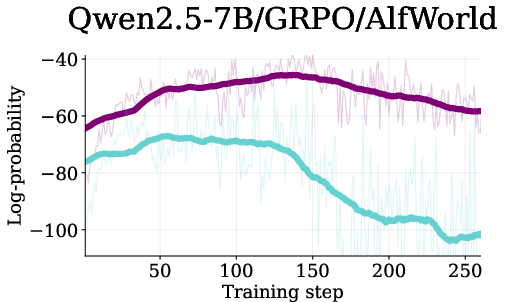
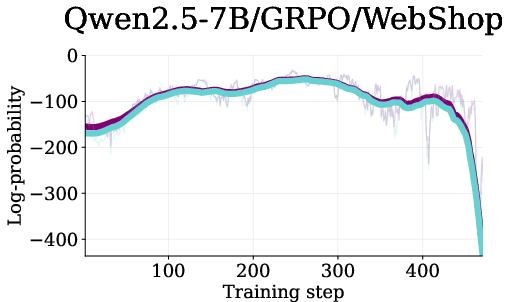
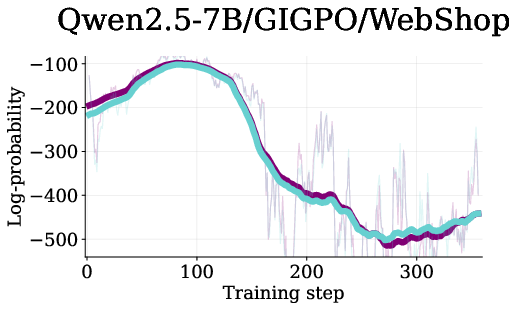
Figure 4: The likelihood of correct and valid trajectories decreases during agent RL, particularly around entropy eruptions.
Amplification of Degenerate Patterns
Entropy eruption is synchronously associated with increased incidence of degenerate patterns, including sentence duplication and hallucinated outputs. Sampling statistics demonstrate significant rises in these metrics during eruption periods.
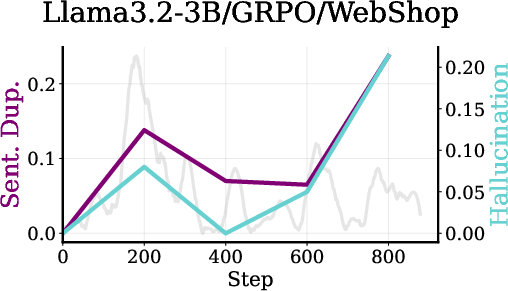
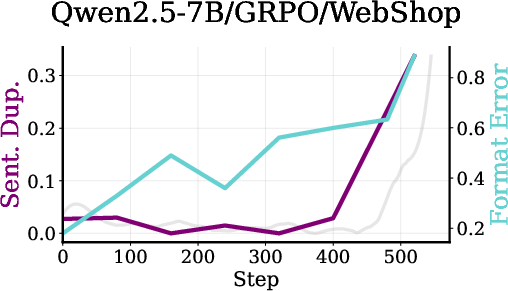
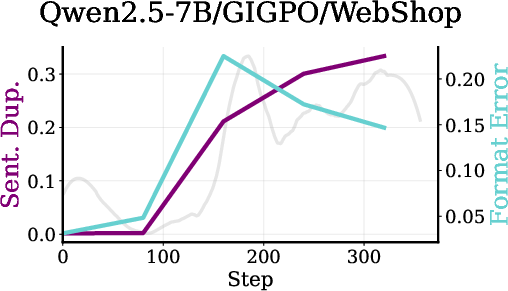
Figure 5: Degenerate patterns such as sentence duplication and hallucination are amplified during entropy eruption.
Phase 3: Entropy Subsidence and Recurring Cycles
Following eruption, entropy gradually subsides as the flattened policy samples more diverse trajectories, reducing mutual representation similarity. Through attenuated gradient interference, the likelihood of correct responses recovers. However, as the policy reconcentrates on newly discovered correct trajectories, similarity rises once more, seeding the next cycle of eruption. The result is a self-perpetuating cyclical dynamic, which repeatedly destabilizes training and pollutes correct mode trajectories with degeneracy accumulated during prior eruptions.
SEAL: Mitigating Entropy Eruption via Representation Separation
Recognizing representation similarity as the root cause, the authors introduce SEAL—a lightweight auxiliary loss encouraging explicit separation between correct and incorrect trajectories in embedding space. SEAL attaches a binary classifier atop token representations, utilizing a cross-entropy penalty to maximize discrimination. By reducing overlap, SEAL weakens gradient interference, mitigates likelihood suppression for valid trajectories, and stabilizes entropy dynamics.
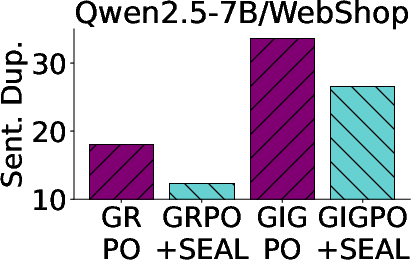
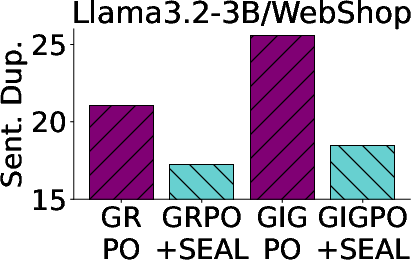
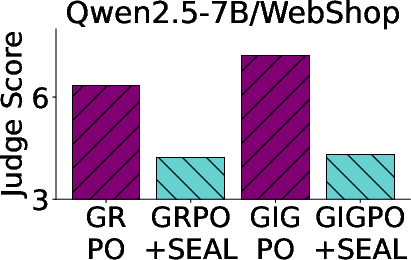
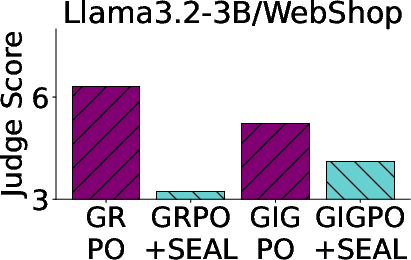
Figure 6: SEAL reduces degenerate patterns in agent RL across metrics for sentence duplication and GPT-4-based degeneracy score.
Experimental evaluation demonstrates the robustness of SEAL across multiple tasks (AlfWorld, WebShop, search-augmented QA), model scales (Qwen2.5 and Llama3.2 series), and RL algorithms (GRPO, GIGPO). Specific numerical results include a 2.81% accuracy improvement on AlfWorld (Qwen2.5-7B with GRPO), a 3.13% WebShop success rate increase, and resolution of reward collapse in Llama3.2-1B, with success rates boosted from 0% to 79.69% upon SEAL integration.
Theoretical and Practical Implications
The discovery and formal characterization of cyclical entropy eruption advance understanding of long-horizon RL in LLM-based agents. The linkage between representation geometry and entropy behavior implies that policy structure must be regularly monitored and constrained, especially in settings with tool use, formatting constraints, and validity gating. The persistence of degenerate patterns across cycles suggests that RL interventions must address not only trajectory selection but also representation alignment.
Practically, SEAL demonstrates that theoretical insights into dynamics can directly inform actionable stabilization strategies, with no additional inference-time overhead. The auxiliary loss mechanism is straightforward to integrate and exhibits insensitivity to moderate hyperparameter tuning, implying broad applicability.
Theoretically, the representation similarity–gradient interference mechanism generalizes to other structured RL settings, with implications for curriculum design, reward shaping, and pretraining interventions. The cyclical instability observed sets a research agenda for further exploration of agentic RL dynamics, including curriculum-based dampening, structure-aware regularization, and early intervention during pretraining or mid-training.
Future Directions in Agent RL
Extending this analysis to longer-horizon, multimodal, and more complex interactive environments will be essential for principled agent development. Investigation into protocols for mitigating cyclical entropy eruption via trajectory filtering, reward gating, or adaptive representation regularization is warranted. The durability of SEAL across versions and settings suggests space for more expressive geometric separation objectives and end-to-end representation shaping. Better understanding of how stability-oriented methods interact with alignment and robustness is critical for safe deployment of persistent agentic LLMs.
Conclusion
This work identifies cyclical entropy eruption as a fundamental instability in agent RL, distinguished from single-turn RL by recurring entropy dynamics governed by representation similarity and gradient interference. The link between policy geometry and degenerate pattern amplification sets forth both a rigorous analytical foundation and an actionable stabilization method, SEAL, which empirically demonstrates robust improvement in performance and sample quality. The results underscore the necessity for deeper monitoring of policy evolution and motivate future research into advanced stabilization and geometric regularization strategies for agentic RL (2605.27954).

