MuChator: Enabling Active Music Discovery via Conversational Music LLMs in Douyin Music
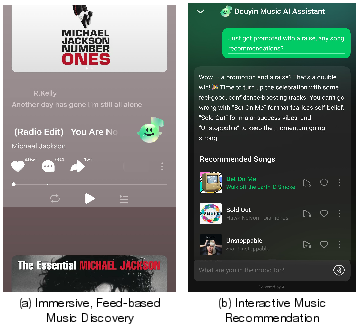
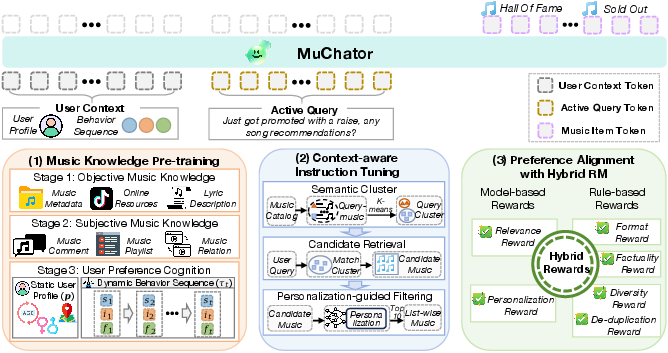
Abstract: Douyin Music, a large-scale platform with millions of daily users, adopts an immersive, feed-based discovery paradigm, where users passively explore music through continuous recommendations. While effective for passive music discovery, this paradigm restricts users to recommendation results and provides limited support for explicitly specifying listening intents. Unlike conventional search, where users express well-defined intents through explicit queries such as specific songs or artists, real-world active music discovery is often situational and colloquial, involving vague or underspecified requests. While LLMs enable natural language interaction, their direct use in music discovery remains limited by insufficient music-domain knowledge, lack of music-query collaborative reasoning, and shallow understanding of personalized preferences. To address these challenges, we introduce MuChator, an interactive MusicLLM-based framework that enables users to actively express situational music intents in natural language. MuChator incorporates three key components: (1) Music Knowledge Pre-training, a three-stage scheme that incrementally injects objective music knowledge, subjective music knowledge, and personalized music preferences into LLMs; (2) Context-aware Instruction Tuning, which constructs high-quality user-query-music triplets through an automated synthesis pipeline to align LLMs with active and situational user intents; and (3) Preference Alignment with Hybrid RM, which jointly models intent relevance, personalized preferences, and basic constraints, and is optimized using GRPO-based reinforcement learning. Extensive evaluations on industrial music recommendation datasets demonstrate that MuChator outperforms leading proprietary models, such as Gemini-3-Pro. The model has been deployed on Douyin Music App within ByteDance, with 46.49\% improvement of user active days in online A/B test.
Paper Prompts
Sign up for free to create and run prompts on this paper using GPT-5.
Top Community Prompts
Explain it Like I'm 14
What is this paper about?
This paper introduces MuChator, a smart music assistant used in the Douyin Music app (a music service from the company behind TikTok). Instead of making you scroll through endless recommendations, MuChator lets you talk to the app in plain language—like “I need chill songs for falling asleep”—and it replies with a personalized playlist that fits your situation and taste.
What questions were the researchers trying to answer?
The team wanted to solve three everyday problems with music discovery:
- How can people ask for music in normal, casual language (not just “play Song X by Artist Y”)?
- How can the system understand both the meaning of the request and the person’s taste at the same time?
- How can the system suggest songs that actually exist in the app’s catalog and feel fresh, not repetitive?
How did they build MuChator?
Think of MuChator as a helpful robot that reads and writes text really well (a LLM, or LLM), then gets taught all about music and your preferences. The researchers trained it in three big steps and added a special “practice mode” to fine‑tune its behavior.
Step 1: Music Knowledge Pre-training (teaching the basics, opinions, and taste)
They used “curriculum learning,” which is like teaching in stages from easy to hard:
- Objective music knowledge: Facts about songs, artists, lyrics, and genres—like a music encyclopedia.
- Subjective music knowledge: Opinions and relationships—what people say about songs, which songs are often grouped together in playlists, and how songs relate to each other.
- Personalized preferences: Patterns from real users—profiles (like age or gender), what people listened to, and how they reacted (liked, skipped, or disliked).
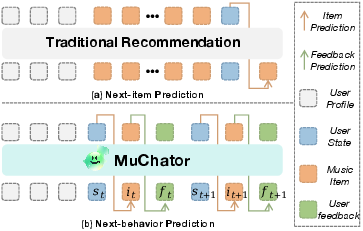
To make preference learning stronger, they did “next-behavior prediction.” Instead of only guessing the next song you might play, the model also learns to predict how you might react to that song. It’s like watching your listening timeline and learning both “what you’ll pick next” and “how you’ll feel about it,” which gives the model richer training.
Step 2: Context-aware Instruction Tuning (training on realistic examples)
The team created lots of examples that look like: (User’s context + a natural-language request) → (a ranked list of suitable songs).
They built these examples automatically by:
- Clustering similar requests (e.g., “workout songs,” “motivational songs”) into about 40,000 groups.
- Gathering candidate songs linked to those requests.
- Scoring candidates with a “personalization model” so the final list fits the specific user, not just any user.
Step 3: Preference Alignment with Hybrid Rewards (practice with feedback)
They then fine-tuned MuChator using reinforcement learning—a try-and-improve practice mode—guided by a set of rewards:
- Relevance reward: Does the playlist match the user’s request?
- Personalization reward: Is it likely the user will enjoy these songs based on their history?
- Rule-based rewards:
- Format: Is the answer easy for the app to read?
- Factuality: Do these songs actually exist in the catalog? No made-up songs.
- Diversity: Not all from the same artist or too similar.
- De‑duplication: Don’t repeat songs the user just played recently.
They used an algorithm called GRPO (a policy optimization method) to help MuChator learn to maximize these rewards without drifting away from what it already does well.
What did they find, and why does it matter?
The researchers tested MuChator both offline (in controlled datasets) and online (with real users in the Douyin Music app). Here’s what stood out:
- Better personalization and relevance: Compared to strong models like Gemini‑3‑Pro and GPT‑5.2, MuChator picked songs that matched requests and personal taste more accurately.
- More diversity and fewer mistakes: It recommended a wider range of songs and almost never suggested non-existent tracks.
- Big improvements with real users: In a month‑long test, MuChator increased:
- User active days by about 46.5%
- Listening duration by about 77.4%
- Click-through rate by about 11.3%
In simple terms, people used the app more, listened longer, and clicked recommendations more often when using MuChator. That means the system made music discovery feel more satisfying and fun.
Why is this important?
- Easier music discovery: You can ask for music the way you talk to a friend—“hype songs for a big game,” “lo‑fi beats for studying,” or “sunny-day road trip tracks”—and get results that fit you.
- More inclusive: You don’t need to know genres or artist names to find what you want.
- Smarter recommendations: The assistant balances what you asked for, what you personally like, and practical rules (like song availability and variety).
- Real-world impact: It’s already deployed in a major app and significantly boosts user engagement.
Bottom line
MuChator shows how combining a conversational AI with deep music knowledge and personal listening patterns can transform music discovery from passive scrolling to active, enjoyable exploration. The same ideas—mixing language understanding, domain knowledge, personalization, and careful feedback—could help build better assistants for other media too, like movies, podcasts, or books.
Knowledge Gaps
Knowledge gaps, limitations, and open questions
Below is a focused list of concrete gaps and unanswered questions that future work could address:
- Reproducibility and openness: All training data (metadata, comments, playlists, relational signals, and the 16B-token user-context corpus) and the DouyinMusic-MuChator evaluation set are proprietary; no release or detailed schema prevents independent replication and benchmarking.
- Generalization beyond Douyin: It is unclear how the approach transfers to other catalogs, cultures, and markets (e.g., Western platforms, non-Douyin item IDs), especially given the tight coupling to platform-specific identifiers and data distributions.
- Multilingual coverage: The paper does not evaluate cross-lingual intent understanding or recommendation (e.g., non-Chinese queries or mixed-language intents), leaving multilingual robustness untested.
- Cold-start scenarios: Handling for new users (no or sparse interaction history) and new items (unseen tracks/artists) is not discussed; no strategies (e.g., meta-learning, content features, exploration) are presented.
- Multimodal integration: The system appears text-centric (metadata, lyrics, comments, playlists) with no explicit use of audio embeddings, acoustic features, or cover art; whether adding audio improves query–music grounding remains untested.
- Context modalities and robustness: “State” features (time, location, activity, mood) are referenced but not enumerated, quantified, or ablated for out-of-distribution scenarios (e.g., missing/noisy contexts, sensor errors).
- Query modality limitations: Support for non-text inputs (voice, humming, audio examples) is not considered, despite common music-discovery behaviors requiring audio-anchored queries.
- Reward model validity: Personalization and relevance are evaluated by in-house models used both for training (rewards) and offline evaluation, risking circularity and optimistic bias; no human evaluation or external benchmarks verify alignment quality.
- LLM judge reliability: The binary relevance gate relies on a fine-tuned judge LLM without reporting calibration, inter-annotator agreement, or robustness to adversarial/ambiguous queries.
- Reward hacking and stability: There is no analysis of reward gaming, failure modes, or GRPO stability (e.g., variance across seeds, reward-scale sensitivity, KL penalty effects).
- Diversity vs. personalization trade-off: The RL stage reduces diversity; no explicit mechanism (e.g., constrained RL, multi-objective optimization, entropy regularization, or long-tail priors) is offered to maintain diversity without sacrificing relevance.
- Popularity and exposure bias: Training signals from historical logs and the online ranking model can entrench popularity bias and filter bubbles; fairness-aware or de-biasing strategies are not explored.
- Fairness and artist exposure: There is no audit for equitable exposure across genres, demographics, or independent artists, and no fairness metrics or mitigation approaches are reported.
- Safety and content governance: Safety constraints (e.g., explicit-content filtering, age-appropriate recommendations, sensitive-topic avoidance) are absent from rewards and evaluation, despite user-profile attributes (age) being available.
- Privacy and data governance: The system uses sensitive user attributes (age, gender, occupation) and rich behavior sequences; protections (consent, minimization, anonymization, differential privacy, on-device processing) are not described.
- Catalog dynamics and continual learning: How the model updates as the catalog evolves (new releases, licensing changes) and how to avoid catastrophic forgetting during continuous updates remain open.
- Factuality beyond existence checks: Factuality reward only verifies catalog existence, not metadata correctness (e.g., wrong artist attribution, alternate versions, region-specific variants); disambiguation policies are unspecified.
- Instruction data synthesis risks: UQ2I data derives partly from LLM-generated queries and cluster assignments; the impact of synthetic-query artifacts, cluster noise, and leakage from training to evaluation is not quantified.
- Playlist/list-wise quality: The method outputs top-10 lists but does not assess sequencing, flow, transitions, or session coherency (e.g., with metrics like NDCG@k, intra-list similarity control, or user studies on playlist “feel”).
- Long-term effects: Online A/B testing spans ~1 month; there is no analysis of longer-term outcomes (novelty fatigue, retention beyond novelty effects, habit formation, or changes in consumption diversity over time).
- Statistical rigor of online results: The A/B setup lacks details on traffic allocation, variance, significance tests, seasonality controls, and guardrail metrics; causality beyond correlational gains is not established.
- Exposure bias and off-policy learning: Rewards trained on historical logs are subject to exposure bias; no counterfactual evaluation, IPS/DR estimators, or interleaving tests are used to correct or validate off-policy learning.
- Next-behavior prediction details: Tokenization of item IDs and feedback, negative sampling, sequence truncation, and handling of delayed/implicit feedback are not specified; how predicted feedback is used at inference is unclear.
- Per-item vs. list-level credit assignment: GRPO optimizes list-level rewards without per-item attribution; how this affects learning of ordering and item contribution remains unexplored.
- Hyperparameters and reward weights: No rationale, sensitivity analysis, or tuning procedure is given for reward weights (e.g., λpers, λrule) or GRPO settings (group size, ε, β), limiting reproducibility and interpretability.
- Robustness to adversarial inputs: The system’s resilience to prompt injection, spam queries, and coordinated manipulation (e.g., biased comments/playlists) is not evaluated; data sanitization strategies are unspecified.
- Human-in-the-loop design: The paper does not explore interactive controls (e.g., critiquing, constraints, vetoes) or explanation capabilities that could help users steer and trust recommendations.
- Ordering latency and scalability: Reported latency (TTFT 0.09s, ~1.87s E2E) uses large GPU clusters; there is no discussion of cost, scalability to peak traffic, fallback strategies, or edge/on-device options.
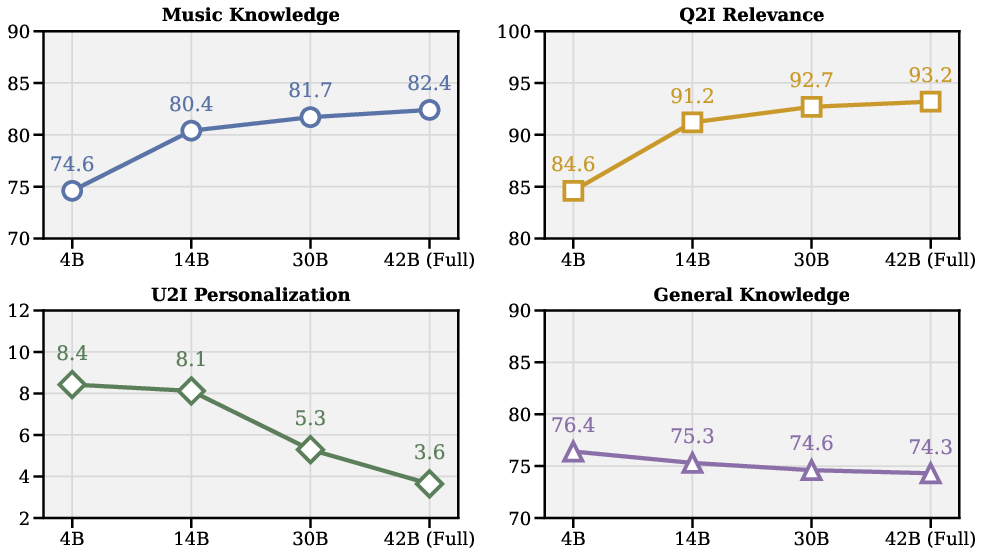
- Catastrophic forgetting of general knowledge: Pre-training on music data slightly degrades general knowledge; methods to preserve general abilities (e.g., LwF, elastic weight consolidation, adapters) are not investigated.
- Comparative baselines: The online baseline is an internal search system; comparisons to strong non-LLM interactive recommenders or hybrid bandit systems are missing, as are standardized public evaluation benchmarks.
- Handling contradictory or underspecified intents: Strategies for resolving conflicting constraints (“sad but upbeat,” “energetic but calm”), conducting clarification turns, or uncertainty-aware recommendation are not specified.
- Cross-session and session boundary modeling: How the system handles session resets, cross-session context, and drift in tastes within/ across sessions is not detailed.
- Geographic, device, and demographic stratification: No subgroup analysis is provided to ensure performance parity across regions, devices, or demographics.
- Legal and rights considerations: The use of lyrics, user comments, and third-party metadata raises copyright and licensing questions; compliance practices are not described.
- Environmental impact: Training on 512 GPUs and RL at scale have energy costs; no reporting of efficiency measures or carbon footprint is provided.
- Failure analyses and qualitative diagnostics: The paper lacks case studies of failure modes (e.g., misinterpretations, hallucinated items before gating, repetitive outputs) and systematic error taxonomies to guide future fixes.
Practical Applications
Immediate Applications
The paper’s deployed system and training pipeline enable several ready-to-use applications across products and operations today:
- Conversational music assistant in streaming apps (Sector: software/media)
- What: In-app chat or voice agent that turns situational, colloquial intents (“songs for a seaside walk,” “focus beats without lyrics”) into personalized, factual playlists.
- How it derives from the paper: Music Knowledge Pre-training + UQ2I instruction tuning + hybrid rewards (relevance, personalization, factuality, diversity) + GRPO optimization.
- Potential tools/products/workflows: “Active Discovery” chat surface; playlist preview + one-tap queueing; fallback to feed if satisfaction is low.
- Assumptions/dependencies: Access to a well-structured catalog and metadata; a trained relevance judge and personalization RM; online ranking signals; low-latency inference infrastructure.
- Cold-start onboarding via dialogue (Sector: software/media)
- What: Short, conversational onboarding that learns preferences (artists, moods, activities) and immediately seeds a tailored station.
- How: Next-behavior prediction and contextualized instruction tuning improve personalization from minimal history.
- Tools/products: Onboarding flow that collects a few conversational cues and spins up a playlist; progressive preference refinement.
- Assumptions: Enough metadata and playlist co-occurrence to infer tastes from sparse signals; privacy-consented user profiling.
- In-car and smart-speaker voice music control (Sector: consumer electronics/automotive)
- What: Hands-free, intent-driven playlist generation (e.g., “upbeat tracks for a night drive, keep it Mandarin pop”).
- How: Conversational MusicLLM with rule-based formatting/factuality ensures parsable, catalog-valid items; de-dup prevents recent repeats.
- Tools/products: Integrations for infotainment OS and smart speakers; wake-word pipelines calling the LLM backend.
- Assumptions: Stable connectivity or on-edge quantized model; latency budgets (<2s end-to-end); speech-to-text and NLU integration.
- Editorial and marketing playlist co-creation (Sector: media/marketing)
- What: Assist editors and marketers in rapidly generating on-theme, diverse, non-repeating playlists, with explainable intent alignment.
- How: Hybrid rewards (diversity, factuality, de-dup) and a relevance judge constrain quality; subjective knowledge and playlists aid curation.
- Tools/workflows: Brief-to-playlist generator; batch curation assistant; “explain why this track fits” summaries.
- Assumptions: Human-in-the-loop review; label/copyright constraints; internal catalog access.
- Long-tail catalog surfacing without hallucinations (Sector: media/catalog operations)
- What: Promote less-exposed tracks that fit user intent while guaranteeing catalog validity.
- How: Rule-based factuality, diversity, de-dup rewards mitigate hallucinations and repetition; playlist/data signals broaden coverage.
- Tools: Long-tail discovery widgets; periodic re-ranking with diversity caps.
- Assumptions: Sufficient metadata quality for lesser-known tracks; calibrated diversity weights to avoid relevance loss.
- A/B testing and RL alignment pipeline for recommenders (Sector: software/platform operations)
- What: Use the GRPO-based RL with hybrid rewards to tune any list generator toward intent relevance, preference fit, and operational constraints.
- How: The paper’s GRPO + hybrid RM setup and strict data isolation procedures.
- Tools: Internal RL alignment service; reward model training toolkit; offline-to-online promotion pipeline.
- Assumptions: Existing A/B infra; clear objective definitions; guardrails to control overfitting and diversity collapse.
- Automated data synthesis for instruction tuning (Sector: ML ops/research)
- What: Generate high-quality User–Query–Item data via semantic clustering, candidate retrieval, and personalization-guided filtering.
- How: The UQ2I pipeline described in the paper.
- Tools: Data generation jobs, clusterers, personalization scoring services; deduplication and quality filters.
- Assumptions: Availability of user logs with consent; robust embedding models; governance for synthetic data use.
- Retail/hospitality background music programming (Sector: retail/hospitality)
- What: Conversationally specify ambiance (“brunch crowd, mellow indie, avoid explicit lyrics”) to auto-generate rotating playlists.
- How: Intent understanding + rule-based constraints (format, de-dup) + diversity rewards for varied soundtrack.
- Tools: Venue dashboard with time-of-day templates; integrations with in-store audio systems.
- Assumptions: Commercial licensing; content policy filters; periodic refresh to avoid repetition.
- Wellness and fitness playlisting (Sector: healthcare/wellness/fitness)
- What: Mood- and activity-aligned music for focus, relaxation, or workouts (e.g., tempo/energy constraints).
- How: Context-aware intent handling with subjective knowledge and user feedback modeling for sustained preference fit.
- Tools: In-app routines; integration with activity trackers for contextual cues (time, activity).
- Assumptions: Clear consent for contextual data; careful claims (wellness, not clinical therapy).
- Creator companion for short-video soundtracks (Sector: creator economy)
- What: Suggest licensable tracks matching video mood or storyboard prompts; ensure catalog existence and avoid recent repeats.
- How: Relevance gating and factuality reward; playlist co-occurrences guide style matches.
- Tools: “Add sound” assistant tied to creator’s past performance; batch soundtrack suggestions for content calendars.
- Assumptions: Rights/territory filters; latency acceptable within editing workflow; metadata aligned to visual themes.
Long-Term Applications
Beyond immediate deployment, the methods suggest scalable directions that require further research, integration, or standardization:
- Cross-domain conversational recommenders (video, podcasts, audiobooks, shopping) (Sector: media/e-commerce)
- What: Extend the same pipeline (domain pre-training, UQ2I synthesis, hybrid RM + GRPO) to other catalogs and modalities.
- Dependencies: Domain-specific metadata, relevance judges, and multi-objective RMs; cross-modal embeddings; retraining at scale.
- Privacy-preserving personalization (on-device/federated) (Sector: software/privacy)
- What: Move next-behavior modeling and personalization to edge or federated learning to reduce raw data collection.
- Dependencies: Efficient on-device models; secure aggregation; privacy budgets; quantization/distillation research for LLMs.
- Multimodal and sensor-informed context (Sector: wearables/automotive/smart home)
- What: Incorporate audio descriptors, acoustic embeddings, and optional wearable or ambient signals (e.g., pace, noise levels) for richer contexts.
- Dependencies: Consent-driven data capture; multimodal fusion models; robustness to noisy signals; safety considerations.
- Explainable and controllable recommendation policies (Sector: policy/compliance/platform governance)
- What: User- and regulator-facing controls for diversity, novelty, and repetition; explain intent alignment (“this track matches your ‘sunset walk’ request due to tempo/genre”).
- Dependencies: Interpretable reward components; UI standards; measurement frameworks for fairness/diversity; policy alignment.
- Standardized benchmarks and evaluation suites for conversational recommenders (Sector: academia/standards)
- What: Public tasks mirroring “Music Knowledge,” “Q2I relevance,” and “U2I personalization,” plus factuality and diversity checks.
- Dependencies: Shareable datasets with licensing; anonymization protocols; common metrics; community baselines.
- Cross-lingual/cross-cultural intent understanding (Sector: global media)
- What: Robust handling of colloquial, culture-specific intents across languages; adaptation of subjective music knowledge across regions.
- Dependencies: Multilingual corpora and catalogs; culturally-aware RMs; domain transfer methods.
- Accessibility-centric agents (Sector: accessibility/assistive tech)
- What: Voice-first or simplified conversational discovery for visually impaired or elderly users; personalization with minimal friction.
- Dependencies: ASR/TTS quality; UX research for accessibility; lightweight on-device models; privacy-by-design.
- Enterprise soundscape orchestration (Sector: workplace/productivity)
- What: Dynamic, team- or task-based music programming to improve focus or morale (e.g., “deep work hours playlist, low lyrics, moderate tempo”).
- Dependencies: Organizational policies; opt-in; evidence-based outcomes; admin controls for content filters.
- Creator/label analytics and A&R support (Sector: music industry/analytics)
- What: Use cluster-level intent and co-occurrence insights to identify emerging listening contexts and potential audience fits for tracks.
- Dependencies: Aggregated, privacy-safe analytics; bias mitigation for exposure; collaboration with rights holders.
- Human-in-the-loop RL alignment platform (Sector: ML ops)
- What: Combine hybrid RMs with editor or user judgments to steer models toward brand-, region-, or age-appropriate recommendations.
- Dependencies: Scalable labeling tools; preference drift monitoring; safe RL practices; continual learning infra.
- Clinical-grade music therapy personalization (Sector: healthcare)
- What: Tailor music interventions for sleep, stress, or rehabilitation under clinician guidance, with auditable controls.
- Dependencies: Clinical evidence; regulatory approval; medical data integration; rigorous safety and efficacy validation.
Key Assumptions and Dependencies (cross-cutting)
- Data and catalog: High-quality, rights-cleared catalogs with rich metadata; user interaction logs collected with explicit consent and governance.
- Models and infra: Access to foundation LLMs, domain pre-training tokens, and large-scale compute; low-latency serving stacks; multilingual support as needed.
- Reward models: Well-calibrated relevance judges and personalization RMs trained on representative, unbiased data; regular audits for drift and bias.
- Policy and ethics: Privacy compliance (e.g., explicit consent, data minimization), transparency for users, and controls for diversity/fairness; safeguards against over-personalization and echo chambers.
- Integration: Product surfaces that support conversational UX; A/B testing and monitoring pipelines; fallbacks to conventional retrieval/ranking when needed.
Glossary
- A/B testing: An online controlled experiment setup that compares two or more system variants to measure impact on key metrics. Example: "The online A/B testing environment supports large-scale experiments, with daily metrics including daily users over 0.1 billion."
- Autoregressive objective: A training objective where the model predicts the next token (or element) conditioned on previous ones in a sequence. Example: "optimized under a unified autoregressive objective."
- Candidate Retrieval: A retrieval step that assembles a pool of plausible items before final ranking or filtering. Example: "Step 2: Candidate Retrieval."
- Collaborative filtering (CF): Recommendation techniques that infer user or item similarities from interaction patterns to make suggestions. Example: "CF methods~\cite{sanchez2016collaborative,shakirova2017collaborative}"
- Context-aware Instruction Tuning: Supervised fine-tuning that aligns the model to produce list-wise recommendations conditioned on user context and queries. Example: "Context-aware Instruction Tuning"
- Context-aware methods: Recommendation approaches that incorporate situational or user context (e.g., time, location, emotion) into the model. Example: "context-aware methods~\cite{wang2021modeling,wang2023multi}"
- Curriculum learning: A training strategy that presents data from easier to harder to improve learning efficiency and capability. Example: "adopts a curriculum learning strategy"
- De-duplication Reward: A rule-based reinforcement learning reward that penalizes recommending items the user has recently interacted with positively. Example: "De-duplication Reward"
- Diversity Reward: A rule-based reward that encourages non-redundant recommendations (e.g., avoiding repeated artists or titles). Example: "Diversity Reward"
- Factuality Reward: A rule-based reward that verifies generated items exist in the catalog to prevent fabrications. Example: "Factuality Reward"
- Few-shot prompting: Supplying a model with a small number of in-context examples to guide behavior without full fine-tuning. Example: "few-shot baselines"
- GRPO (Group-wise Policy Optimization): A policy optimization algorithm variant used to optimize sequence outputs under grouped sampling with clipped objectives and KL regularization. Example: "Group-wise Policy Optimization (GRPO)"
- Hallucinations: Model outputs that invent non-existent facts or items. Example: "prevent hallucinations."
- Hard gating signal: A binary gate that enforces strict conditions on whether a reward is applied. Example: "binarized into a hard gating signal"
- Hybrid reward: A combined reinforcement learning signal that integrates model-based and rule-based rewards. Example: "we design a hybrid reward"
- In-context learning: The ability of LLMs to generalize from examples provided directly in the prompt without parameter updates. Example: "in-context learning abilities of LLMs"
- Item-CF: Item-based collaborative filtering, which infers related items from co-occurrence patterns. Example: "item-cf data"
- Knowledge graph: A structured graph of entities and relations that captures domain knowledge (e.g., songs, artists, comments). Example: "music knowledge graphs"
- Kullback–Leibler (KL) divergence: A measure used in RL fine-tuning to regularize the learned policy against a reference policy. Example: "D_{\mathrm{KL}!\Big("
- Long-tail exploration: Recommendation behavior that promotes less popular items to improve coverage and novelty. Example: "while limiting long-tail exploration."
- Multi-objective ranking model: A ranking system trained to optimize multiple goals (e.g., relevance, satisfaction, retention) simultaneously. Example: "online multi-objective ranking model"
- Music Knowledge Pre-training: A multi-stage pre-training scheme to inject objective, subjective, and personalized music knowledge into an LLM. Example: "Music Knowledge Pre-training"
- Music LLM (MusicLLM): A LLM specialized for music-related understanding and recommendation. Example: "MusicLLM-based framework"
- Next-behavior prediction: A sequence modeling paradigm that jointly predicts the next item and the user’s feedback in an interleaved autoregressive sequence. Example: "Next-behavior Prediction."
- Next-item prediction: A standard sequence modeling task that predicts the next consumed item from a user’s history. Example: "Next-item prediction"
- Personalization Reward: A model-based reward that measures alignment between recommendations and a user’s individualized preferences. Example: "Personalization Reward ($R_{\text{pers}$)."
- Perplexity (PPL): A language modeling metric indicating how well the model predicts a sequence (lower is better). Example: "reducing PPL from 8.12 to 3.64"
- Preference Alignment: Post-training methods that align model outputs with user intent and personalized preferences, often via RL with reward models. Example: "Preference Alignment with Hybrid RM"
- RAG (Retrieval-Augmented Generation): Techniques that retrieve relevant documents or items to ground and guide generative outputs. Example: "retrieval-augmented generation (RAG)"
- Relevance Reward: A model-based reward that evaluates semantic alignment between the user’s query and recommended items. Example: "Relevance Reward ($R_{\text{rel}$)."
- Reward Model (RM): A model that scores outputs for use as a learning signal in reinforcement learning. Example: "reward models (RM)"
- Semantic clustering: Grouping queries or items based on semantic similarity to form clusters of intents or topics. Example: "Semantic Clustering."
- Semantic retrieval: Retrieval that matches based on meaning rather than exact keyword overlap. Example: "semantic retrieval"
- SFT (Supervised Fine-Tuning): Training a pretrained LLM on labeled task data to specialize its behavior. Example: "supervised fine-tuning (SFT)"
- Time-series user context: A structured representation of evolving user states, items, and feedback over time. Example: "Time-series User Context."
- U2I Personalization: A user-to-item personalization metric evaluating how well outputs align with user-specific preferences. Example: "U2I Personalization"
- UQ2I (User–Query–to–Item): An instruction format/dataset mapping user context and query to a list-wise item recommendation. Example: "UQ2I instruction data"
- Zero-shot prompting: Using an LLM without any in-context examples, relying solely on the prompt and pretrained knowledge. Example: "zero-shot baselines"
Collections
Sign up for free to add this paper to one or more collections.