- The paper presents a novel dialogue-conditioned background music recommendation task with the DialBGM benchmark, pairing 1,200 multi-turn dialogues with 4,800 expert-ranked music clips.
- The paper details a four-stage methodology combining rule-based filtering, LLM-generated dialogue summaries, embedding-based candidate selection, and expert human ranking to ensure high-quality annotations.
- The paper's experiments demonstrate that current state-of-the-art models underperform human annotators, highlighting significant challenges in aligning dialogue context with affective music suitability.
DialBGM: Benchmarking Dialogue-Conditioned Background Music Recommendation
Automatic selection of background music (BGM) for conversational contexts is crucial in multimedia production, conversational agents, and immersive environments yet remains under-explored in the intersection of language and music processing. The challenge uniquely lies in inferring affect and narrative trajectories from multi-turn dialogues that lack explicit musical descriptors or cues, as opposed to traditional music retrieval tasks that assume the presence of music-related queries. Addressing this gap, the paper introduces the dialogue-conditioned BGM recommendation task: given a multi-turn dialogue and a pool of music candidates, the objective is to rank these tracks according to their appropriateness as BGM, emphasizing contextual relevance, non-intrusiveness, and consistency.
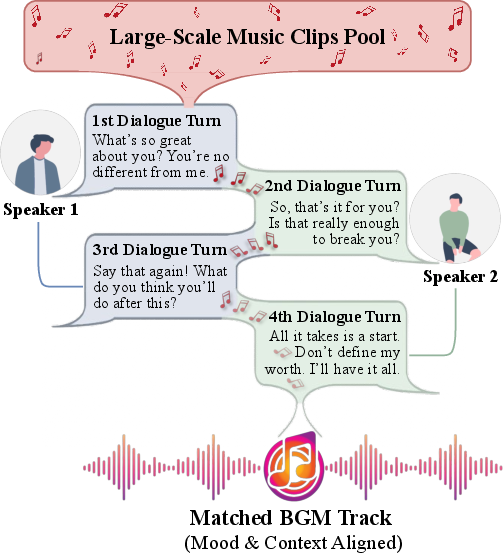
Figure 1: The dialogue-conditioned BGM recommendation pipeline utilizes multi-turn dialogue as context to filter and rank music candidates for optimal background suitability.
DialBGM Dataset: Design and Construction
Central to the contribution is DialBGM, a publicly released benchmark that pairs 1,200 open-domain multi-turn dialogues with four music clips each (totaling 4,800 dialogue-music pairs), annotated by 12 expert raters using rigorous background suitability criteria. Dialogues are curated from DailyDialog for rich, emotionally varied naturalistic conversations; music candidates are drawn from a filtered subset of MusicCaps, ensuring instrumental, non-intrusive audio.
Dataset construction follows a four-stage pipeline:
- BGM Suitability Filtering: Rule-based exclusion of vocal, noisy, or effect-laden music tracks, producing a high-quality instrumental pool.
- Dialogue Caption Generation: LLMs (GPT-4o) produce condensed, music-oriented summaries per dialogue to bridge modality gaps for downstream retrieval.
- Embedding-based Candidate Selection: Cosine similarity in a shared embedding space selects top-1 and three more candidates (from the top-10%) per dialogue, balancing relevance and diversity.
- Expert Human Ranking: Audio-expert annotators rank the four candidates for each dialogue using a Gradio-based interface, guided by relevance, non-intrusiveness, and consistency.
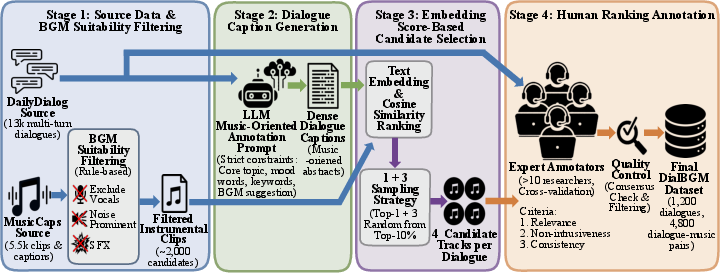
Figure 3: DialBGM dataset instances consist of dialogues, four candidate BGM clips, and human preference rankings per dialogue-music set.
Figure 2: The construction pipeline integrates automatic filtering, LLM-based captioning, embedding-based candidate selection, and human ranking for robust, reproducible dataset creation.
Strong quality control via inter-annotator consensus (Kendall's W) and exclusion of low-agreement examples ensures annotation reliability (mean W=0.79). The dataset spans diverse conversational topics and emotional tones, with audio genres including classical, electronic, jazz, rock, and others.
Experimental Protocol and Baselines
Evaluation leverages multiple ranking metrics—Hit@1, MRR, nDCG@4, and Kendall's τb—to capture both top-pick retrieval and full-order correlation with human consensus. Tie-aware variants ensure robustness to frequent model ambiguity.
A suite of strong baselines is constructed:
Input configurations systematically vary the use of full dialogues vs. LLM-generated summaries, as well as audio versus music captions for candidate representation.
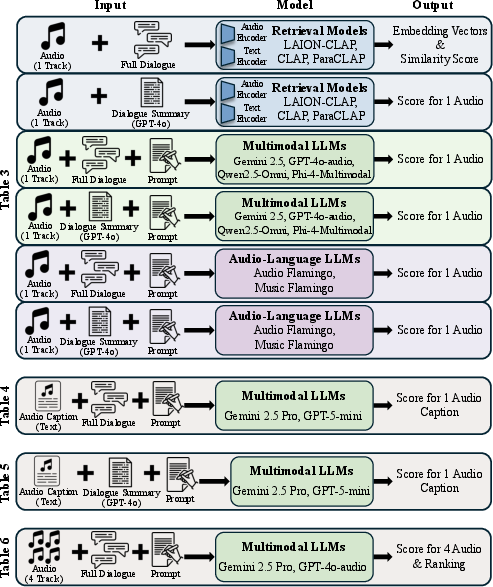
Figure 4: Experiment design covers audio-based, caption-based, dialogue-based, and prompt-driven evaluation routes across model families.
Empirical Findings and Analysis
All evaluated models demonstrably underperform relative to human annotators:
- Upper-bound Hit@1: No model exceeds 35% strict top-1 accuracy.
- Ranking Consistency: Kendall's τb remains <0.2 for best models, indicating poor global ranking alignment with humans.
- LLM Superiority in Text-Only Setting: Proprietary LLMs (Gemini 2.5 Pro, GPT-5-mini) are most competitive in the text-only condition, but still fail to reach consensus-level performance.
- Little Gain from Dialogue Summarization: Using condensed summaries yields marginal benefit over raw multi-turn dialogues.
- Prompting Strategies Non-Beneficial: Chain-of-thought, few-shot, and joint ranking prompts fail to close the gap, and often degrade results due to hallucinated reasoning and overfit to superficial cues.
Numerically, the best models (Gemini 2.5, GPT-4o, Qwen2.5-Omni) achieve Hit@1 ∼0.33–0.35 and MRR <0.60, far below inter-annotator reliability.
Error Analysis and Model Clustering
Model preference analysis reveals high intra-family agreement (e.g., Flamingo variants, LLMs) but weak alignment across architectural families and with human consensus.
Qualitative failure examples show models fixating on explicit textual cues (e.g., "party") instead of pragmatic or affective cues in dialogues, resulting in background choices discordant with actual speaker intent.
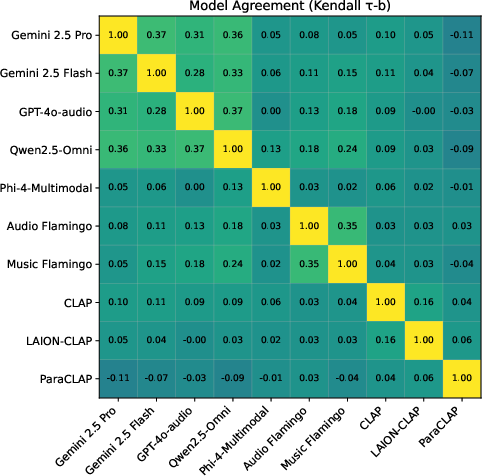
Figure 5: Pairwise Kendall's τb correlation matrix highlights low consensus and distinct clustering between model types.
Dataset Utility
The DialBGM benchmark exposes that zero-shot dialogue-to-music affective matching does not naturally emerge from current pretraining regimes—even in the largest, most capable multimodal LLMs. The negative results hold across architectures, input/target settings, and prompting tactics, highlighting the need for specialized data and training objectives.
Implications and Future Directions
The inability of existing SOTA retrieval, multimodal, and audio-language architectures to approach human-level affective matching in dialogue-conditioned BGM recommendation has several implications:
- Theory: Effective cross-modal mapping between natural conversation and music requires models to reason over subtle, non-explicit cues, integrating pragmatic, affective, and acoustic factors not present in current pretraining data or alignment protocols.
- Practice: For AI-driven soundtrack production or conversational UX, model-in-the-loop remains risky without further research and supervised adaptation.
Anticipated advancements must focus on:
- Pretraining: Incorporating dialog-music aligned objectives, mood trajectory tracking, and discourse-aware semantic alignment during representation learning.
- Fine-tuning: Leveraging DialBGM for adapter training or targeted supervised learning to inject affective alignment priors into LALMs and multimodal LLMs.
- Generative Modeling: Extending benchmarks into generative BGM creation, integrating feedback on affect, pacing, and dialogue flow.
Conclusion
DialBGM is established as the first systematic, large-scale benchmark and testbed for studying dialogue-conditioned BGM recommendation. Empirical evaluation over a broad spectrum of architectures and prompting methods shows that current AI systems exhibit a substantial performance gap in aligning dialogue affect and background music suitability, with no architecture able to approach human-level annotation reliability. These results underline a persistent open challenge for multimodal intelligence, motivating new research directions in affective alignment, discourse modeling, and specialized audio-LLM training.