Unified Neural Scaling Laws
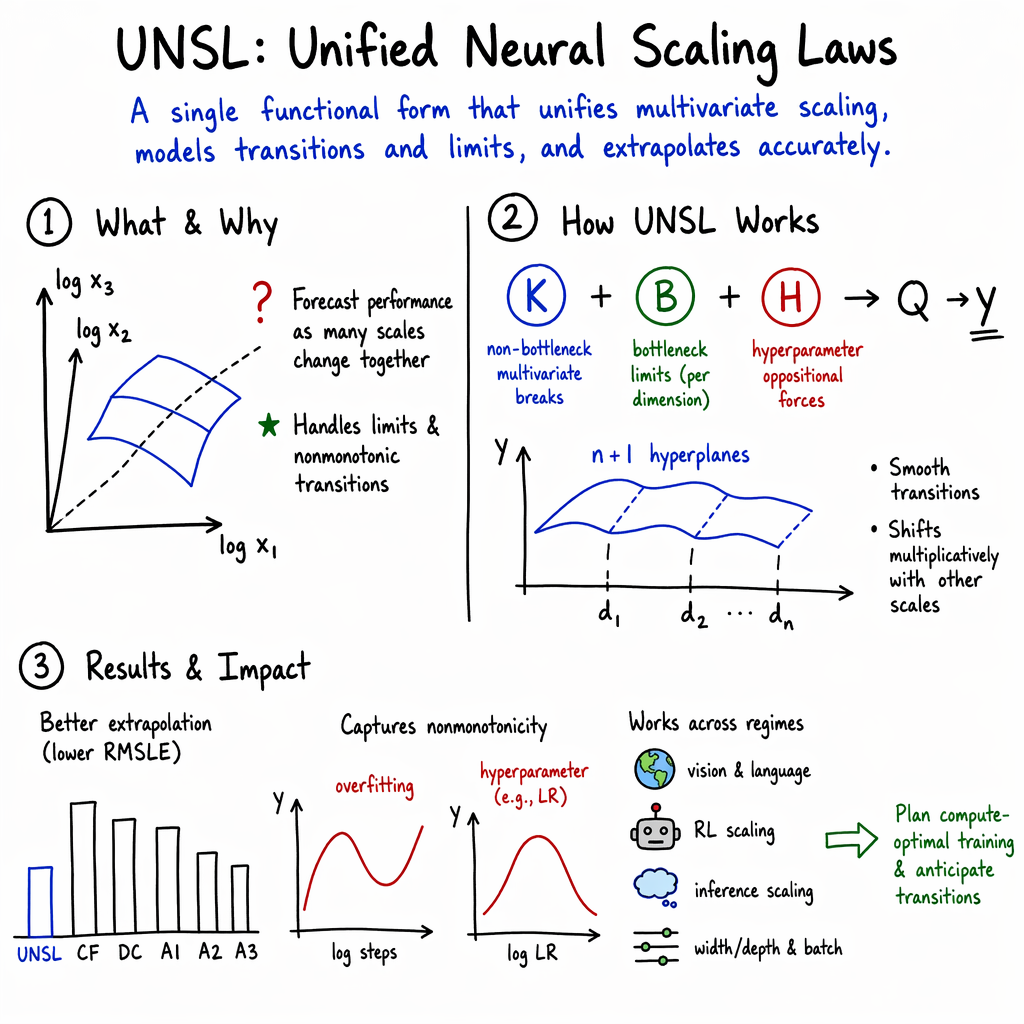
Abstract: We present a functional form (that we refer to as a Unified Neural Scaling Law (UNSL)) that accurately models and extrapolates the scaling behaviors of deep neural networks as multiple dimensions all vary simultaneously (i.e. how the evaluation metric of interest varies as one simultaneously varies the number of model parameters, training dataset size, number of training steps, number of inference steps, amount of compute, and various hyperparameters) for various architectures and for each of various tasks within a varied set of upstream and downstream tasks. This set includes large-scale vision, language, math, and reinforcement learning. When compared to other functional forms for neural scaling, this functional form yields extrapolations of scaling behavior that are considerably more accurate on this set.
Paper Prompts
Sign up for free to create and run prompts on this paper using GPT-5.
Top Community Prompts
Explain it Like I'm 14
Explaining “Unified Neural Scaling Laws” (UNSL)
Overview: What is this paper about?
This paper is about predicting how well big AI models will perform when you change many things at once, like:
- how large the model is,
- how much data you train on,
- how long you train,
- how you set training “knobs” (hyperparameters) like the learning rate.
The authors introduce a new, flexible “master formula” called Unified Neural Scaling Laws (UNSL). It can describe and predict performance across many situations better than previous formulas.
Objectives: What questions are they trying to answer?
In simple terms, the paper asks:
- If we turn several knobs of an AI model at the same time, how will performance change?
- Can we build one formula that works across different model types, tasks, and settings?
- Can that formula predict performance at larger scales than we’ve tested yet (extrapolate)?
- Can it handle tricky cases where performance first gets better and then worse (like overfitting)?
Methods: How did they approach the problem?
Think of training an AI like driving along a road where:
- Each “knob” (model size, data size, training steps, learning rate, etc.) is a direction you can move in.
- Performance (like error rate) is your altitude: lower is better.
The UNSL formula is designed to map this “terrain” in a smart way:
- Multi-log space
- The authors look at the data on a log scale. This turns curvy relationships into straighter ones, making patterns easier to model and connect smoothly.
- Smoothly connected “broken lines”
- UNSL uses pieces of straight surfaces that join smoothly. These joins are called “hyperbreaks.”
- A hyperbreak is like a gentle bend or turning point where the trend changes. For example, as you add more data, performance improves quickly at first, then slows down: that change in speed is a hyperbreak.
- Bottlenecks vs non-bottlenecks
- A bottleneck is like a narrow pipe that limits flow: one dimension (like too little data) caps performance even if everything else is strong.
- UNSL has parts that model both bottlenecks (hard limits from one dimension) and non-bottlenecks (general improvements across several dimensions).
- Oppositional forces
- Some choices can push performance the wrong way. For instance:
- Overfitting: training too long on too little data can make test performance worse.
- Hyperparameters: setting learning rate too high can also hurt performance.
- UNSL includes special terms for these “oppositional forces,” which can create hump-shaped trends (first better, then worse).
- Some choices can push performance the wrong way. For instance:
- Fitting and testing
- They fit UNSL to real training results using optimization (a computer method that finds the best constants for the formula).
- They measure accuracy using RMSLE (Root Mean Squared Log Error), a way to compare predicted vs actual performance on a log scale.
- They test on “held-out” points (data not used for fitting) to check whether UNSL can truly predict new situations.
Findings: What did they discover and why it matters?
The main takeaways:
- UNSL predicts performance more accurately than other well-known formulas on many tasks.
- It works across different domains:
- Vision (image classification on datasets like ImageNet, Birds, Cars)
- Language (tasks like common-sense reasoning and LAMBADA)
- Also in reinforcement learning and test-time (inference) scaling.
- It is especially strong when several dimensions change at once and when trends are not simple straight lines (for example, when overfitting or bad hyperparameter choices cause performance to dip).
- Numbers to give a sense of the advantage:
- In vision tasks, UNSL was the best extrapolator in about 61% of cases tested.
- In language tasks, UNSL was best in about 89% of cases.
- UNSL can forecast to much larger scales than the data used for fitting, sometimes an order of magnitude bigger in multiple dimensions at once.
- It also helps estimate “compute-optimal” settings—how to best spend training compute across model size, data, and steps to get the most performance for your budget.
Why this is important:
- Training giant models is expensive. Better predictions mean less wasted time and compute.
- The best small-scale method is not always the best at large scale. UNSL helps choose strategies that stay strong as you scale up.
- For safety, anticipating when models gain new abilities at larger scales matters. UNSL gives a more reliable forecast tool.
Implications: What could this change in practice?
- Smarter planning: Teams can use UNSL to decide where to invest resources (more data vs bigger model vs longer training) for maximum impact.
- Fewer surprises: UNSL can warn about overfitting or harmful hyperparameter settings before you spend lots of compute.
- Better benchmarks: UNSL provides a common way to compare models and training strategies across tasks.
- Safer scaling: More accurate forecasts help researchers prepare for capability jumps and set guardrails.
- Broad applicability: Because it handles many dimensions and tricky nonmonotonic trends, UNSL can be applied to new tasks and architectures with more confidence.
In short, UNSL is like a detailed, flexible map for the landscape of AI performance. It helps you navigate multiple roads at once, avoid pitfalls like overfitting, and plan the best route to stronger results.
Knowledge Gaps
Knowledge gaps, limitations, and open questions
Below is a single, consolidated list of what remains uncertain, missing, or unexplored in the paper, phrased to guide actionable future research.
- Lack of theoretical derivation: No principled justification (from learning dynamics, optimization, or generalization theory) for why piecewise-linear (in multi-log space) plus reciprocal “additive symmetry” should universally model neural scaling; conditions for validity and failure are unspecified.
- Parameter identifiability: The UNSL parameters (a, b, c, d, f) and index sets (U, T, Tr, M) may be non-unique; an identifiability analysis or equivalence classes of parameterizations are not provided.
- Structure selection: How to choose the number of components, the number and placement of hyperbreaks n, and which dimensions are in bottleneck vs non-bottleneck components (U, T, Tr) is left to heuristic validation; no principled model-selection criterion (e.g., information criteria, MDL) is offered.
- Sample complexity: No bounds or guidelines on how many observations are needed to reliably fit UNSL for given dimensionality and number of hyperbreaks; minimal coverage near each hyperbreak remains an open design question.
- Hyperbreak detection: No statistical procedure to detect the existence and location of hyperbreaks (and to estimate their sharpness f) from noisy data is provided.
- Robustness to noise/outliers: Sensitivity of UNSL fits to heteroskedastic evaluation noise, outliers, and run-to-run variance is not analyzed.
- Uncertainty quantification: No predictive uncertainty or confidence intervals for extrapolations are reported; calibration of extrapolation error (especially out-of-convex-hull) is missing.
- Seed and optimizer sensitivity: Fits depend on 20 random initializations and KFAC-JAX; best seed is chosen by training error rather than validation, potentially biasing results; robustness to optimizer choice and initialization is unassessed.
- Overfitting risk: UNSL is highly expressive; without explicit complexity control beyond L2 on exponents, risk of fitting noise (especially for large n or many components) is unquantified.
- Automatic selection of S (misperformance components): Choice of S (often ≤1) is heuristic; no data-driven, principled method to determine the number/nature of “oppositional force” misperformance limits.
- Additive symmetry justification: The empirical preference for the “additive symmetry” form (Eq. 5) over the more general Eq. 6 in nonmonotonic transitions lacks a theoretical basis; when each should be preferred remains unclear.
- Failure mode characterization: The paper reports successes but not cases where UNSL fails (e.g., multiple reversals, oscillations, or pronounced double descent in model size); a taxonomy of failure regimes is absent.
- Log-transform edge cases: Inputs are assumed strictly positive; how to handle x=0 regimes (e.g., zero inference steps) or y near 0/upper bounds (beyond adding ε to y) is not specified.
- Prior/constraint incorporation: No mechanism is given to encode known monotonicities or bounds (e.g., error decreases with more data at small scales) into the fit to improve robustness.
- Generalization across modalities: Evidence is restricted to selected vision, language, some RL, and inference tasks; scalability to speech, multimodal, graph, multi-agent, or control domains is not evaluated.
- Non-stationary training: UNSL assumes fixed data distributions; curricula, changing data mixtures, or staged training (e.g., RLHF, SFT→RL) are not modeled.
- Categorical choices: Architectural choices (e.g., ViT vs CNN, optimizer type) are handled via separate fits; no approach to include discrete factors within a unified model is proposed.
- Hyperparameter schedules: Learning-rate schedules and other time-varying hyperparameters are not systematically incorporated as inputs (beyond “constant vs chinchilla” cases); modeling schedule shapes remains open.
- Interaction among hyperparameters: UNSL posits “oppositional forces,” but systematic modeling of interactions (e.g., LR × init scale × batch size) and multiple simultaneous misperformance limits is undeveloped.
- Interpretability of hyperbreaks: No method to map learned hyperbreaks to specific mechanistic or statistical phenomena (e.g., underfit→fit, data-limited→compute-limited transitions) is provided.
- Causal vs correlational variables: The argument that more predictors reduce conditional entropy does not ensure causal relevance; how to select causally meaningful variables that improve extrapolation remains open.
- Extrapolation guarantees: There is no formal guarantee that enforcing the desiderata or additive symmetries improves generalization out of support; no bounds linking distance from the convex hull to error beyond a single simulation.
- Distance-to-support quantification: Aside from the parity-task simulation, there is no systematic analysis relating extrapolation error to distance from fitted regions for real datasets.
- Compute-optimal prescriptions: The Lagrangian system for compute-optimal inputs assumes differentiability and ignores real-world compute constraints (memory, parallelism, communication); no empirical validation of predicted compute-optimal policies.
- Evaluation metrics: Results focus on RMSLE; sensitivity to metric choice (e.g., MAE in natural units, calibration error) and effects of log-scaling are not assessed.
- Statistical significance: “Best on % of tasks” is reported without hypothesis tests or uncertainty on differences; effect sizes by task/domain are not systematically compared.
- Baseline parity: It is unclear whether all baselines received comparable model-selection/tuning (e.g., validation-based selection of structural hyperparameters), leaving fairness of comparisons uncertain.
- Data heterogeneity: Vision and language datasets are drawn from different sources with varying protocols; potential biases or inconsistencies are not controlled or analyzed.
- Scaling to high dimensional input: Practical scalability of fitting (runtime, stability) as the number of input dimensions m and components grows is unreported.
- Predicting emergent capabilities: Despite safety motivation, UNSL is not evaluated on abrupt/emergent capability thresholds; ability to anticipate capability onset remains untested.
- Transfer across tasks: UNSL treats each task/metric independently; joint or hierarchical modeling to share structure across related tasks (upstream→downstream) is not attempted.
- Inference-time vs training-time tradeoffs: Although inference scaling is shown in an appendix, a unified treatment of joint training and inference budget allocation is not developed.
- Bounds for bounded metrics: While a2 handles upper bounds conceptually, how to enforce predictions within valid ranges (e.g., error ∈ [0,1]) under extrapolation is not demonstrated.
- Reproducibility details: Appendix 20 references code, but key replicability details (preprocessing, data splits, initialization ranges, search over n/S/λ) are not fully specified in the main text.
Practical Applications
Immediate Applications
The items below summarize concrete ways the UNSL framework can be put to work today, drawing on the paper’s functional form, fitting procedure, and empirical results. Each item includes the likely sector(s), a tool/product/workflow concept, and key assumptions or dependencies.
- Industry (software/ML platforms, LLMOps, vision/NLP model teams): Forecasting dashboards for scale-up decisions
- What: Fit UNSL to existing runs to forecast downstream performance as you jointly vary model size, data size, training steps, batch size, and hyperparameters; compare competing recipes at future scales.
- Tool/product/workflow: “Scaling Forecasts” dashboard integrated with experiment trackers (e.g., Weights & Biases, MLflow) that ingests training logs and fits UNSL; visualizes predicted hyperbreaks and error bars on RMSLE.
- Assumptions/dependencies: Need a modest set of diverse observed points covering relevant regimes; include points near anticipated “hyperbreaks” to improve extrapolation; stable data distribution and evaluation metric.
- Industry (training-cost optimization across LLMs, vision, speech): Compute-optimal recipe selection under budget constraints
- What: Use Appendix 12’s optimization (Lagrangian system) on a fitted UNSL to pick compute-optimal allocations among parameters, data, and steps for a fixed budget.
- Tool/product/workflow: “Compute Optimizer” that outputs recommended (parameters, dataset size, steps, batch size) and projected performance; supports “Chinchilla-like” trade-off analysis tailored to your stack.
- Assumptions/dependencies: Accurate UNSL fit; correct identification of which dimensions contribute to compute; compute cost model validity for your hardware/software stack.
- Industry (inference, product engineering, robotics, recommender systems): Test-time compute tuning
- What: Use UNSL with “number of inference steps” as an input to pick decoding steps, self-consistency samples, or diffusion steps that optimize latency–accuracy trade-offs per SKU or user tier.
- Tool/product/workflow: “Inference Budgeter” that maps SLA targets to optimal test-time compute and expected quality uplift.
- Assumptions/dependencies: Collected inference-scaling data across models/prompts/tasks; consistent serving stack; stable prompt/task distributions.
- ML Ops/AutoML: Hyperparameter guardrails to avoid nonmonotonic “oppositional forces”
- What: Leverage UNSL’s explicit modeling of nonmonotonic hyperparameter effects (e.g., learning rate, init scale) to define safe regions and early-stop rules preventing quality collapse.
- Tool/product/workflow: “Hyperparameter Guardrails” that flag runs drifting toward misperformance limits; auto-adjust LR schedules.
- Assumptions/dependencies: Include relevant hyperparameters as UNSL inputs; schedule/control system able to intervene.
- Data strategy (all sectors): Data procurement ROI calculator
- What: Quantify marginal returns of more data vs more parameters/steps by reading UNSL’s local gradients in multi-log space; prioritize labeling/curation vs scale-up.
- Tool/product/workflow: “Data ROI” planner embedded in data pipelines (active learning, synthetic data generation) to choose cost-effective next steps.
- Assumptions/dependencies: Reliable cost estimates for data acquisition/cleaning; coverage of current data regime in fitted UNSL.
- Academia and industrial research: Experiment design and active selection of scale points
- What: Use UNSL to choose informative next experiments, especially near predicted hyperbreaks where curvature is high and forecasts diverge.
- Tool/product/workflow: “Active Scaling DoE” that proposes the next runs to minimize forecast uncertainty.
- Assumptions/dependencies: Ability to schedule targeted runs; capture variance across seeds to stabilize fits.
- Safety and eval teams (all sectors): Capability triage and early warnings
- What: Forecast near-term capability jumps as compute/data increase; prioritize evaluation suites where UNSL predicts rapid improvements.
- Tool/product/workflow: Capability heatmaps of performance vs compute, with “watch zones” near hyperbreaks; gating policies for deployment expansions.
- Assumptions/dependencies: Representative evals; conservative uncertainty quantification for extrapolations.
- Cloud providers and FinOps/Sustainability: Budget and carbon impact forecasting
- What: Predict performance vs spend and CO2e under different scaling paths; recommend greener or cheaper paths to target accuracy.
- Tool/product/workflow: “Green Scaling Planner” that joins UNSL forecasts with energy/carbon models and spot/commit pricing.
- Assumptions/dependencies: Up-to-date emissions factors; accurate price/throughput models; stable hardware efficiency.
- Benchmarks, model cards, and governance (policy/industry/academia): Standardized scaling-law reporting
- What: Require publishing fitted UNSL parameters, fit quality (RMSLE), and forecast ranges alongside results.
- Tool/product/workflow: Model card extension for “Scaling Behavior” plus verification scripts.
- Assumptions/dependencies: Community buy-in; minimal overhead via shared tooling (Appendix 20 code).
- SMEs, startups, OSS practitioners (daily life of practitioners): “Should we train or rent?” calculators
- What: Rough-cost forecaster to decide between fine-tuning in-house vs using an API, given target quality and budget, using canned UNSL fits for common backbones.
- Tool/product/workflow: Web calculator with presets (e.g., ViT-B/16, Llama-class) and adjustable knobs.
- Assumptions/dependencies: Access to reasonable public UNSL fits; awareness that domain shift reduces accuracy.
Long-Term Applications
These opportunities likely require further research, broader datasets, integration, or standardization before widespread deployment.
- Policy and governance: Compute-cap setting and capability forecasting for regulation
- What: Use UNSL-based forecasts to anticipate capabilities at given compute thresholds; design evidence-based compute caps, red-teaming triggers, and reporting requirements.
- Tools/workflows: Regulator-facing “Capability-at-Compute” reports; pre-deployment forecast filings.
- Assumptions/dependencies: Valid fits across architectures and tasks; public access to training logs; uncertainty bounds accepted in policy contexts.
- Safety: Emergent capability early-warning systems
- What: Monitor training trajectories and online-fit UNSL to detect impending hyperbreaks indicative of phase transitions (e.g., reasoning spikes).
- Tools/workflows: Training-time controllers that pause, escalate evals, or adjust recipes near predicted breakpoints.
- Assumptions/dependencies: Robust online fitting; fast eval suites; clear escalation playbooks.
- Adaptive training controllers (LLMOps): Closed-loop recipe optimization during training
- What: Fit UNSL online and solve the compute-optimal system periodically to adjust LR schedules, batch sizes, and training duration in-flight.
- Tools/workflows: “Autopilot for Scaling” integrated with schedulers (Ray, Kubernetes) and optimizers.
- Assumptions/dependencies: Stable convergence of online fits; safe intervention mechanisms; reliable telemetry.
- Hardware–software co-design (semiconductors, systems): Architecture planning via UNSL-informed objective functions
- What: Use cross-architecture UNSL fits to prioritize memory/throughput features that improve scaling exponents where it matters (e.g., inference hyperbreak sensitivity).
- Tools/workflows: Design-space exploration that couples UNSL objectives with hardware simulators.
- Assumptions/dependencies: Cross-architecture datasets; mapping from hardware features to effective scaling inputs (e.g., steps/sec, batch-size ceilings).
- Marketplaces and registries: Public repositories of scaling curves and UNSL parameters
- What: Community resources for comparable, reproducible scaling forecasts across domains (vision, NLP, RL, multimodal).
- Tools/workflows: “Scaling Law Hub” with APIs, schema for UNSL parameters, and benchmarking leaderboards weighted by extrapolation accuracy.
- Assumptions/dependencies: Standardized protocols; incentives for contribution; privacy-preserving aggregation for proprietary data.
- Enterprise planning and energy sector: Data-center and grid capacity planning for AI load
- What: Use portfolio-level UNSL forecasts to anticipate compute demand, smooth peak loads, and align with renewable availability.
- Tools/workflows: Capacity planners that translate project roadmaps into MW/MWh forecasts with uncertainty.
- Assumptions/dependencies: Accurate program portfolios; integration with energy markets; long-horizon UNSL validity.
- Automated scientific discovery (academia/biotech/materials): UNSL-guided scale-up for domain models
- What: Apply multivariate scaling forecasts to plan compute/data for structure prediction, simulation surrogates, and generative design under constrained budgets.
- Tools/workflows: Lab planners that prioritize experiments/data collection where UNSL predicts maximal marginal gains.
- Assumptions/dependencies: Domain-specific metrics and inputs incorporated into UNSL; sufficient baseline data.
- Standards and audits: UNSL-based conformance checks
- What: Require third-party audits to validate published UNSL fits, forecast ranges, and claimed “compute-optimality.”
- Tools/workflows: Audit suites; reproducibility badges tied to scaling-law verification.
- Assumptions/dependencies: Independent access to sufficient data; agreed-upon fit quality thresholds (e.g., RMSLE bounds).
- Robust cross-domain generalization: Unified treatment of training and inference scaling in multi-agent/robotic systems
- What: Jointly model training scale, environment diversity, and test-time planning steps to forecast embodied performance.
- Tools/workflows: Mission planners optimizing train/test compute allocation for fielded robots or agents.
- Assumptions/dependencies: High-fidelity evals; inclusion of environment/task diversity as inputs; longitudinal datasets.
- Insurance and risk pricing (finance/policy): Underwriting AI deployments based on scaling forecasts
- What: Use validated UNSL fits to price risk of failure or harm conditional on planned scale-ups, triggering premiums or additional controls near hyperbreaks.
- Tools/workflows: Risk models incorporating UNSL-derived hazard rates.
- Assumptions/dependencies: Historical incident data; correlation between capability jumps and risk; regulatory support.
Notes on feasibility across applications:
- Data requirements: Extrapolation accuracy improves when observed points are close (in multi-log space) to anticipated hyperbreaks; sparse or narrow datasets reduce reliability.
- Model/metric drift: Forecasts assume consistent data distributions and evaluation metrics; significant shifts require refitting.
- Parameterization choices: Correctly specifying which inputs affect compute and which act as hyperparameters is crucial for the compute-optimal solver.
- Fit stability and cost: Fitting UNSL (e.g., with KFAC-JAX as in the paper) requires multiple seeds and training steps; automation and cloud integration can mitigate overhead.
- Uncertainty communication: RMSLE and root standard log error should accompany forecasts; downstream decisions should incorporate conservative margins, especially far beyond observed regimes.
Glossary
- Additive symmetry: A structural property in the functional form allowing certain additive combinations to model transitions; the paper ablates it to test importance. "all the additive symmetries discussed in Section 2.1 have been removed"
- Bayes error: The minimal achievable error due to inherent uncertainty/noise in the data distribution. "e.g. the irreducible entropy or Bayes error"
- Bottleneck component: A model term representing performance limits imposed by a single limiting dimension. "The orange hyperbreak is created by an x1 bottleneck component."
- Broken Neural Scaling Law (BNSL): A piecewise-smooth power-law model for univariate scaling with breakpoints (“hyperbreaks”). "Equation 4 is an extension of the univariate broken neural scaling law (BNSL) of Caballero et al. (2023) to multivariate settings."
- Chinchilla-scaling: A learning-rate scheduling strategy tuned for training compute optimality. "they are called “chinchilla” because they use “chinchilla-scaling” (i.e. a learning rate schedule that is chosen to be training compute optimal as in Hoffmann et al. (2022))"
- Compute-optimal: Refers to choices of inputs or schedules that minimize error for a fixed compute budget. "See Appendix 12 for how to obtain the compute-optimal values of the input dimensions from a fitted UNSL."
- Conditional entropy inequality: The information-theoretic result H(Y|X) ≤ H(Y), used to justify including more predictors. "due to the standard conditional entropy inequality, H(Y|X) ≤ H(Y)"
- Convex hull: The smallest convex set containing all observed points; used to discuss extrapolation geometry. "the shortest distance to each hyperbreak from (the convex hull of) the points used for fitting must be sufficiently small."
- Downstream: Evaluation on tasks or data not seen during pretraining, often reflecting transfer performance. "Experimental data of scaling behavior in left plot is downstream performance on CSR (Common Sense Reasoning)"
- Hyperbreak: A smooth transition region between adjacent power-law regimes (hyperplanes) in multi-log space. "Constant n corresponds to the number of (smooth) “hyperbreaks” (i.e. transitions) between n + 1 consecutive hyperplanes in multi-log space"
- KFAC-JAX: A JAX-based optimizer library using Kronecker-Factored Approximate Curvature, used here for fitting. "We fit the UNSL by implementing it in KFAC-JAX (Botev & Martens, 2022) and minimizing mean squared log error (MSLE)"
- Lagrange multiplier: An auxiliary variable used to enforce compute constraints in optimization. "X is a Lagrange multiplier."
- LeCun Normal initialization: A weight initialization scheme suited to certain activation functions and layers. "We use the JAX default “LeCun Normal” initialization as the distribution from which each random initialization (for each seed) is drawn"
- Misperformance limit: An upper-bound regime of poor performance (e.g., random guessing) when factors oppose learning. "aq represents a misperformance limit (e.g., the cross-entropy or test error rate of random guessing)."
- Multi-log space: The space obtained by taking logarithms of all inputs and the output, where the model becomes piecewise linear. "We use the term multi-log space to refer to the (m+1)-dimensional space obtained by applying the logarithmic transformation to each of every dimension (x1 ... I’m, y)."
- Multivariate Broken Neural Scaling Law (MBNSL): The generalization of BNSL to multiple inputs, summing smoothly connected hyperplanes. "K is a Multivariate Broken Neural Scaling Law (MBNSL), defined as follows"
- Non-bottleneck component: A model term representing smoothly connected hyperplanes not tied to single-dimension limits. "The component K (Ur, nro, r.(m+1)) is referred to as a “non-bottleneck” component"
- Nonmonotonic transition: A change in performance that increases then decreases (or vice versa), often due to overfitting or hyperparameters. "Empirically, we observe that nonmonotonic transitions always seem to be characterized by Equation 5 rather than 6."
- Oppositional force: A modeling construct for effects (e.g., overfitting or large learning rates) that oppose performance improvements. "The remaining contents of Equation 2 represent the “oppositional force” of hyperparameters (such as learning rate and standard deviation of weights at initialization)"
- Performance limit: The best achievable performance bound as inputs approach optimal values or when constrained by a bottleneck. "corresponds to each of the performance limits when bottlenecked by each of the dimensions"
- Root mean squared log error (RMSLE): Evaluation metric measuring squared errors in log space, averaged and square-rooted. "All the extrapolation evaluations reported in the tables (that have _ symbol in the top row) are reported in terms of root mean squared log error (RMSLE) ± root standard log error."
- Root standard log error: The reported standard deviation counterpart to RMSLE in log space. "All the extrapolation evaluations reported in the tables (that have _ symbol in the top row) are reported in terms of root mean squared log error (RMSLE) ± root standard log error."
- Softplus activation: A smooth approximation to ReLU used in the theoretical equivalence of the model to a neural network. "which is a single-hidden-layer feedforward network with softplus activation, linear skip connection, and n hidden units."
- Sparse parity task: A benchmark problem where labels depend on a small subset of bits, used to test predictability limits. "the (n, k)-sparse parity task (with n = 40 and k = 4) of Barak et al. (2022)."
- Supremal expressivity: The maximal representational capacity across model variants in the limit of parameters. "A1, A2, A3, and UNSL all have the exact same supremal expressivity."
- Tangent hyperplane: The first-order linear approximation (in multi-log space) used to extend additive symmetry relations. "that is the tangent hyperplane in multi-log space."
- Unified Neural Scaling Law (UNSL): The proposed functional form that jointly models scaling across multiple varying dimensions. "We present a functional form (that we refer to as a Unified Neural Scaling Law (UNSL))"
- Universal approximation theorem: The result guaranteeing dense function approximation by networks with non-polynomial activations. "the universal approximation theorem for non-polynomial activations (Leshno et al., 1993; Cybenko, 1989; Hornik, 1991) ensures that {A1 : n E N} is dense"
- Upstream: Performance measured on the pretraining distribution (e.g., validation on the original data). "upstream (i.e., measured on the validation dataset from the pretraining data distribution)"
Collections
Sign up for free to add this paper to one or more collections.

