- The paper demonstrates that users precisely estimate independent task times but significantly misjudge AI-assisted speeds, highlighting the speedup illusion.
- The paper employs a large-scale behavioral study (N=1237) across varied cognitive tasks to reveal that reduced subjective effort does not consistently align with objective time savings.
- The paper finds that individual differences, such as need for cognition, intensify miscalibration, raising concerns about potential long-term cognitive deskilling in human-AI collaboration.
Cognitive Offloading and the Speedup Illusion in Human-AI Interaction
Study Overview and Experimental Design
The paper investigates the interplay between cognitive offloading and users’ calibration in predicting task completion times during human-AI interaction, focusing on the phenomenon termed the “speedup illusion.” LLMs are often perceived as productivity-enhancing tools, but the calibration between expected and actual efficiency gains remains underexplored, especially for simple tasks. Leveraging a large-scale behavioral study (N=1237) with both prediction and completion samples, participants either forecasted task completion times or performed tasks independently or with GPT-4o assistance. Tasks spanned four cognitive categories and two difficulty levels. The study’s between-subjects design mitigated bias from task familiarity and enabled robust analysis of calibration across conditions.
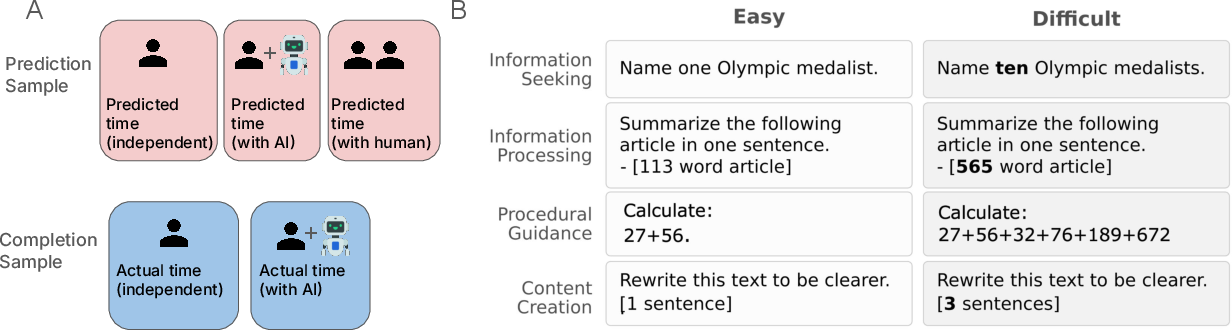
Figure 1: Experimental setup for prediction and completion samples with illustrative tasks per category and difficulty.
Empirical Findings: Miscalibration and Effort Dissociation
The primary result demonstrates a systematic asymmetric miscalibration: participants precisely estimated their independent completion times but significantly underestimated AI-assisted times. Specifically, the predicted speedup with AI was, on average, 68.5 seconds per task, far greater than that predicted with human assistance. However, actual completion times did not reliably decrease with AI use except for a subset of difficult tasks (notably, three tasks involving lexical generation, summarization, and editing). The speedup illusion persisted across all task categories, with no significant effect for easy tasks.
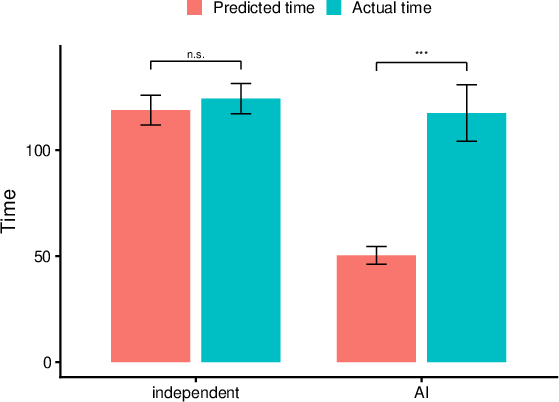
Figure 2: Comparison of predicted vs. actual completion times—accurate calibration for independent completion; miscalibration under AI.
Furthermore, while subjective effort (quantified via NASA-TLX) correlated weakly with completion time (r=0.26), AI assistance produced substantial reductions in perceived mental effort across nearly all tasks (ΔNASA-TLX=−0.61, p<0.001), regardless of actual time savings. Thus, AI generates a dissociation between subjective effort and objective time, supporting the assertion that efficiency is multifaceted and cannot be captured by time alone.
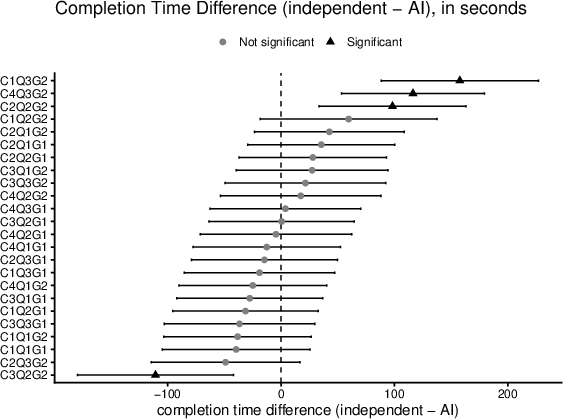
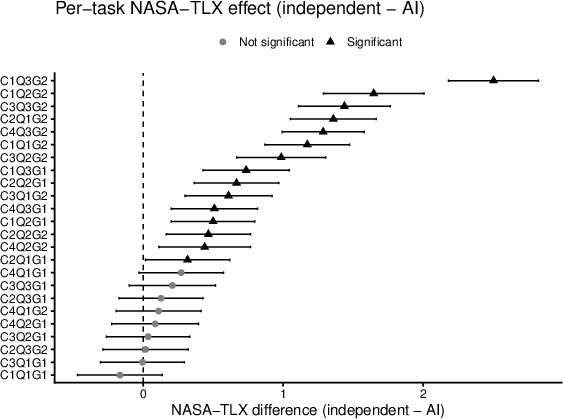
Figure 3: Task-by-task breakdown of completion time and NASA-TLX differences, highlighting pervasive effort offloading under AI.
Individual variation was observed: participants with higher aversion to thinking (as measured by Need for Cognition) overestimated AI speedup more strongly, while AI familiarity did not moderate calibration error. Task prompting behaviors varied, but most interactions were single-turn and often involved direct copying of task instructions. Prompting did not universally accelerate task completion, but it further reduced mental effort.
Theoretical and Practical Implications
The findings provide empirical support for a resource-rational account of cognitive offloading, but reveal that users’ mental models of AI efficiency are systematically skewed. Crucially, the speedup illusion is not merely a function of lack of experience with AI—rather, it is rooted in the conflation between reduced subjective effort and objective time. This dissociation has significant implications: users may erroneously increase reliance on AI, initiating a feedback loop where miscalibration begets greater AI use and further erosion of independent cognitive skills. Such deskilling raises concerns for long-term cognitive autonomy and the robustness of human-AI collaboration.
The analysis of prompting behaviors highlights the diversity of interaction modes and degrees of engagement. Even though AI does not always result in time savings, it persistently reduces experienced cognitive load. This further incentivizes offloading, but may undermine deep engagement and critical reasoning, particularly in environments with low-stakes incentives.
Limitations and Future Research Directions
The study’s scope was restricted to tasks under five minutes, leaving open questions about calibration in more complex domains. Motivation and incentives were not rigorously controlled, although quality filtering was applied. Future research should interrogate how motivation, task complexity, and individual preferences modulate calibration errors and efficiency outcomes. Longitudinal studies are warranted to quantify the impact of persistent AI offloading on cognitive skill retention and the dynamics of feedback loops. Additionally, exploring within-subject calibration dynamics using hybrid experimental designs will elucidate fine-grained behavioral shifts.
Conclusion
This work elucidates a pervasive miscalibration in human-AI interaction centered on a speedup illusion: AI assistance reliably lowers perceived effort, but does not translate into universal time savings. The dissociation between subjective effort and completion time has substantive consequences for individual decision making, cognitive deskilling, and broader narratives around AI-driven productivity. Careful calibration and expanded notions of cognitive offloading are essential for designing interventions and frameworks that sustain both efficiency and cognitive agency.