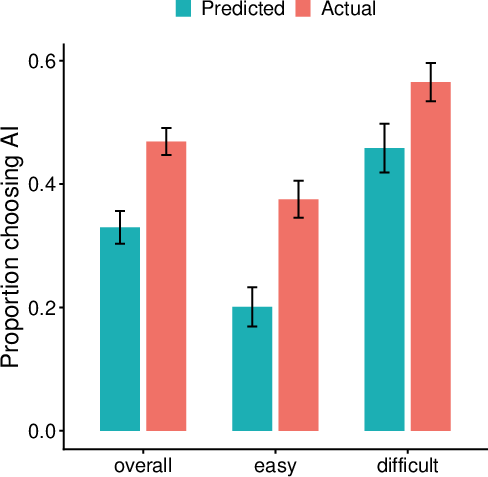
- The paper demonstrates a 14-percentage point gap between predicted (33%) and actual (47%) AI usage, revealing significant miscalibration.
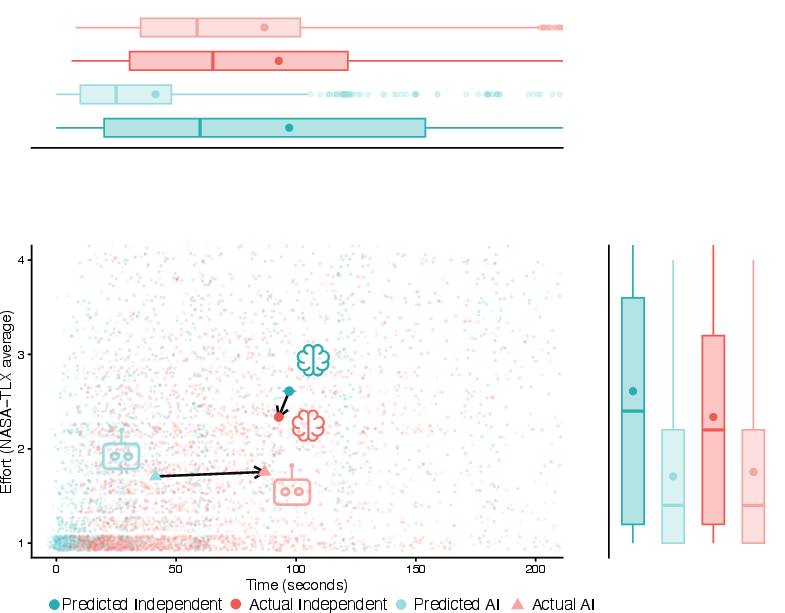
- It finds that anticipated efficiency gains (55.7 seconds saved) are illusory as actual gains are minimal (7.5 seconds) and interface friction may add time.
- Exposure to AI assistance increases subsequent reliance, driving a feedback loop that could lead to cognitive deskilling and automation bias.
The Efficiency-Gain Illusion in AI-Assisted Simple Tasks: Calibration, Usage, and Behavioral Feedback
Study Motivation and Design
The paper "The efficiency-gain illusion: People underestimate the rate of AI use and overestimate its benefits on simple tasks" (2605.22687) investigates metacognitive miscalibration and behavioral biases in AI-assisted workflows for simple, cognitively elementary tasks. The premise is that the public discourse posits LLMs and AI assistants as productivity amplifiers, yet empirical evidence demonstrates that such assistance may not yield actual gains in time or effort—potentially leading to both inefficiency and cognitive deskilling.
To empirically dissect these issues, the researchers conducted three large-scale, pre-registered studies with N=2691 participants. Tasks were drawn from a taxonomy spanning four cognitive categories: information seeking, information processing/synthesis, procedural guidance/execution, and content creation/transformation, with easy and difficult variants per task type. The study designs systematically measured both predicted and behavioral AI usage, as well as subjective and objective efficiency outcomes.
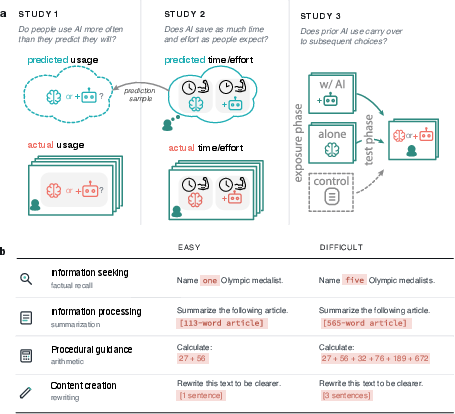
Figure 1: Study overview and task taxonomy; measurement contrasts for AI-assisted versus independent modes across three studies.
Self-Estimate Miscalibration: Underestimating AI Use
A core finding is that individuals exhibit robust miscalibration regarding their propensity to use AI assistance.
This demonstrates a population-level underestimation of reliance on external cognitive support, revealing poor metacognitive monitoring of assistive technology usage, consistent with the planning fallacy and biases in self-assessment literature.
Efficiency-Gain Illusions: Overestimating Time and Effort Savings
Contrary to the prevailing narrative, the studies show that AI adoption for simple tasks does not confer meaningful gains in time or effort.
This establishes the "speedup illusion" and "offloading illusion," wherein the perceived resource savings from AI delegation exceed the realized gains—sometimes inverting the efficiency rationale altogether when interface friction outweighs computational speed.
Carryover Effects: Behavioral Feedback and Entrenchment of Miscalibration
Exposure to AI-assisted completion in prior tasks increases both the likelihood of subsequent AI adoption and the degree of miscalibration regarding AI's efficiency benefits.
- Participants who completed tasks with AI in the exposure phase had a subsequent AI usage rate of 44.5%, compared to 27.7% among those exposed to independent completion.
- AI-exposed participants showed greater agreement with the speedup illusion, operationalized by reverse-coded ratings; prior exposure entrenched distorted time savings beliefs and induced an overreliance feedback loop.
- The effects were robust across easy and difficult task variants and persisted across both first and second test trials.
- Independent completion exposure did not significantly reduce subsequent AI usage rates compared to baseline controls.
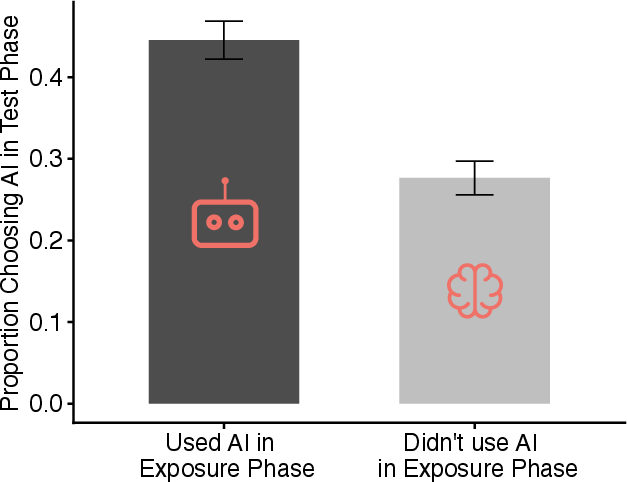
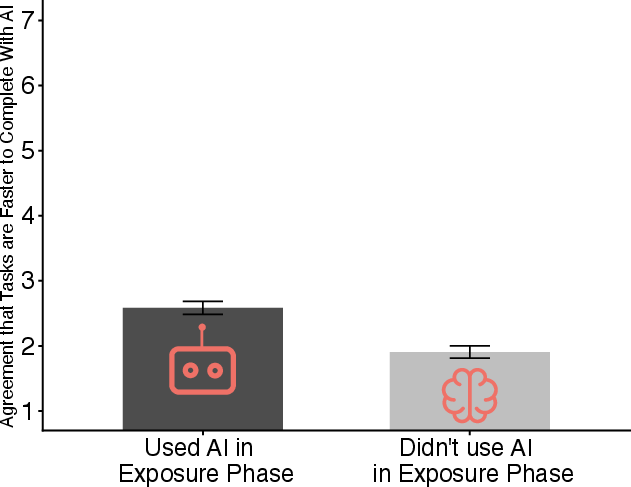
Figure 4: Exposure to AI in early task phases increases subsequent AI adoption and amplifies miscalibration regarding completion speed.
This demonstrates a behavioral bias akin to inertia and habit formation, wherein assistive technology usage cascades and entrenches distorted resource rationality judgments.
Task-Level Effects and Individual Variation
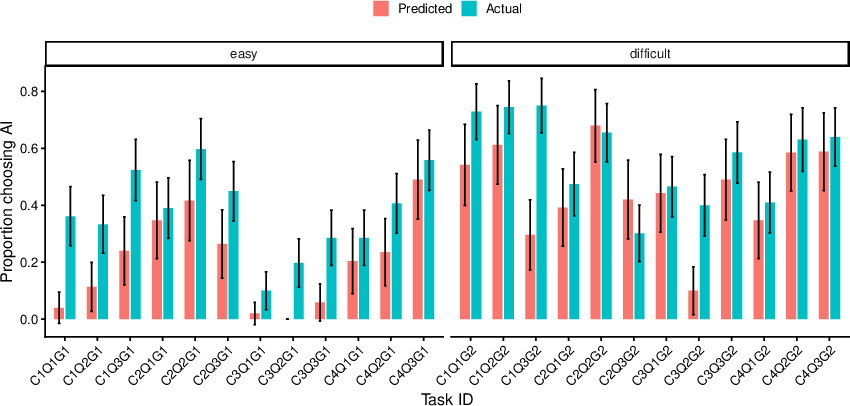
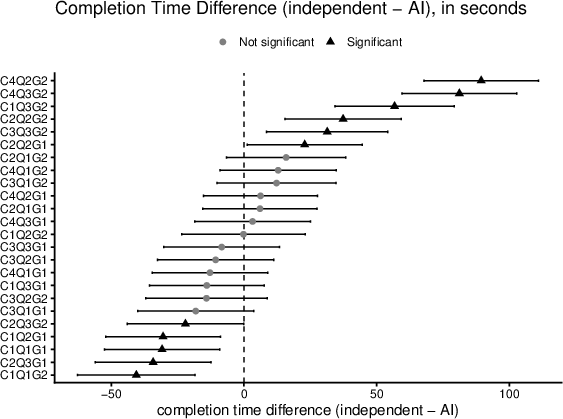
Analysis at the task granularity reveals that:
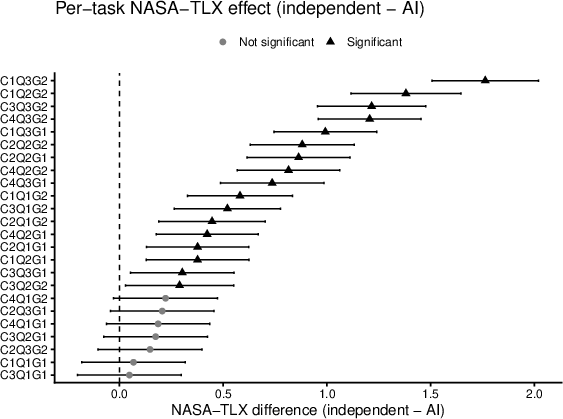
Figure 7: Task-level analysis showing heterogeneity in time and effort differentials between AI-assisted and independent conditions.
Practical and Theoretical Implications
The empirical findings challenge prevailing assumptions about the utility of LLM-based AI in everyday workflows, particularly for simple, rapidly solvable tasks. The main implications include:
- High rates of unproductive delegation may lead to cognitive deskilling, reduced confidence, impaired independent performance, weakened knowledge retention, and diminished learning capacity, effecting a spectrum of individual and societal risks.
- AI-specific miscalibration is distinct from generic delegation errors—participants expect more from AI than from human assistance, driving irrational offloading behaviors.
- Behavioral feedback loops may develop, wherein initial exposure further entrenches miscalibrated beliefs and increases subsequent reliance, risking automation bias and overreliance.
The study recommends interventions at the level of belief calibration, rather than surface-level exposure controls, to mitigate inefficient AI usage. Such interventions may include metacognitive prompts, feedback on actual efficiency outcomes, or friction-modulation mechanisms in user interfaces.
Future Directions and Limitations
Key limitations for further study include:
- The focus on tasks solvable within five minutes constrains generalizability to more complex workflows; subsequent research should delineate the threshold complexity at which AI assistance yields net resource savings.
- AI capabilities are dynamically evolving; miscalibration patterns may shift over time and require longitudinal investigation.
- Motivation and incentive structures may influence completion behaviors in crowdworking settings, necessitating context-sensitive analysis.
- Within-subject metacognitive monitoring metrics were not directly computed; future work should leverage longitudinal within-subject designs and direct metacognitive self-reports.
Conclusion
This paper rigorously demonstrates that users underestimate their reliance on AI and overestimate the associated efficiency gains for simple cognitive tasks. Behavioral feedback loops exacerbate miscalibration and overreliance, with practical consequences for skill retention and cognitive agency. Addressing miscalibration at the belief level is critical for optimizing human-AI interaction paradigms, and ongoing research is needed to examine how calibration, experience, and dynamic AI capabilities interact to shape decision making in assistive workflows.