- The paper introduces QLIF-CAST, a hybrid quantum-classical model that employs Quantum Leaky Integrate-and-Fire neurons to reduce MSE by 15.4% in weather forecasting.
- It demonstrates up to 94% faster convergence than variational quantum models and verifies operational viability on IBM's Marrakesh QPU.
- The study indicates that quantum interference and non-linear decay enable richer temporal dynamics, offering a practical trade-off between speed and accuracy over classical LIF models.
QLIF-CAST: Quantum Leaky-Integrate-and-Fire for Time-Series Weather Forecasting
Introduction
The QLIF-CAST architecture advances quantum machine learning (QML) for time-series regression, targeting multivariate weather forecasting. The model leverages Quantum Leaky Integrate-and-Fire (QLIF) neurons, where neuron excitation is encoded as single-qubit quantum superpositions, updated via Rx rotations and T1 relaxation decay. QLIF-CAST is embedded in a hybrid quantum-classical recurrent architecture, contrasting classical Leaky Integrate-and-Fire (LIF) baselines and state-of-the-art quantum sequence models, namely Quantum LSTM (QLSTM) and LSTM-QNN.
The paper positions QLIF-CAST as a low-depth, parameter-free quantum circuit that delivers substantial prediction error reductions in controlled comparisons, achieving a 15.4% lower MSE and 4.4% lower MAE than the classical LIF baseline on real-world weather datasets. Additionally, it demonstrates up to 94% faster convergence than variational quantum architectures with modest trade-offs in predictive accuracy. Hardware validation on IBM Marrakesh confirms the operational viability of QLIF-CAST’s circuits on near-term quantum processors.
Quantum Leaky Integrate-and-Fire Neuron Model
QLIF neurons encode excitation probabilities as qubit rotation angles, updating their internal state by composing two Rx rotations per timestep. Input integration, decay, and spike generation are resolved quantum mechanically:
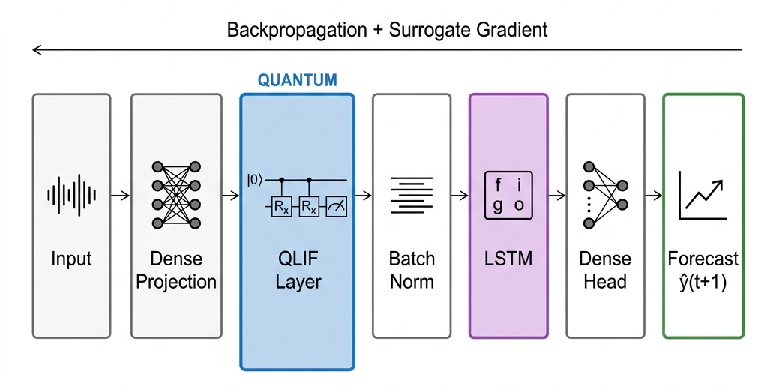
Figure 1: The QLIF neuron circuit uses single-qubit initialization, rotation for prior excitation (Rx(ϕ)), input integration (Rx(θinput)), and measurement.
This structure contrasts the classical LIF’s scalar exponential membrane dynamics:
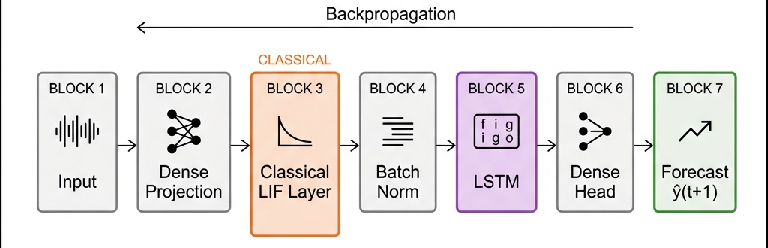
Figure 2: The classical LIF neuron updates membrane potential U via exponential decay and synaptic input, emitting spikes upon crossing a fixed threshold.
QLIF neurons rely solely on trainable classical weights for computing rotation angles, eschewing trainable quantum parameters entirely. Quantum state decay utilizes T1 relaxation for probabilistic reduction of excitation in the absence of spikes. Spike emission is determined by thresholding excitation probability, with surrogate gradient methods facilitating backpropagation of the non-differentiable step function.
Hybrid Quantum-Classical Architecture and Methodology
QLIF-CAST adopts a seven-layer recurrent design, structurally identical to the classical baseline except for Layer~2, where QLIF neurons replace LIF units. The architecture projects input features, applies nonlinear neuron dynamics, normalizes activations, aggregates temporally via classical LSTM, and outputs via regression heads.
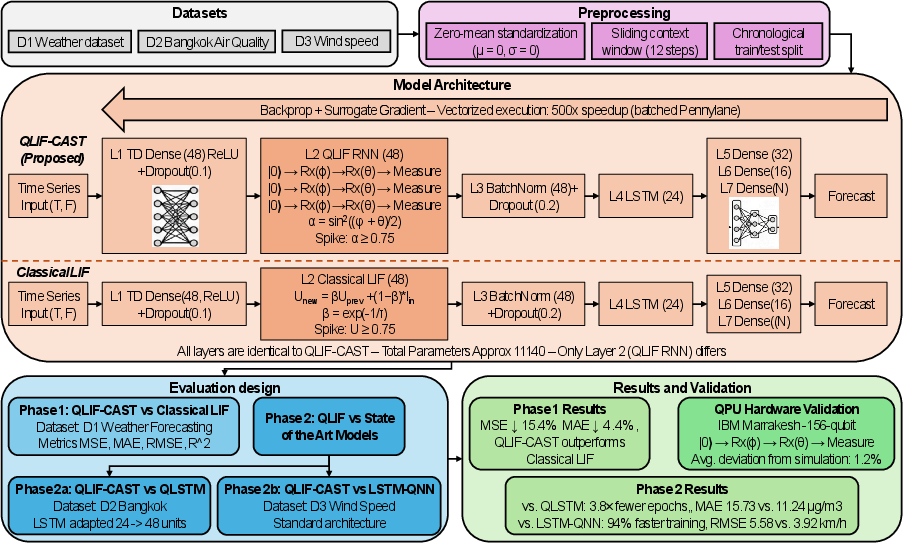
Figure 3: The QLIF-CAST methodology pipeline covers three datasets, preprocessing, identical architectures for QLIF-CAST and Classical LIF except for Layer~2, a two-phase evaluation, and QPU validation.
QLIF-CAST employs vectorized circuit execution for scalable batch training, flattening all parameters into a single parallel quantum circuit call, yielding over 500× speed-up over naive sequential implementations.
Controlled Comparison: QLIF-CAST vs. Classical LIF
On the Weather History dataset, QLIF-CAST demonstrates clear quantitative advantages:
- MSE reduction: –15.4%
- MAE reduction: –4.4%
- RMSE reduction: –8.0%
Detailed per-variable analyses highlight that QLIF-CAST achieves lower error on variables exhibiting strong temporal structure (temperature, pressure), while classical LIF fares better on stochastically fluctuating variables (humidity, wind speed). This is visualized in the multivariate prediction performance:
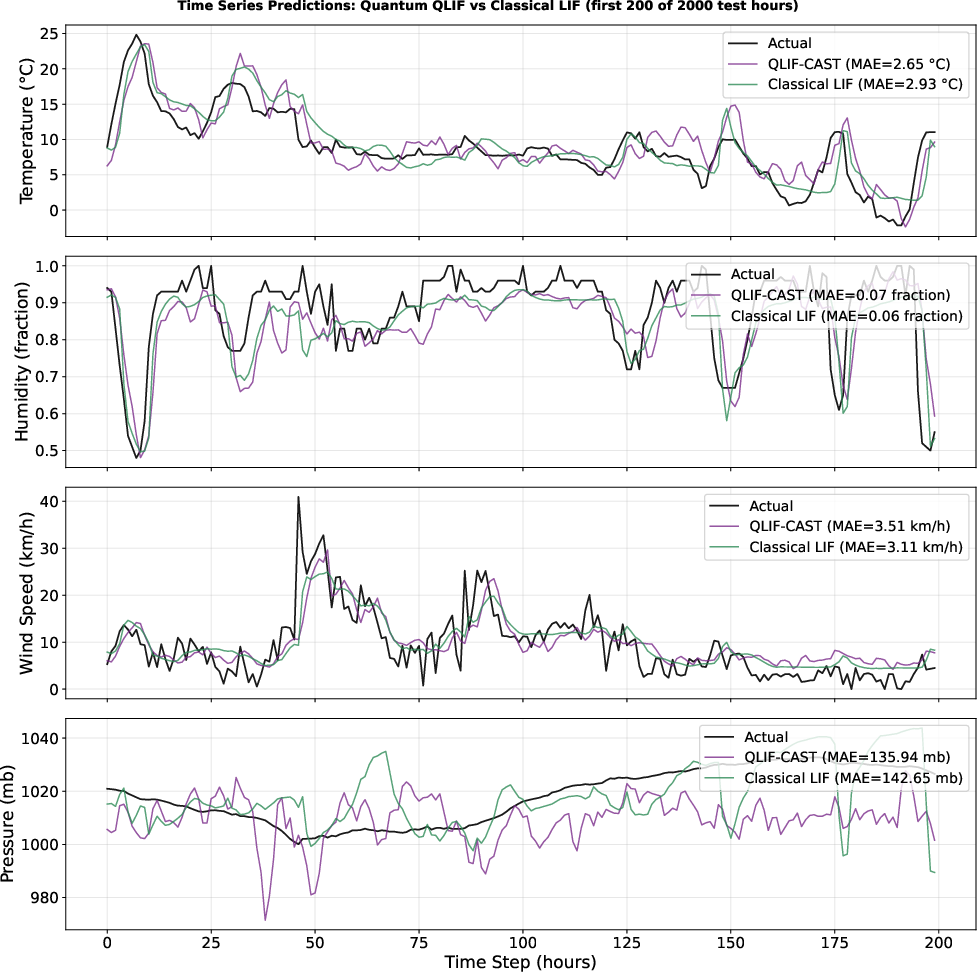
Figure 4: Predicted vs.\ actual for four weather variables: QLIF-CAST shows closer alignment on temperature and pressure.
Convergence profiles show stable training for both models, with QLIF-CAST exhibiting marginally lower validation loss variance:
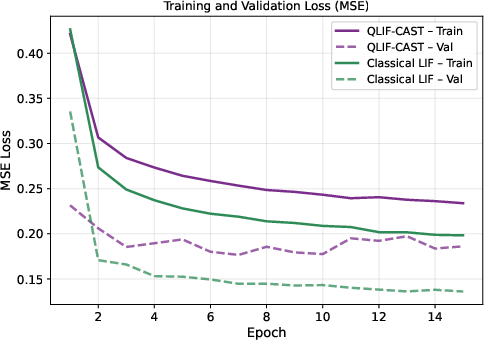
Figure 5: Training and validation loss curves for QLIF-CAST and Classical LIF; quantum dynamics account for residual error differences.
The improved predictive performance is attributable to quantum interference, non-linear decay trajectories in the rotational domain, and a probabilistic state representation, supporting richer temporal modeling without increased parameterization.
Comparative Analysis: QLIF-CAST vs. Quantum LSTM and LSTM-QNN
QLIF-CAST is benchmarked against quantum variational sequence models across air quality and wind speed tasks:
- Bangkok PM2.5 forecasting: QLIF-CAST achieves 26.8% lower MAE vs. Classical LSTM, converges 3.8× faster than QLSTM, with 40% higher error than QLSTM.
- Wind speed forecasting: QLIF-CAST converges in 3.88 minutes vs. 65.3 minutes for LSTM-QNN, with a +42.3% RMSE trade-off; absolute error remains within operational tolerances.
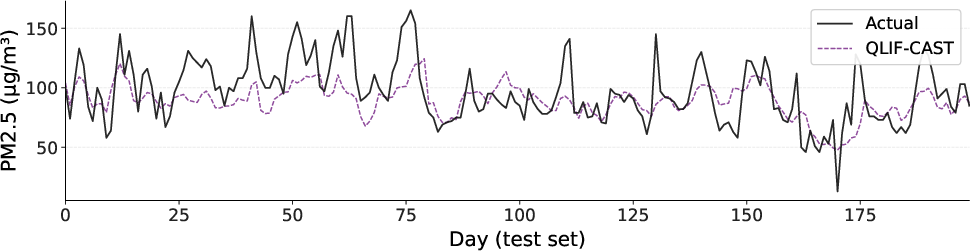
Figure 6: QLIF-CAST’s predicted PM2.5 concentrations closely track actuals but smooth over pollution spikes.
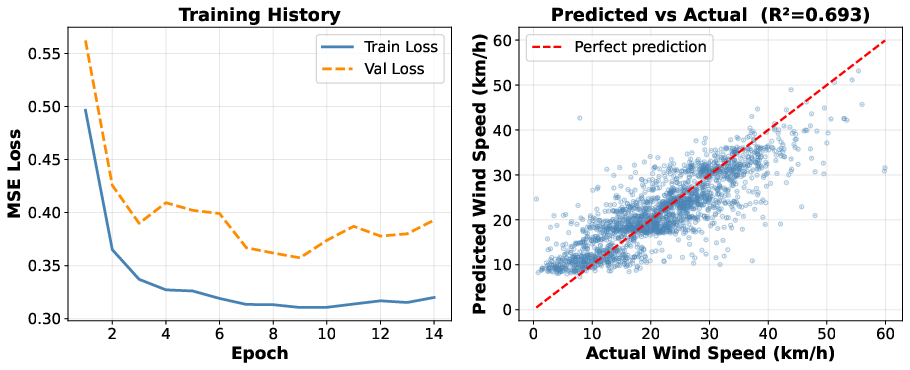
Figure 7: Wind speed forecasting: rapid loss convergence and strong predicted vs.\ actual correlation (R² = 0.693) for QLIF-CAST.
QLIF-CAST occupies a unique Pareto-optimal position—offering rapid convergence and hardware compatibility, at the expense of top-end precision. For domains where retraining speed and operational deployment outweigh requirements for maximum accuracy, QLIF-CAST provides a practical alternative to deeper, slower quantum models.
Hardware Validation and Practical Deployment
QLIF-CAST circuits were directly validated on IBM’s Marrakesh QPU. The depth-2, single-qubit design exhibited only 1.2% average deviation from ideal simulations, confirming resilience to NISQ-era hardware imperfections. Unlike deep multi-qubit variational circuits, QLIF-CAST avoids accumulative gate errors and is uniquely validated for near-term deployment scenarios.
Theoretical and Practical Implications
QLIF-CAST extends quantum spiking models beyond classification, establishing viability for continuous-valued regression. The results highlight the inductive benefits of quantum neuronal dynamics for time-series forecasting, with direct improvements not linked to parameter count or classical overfitting. Its architectural simplicity facilitates integration and deployment in edge settings where classical and quantum speed-error trade-offs are paramount. The paradigm further suggests potential in ensemble forecasting, multi-step prediction, and hybrid variational models.
Conclusion
QLIF-CAST achieves demonstrable prediction error reductions relative to classical spiking neural architectures, and substantial speed advantages compared to deep variational quantum models, with modest trade-offs in absolute accuracy. Hardware validation underscores immediate practical relevance. This architecture is suited for deployment-constrained applications requiring quantum advantage and efficiency without sacrificing operational accuracy. Future work should pursue full-QPU end-to-end training, more expressive hybrid spiking architectures, and ensemble methods for multi-horizon forecasting.

