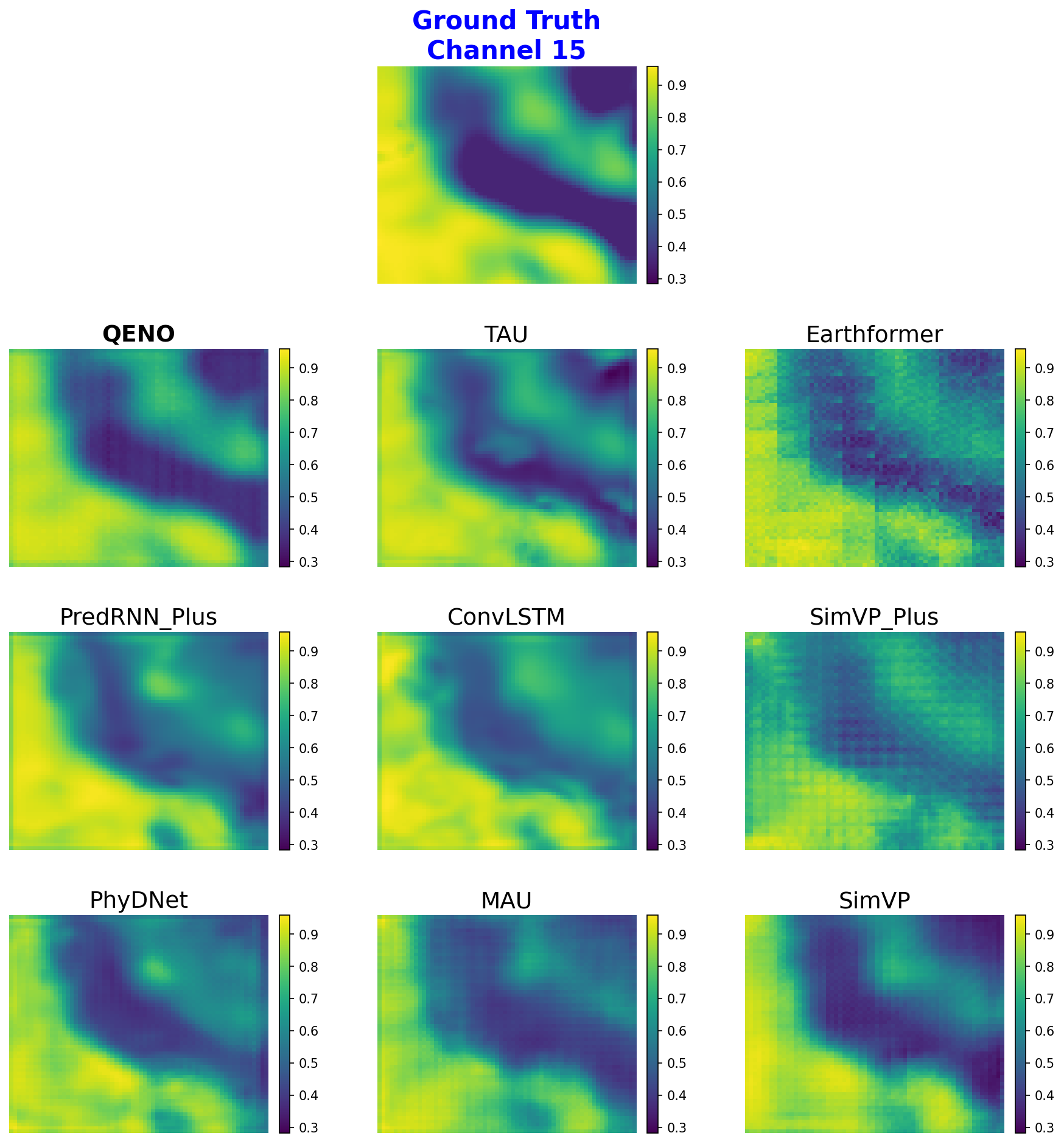
- The paper introduces QENO, a hybrid quantum-classical neural operator that enhances 3D cloud forecasting by incorporating topology-aware quantum modules alongside classical spatiotemporal encoders.
- It employs a modular design with a classical encoder, Topological Entanglement Quantum Enhancer, and Dynamic Fusion Temporal Unit to effectively capture cross-layer interactions and long-range dependencies.
- Empirical results demonstrate superior accuracy (MSE=0.2038, SSIM=0.6291) and parameter efficiency (0.03M parameters), outperforming state-of-the-art models in volumetric cloud prediction.
Hybrid Quantum-Classical Spatiotemporal Forecasting for 3D Cloud Fields
Introduction
The accurate prediction of 3D cloud fields presents a formidable challenge in atmospheric science due to the inherently multiscale, nonlocal, and highly coupled nature of cloud dynamics. Classical approaches—ranging from parameterized NWP systems to deep spatiotemporal neural models—have improved lower-dimensional meteorological prediction, but fail to fully capture the cross-layer interactions and long-range dependencies essential for volumetric cloud forecasting. The paper "Hybrid Quantum-Classical Spatiotemporal Forecasting for 3D Cloud Fields" (2603.29407) introduces QENO, a topology-aware quantum-classical neural operator targeting these limitations through quantum-enhanced latent processing. This essay provides a detailed formal summary of the proposed framework, empirical findings, and its broader implications for machine learning and geoscience.
Technical Development of QENO
QENO employs a modular hybrid architecture structured to efficiently extract, transform, and fuse cloud field representations by integrating classical and quantum modules:
- Classical Spatiotemporal Encoder: Utilizes ConvSC and MSIM modules to embed input 3D cloud snapshots into compact latent features, facilitating computationally-tractable quantum encoding.
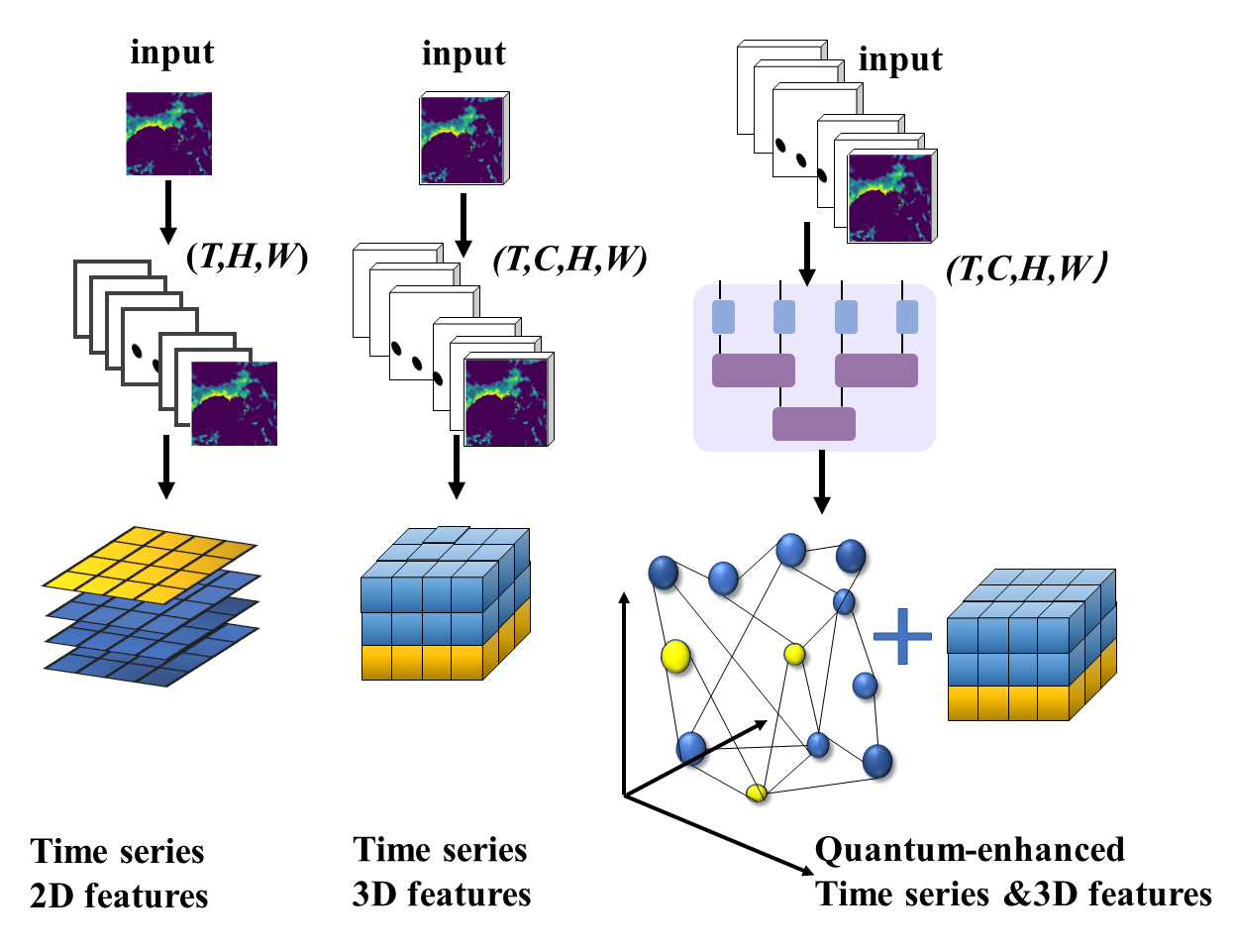
Figure 1: Comparison of 2D, 3D CNN and quantum-enhanced feature extraction.
- Topological Entanglement Quantum Enhancer (TEQE): Implements shallow, data-driven quantum circuits where qubit entanglement graphs are aligned to the spatial/vertical cloud topology, mapping latent states through parameterized rotations and entangling gates. Classical-to-quantum encoding is performed via angle encoding, maintaining the structure of binary or probabilistic cloud-mask patterns in qubit amplitudes.
- Dynamic Fusion Temporal Unit (DFTU): A fusion cell performs joint temporal integration by gating classical LSTM-like hidden and cell states with projective quantum measurements derived from the TEQE. This structure supports bidirectional information flows between quantum-enhanced features and recurrent memory dynamics, increasing expressivity for nonlocal dependence modeling.
- Classical Decoder: Reconstructs high-dimensional future cloud volumes from fused representations, leveraging skip connections and deep upsampling layers for high-resolution output.
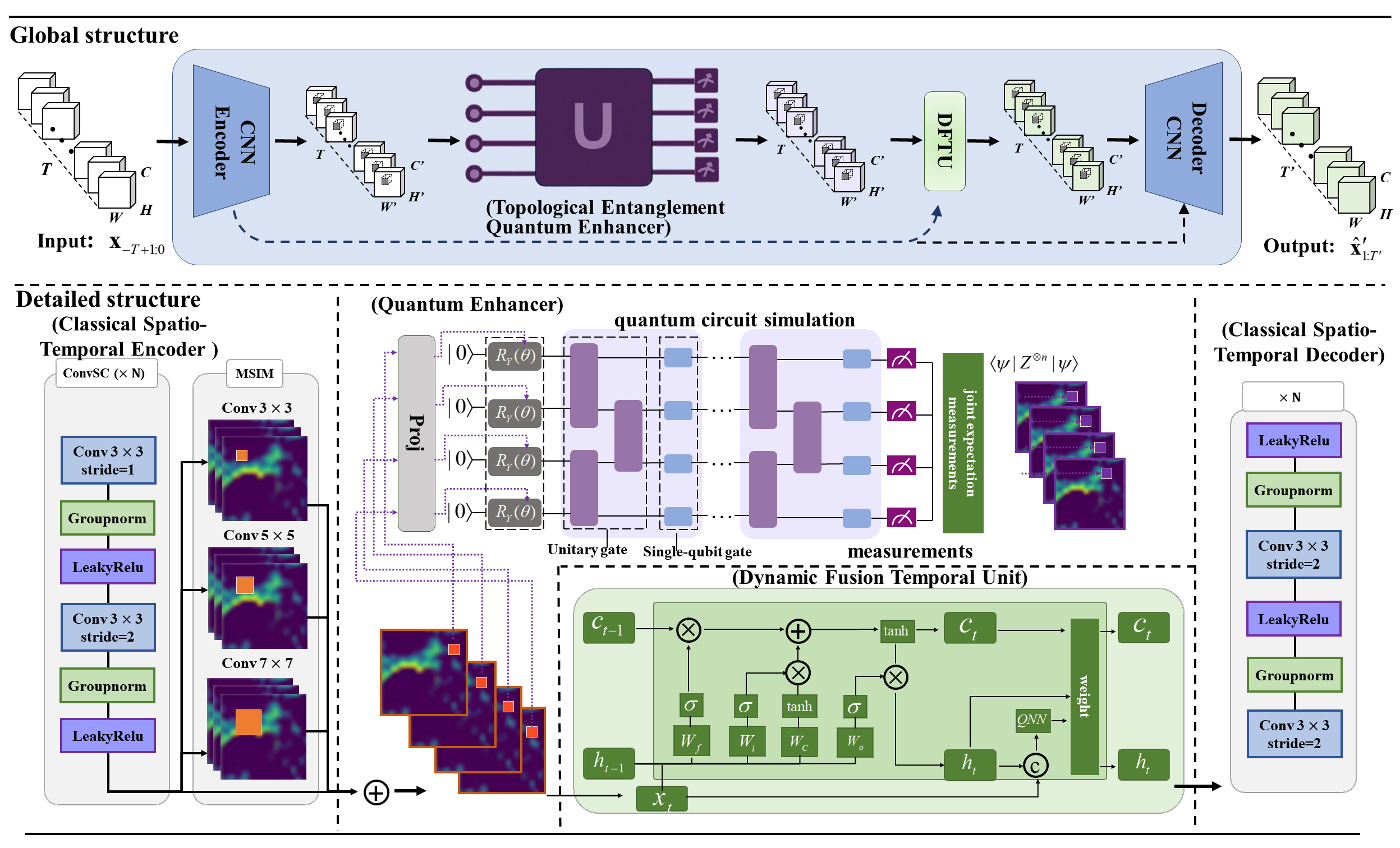
Figure 2: The overall architecture of QENO, depicting its classical encoder/decoder backbone, entanglement block, and quantum-classical fusion interface.
Quantum modules are simulated efficiently using the torchquantum package; the architecture maintains practical training and inference efficiency, with a parameter count of 0.03M—significantly below all tested classical baselines.
Empirical Evaluation and Results
QENO is benchmarked on 3D cloud field sequences from CMA-MESO, with 3 km spatial, 3-hour temporal, and 42-level vertical coverage. Comparative analysis involves eight state-of-the-art spatiotemporal predictors: ConvLSTM, PhyDNet, MAU, SimVP, SimVP_Plus, Earthformer, TAU, and PredRNN_Plus. Key outcomes include:
Component Contribution and Ablation
Ablation studies reveal the necessity of both quantum-enhanced modules:
- QENO-QEMid (Intermediate Quantum Module Suppressed): Sharp performance deterioration (MSE increases to 0.8995, SSIM drops to 0.1938).
- QENO-QEDecoder: Degrading but less severe; maintains partial benefit over purely classical counterparts.
Coherence analysis via latent activation correlation matrices demonstrates the emergence of strongly organized, block-structured inter-feature correlations—indicative of nonlocal coupling—only in the full QENO model.
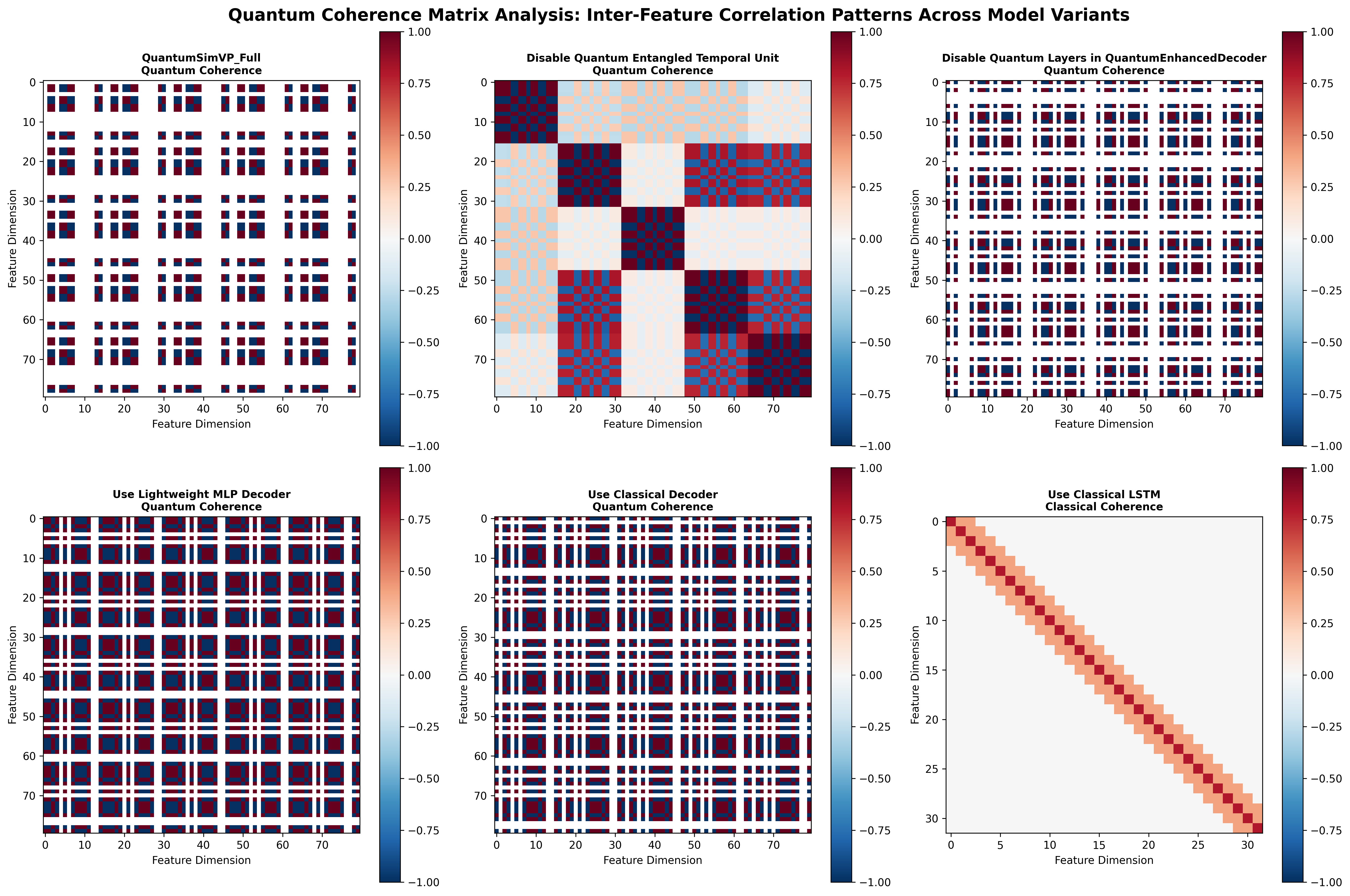
Figure 4: Quantum coherence matrix analysis; QENO uniquely exhibits large-scale, off-diagonal, nonlocal correlation patterns, not observed in ablated or classical models.
Implications and Theoretical Considerations
QENO's architecture supports several important conclusions:
- Physical Alignment of Quantum Circuits: By encoding qubit entanglement graphs that mirror cloud spatial topology, QENO ensures that quantum amplitude connectivity reflects geophysical reality, a departure from generic quantum circuit design in earlier QML work.
- Nonlocal Feature Integration: The TEQE module, coupled with the DFTU fusion cell, facilitates efficient cross-layer and long-range dependency modeling, resolving a key failure mode for locality-constrained CNN, RNN, and even transformer architectures.
- Quantum Module Utility without Hardware Superiority: While QENO is simulated classically (no demonstration of quantum computational advantage), it reveals that quantum-inspired topological integration provides distinct empirical benefits in structured high-dimensional physical forecasting.
- Computational Efficiency: The quantum-enhanced feature mapping yields high data efficiency and parsimony, motivating further research into hybridization for operational and embedded forecasting systems.
Future Directions
The demonstrated representational and predictive superiority of QENO positions hybrid quantum-classical neural operators as an important direction for both physical data science and ML. Immediate extensions include:
- Further reduction of quantum circuit depth and classical/quantum resource coupling to facilitate deployment in practical quantum hardware settings;
- Generalization to other geoscientific sequence modeling tasks—such as precipitation, wind, or mixed-phase cloud microphysics—where nonlocal, cross-scale coupling is critical;
- Investigation of noise-resilient quantum circuit architectures, motivated by the observed link between block coherence and predictive accuracy.
Conclusion
QENO represents a rigorous demonstration that topology-aligned quantum enhancement within a classical neural encoder-decoder pipeline markedly improves 3D cloud field forecasting. The empirical analyses establish the capability of QENO to recover fine-scale structure and long-range spatiotemporal dependencies with minimal parameter overhead, outperforming both classical and prior quantum-inspired models. The findings substantiate the theoretical premise that leveraging physically-informed quantum entanglement patterns yields practical and substantial gains, opening new avenues for quantum-assisted physical simulation and environmental AI.