Boundary-Aware QFT Block-Encoding of Fractional Laplacians
Published 16 May 2026 in quant-ph | (2605.16749v1)
Abstract: We study the quantum Fourier transform (QFT) block-encoding of the semi-discrete fractional Laplacian on bounded domains with open, zero-extension boundary conditions. In the notation of the main construction, the target operator is the finite Toeplitz truncation (A{(N)}_{α,h}) obtained from the full-lattice semi-discrete operator with symbol (|ξ|α). A finite QFT register, however, diagonalizes circulant matrices rather than Toeplitz truncations. The native QFT circuit therefore implements a periodic surrogate (\widetilde A{(N)}_{α,h}), not the open-boundary operator. We identify this mismatch through an exact Toeplitz-to-circulant aliasing identity. To recover the open-boundary action, we zero-pad the state into a larger (M)-point QFT register, apply the same Fourier-symbol block-encoding, and compress back to the physical subspace. The resulting compressed block satisfies (P_{N\to M}{\dagger}\widetilde A{(M)}{α,h}P{N\to M} = A{(N)}_{α,h}+E{(M)}), where (E{(M)}) is controlled by the tail of the semi-discrete convolution kernel. Thus, the QFT layer implements the fractional symbol, while zero-padding supplies the open-boundary geometry. The construction is an operator-compilation primitive for boundary-aware quantum simulation rather than a complete PDE solver.
The paper introduces a zero-padding method to transform QFT's circulant encoding into a boundary-aware Toeplitz block-encoding for open-boundary fractional Laplacians.
It provides an error analysis showing that the residual decays polynomially with register size, ensuring controlled accuracy in quantum simulations.
The approach generalizes to multidimensional grids, enabling boundary-sensitive quantum simulation of nonlocal PDEs and anomalous diffusion models.
Boundary-Aware QFT Block-Encoding of Fractional Laplacians
Overview
The paper "Boundary-Aware QFT Block-Encoding of Fractional Laplacians" (2605.16749) systematically addresses the algebraic mismatch between quantum Fourier transform (QFT)-diagonalizable operators and the open-boundary fractional Laplacian, elucidating the construction required for boundary-sensitive block-encodings on quantum computers. The main contribution is the introduction of a zero-padding approach that enables QFT circuits to encode Toeplitz truncations, rather than native circulant operators, thus facilitating quantum simulation of nonlocal bounded-domain fractional models with controlled boundary error.
Operator Distinction and Boundary Obstruction
Quantum algorithms natively exploit the diagonal structure of periodic operators via the QFT, primarily resulting in circulant matrices. However, bounded-domain fractional Laplacians, relevant for anomalous diffusion and bounded fractional PDEs, manifest as Toeplitz truncations stemming from the semi-discrete convolution kernel with symbol ∣ξ∣α [DuoWykZhang2018, ZhouZhang2023]. The paper formalizes the distinction:
Open Boundary Target: Toeplitz matrix Aα(N) reflecting zero-extension boundary conditions.
An exact Toeplitz-to-circulant aliasing identity is stated:
(Aα(N))ij=ℓ∈Z∑ci−j+ℓN
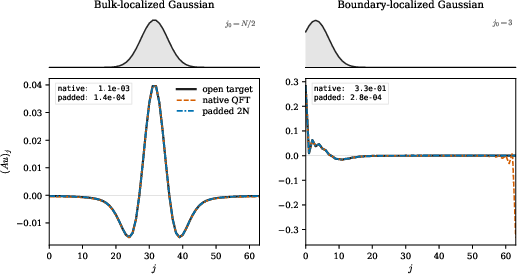
This identity quantifies the artificial wrap-around created by periodic geometry, which becomes significant near boundaries and is suppressed by the kernel tail for bulk-localized states.
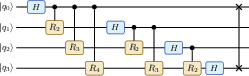
Figure 1: Illustrative decomposition of a four-qubit QFT; this spectral layer imposes periodic geometry intrinsically.
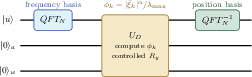
Figure 2: Native QFT block-encoding realizes a circulant operator, not the open-boundary Toeplitz target.
Compressed Block-Encoding via Zero-Padding
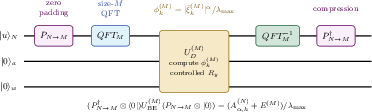
To resolve the boundary mismatch, the authors apply zero-padding to embed the state into a larger QFT register (M≥2N) and post-compress back to the physical N-site domain. The result is a block-encoding whose ancilla block implements
PN→M†Aα(M)PN→M=Aα(N)+E(M)
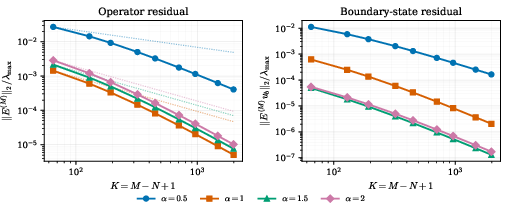
where E(M) encodes the kernel-tail residual explicitly. The residual, constructed from periodic images outside the physical block, decays polynomially with M−N according to the kernel's analytic properties.
Figure 3: Compression mechanism: periodic QFT circuit on padded register, compressed back to yield Toeplitz plus tail.
Error Analysis and Resource Scaling
The norm of the residual E(M) is bounded as
Aα(N)0
with Aα(N)1 for Aα(N)2. This yields sufficient scaling
Aα(N)3
for target accuracy Aα(N)4. The block-encoding gate complexity per call is Aα(N)5 for Aα(N)6 and arithmetic precision Aα(N)7.
Multidimensional Extension
The mechanism generalizes to tensor-product grids, where zero-padding and compression are applied separately in each spatial direction. The multidimensional kernel tail governs the precision, and the block-encoding cost scales as Aα(N)8 for three-dimensional grids.
Numerical Diagnostics
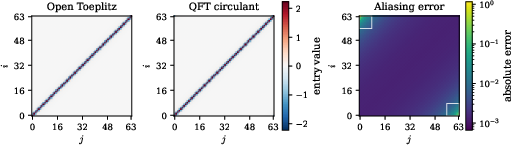
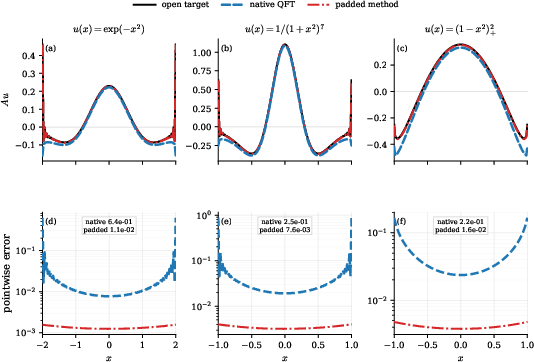
The paper offers matrix-level and functional benchmarks to substantiate the boundary correction. For Aα(N)9, Aα(N)0, Aα(N)1, diagnostic plots illustrate:
The aliasing structure; discrepancies near the matrix corners from wrap-around artifacts.
Functional comparisons: the padded construction mitigates boundary error evident in QFT-circulant action.
Spectral norm decay of the zero-padding residual, confirming theoretical expectations.
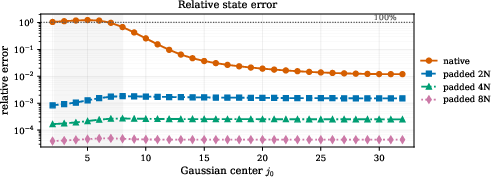
Gaussian-state inputs localized near boundaries demonstrate heightened sensitivity to boundary condition; the zero-padded construction suppresses the artificial periodic coupling, as shown in the error sweep across domain positions.
Figure 8: Relative error as the Gaussian center is displaced from the boundary; boundary artifacts diminish away from edges.
Implications and Outlook
This operator-level primitive advances boundary-aware quantum simulation of fractional Laplacians, with explicit error control via kernel tail decay. The QFT-based construction complements higher-level routines—quantum singular value transformation (QSVT), Hamiltonian simulation, and quantum linear-system solvers—by providing a modular, boundary-adapted block-encoding.
Practically, this architecture facilitates fractional PDE and anomalous diffusion modeling on quantum platforms, provided boundary artifacts are appropriately suppressed. Further theoretical development may target coefficient-decoupled and variable-coefficient generalizations [javanmard2026coefficient], integration with tensor-network protocols, and optimization of block-encoding arithmetic. Potential expansion to other boundary settings (e.g., Dirichlet, mixed, or nonlinear extensions) requires tailored embedding and compression strategies.
Conclusion
The paper rigorously solves the native QFT block-encoding boundary mismatch for fractional Laplacians by zero-padding and compression, transforming circulant QFT representations into boundary-aware Toeplitz forms with analytically controlled residuals. The construction is applicable across quantum simulation and operator compilation workflows, forming a foundation for boundary-sensitive quantum algorithms in nonlocal PDE settings.
“Emergent Mind helps me see which AI papers have caught fire online.”
Philip
Creator, AI Explained on YouTube
Sign up for free to explore the frontiers of research
Discover trending papers, chat with arXiv, and track the latest research shaping the future of science and technology.Discover trending papers, chat with arXiv, and more.