Quantum Data Loading for Carleman Linearized Systems: Application to the Lattice-Boltzmann Equation
Published 1 May 2026 in quant-ph | (2605.00302v1)
Abstract: Herein, we introduce a strategy to decompose an arbitrary square matrix into a linear combination of non-unitaries (LCNU) where each non-unitary term is embedded into a unitary matrix. The result is a linear combination of unitaries (LCU) with an equal number of terms as the LCNU. Using this approach, we construct a generalized LCU framework for any Carleman linearized autonomous dynamical system with a polynomial nonlinearity. This framework is then used to construct an LCU for the 3-dimensional Carleman linearized lattice Boltzmann equation (LBE) in which the number of terms scales like $N_s \sim \mathcal{O}(α2 Q2)$, where $α$ is the Carleman truncation order and $Q$ is the number of discrete velocities from the LBE. Importantly, $N_s$ is completely independent of both the number of temporal and spatial discretization points. Lastly, we provide an estimate of our LCNU strategy's T gate cost in conjunction with (1) PREP and SELECT block encoding oracles, and (2) the variational quantum linear solver. In the former, the T cost scales like $\mathcal{O}(α3 Q2 (\log_2 n)2)$, where $n$ is the total number of spatial grid points across all dimensions. Next, the latter requires $N_s2(\log_2 (2n_tnα)+1)$ circuits per iteration, with a worst case T gate cost of $\mathcal{O}(α(\log_2 Qn)2)$ among them. We, therefore, provide an efficient decomposition strategy useful for both fault-tolerant and variational approaches.
The paper develops an LCNU framework that embeds non-unitary operators into unitary matrices, enabling efficient quantum data loading for Carleman-linearized LBE.
It employs block encoding and zero padding techniques to achieve polylogarithmic circuit depth and substantial T gate reductions compared to classical methods.
Numerical results demonstrate nearly four orders of magnitude resource savings over dense Pauli decomposition, making quantum simulation of nonlinear fluid dynamics more feasible.
Quantum Data Loading via Carleman Linearization for the Lattice-Boltzmann Equation
Introduction and Motivation
The paper "Quantum Data Loading for Carleman Linearized Systems: Application to the Lattice-Boltzmann Equation" (2605.00302) develops an efficient quantum data loading protocol for autonomous dynamical systems with polynomial nonlinearity, focusing on the Carleman linearized Lattice-Boltzmann Equation (LBE). Classical simulation of nonlinear PDEs/ODEs presents substantial challenges for quantum computation due to intrinsic linearity of quantum operations. Carleman linearization circumvents this via infinite-dimensional linearization and subsequent truncation to finite dimensions, yielding a system amenable to quantum linear system algorithms (QLSAs).
A critical bottleneck for QLSAs lies in the complexity of loading classical data onto the quantum computer. This is exacerbated for dense matrices but is tractable for structured, sparse matrices as produced by Carleman linearization. The authors propose a resource-efficient decomposition exploiting a generalized linear combination of non-unitaries (LCNU) approach, embedding non-unitary components into unitary matrices to yield a scalable linear combination of unitaries (LCU).
LCNU Framework and Embedding Non-Unitary Operators
The core contribution is a formal framework for decomposing arbitrary matrices as LCNU:
L=∑l=1NsclLl
where each Ll is either unitary or admits efficient completion to a unitary via the "Sigma basis" (Pauli matrices, standard basis elements, and permutation matrices). The embedding protocol utilizes efficient multi-controlled NOT gates and block encoding strategies, ensuring the circuit construction for embedded unitary matrices Ul has polylogarithmic scaling in matrix dimension.
Efficient completions are guaranteed for matrices constructed via Kronecker/matrix products from the base set P1. The approach leverages the rowspace structure and 1-sparsity of the constituent matrices to guarantee the existence of scalable unitary embeddings.
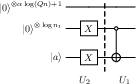
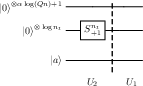
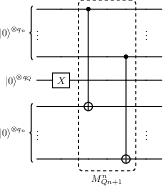
Figure 1: Embeddings for the two nontrivial L1(e) terms, illustrating the circuit structure for LCNU embedding with ancilla qubits and block separation for U1/U2.
Carleman Linearization and Zero Padding
The framework is systematically applied to Carleman linearized autonomous dynamical systems:
∂t∂f=k=0∑NFFkf⊗k
Yielding a block-structured linear system after temporal discretization and zero padding:
L(e)Y(e)=B(e)
Zero padding is introduced for uniform matrix dimensions, facilitating efficient decomposition into LCNU terms. This homogenizes the block structure, enabling scalable circuit generation and resource estimation. The decomposition of L(e) is shown to depend only on Carleman truncation order Ll0 and discrete velocity count Ll1, with independence from spatial/temporal discretization.
Application to Lattice-Boltzmann Equation
The authors derive the Carleman linearized LBE, mapping the coefficients and velocities into structured operators (Ll2) amenable to LCNU decomposition. They implement the efficient decompositions for the streaming and collision terms for standard lattice geometries (D1Q3*, D2Q9*, D3Q15*), embedding all operators into sparse, structured matrices suitable for quantum loading.
Key numerical values for Pauli decomposition terms and SVD costs for velocity sets are provided, confirming the scaling behavior of the proposed method vis-à-vis traditional Pauli decomposition (orders of magnitude reduction in gate and term counts).
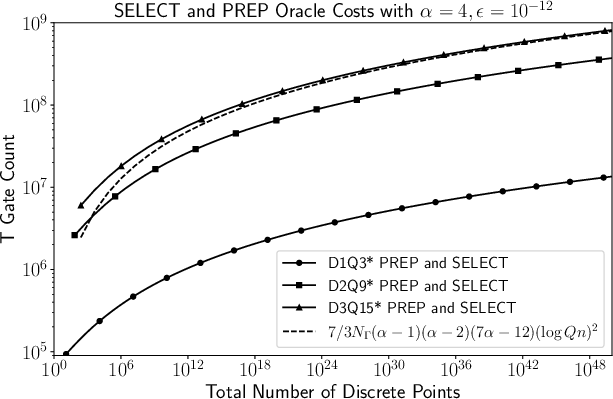
Figure 2: T gate count for quantum encoding of the Carleman linearized LBE matrix via PREP and SELECT oracles, illustrating polylogarithmic scaling and dominance of nonlinear commutation.
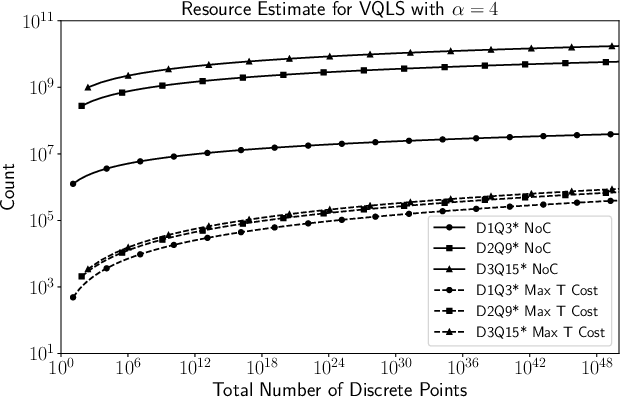
Figure 3: Number of circuits and maximal T cost per circuit for encoding the LBE, emphasizing quadratic scaling in Ll3 and independence from discretization size.
Resource Estimation: Fault-Tolerant vs Variational Quantum Loading
The paper presents detailed resource estimates for both block-encoding-based data loading (PREP and SELECT oracles) and variational quantum linear solvers (VQLS). The T gate counts scale as Ll4 for block encoding (Ll5 total spatial points), and the number of VQLS circuits per iteration grows as Ll6 with per-circuit T cost Ll7.
The dominant contributions stem from nonlinear commutation matrices and quadratic collision term decompositions. This analysis convincingly demonstrates the substantial efficiency improvements relative to classical Pauli decomposition (e.g., achieving Ll8 T gates versus Ll9 for comparable system size).
Strong Claims and Key Results
Number of LCNU terms Ul0 is independent of spatial and temporal discretization, scaling only with Ul1 and Ul2.
Polylogarithmic circuit depth and gate count for all matrix embedding steps.
Four orders of magnitude reduction in resource requirements compared to dense Pauli decomposition for Carleman-LBE systems (highlighted in explicit resource comparison and strong numerical results).
Efficient unitary completions for all LCNU terms demonstrated via algebraic proofs and concrete circuit synthesis.
Figure 4: Embedding for Ul3, representing most costly nonlinear collision circuit, using commutation matrices, permutation gates, and block SVD operators.
Practical and Theoretical Implications
Practically, the proposed framework enables scalable quantum simulation of structured nonlinear systems such as the LBE, with direct applicability to fluid mechanics and potentially other domains requiring efficient high-dimensional linearization. Theoretical implications include the extension of block encoding and LCU techniques to broader classes of non-unitary matrices and dynamical systems, with formal guarantees on circuit complexity and resource scaling.
The authors note key caveats: efficient data loading is necessary but not sufficient for quantum advantage; issues such as matrix condition number, preconditioning, readout, and barren plateaus must be addressed. Moreover, zero padding may increase condition number, requiring careful preconditioning strategies.
The flexibility of the LCNU approach allows for usage of higher-order discretization schemes and porting to diverse quantum architectures, although further transpilation and architectural adaptation may optimize the proposed circuits.
Future Outlook
The methodology is likely to see further development in preconditioning strategies, hybrid quantum-classical solvers, and extension to other nonlinear PDEs/PDEs. Reduction in commutation matrix cost or further exploitation of problem structure could lead to additional resource savings. Quantum multigrid and alternative cost function formulations for VQLS also appear promising to curtail circuit requirements.
Conclusion
This work establishes a formal, scalable protocol for quantum data loading through LCNU decomposition in Carleman linearized systems, offering substantial resource savings and enabling quantum simulation of nonlinear fluid dynamics systems such as LBE. The proposed strategy generalizes quantum compilation techniques to broad structured matrix classes and provides the practical foundation for future quantum fluid dynamics solvers and structured nonlinear system simulations.
“Emergent Mind helps me see which AI papers have caught fire online.”
Philip
Creator, AI Explained on YouTube
Sign up for free to explore the frontiers of research
Discover trending papers, chat with arXiv, and track the latest research shaping the future of science and technology.Discover trending papers, chat with arXiv, and more.