Published 28 Jul 2025 in cond-mat.str-el, cond-mat.dis-nn, hep-th, math-ph, and quant-ph | (2507.21209v2)
Abstract: 't Hooft anomalies of global symmetries play a fundamental role in quantum many-body systems and quantum field theory (QFT). In this paper, we make a systematic analysis of lattice anomalies - the analog of 't Hooft anomalies in lattice systems - for which we give a precise definition. Crucially, a lattice anomaly is not a feature of a specific Hamiltonian, but rather is a topological invariant of the symmetry action. The controlled setting of lattice systems allows for a systematic and rigorous treatment of lattice anomalies, shorn of the technical challenges of QFT. We find that lattice anomalies reproduce the expected properties of QFT anomalies in many ways, but also have crucial differences. In particular, lattice anomalies and QFT anomalies are not, contrary to a common expectation, in one-to-one correspondence, and there can be non-trivial anomalies on the lattice that are infrared (IR) trivial: they admit symmetric trivial gapped ground states, and map to trivial QFT anomalies at low energies. Nevertheless, we show that lattice anomalies (including IR-trivial ones) have a number of interesting consequences in their own right, including connections to commuting projector models, phases of many-body localized (MBL) systems, and quantum cellular automata (QCA). We make substantial progress on the classification of lattice anomalies and develop several theoretical tools to characterize their consequences on symmetric Hamiltonians. Our work places symmetries of quantum many-body lattice systems into a unified theoretical framework and may also suggest new perspectives on symmetries in QFT.
The paper introduces blend equivalence as a novel method to classify lattice symmetry anomalies distinct from traditional QFT obstructions.
It demonstrates how IR-trivial and IR-nontrivial anomalies impact symmetric boundary realizations and commuting projector models.
The study employs cohomological invariants and bulk-boundary correspondences to connect lattice models with higher-dimensional topological phases.
Anomalies of Global Symmetries on the Lattice: A Technical Overview
Introduction and Motivation
This paper develops a rigorous, lattice-based theory of global symmetry anomalies—termed lattice anomalies—and systematically analyzes their classification, their relationship to field-theoretic ('t Hooft) anomalies, and their physical consequences, particularly for gapped phases, commuting projector models, and many-body localized (MBL) systems (2507.21209). Unlike conventional anomaly analyses rooted in continuum QFT, this framework formulates anomalies as topological invariants intrinsic to the action of symmetry on the lattice algebra of local operators, detached from any specific Hamiltonian.
The central innovation is the construction of a precise equivalence relation—blend equivalence—for symmetry representations, allowing anomalies to be characterized as equivalence classes under this relation, rather than as obstructions to gauging per se or features of Hamiltonian spectra. This provides both mathematical clarity and new insight into the subtle distinctions between lattice and QFT anomaly classifications, with implications for the study of SPT phases, MBL phases, and quantum cellular automata (QCA).
Framework for Symmetry and Anomaly on the Lattice
Symmetry Actions and G-Reps
A symmetry group G acts via local automorphisms (QCA or locality-preserving unitaries) on the operator algebra: a G-rep is a homomorphism U:G→LAut(A) respecting the spatial structure. On-site symmetries (trivial range) are anomaly-free. Non-on-site G-reps—particularly those with finite but nontrivial range—are potential hosts of anomalous symmetry realization.
Blend Equivalence and Lattice Anomaly
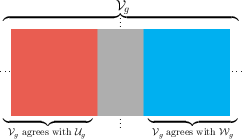
Two G-reps U,W are blend equivalent if a third G-rep V exists, agreeing with U on a left half-space and W on a right half-space; V acts as an interpolant across an interface (see below).
Figure 1: The G-rep V is a blend between U and W if, for all g, Vg agrees with Ug on a left half-volume and with Wg on a right half-volume. Blend equivalence classes define lattice anomalies.
A lattice anomaly is a blend equivalence class of G-reps. The trivial anomaly corresponds to the class of on-site symmetries; non-trivial classes capture obstructions to implementing the symmetry locally. The stacking operation (⊗) endows the set of anomalies with an abelian group structure.
IR-Trivial versus IR-Nontrivial Anomalies
A key finding is that not all nontrivial lattice anomalies are IR-nontrivial: some admit symmetric product states and thus trivial low-energy effective QFTs—they are termed IR-trivial anomalies. This is a crucial departure from the QFT context, where anomalies (as obstructions to gauging) and forbidden trivial gapped ground states are usually equivalent.
Relationship to QFT Anomalies
There is a group homomorphism φ:AnomdG→AnomdG, mapping lattice anomalies to QFT (continuum) anomalies. This map is generically neither injective nor surjective:
Non-injective: Lattice anomalies with IR-trivial realization vanishing under φ, i.e., mapping to trivial QFT anomalies.
Non-surjective: Not all QFT anomalies are accessible from lattice anomaly classes; e.g., the chiral U(1) anomaly in (1+1)d is not realized by U(1) lattice symmetry [Kapustin 2401].
This breaks the anticipated one-to-one correspondence, underscored by explicit lattice models and cohomological examples.
Classification via Cohomological Invariants
The paper identifies a hierarchy of cohomological invariants for lattice anomalies, constructed from QCA classifications and group cohomology. These invariants generalize known QFT anomaly invariants for the lattice:
H1[G,Qd]: Obstruction at the level of symmetries acting as QCAs.
H2[G,Qd−1]: Obstruction encoded in lower-dimensional QCAs acting on spatial boundaries.
H3[G,Qd−2] and higher: Higher-order obstructions corresponding to defects at codimension p loci.
Here Qd denotes the abelian group of d-dimensional QCA classes. The sequence aligns with the structure of generalized cohomology, and the full classification is conjectured to arise from a generalized cohomology theory defined by the Ω-spectrum of the QCA spaces.
Bulk-Boundary Correspondence and Physical Consequences
A significant advance is the establishment of a bulk-boundary correspondence between d-dimensional lattice anomalies and (d+1)-dimensional invertible phases of commuting projector models or G-QCAs:
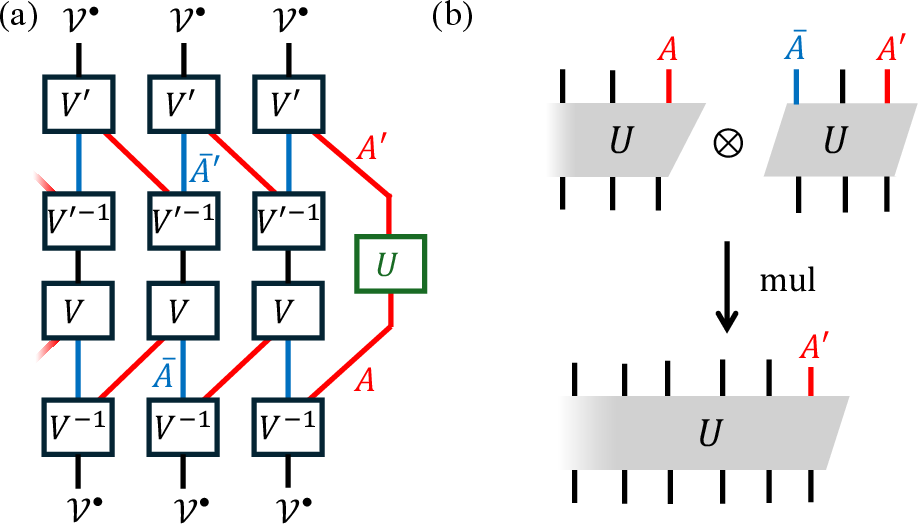
Figure 2: Schematic illustration of the construction associating boundary blend classes (anomalies) directly to symmetry-protected circuit classes of (d+1)-dimensional QCAs or invertible commuting models.
The group of G-invertible commuting model phases in (d+1) dimensions, their edge anomalies, and G-QCA classes are shown to be isomorphic in the appropriate regime. This demonstrates that lattice anomalies, even those that are IR-trivial, serve as obstructions to realizable symmetric boundaries in commuting models and, by extension, to symmetric invertible MBL phases.
Constraint: If a local symmetry G-rep carries a nontrivial lattice anomaly, there can be no symmetric commuting projector Hamiltonian whose boundary algebra is invertible (i.e., locally isomorphic to an on-site algebra)—obstructing trivial localized symmetric MBL phases.
Explicit Examples and Lattice versus QFT Subtleties
The Radical Chiral Floquet Z2-Rep in d=2
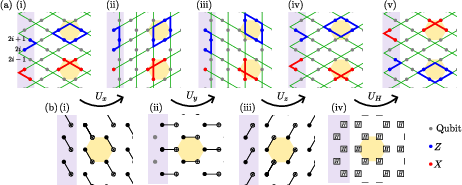
The radical chiral Floquet (CF) circuit provides an instructive instance: a Z2 symmetry is realized as a G-rep whose restriction to a half-space squares to a translation along the boundary, with irrational index (2), violating the rationality expected from on-site boundary algebras.
Figure 3: The radical CF circuit: sequence of CNOT/Hadamard gates acts as e↔m automorphism in toric code, ultimately leading to a nontrivial H2[Z2,Q1] lattice anomaly upon boundary restriction.
Yet, this anomaly is IR-trivial: the model admits a symmetric gapped product ground state (in contrast to QFT anomaly expectations). The boundary algebra and its Kramers-Wannier duality automorphism have irrational index, which is forbidden for on-site algebras—directly connecting the anomaly to the non-invertible structure of the boundary algebra.
Lattice Gravitational Anomalies
QFT "gravitational" anomalies correspond, in the lattice setting, to invertible local operator algebras not ultra-locally isomorphic to any on-site algebra. Their classification is demonstrably isomorphic to the group of (d+1)-dimensional QCA classes.
Theoretical and Practical Implications
Theory of SPT, MBL, and Topological Order: The framework deepens bulk-boundary anomaly matching for SPT and MBL phases, including cases not previously subsumed under QFT-based anomaly matching. It clarifies "anomalous" symmetry action on boundaries of MBL and commuting projector systems—crucial for understanding localizability and symmetry constraints in disordered systems.
Topological Phases beyond QFT: The methods facilitate the construction and diagnosis of exotic boundary phenomena, especially in higher dimensions where "beyond cohomology" phases appear [Fidkowski et al.].
Generalized Cohomology and Homotopy Structure: The analysis reveals that the lattice classification and anomaly constraints have canonical interpretation via Ω-spectrum and generalized cohomology, connecting to the framework proposed for generalized SPT order.
Limitations of RG and Lattice-QFT Matching: The non-invertibility and non-surjectivity of the lattice-to-QFT anomaly map underscores the inherent difference between RG in lattice models and QFT: coarse-graining can trivialize certain lattice anomalies while preserving others, indicating that not all anomaly constraints survive passage to the continuum.
Figures in the Argument Structure
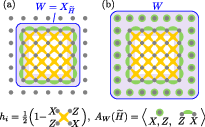
Figures throughout the paper elucidate the nonlocal action of anomalous blends, explicit implementations in models such as the radical CF circuit, the structure of boundary algebras (e.g., Wen plaquette and toric code), and the geometric construction of blends in bulk-boundary correspondences.
Figure 4: Example of a boundary algebra in the Wen plaquette model—a simple instance where the boundary algebra is not on-site, illustrating the type of non-on-site structures required to host anomalous symmetries.
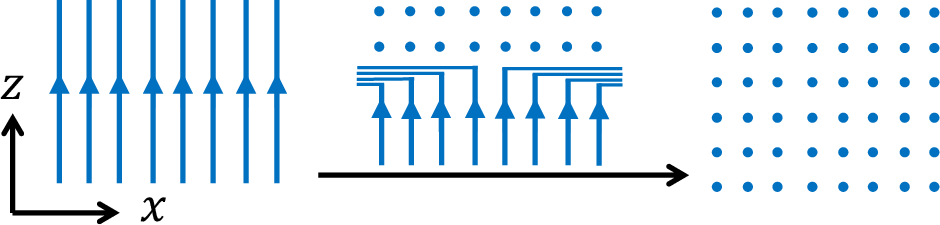
Figure 5: Geometric blend construction for translation symmetry, showing how lattice translations can be "turned a corner" at z=0 by running along a transverse direction with ancilla augmentation—demonstrating nontrivial bulk-boundary matching.
Conclusion
The work presents a comprehensive, mathematically precise theory of symmetry anomalies in quantum lattice systems, establishing lattice anomaly as a robust, universal invariant of symmetry action. The relationship to QFT anomalies is nuanced: lattice anomalies can, but need not, survive to low energies, and not all field-theoretic anomalies are lattice-realizable. This dichotomy has direct implications for the classification and physical realization of SPT phases, constraints in MBL settings, and the nature of quantum entanglement and nonlocality in extended systems. Further, the connection to generalized cohomology and higher-categorical structures paves the way for systematic exploration and eventual classification of lattice anomalies in broad classes of quantum systems.