- The paper introduces a novel framework that employs fractional extensions of differential generators to regularize divergent power sums beyond standard zeta methods.
- It develops a generalized spectral function that recovers the Riemann zeta prescription while incorporating corrections from analytic functions such as h(t).
- By extending operators to non-integer powers, the approach ensures continuous regularization across integer and non-integer exponents, with implications in quantum field theory and spectral analysis.
Regularization of Divergent Power Sums via Fractional Extension of Differential Generators
Introduction and Motivation
The article fundamentally approaches the regularization of divergent sums of the form ∑n=1∞nα for Reα>−1 through the lens of generalized differential operators and their fractional powers. The main objective is to systematize a regularization prescription that encompasses the Riemann zeta regularization as a special case, while allowing a family of more general regulators parameterized by a differential generator L. This framework addresses physical scenarios where the traditional Riemann zeta function regularization yields physically non-intuitive results, such as the vanishing Casimir force in some fermionic systems, motivating the need for a more flexible and physically motivated regularization machinery.
Generalized Spectral Function Framework
The approach relies on associating to any regularization a differential generator L acting on a set of eigenfunctions gn(t), defined by the eigenvalue equation Lgn(t)=ngn(t) with suitable boundary conditions gn(0)=1 and gn(∞)=0. The generalized spectral function (GSF) is thus defined as KL(t)=∑n=1∞gn(t).
For the canonical zeta prescription, L=−d/dt yields Reα>−10 and recovers the traditional spectral function Reα>−11.
The regularized value of the trace identities, i.e., the divergent sum Reα>−12, is assigned via an analytic prescription based on the expansion of Reα>−13 about Reα>−14 and extraction of the constant (finite-part) via contour integration. For arbitrary Reα>−15, the Keldysh-type operator solution Reα>−16 with Reα>−17 analytic and non-vanishing at zero, yields Reα>−18 with Reα>−19. Thus, the spectral function generalizes to L0, transforming the kernel (L1) and, by extension, deforming the singularity structure in the analytic continuation.
Regularized Trace Identities and Polylogarithm Structure
The L2-th action of L3 is related via the transformation L4 to the shifted operator L5. This observation allows the direct realization
L6
where L7 is the polylogarithm, thus relating regularization to polylogarithmic structures and their analytic continuations.
The regularized value is then
L8
with the contour enclosing the pole at L9.
Employing established asymptotic expansions for the polylogarithm, this regulator separates into the Riemann zeta value (i.e., L0) plus a term encoding the choice of L1—that is, the difference between this general prescription and the standard zeta regularization is entirely captured by derivatives of L2 at L3. Explicit examples for L4, etc. are given in terms of L5.
Fractional Extension of Generators: Non-Integer Powers
A central technical contribution of the work is formulating a fractional calculus extension L6 that interpolates between integer powers, in such a way that the regularized values for non-integer L7 are continuous in the limit L8.
The operatorial action L9 is first constructed in differential form via a generalized Stirling number expansion, and an integral representation via repeated formal inversion. Both approaches agree for the spectral function acting on gn(t)0, yielding
gn(t)1
and, for the spectral kernel,
gn(t)2
valid for all complex gn(t)3.
The analyticity properties of gn(t)4 and the deformation of contour integrals to respect branch cuts and singularities are meticulously discussed. In particular, for gn(t)5, the singularity at gn(t)6 remains a branch point, necessitating Hankel-type integral prescriptions.
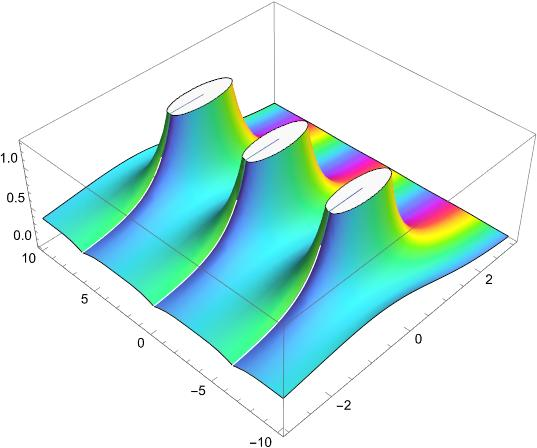
Figure 1: The plot of gn(t)7; the main branch cut at gn(t)8 and secondary cuts from gn(t)9 highlight the analytic structure controlling the contour deformation for regularization.
Hankel-Type Regulators and Explicit Integral Representations
For suitable Lgn(t)=ngn(t)0, the analytic structure allows a deformation to a Hankel contour along the negative real axis. The prescription reads
Lgn(t)=ngn(t)1
recovering the standard zeta value when Lgn(t)=ngn(t)2 (i.e., Lgn(t)=ngn(t)3).
For more involved Lgn(t)=ngn(t)4, the additional term is nonvanishing, resulting in a scheme that is explicitly dependent on the generator and able to yield physically distinct results. The same framework also allows the use of (finite-part) regularized Mellin transforms to express the correction term.
An explicit worked example is given for Lgn(t)=ngn(t)5, yielding polynomial Lgn(t)=ngn(t)6 and nontrivial multi-branch-point structure.
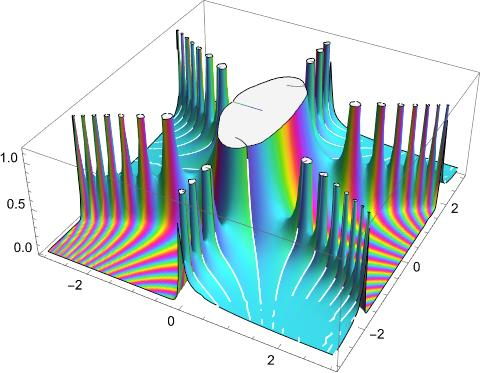
Figure 2: The plot of Lgn(t)=ngn(t)7, illustrating additional branch cuts from zeros of Lgn(t)=ngn(t)8 and enhanced analytic complexity for the regulator.
Recovery of the Riemann Zeta Regularization
For the canonical case Lgn(t)=ngn(t)9, all correction terms vanish, i.e., gn(0)=10 and all derived objects revert to the Riemann zeta prescription. Thus, gn(0)=11 over the required domain.
A noteworthy byproduct is a new Hankel-type integral representation of the Riemann zeta function in terms of polylogarithm transforms,
gn(0)=12
valid for gn(0)=13.
Finite-Part versus Regularized Limit
The paper rigorously distinguishes between the finite-part regularization (term-by-term subtraction of divergences in small-gn(0)=14 asymptotics) and the regularized limit as implemented via the contour prescription. It is shown that mere finite-part extraction breaks continuity between non-integer and integer gn(0)=15, thus failing the physically motivated requirement that the regulator behaves continuously in the gn(0)=16 limit. The contour regularization prescription ensures this consistency, at the cost of more intricate corrections for integer indices.
Implications and Outlook
The results presented establish an infinite family of regularizations for divergent series, parameterized by the choice of differential generator gn(0)=17, all consistent with analytic continuation and fractional calculus. This scheme allows adaptation to specific physical requirements, e.g., the sum gn(0)=18 resulting in nonzero values in physically motivated alternatives to the standard zeta regularization.
Importantly, the method generalizes to power sums over arbitrary monotonic spectra gn(0)=19 by choosing gn(∞)=00 such that gn(∞)=01 is well-posed, providing a systematic path to a gamut of regularizations beyond the physical and mathematical domains already addressed in the spectral zeta formalism.
The article also addresses the analytic caveats: for certain spectral sequences, e.g., gn(∞)=02, the GSF may possess natural boundaries that thwart analytic continuation; such situations will require further technical refinement.
From a functional analysis perspective, full rigor can be obtained via sectorial operators on Banach spaces, where the Balakrishnan calculus is applicable. The isospectrality with the reference first-order generator allows for reinterpreting regularization in operator-theoretic terms.
Conclusion
The fractional extension of differential generators yields a unifying framework for regularizing divergent power sums, subsuming and generalizing the Riemann zeta function prescription. This formalism not only provides analytic control and flexibility but is amenable to explicit calculation via polylogarithm and Mellin transform analytical machinery. Its implications are immediate in fields requiring regularization of divergent series—quantum field theory (spectral determinants, Casimir energy), mathematical physics (trace identities), and analytic number theory—while also hinting at deeper relations between operator theory, spectral analysis, and regularization procedures.
The principal open issue is the selection of the “physically correct” regulator gn(∞)=03 in any application. The work suggests that physical constraints—possibly derived from dynamical, boundary, or symmetry conditions—will guide this choice, ultimately linking the abstract theory with empirical observables.