- The paper presents a novel attack vector by exploiting integrity gaps in vector stores, allowing covert steganographic exfiltration through embedding manipulation.
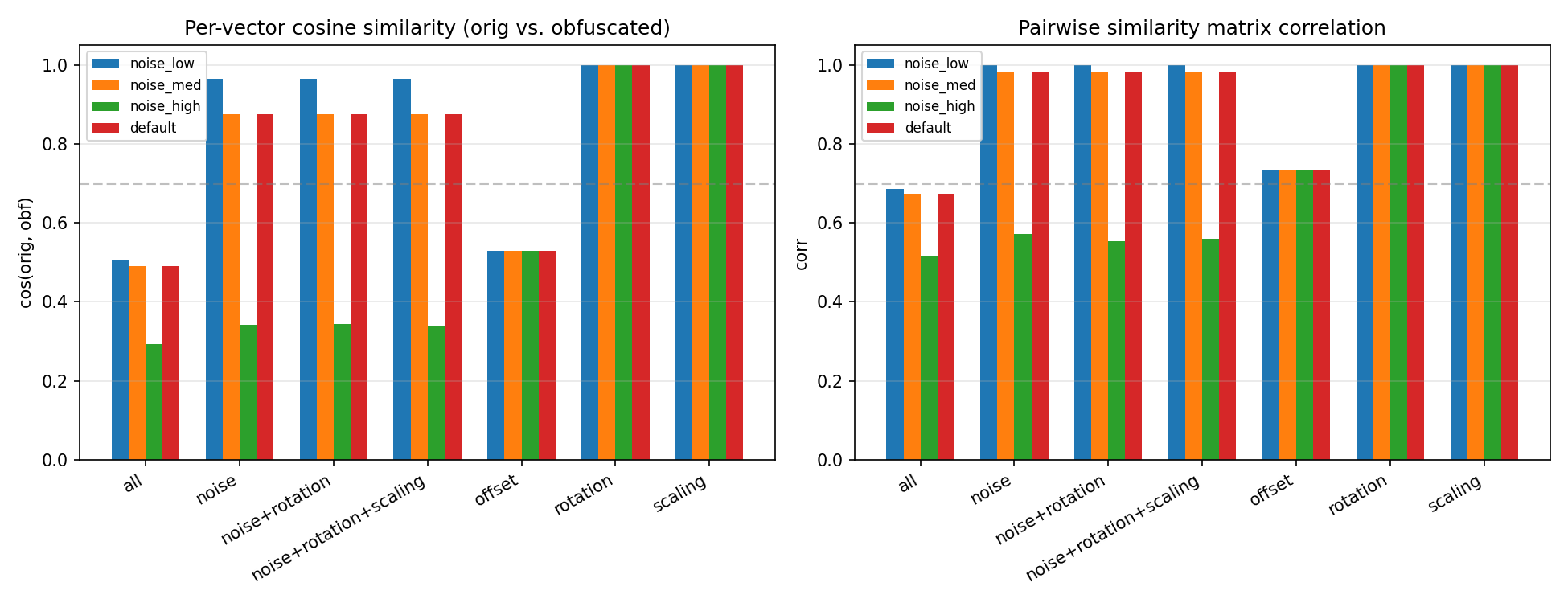
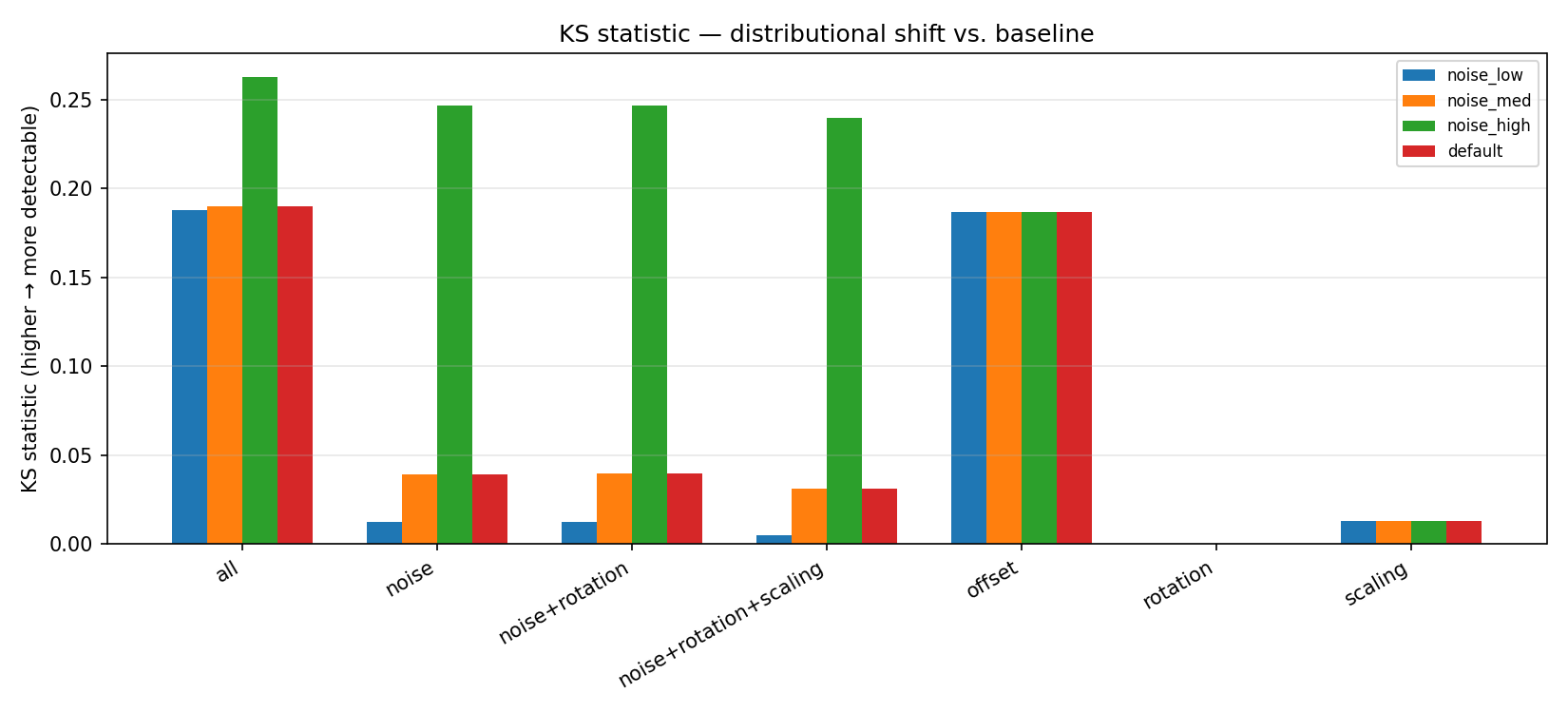
- It evaluates six manipulation techniques, demonstrating that small perturbations maintain retrieval fidelity while remaining undetected by conventional statistical detectors.
- The proposed VectorPin protocol provides a lightweight, cryptographic provenance defense that ensures tamper evidence for post-ingestion modifications.
Steganographic Exfiltration in Embedding Stores and Cryptographic Provenance: An Analysis of "VectorSmuggle" (2605.13764)
Introduction and Context
"VectorSmuggle" (2605.13764) exposes critical integrity vulnerabilities in production vector database systems underpinning Retrieval-Augmented Generation (RAG) pipelines. The work establishes that current vector-store products treat high-dimensional embeddings as opaque, lacking native mechanisms for integrity checking, anomaly detection, or cryptographic attestation. This design gap enables a new class of practical steganographic exfiltration attacks, specifically targeting the embedding ingestion pipeline. The paper further introduces a robust, deployable cryptographic defense: VectorPin. The analysis below examines the technical contributions, empirical validation, and implications for secure AI infrastructure.
The security analysis is underpinned by a formal three-tier adversary model:
- Threat Model A (Insider with Backup Access): Privileged operator can inject embeddings and exfiltrate vector store backups, but cannot export original documents due to traditional DLP.
- Threat Model B (Compromised Database Credentials): Attacker can read embeddings but cannot modify or inject.
- Threat Model C (Query-only): Attacker has only search/query access.
The paper's empirical focus is on threat model A, a realistic and unmitigated insider risk in current RAG deployments.
Steganographic Attack Techniques
The attack surface exists due to a lack of distributional checks or provenance validation at ingestion. The paper defines and evaluates six steganographic embedding manipulation techniques:
- Noise Injection: Additive Gaussian noise per embedding dimension.
- Orthogonal Rotation: Keyed Givens rotations, preserving L2 norm and pairwise cosine similarities.
- Magnitude Scaling: Per-vector scaling.
- Fixed Offset: Uniform additive offset across all vectors.
- Combined Pipelines: Sequential composition of the above.
- Cross-Model Fragmentation: Architectural exfiltration by splitting data across models.
All techniques require recovery metadata, and all except fragmentation are fundamentally post-embedding modifications—this property is critical for the defense argument.
Empirical Evaluation
Fidelity and Retrieval Preservation
The fidelity analysis quantifies the impact of attacks on the functional properties of embeddings:
Distributional Anomaly Detection
Off-the-shelf density-based detectors—Isolation Forest and One-Class SVM—are trained on clean splits and tested on obfuscated embeddings:
Quantization and Backend Surfaces
- Int8 quantization (Qdrant, Chroma): Targeted attacks remain resilient, as vector quantization-induced noise is dominated by attacker-induced perturbation.
- FAISS IVF-PQ (product quantization): Only configuration that materially narrows the bit exfiltration channel (cosine drops to 0.76–0.88), but this is a side effect of compression, not a deliberate defense.
Empirical Capacity and Channel Analysis
A closed-form and implemented exfiltration channel is constructed using disjoint Givens rotations:
- Closed-form channel ceiling: ⌊d/2⌋×b bits per vector for d dimensions and b bits per encoded angle. At d=3072, b=10, the theoretical ceiling is 1,920 bytes per vector.
- Against clean Gaussian synthetic data: The full channel is undetectable by density-based detectors.
- Against real embedding distributions (OpenAI text-embedding-3-large, BEIR NFCorpus): As K (number of rotated pairs) increases, high-capacity rotations become detectable (OCSVM AUC >0.9 at a few hundred bytes/channel). The detection threshold depends on the local data manifold and training coverage.
- Operational regime: Retrieval-preserving capacity is in the hundreds of bytes per vector at practical cosine similarity thresholds (≥0.850).
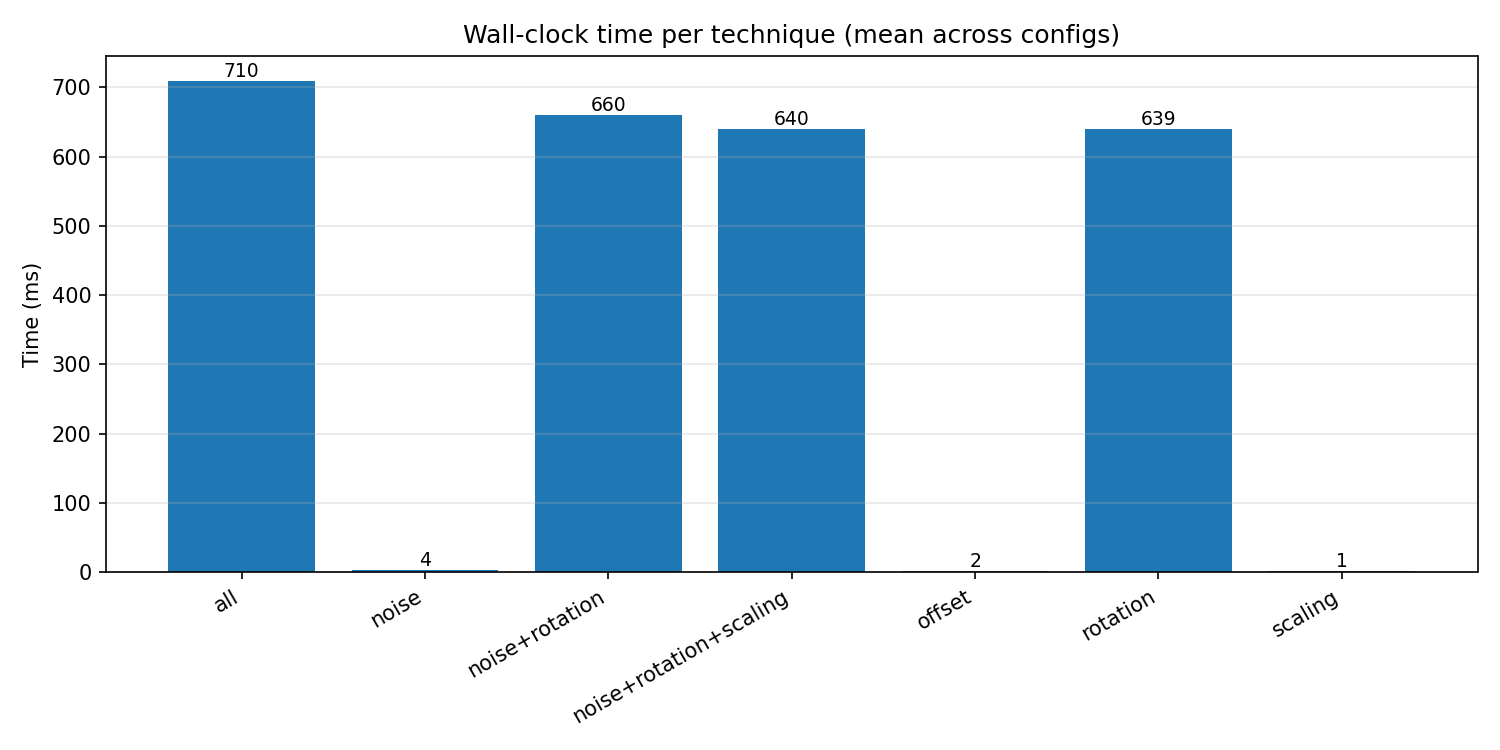
Figure 3: Full-pipeline wall-clock time per batch across techniques; time is dominated by the rotation (Givens) operation, but remains sub-second, confirming feasibility for ingestion-line-rate attacks or defenses.
Cross-Model and Cross-Corpus Universality
Rotation’s undetectability is universal across a spectrum of embedding models (OpenAI, Nomic, EmbeddingGemma, Snowflake Arctic, MXBai) and disjoint corpora (PII, medical, Q&A). This validates structural invariance of rotation against distributional detection.
Cryptographic Defense: The VectorPin Protocol
Protocol Structure
VectorPin anchors a cryptographic provenance commitment to each embedding across three axes:
- Source Content: SHA-256 hash.
- Embedding Model/ID: Model identifier and optional hash.
- Vector Hash: SHA-256 over a canonical, dtype-specified byte encoding.
- Signature Scheme: Ed25519 with deterministic serialization to guarantee cross-language consistency.
A signed JSON "Pin" is bundled with each embedding; any post-embedding manipulation triggers a verifiable integrity failure on read.
Guarantees and Limitations
- Tamper Evidence: All six attack techniques are mapped to detection outcomes; any modification after pinning guarantees verification failure.
- Supply Chain Integrations: Upstream pipeline or ingestion compromises remain out of scope; VectorPin only guarantees post-ingestion integrity.
- Replay Protection and Extensibility: Reserved fields for collection and record identifiers allow for binding and future protocol expansion.
Empirical Validation
Empirical tests demonstrate that, for every studied attack and realistic operational configuration, any post-pinning modification is structurally detectable—no observed undetectable bypass exists under the cryptographic model, independent of data distribution or model.
Implications and Future Work
Practical Impact
The results highlight a critical gap in current enterprise RAG deployments: embedding stores, often containing sensitive or regulated content, can serve as undetectable exfiltration vectors in their default state. Steganographic capacity at the hundreds-of-bytes-per-vector scale, channel survivability after quantization and retrieval, and the brittleness of statistical detection make a compelling case for immediate adoption of cryptographic integrity controls.
Theoretical Implications
This work reframes the steganography-in-embeddings discussion from a purely distributional anomaly detection problem to a provenance attestation problem. The channel/detector trade-off analysis provides new baselines for information-theoretic and adversarial analyses of vector representations in machine learning.
Path to Adoption and Standardization
Widespread adoption is likely to require:
- Compliance Drivers: Regulatory bodies will mandate controls similar to those for data-at-rest as RAG pipelines ingest ever more sensitive content.
- Vendor-side Adoption: Native integration into major vector database and AI orchestration products is feasible, as protocol and implementations are lightweight and cross-platform.
- Incident-Driven Maturation: Large-scale public breaches will catalyze operational pressure, as with default-public S3 or DNS exfiltration in the past.
- Extensible Protocols: The cross-language, open-source discipline followed by VectorPin is likely to become a de facto standard.
Outstanding Scientific Challenges
- Black-box and adaptive evasion: While white-box adaptive attackers fully defeat classical detectors, systematic study of black-box adaptation, transferability, and new defense ensembles are needed.
- High-capacity undetectable channels: Construction of information channels that operate below manifold or detector visibility under realistic operational constraints remains open.
- Confidentiality, not just integrity: Composition with schemes ensuring confidentiality in addition to integrity is required for comprehensive security.
Conclusion
"VectorSmuggle" provides an exhaustive empirical, theoretical, and practical study of the embedding-store exfiltration problem in AI infrastructures. The work combines meticulous adversary modeling, attack-channel design, anomaly-detection measurement, and deployable protocol engineering. The findings demonstrate that statistical detection alone is neither sufficient nor robust in this threat class: only a cryptographic provenance protocol such as VectorPin achieves the necessary post-ingestion integrity guarantees, with immediate implications for regulators, vendors, and operators of AI systems built atop vector database substrates.