- The paper demonstrates that bounded-context models have a predictable log-linear loss in global coherence, evident in variance and Gaussianity shifts.
- It proves that autoregressive models with explicit reasoning require only O(log n) context to achieve exact generation versus Ω(n) for context-only models.
- Empirical results confirm that reasoning-augmented models maintain global consistency, especially in challenging coloring broadcast scenarios.
Hierarchical Structure, Scaling Laws, and Reasoning in LLMs
Introduction and Motivation
The paper "A Hierarchical LLM with Predictable Scaling Laws and Provable Benefits of Reasoning" (2605.13687) analyzes the fundamental relationship between the context window size in autoregressive LLMs and their ability to capture long-range dependencies, specifically within hierarchical generative processes. By introducing a class of synthetic languages generated via broadcast processes on trees, the authors provide both a precise theoretical analysis and empirical validation of how context limitations and explicit reasoning impact generative capacity and consistency.
Broadcast Process and Hierarchical Model Definition
The central construct is a broadcast process on a d-ary tree of height h, where the root is sampled from a prior ν and each child is generated via a transition kernel κ conditioned on the parent. The language is the marginal distribution of the dh leaf tokens. This model has two instantiated cases:
- Ising Broadcast: Σ={±1}; κ copies the parent's state with probability ρ and randomizes otherwise, introducing soft but global correlations.
- Coloring Broadcast: Σ=[q]; κ chooses a child color different from its parent, corresponding to hard combinatorial constraints analogous to syntactic or semantic rules in code or formal mathematics.
This framework supports rigorous comparison of context-limited h0-gram models, standard transformer models, and models with explicit "working memory" for reasoning.
Lower Bounds for Context-Limited Generation
The analysis addresses the key question: How does limiting context window size degrade the ability to capture global dependencies or enforce hard constraints?
Log-linear Deterioration and Gaussianity in the Ising Process
For the Ising broadcast (with h1), the core statistic is the variance of the sum of leaf variables, normalized by h2. The following holds:
- For true (global context) generation, the log-variance scales linearly with the tree height h3 at slope h4.
- For an autoregressive process with context depth h5, the log-variance scales only as h6, a polynomial loss in global coherence unless h7.
Moreover, the excess kurtosis of the sum—measuring deviation from Gaussianity—vanishes in the large-h8, large-h9 regime. The central limit emerges as the hierarchical structure is progressively lost due to bounded context.
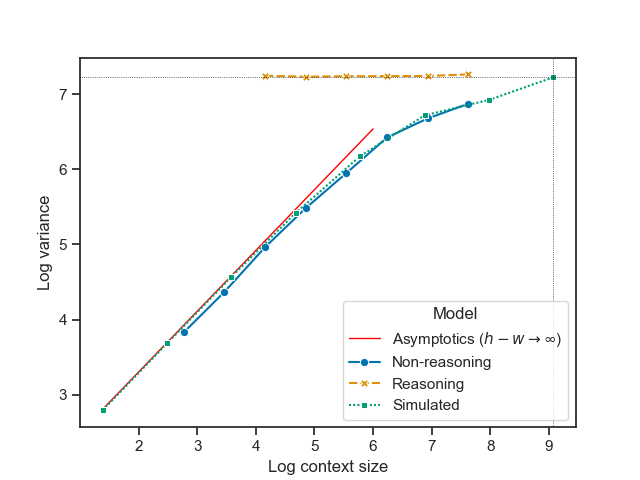
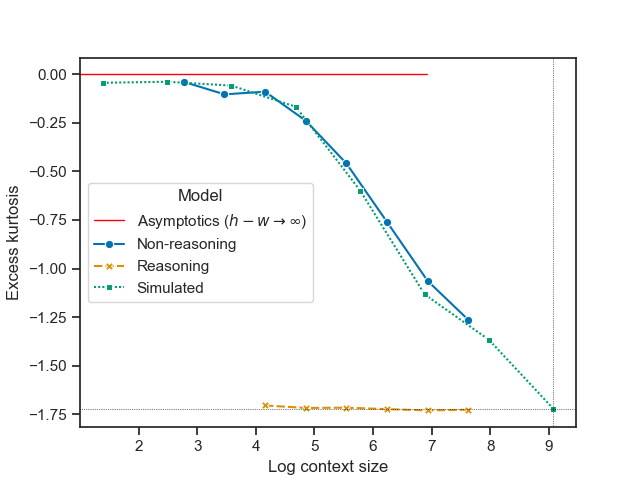
Figure 1: ν0 as a function of log context size and kurtosis of ν1 reflect the context scaling laws and loss of global coherence in the Ising process.
This quantitative decoherence is further confirmed experimentally: bounded-context transformers match analytic predictions for both variance and kurtosis transitions.
Hard Failures in Coloring Processes: Freezing and Inconsistency
The coloring process, which induces hard constraints, exhibits even more stark context limitations. When the tree is in the freezing regime (ν2 sufficiently large compared to ν3), bounded-context sampling rapidly leads to global inconsistency. That is, sampled leaf sequences do not admit any extension to a valid tree coloring with high probability, regardless of the local consistency within context windows. This is a qualitatively dramatic failure distinguished from mere statistical incoherence.
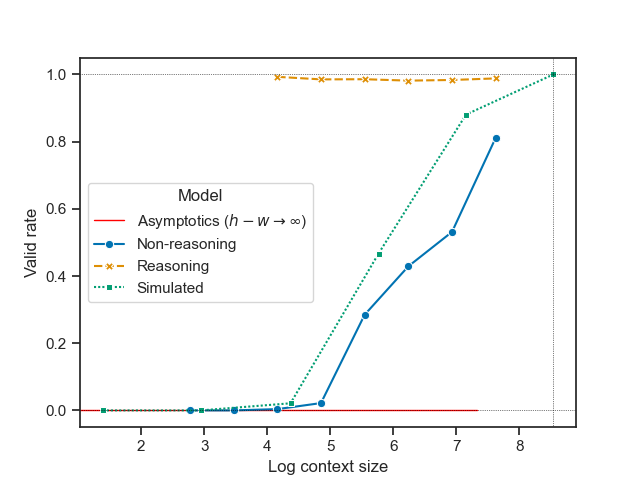
Figure 2: Fraction of valid sequences (valid rate) as a function of context size for the coloring broadcast, demonstrating phase transition between globally consistent and inconsistent sequence generation.
Empirically, transformer models without adequate context almost never generate valid outputs, fully aligning with theoretical predictions.
Logarithmic-Reasoning Models: Exponential Context Compression
Contrasting with these lower bounds, the work formally proves that an autoregressive reasoning model—one that maintains an explicit, updateable working memory of only ν4 bits—can perform exact sampling from the broadcast language. This reasoning memory needs only to store the path from the root to the current output position, tracking the latent taxa necessary for full global consistency.
This exponential gap—ν5 context needed for context-only models, versus ν6 working memory with reasoning—demonstrates the provable benefit of explicit reasoning over sublinear sliding context.
Empirical Validation
Experiments are conducted with transformers trained on synthetic Ising and coloring broadcasts with hierarchical punctuation, using both context-limited standard models and variants augmented with explicit reasoning traces.
- In the Ising process, context-only models show the predicted log-linear variance scaling and Gaussianization, while reasoning-augmented models track true global statistics for all tested context sizes.
- In the coloring process, non-reasoning models fail abruptly in the frozen regime, whereas reasoning-augmented models maintain perfect valid generation across the full range of context sizes.
Theoretical and Practical Implications
The results substantiate several critical conclusions:
- Predictable scaling breakdowns: There is a precise, quantifiable loss in statistical and combinatorial fidelity as context length shortens in hierarchical sequences, sharply deviating from the underlying data distribution.
- Limits to "context-only" architectures: For languages with hierarchical or compositional structure, bounded context transformers are provably insufficient for even approximate generation unless working at scales linear in sequence length.
- Logarithmic reasoning capacity suffices: Explicit short-term reasoning and working memory provide exponential gains in expressivity and enable exact generation of globally coherent and grammatically valid sequences in highly structured languages.
- Theoretical foundation for chain-of-thought and context compression: These findings give a rigorous justification for the empirical success of chain-of-thought prompting and context compaction methods in modern LLMs [anthropic_context, (2605.13687)].
Future Outlook
The analytic machinery developed for hierarchical broadcast models is directly relevant for understanding the scaling of transformer architectures, the computational cost of large context, and the formal necessity of explicit reasoning modules. Extensions to less regular or more realistic language distributions remain an open direction. Integrating theoretical scaling laws and reasoning guarantees from broadcast models into foundation-model design and training regimes holds promise for future generations of sequence models—particularly for tasks demanding global coherence, long-range logical consistency, and cross-chunk memory integration.
Conclusion
This work provides a mathematically robust characterization of the tradeoff between context window size and reasoning capability in autoregressive LLMs, leveraging broadcast processes to obtain explicit scaling laws and phase-transition-style lower bounds. The rigorous identification of an exponential separation between context-only and reasoning-augmented models offers both a theoretical underpinning and an experimental blueprint for advancing long-context and chain-of-thought paradigms in sequence modeling (2605.13687).