- The paper introduces a hierarchical transformer preconditioner that integrates H-matrix partitioning and cosine-Hutchinson loss, achieving a 68× reduction in condition number.
- The method attains consistent Θ(N) scaling in both training and inference, enabling real-time interactive physics simulations with significantly fewer PCG iterations.
- The architecture employs highway connections and fixed-shape GEMMs to maximize GPU efficiency, outperforming traditional preconditioners such as Jacobi and AMG.
Introduction
This paper introduces a Hierarchical Transformer Preconditioner (HTP) tailored for high-performance, interactive physics simulation tasks. The central objective is to overcome limitations in existing neural preconditioners, especially regarding their efficiency and capability to capture long-range couplings in large, frame-varying, sparse SPD systems commonly encountered in fluid dynamics and multiphysics simulations. The proposed solution integrates a Transformer-based architecture with a weak-admissibility H-matrix partitioning scheme, coupled with a cosine-Hutchinson probe loss, enabling consistent Θ(N) scaling in both training and inference. This results in a preconditioning operator that can be applied effectively and efficiently in real-time settings, without incurring the high setup costs or memory overhead seen in classical approaches such as Incomplete Cholesky (IC), Algebraic Multigrid (AMG), and earlier neural alternatives.
HTP leverages a multiscale H-matrix structure, where the degrees of freedom are partitioned into contiguous leaves, producing dense diagonal blocks and hierarchically coarsening off-diagonal tiles. The diagonal blocks are processed by a high-capacity attention stack emitting full-rank PSD factors per leaf. For off-diagonal blocks, the model emits a fixed number of coarse tokens per tile, allowing rank to naturally decay with spatial separation—thereby directly exploiting the compressibility of long-range interactions. This layout enables the preconditioner to be represented with O(N) complexity at inference by ensuring block sizes and computation per tile are fixed, regardless of N.
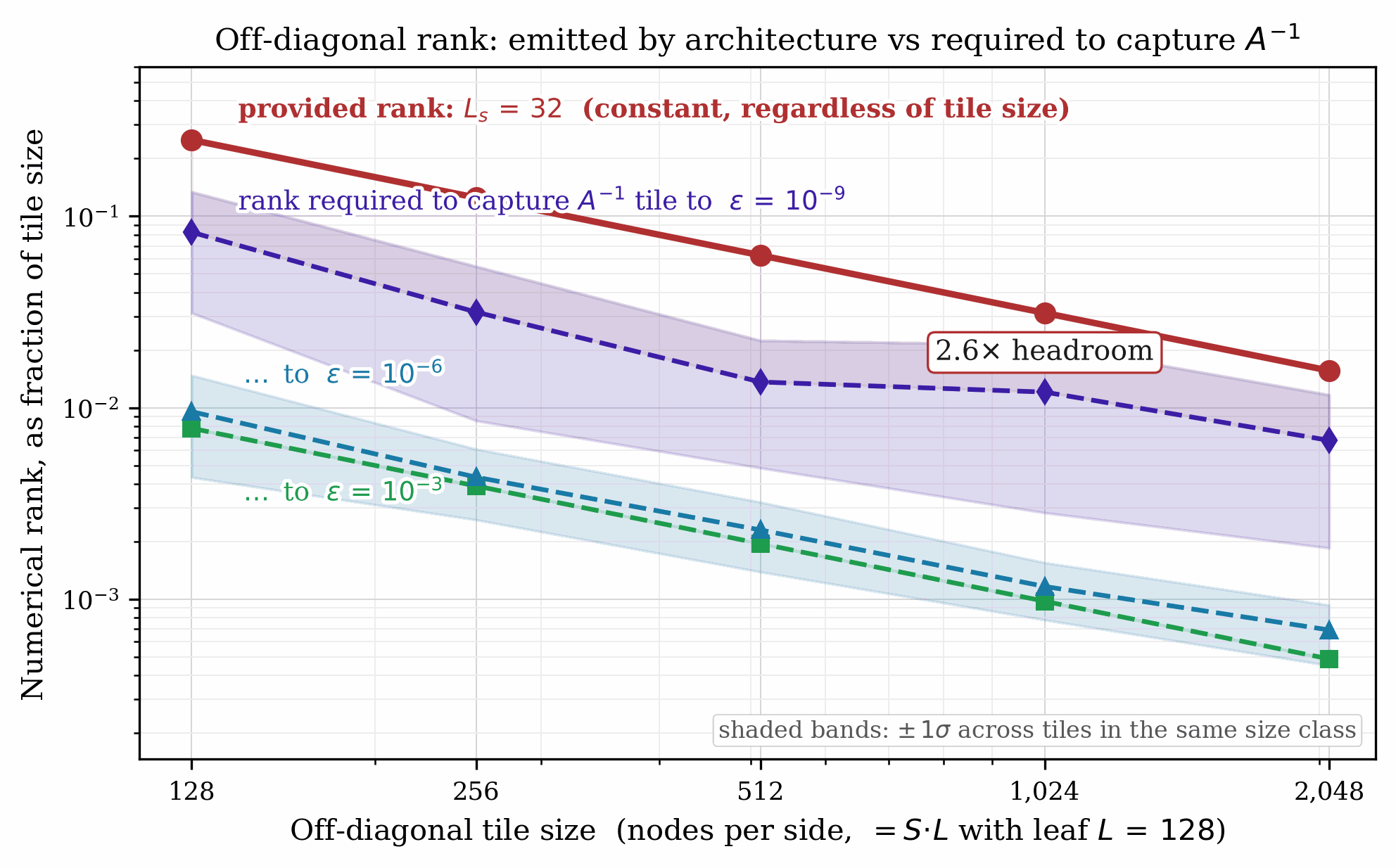
Figure 1: The fixed architecture-provided rank fraction for off-diagonal blocks remains above the numerically required threshold for effective approximate inversion across all distance classes.
To facilitate information flow across the partition without sacrificing scaling properties, the architecture introduces highway connections—axial row/column buffers and a global summary token—that integrate context at multiple hierarchical levels. These design choices enable the transformer to propagate information across non-local regions while preserving linear complexity.
Cosine-Hutchinson Loss: Spectral Clustering via Angular Alignment
A pivotal contribution of the paper is the adoption of a cosine-Hutchinson probe loss for training the preconditioner. Rather than minimizing pointwise distances between MAz and z (as in SAI/Frobenius-objective losses), the cosine loss targets the angular alignment between these vectors, matching the scale invariance required for optimal PCG convergence. This strategy allows eigenvalue clusters in MA to form wherever angular alignment is optimal, rather than forcing them to a prescribed location (e.g., near ∥A∥), thus avoiding unnecessary spectral placement constraints that do not impact convergence.
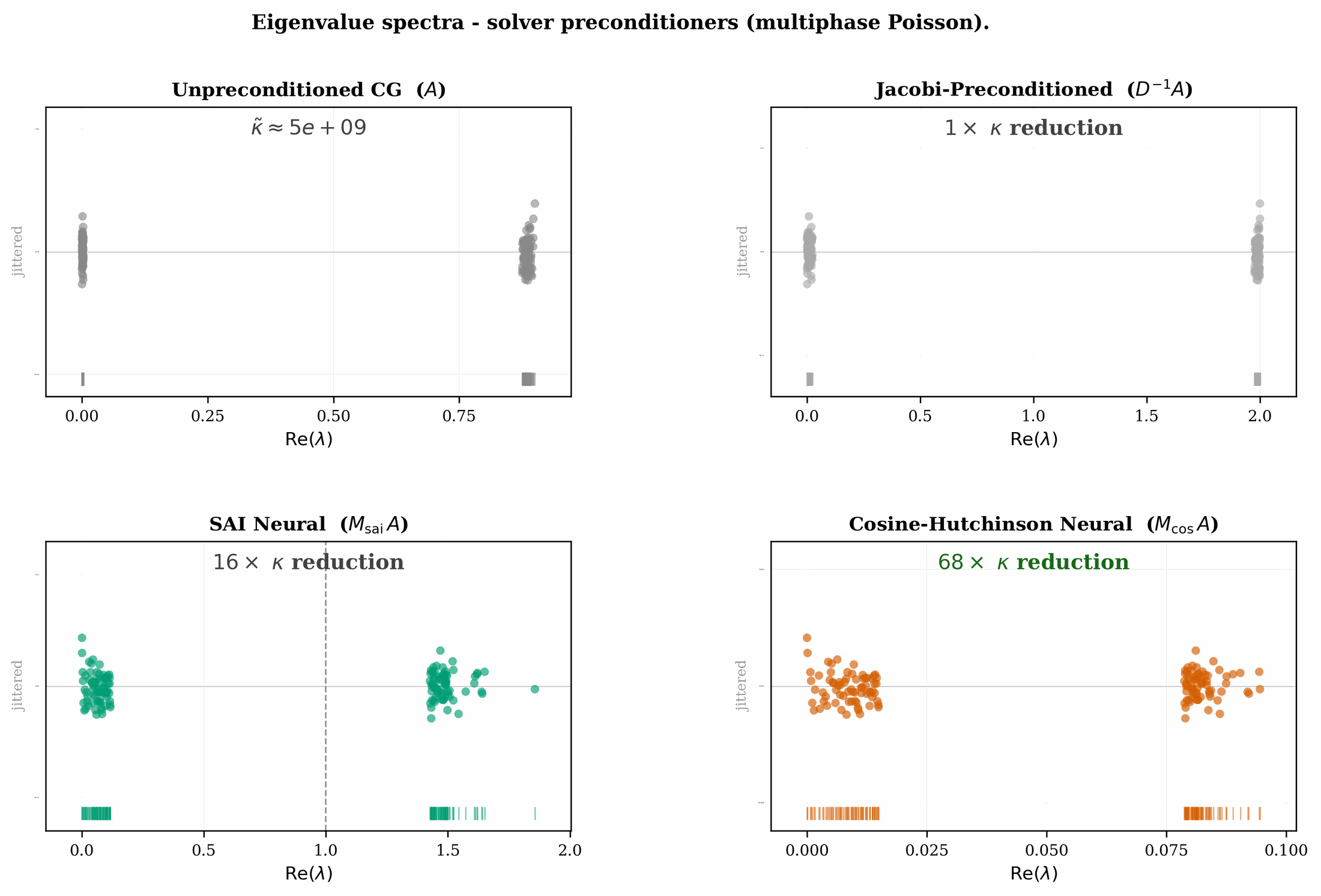
Figure 2: Spectra of Θ(N)0 for the multiphase Poisson system; the cosine-Hutchinson trained model achieves substantially tighter spectral clustering, unconstrained by target eigenvalue location, leading to a Θ(N)1 reduction in condition number.
Empirical analysis demonstrates that, under the same architecture and data distribution, the cosine loss produces markedly better spectral compression than the SAI loss, with a Θ(N)2 improvement in condition number reduction attributable solely to the objective function. This is directly reflected in dramatically reduced PCG iterations and solve times.
Computational Implementation: Dense GEMMs and CUDA Graphs
By structuring the entire PCG inner loop as a sequence of batched GEMMs with fixed shapes—enabled by the static Θ(N)3-matrix partition—HTP allows the entire solve loop to be captured within a single CUDA Graph. This eliminates kernel launch overhead, enables efficient use of GPU compute resources (favoring compute-bound over memory-bound workloads), and further distinguishes the method from alternatives like neural SPAI and IC, whose sparse or triangular solves induce scattered memory access and limited parallelism.
Extensive benchmarks on 2D multiphase Poisson systems (with random per-frame variation in topology and coefficient contrast) confirm the efficacy of HTP in comparison to both classical and learned preconditioners. Across a range of problem sizes (Θ(N)4–Θ(N)5), HTP consistently achieves interactive rates (Θ(N)6–Θ(N)7 fps), with iteration counts improving over GPU Jacobi by factors of Θ(N)8–Θ(N)9 and outpacing retrained neural SPAI baselines by up to H0 in wall-clock time, surpassing even those classical methods that require heavy setup amortization.
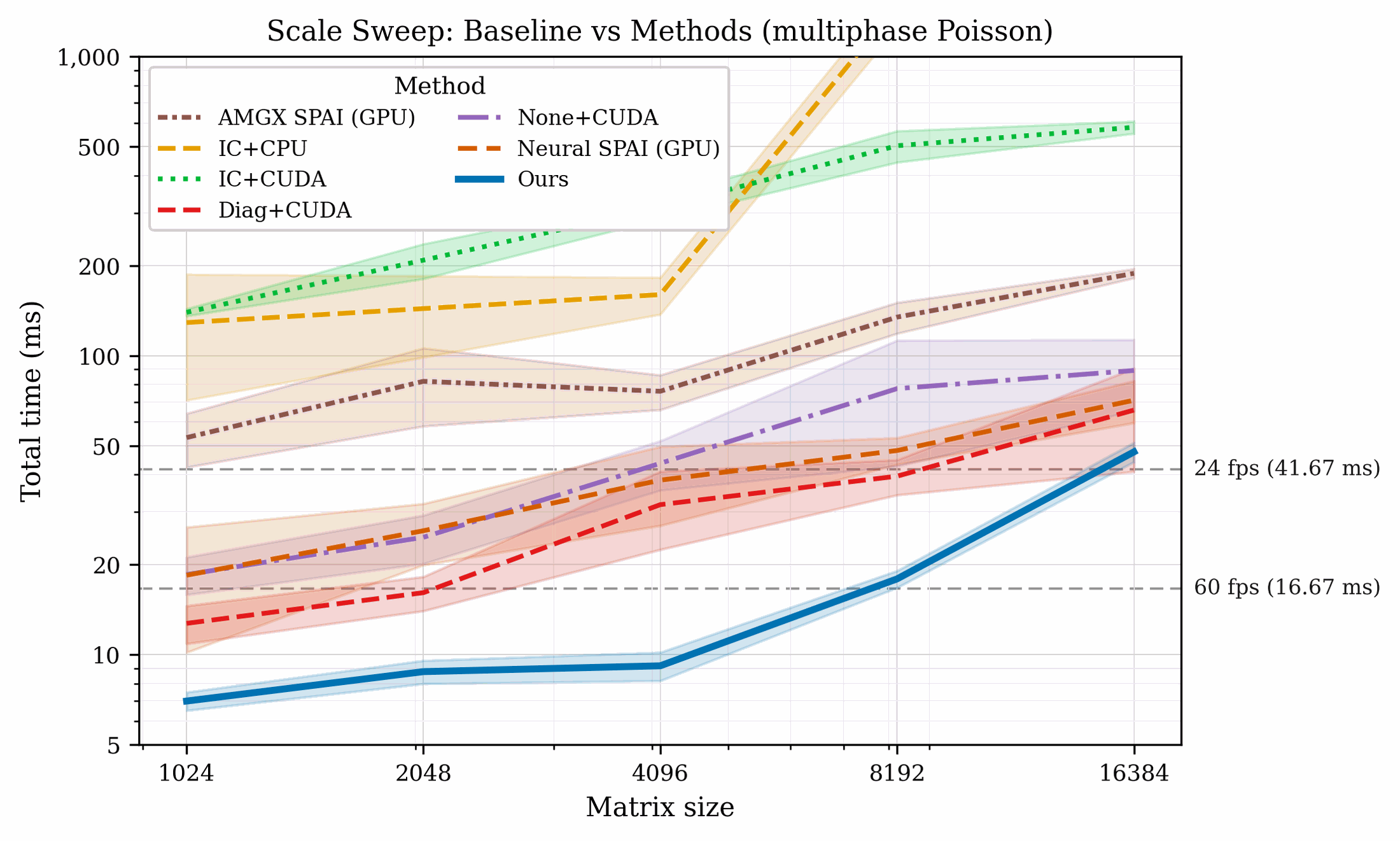
Figure 3: End-to-end solve times demonstrate consistent interactive rates and significant speedup over Jacobi and neural SPAI baselines.
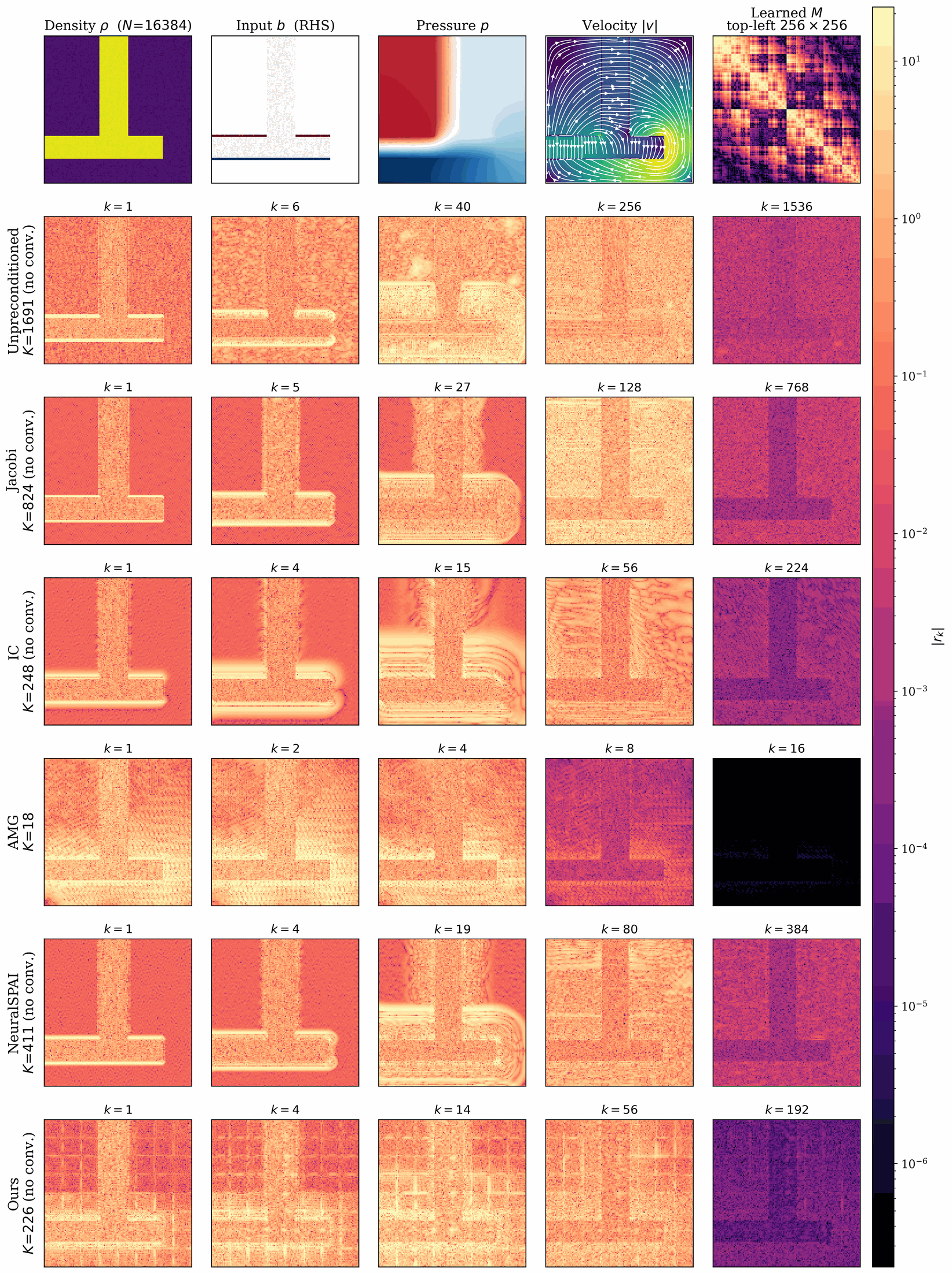
Figure 4: Visualizations of residual propagation highlight the rapid, multiscale error correction enabled by HTP, comparable to AMG but at substantially lower per-iteration cost.
Training dynamics confirm that the cosine-Hutchinson loss offers stable gradient flow and closely tracks PCG convergence, while SAI-based models plateau prematurely. Ablations make clear that both the architectural adaptations (highway connections, block sizes, model width) and the loss formulation are critical to performance.
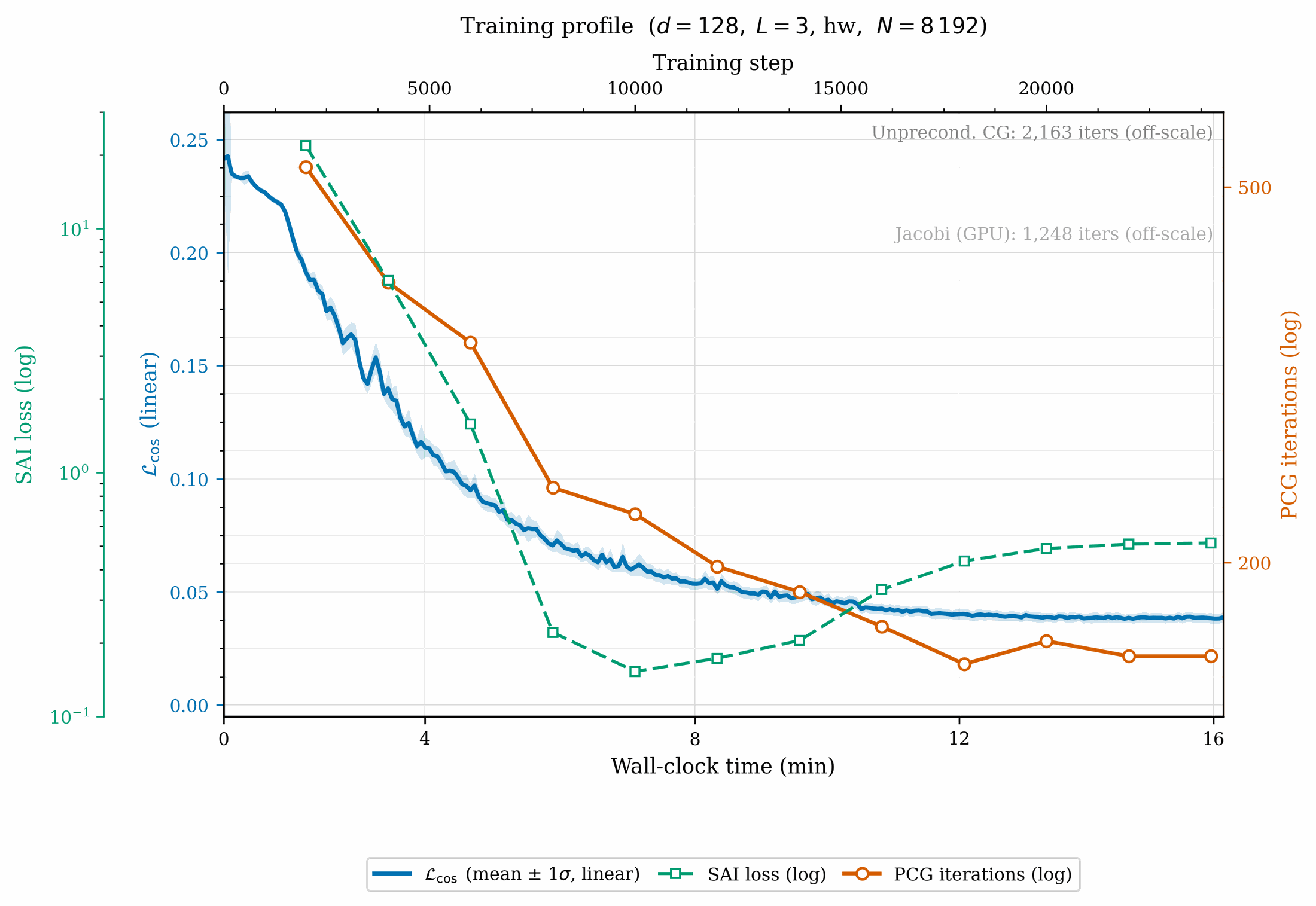
Figure 5: Training profile reveals that the cosine-Hutchinson loss maintains improvement in PCG iteration count after SAI loss stagnates.
Generalization and Robustness
Generalization tests indicate that HTP provides robust performance across significant OOD shifts, including unseen barrier topologies and increased coefficient contrast. Performance remains competitive, as the H1-matrix partition is agnostic to barrier geometry and the loss’s scale invariance absorbs amplitude variations.
Theoretical and Practical Implications
Theoretical implications center on demonstrating that preconditioners operating in the quotient space of linear operators modulo positive scalar can optimize subspace clustering rather than pointwise action, yielding superior spectral properties for conjugate gradient solvers. Practically, this enables deployment in time-critical simulation pipelines where matrix structure evolves every frame and setup amortization is infeasible.
HTP’s approach can be extended beyond 2D pressure-Poisson systems to 3D, soft-body, contact dynamics, and other SPD systems provided there exists a spatial ordering admitting low-rank off-diagonal compressibility. However, performance gains diminish when applied to operators lacking this geometric structure or when H2 is reused sufficiently for classical setup amortization to take effect.
Future Directions
Open avenues include:
- Incorporating dynamic partitioning to allow for variable problem sizes without retraining (moving from fixed leaf size to fixed leaf count).
- Extending the structural priors and loss strategies to indefinite or non-SPD systems.
- Unifying this framework with physics-informed or differentiable simulation environments for end-to-end-optimized solvers.
Conclusion
HTP provides a Transformer-based, H3-matrix-anchored, strictly H4, and hardware-tailored preconditioner for SPD systems in interactive simulation. Its architectural innovations, coupled with the scale-invariant cosine-Hutchinson loss, enable superior spectral clustering, dramatically reduced solver iteration counts, and consistent real-time performance. The method’s structural and theoretical adaptability positions it as a robust alternative for next-generation neural solvers in scientific computing.