- The paper introduces a novel synthesis pipeline that converts static GUI data into dynamic hybrid action trajectories through interleaved tool and GUI interactions.
- It employs a two-stage training paradigm combining tool-bootstrapped GUI supervised fine-tuning and multi-turn reinforcement learning to optimize path selection.
- Empirical results show a 66% relative improvement in accuracy on OSWorld-MCP and robust performance across diverse digital tasks, confirming the framework's efficacy.
Motivation and Problem Statement
Computer Use Agents (CUAs), driven by Multimodal LLMs (MLLMs), are increasingly expected to autonomously operate desktop environments using both atomic GUI actions and high-level structured tool calls. However, empirical evaluation reveals that mere access to hybrid action spaces induces severe policy confusion. Agents either overuse tools, undermining task reliability, or remain GUI-centric, failing to exploit available APIs for efficiency. The central trajectory-level challenge is optimal GUI-Tool path selection: learning a policy capable of context-sensitive switching to achieve maximal reliability and efficiency across long-horizon digital tasks.
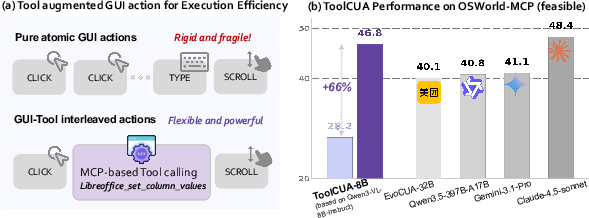
Figure 1: (a) Tool-augmented actions outperform pure GUI actions in trajectory efficiency. (b) ToolCUA delivers superior performance relative to baselines in hybrid action space.
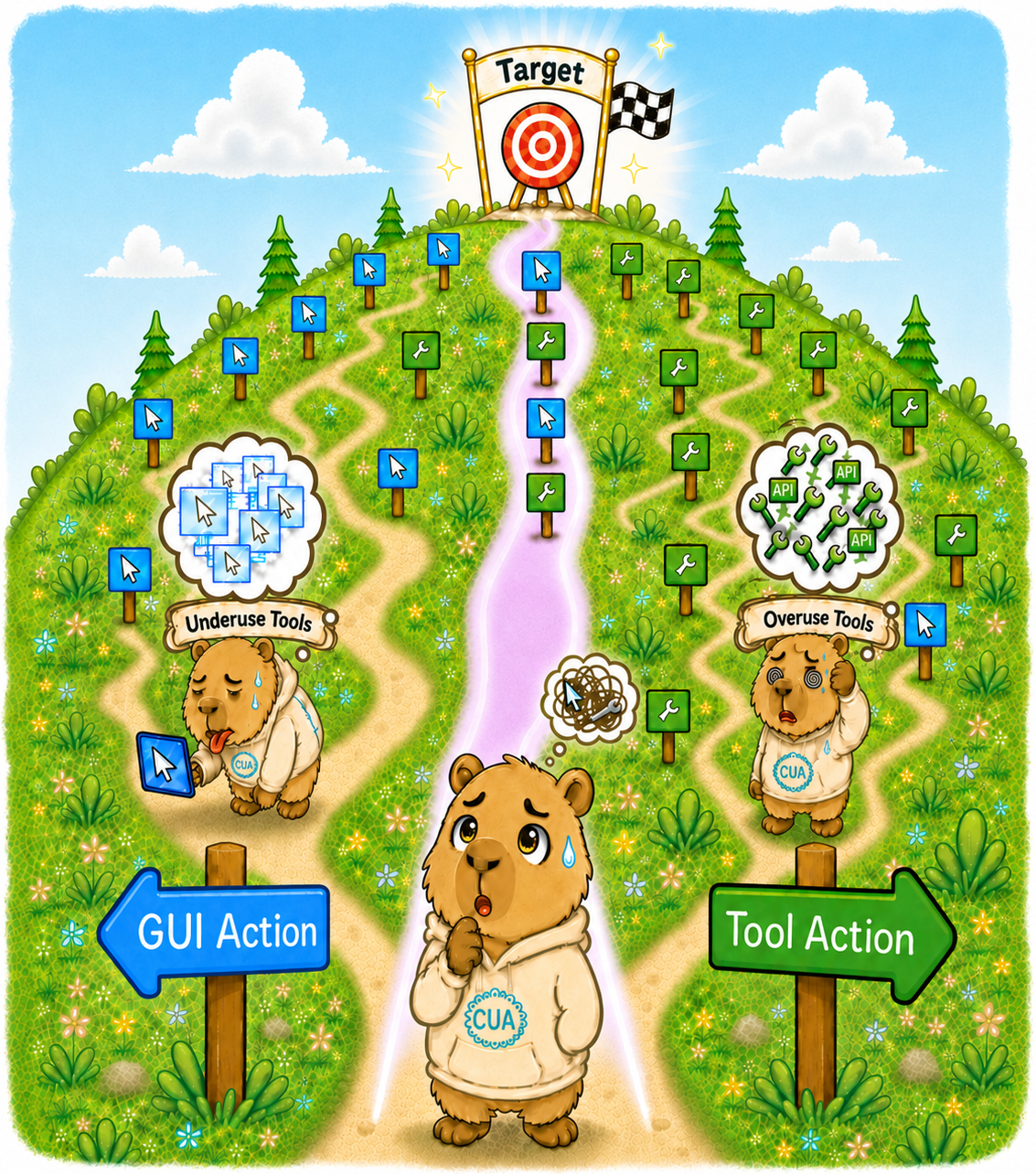
Figure 2: Current CUAs frequently miscoordinate GUI and Tool actions, leading to suboptimal and confused execution paths in hybrid action spaces.
The sheer scarcity of real interleaved trajectories is a fundamental bottleneck. ToolCUA introduces a trajectory scaling pipeline that synthesizes a grounded tool library from recurrent GUI procedures by leveraging MLLMs. The system transforms static GUI-only data into rich hybrid datasets by generating functionally-equivalent tool trajectories and anchoring them to next-state observations. This synthesis is conducted at varied granularity, maximizing coverage across domains, abstraction levels, and switching contexts, yielding crucial data for hybrid-action learning.
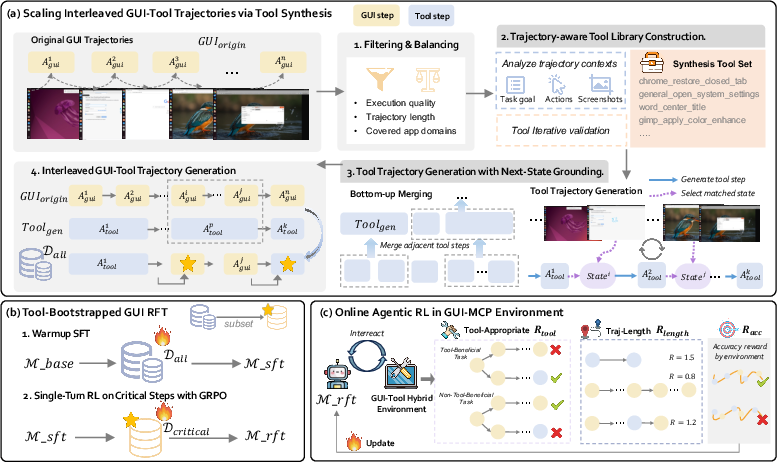
Figure 3: Data collection and training: Interleaved GUI-Tool trajectory scaling, Tool-Bootstrapped GUI RFT, and Online Agentic RL with Tool-Efficient Path Reward.

Figure 4: Synthetic GUI-Tool interleaved trajectory, demonstrating strategic tool selection and appropriate switching between GUI and Tool actions.
Staged Training Paradigm
ToolCUA adopts a two-stage paradigm:
- Tool-Bootstrapped GUI RFT: Warmup Supervised Fine-Tuning (SFT) on synthesized interleaved data grounds the agent in both multimodal tool-calling and GUI operations. Single-turn RL (GRPO) on critical switching steps calibrates the model's local policy for GUI-Tool decisions at path bifurcation points.
- Online Agentic RL with Tool-Efficient Path Reward: Multi-turn RL further refines trajectory-level policy. The reward is decomposed into Rtool (tool appropriateness: incentivize tool use only when beneficial according to task-level labels) and Rlength (path efficiency: reward relative reduction in trajectory length), supplementing conventional accuracy and format rewards. This regimen enforces global optimality in path selection, balancing execution efficiency and tool usage.

Figure 5: RL training dynamics and ablation: Interleaved data bootstrapping and Tool-Efficient Path Reward are critical for effective learning of hybrid orchestration.
Empirical Results and Ablation
ToolCUA achieves a new SOTA on OSWorld-MCP, attaining 46.85% accuracy—a 66% relative improvement over the Qwen3-VL-8B-Instruct baseline—with minimal tool calls and the lowest Average Completion Steps among competitors. This demonstrates genuine orchestration: selective and context-appropriate tool use, not indiscriminate invocation. Cross-domain and cross-platform generalization is robust, with substantial gains on both unseen Linux multi_apps and Windows desktop tasks, outperforming even much larger models.
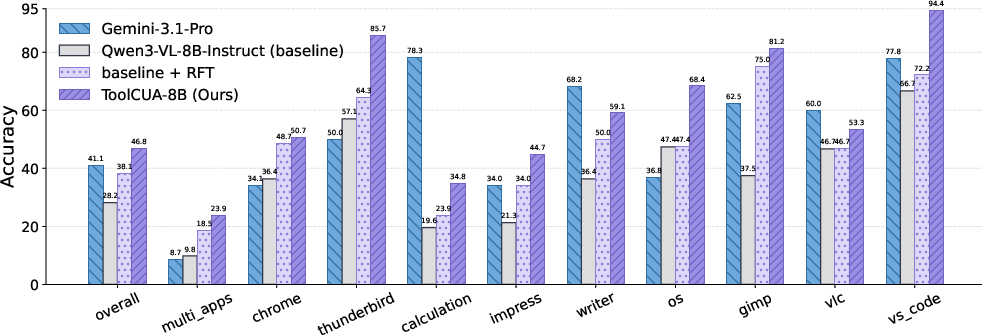
Figure 6: Task-level results across OSWorld-MCP: ToolCUA outperforms Gemini, Qwen, and coldstart RFT baselines in accuracy and efficiency.
Ablation studies confirm the indispensability of the synthesis-driven scaling pipeline and trajectory-level rewards. Models trained with agentic RL alone, without interleaved supervision, fail to acquire reliable tool-calling knowledge and remain stuck at low TIR. Removing tool-efficient rewards during RL disables robust path length reduction and impairs tool-appropriateness.
Case Studies
Case analyses on LibreOffice Calc and VS Code tasks illustrate ToolCUA's ability to exploit high-level tools for efficient, semantically-aligned trajectory completion while seamlessly reverting to GUI actions for tasks outside tool coverage (e.g., handling pop-up dialogs). The hybrid action space enables both deterministic editing and nuanced UI interaction within complex application workflows.
Practical and Theoretical Implications
ToolCUA demonstrates that optimal orchestration of hybrid actions in digital environments is attainable only by combining scalable trajectory synthesis, staged hybrid-action training, and trajectory-level reinforcement signals. This dismantles the assumption that action-space expansion is enough for robust agentic performance. The formal reward decomposition affords principled policy shaping, decoupling tool use from naive task completion. The approach generalizes across diverse domains and platforms, indicative of its utility for universal digital automation frameworks.
Future Directions
Key open problems include synthesis scalability and fidelity coupling to source trajectory diversity, real-world tool interface maturity, and benchmarking breadth. Reducing infrastructure dependence via lighter environments and supporting asynchronous RL for long-horizon agentic optimization are promising directions. Extension to web and mobile domains—and further granularity of tool abstraction—will afford new levels of agent applicability and control.
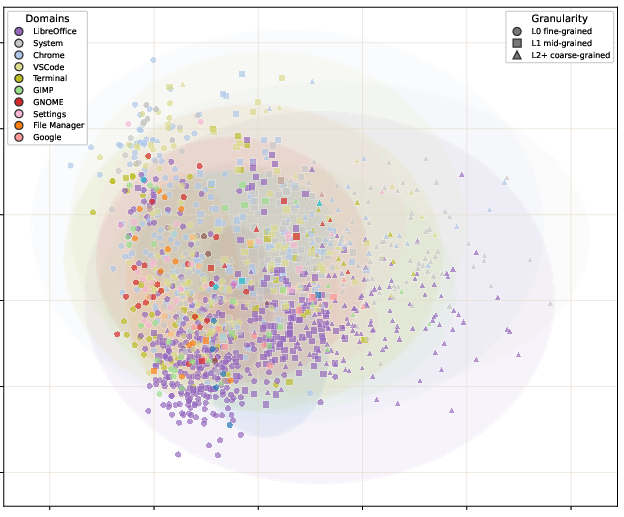
Figure 7: Synthesized tools projected in action space; diverse taxonomy and granularity enable flexible orchestration.
Conclusion
ToolCUA sets a systematic paradigm for learning optimal GUI-Tool path selection in CUAs. The combination of scalable interleaved trajectory synthesis, tool-bootstrapped hybrid-action training, and trajectory-level reward shaping is essential for resolving hybrid action confusion, achieving efficient and reliable automation. This research establishes hybrid action learning as the foundation for generalizable agentic systems in real-world digital environments, with implications for both practical deployments and theoretical policy learning.